
BuddhistCatholicContemplativeEvangelicalGeneral ChristianHinduJewishLatter-day SaintMuslimNew VisionsProgressive Christian
Beliefs
- Buddhist
- Catholic
- Contemplative
- Evangelical
- General Christian
- Hindu
- Jewish
- Latter-day Saint
- More Voices
- Muslim
- New Visions
- Pagan
- Progressive Christian
Topics
- Religion News
- Food and Religion
- Sports and Religion
- Religious Art
- Religious Music and Entertainment
- Religious Events
- History and Religion
- Style and Religion
- Politics and Religion
- Women in Religion
- Recreation Outdoors and Religion
- Business Finance and Religion
- Careers Workplace and Religion
- Education and Religion
- Family Parenting and Religion
- Health Fitness and Religion
- Home and Religion
- Relationships and Religion
- Technology and Religion
- Travel and Religion
Columnists
- Buddhist Columnists
- Business Finance and Religion Columnists
- Careers Workplace and Religion Columnists
- Catholic Columnists
- Contemplative Columnists
- Education and Religion Columnists
- Evangelists Columnists
- Family Parenting and Religion Columnists
- General Christian Columnists
- Health Fitness and Religion Columnists
- Hindu Columnists
- History and Religion Columnists
- Home and Religion Columnists
- Jewish Columnists
- More Voices Columnists
- Latter Day Columnists
- Muslim Columnists
- New Visions Columnists
- Nonreligious Columnists
- Pagan Columnists
- Politics and Religion Columnists
- Progressive Columnists
- Recreation Outdoors and Religion Columnists
- Relationships and Religion Columnists
- Religion News Columnists
- Religious Art Columnists
- Religious Events Columnists
- Religious Music and Entertainment Columnists
- Sports and Religion Columnists
- Style and Religion Columnists
- Technology and Religion Columnists
- Travel and Religion Columnists
- Women in Religion Columnists
Resource Library
- 2026 Calendar
- Library of World Religions
- The 100 Most Holy Places on Earth
- Patheos Answers
- Podcasts
- Videos
- Faith Leaders Database
- Anglican Episcopalian
- Bahai
- Baptist
- Buddhism
- Christianity
- Confucianism
- Eastern Orthodoxy
- Hinduism
- Holiness and Pentecostal
- ISKCON
- Islam
- Judaism
- Lutheran
- Methodist
- The Church of Jesus Christ of Latter-day Saints
- New Age
- Paganism
- Presbytarian and Reformed
- Protestantism
- Religion Behind the Scenes
- Roman Catholic
- Scientology
- Shia Islam
- Sikhism
- Sufism
- Sunni Islam
- Taoism
- Zen
- See all religions
Research Tools
 Ad-Free & Subscriber Log-In Subscription Support
Ad-Free & Subscriber Log-In Subscription Support
Follow Patheos 

- Trending:
- Forgiveness
- |
- Marriage
- |
- Consciousness
- |
- Death Penalty
- |
- Election
- |
- Halloween

- Home
- More Voices
- Dissent
Dissent
Last updated on: July 21, 2017 at 10:18 am by Carl Gregg
Dissent 2017-07-21T10:18:38-04:00 Carl Gregg
Patheos Explore the world's faith through different perspectives on religion and spirituality! Patheos has the views of the prevalent religions and spiritualities of the world.
In my tradition of Unitarian Universalism, it is significant to recall that this past Wednesday was the 200th anniversary of the birthday of our Unitarian ancestor Henry David Thoreau, who was born on July 12, 1817. Among many examples of dissent in Thoreau’s life, the most famous is that at age twenty-nine, during his time living in a cabin he built at Walden Pond, Thoreau spent the night in jail for nonpayment of a poll tax to protest the use of tax dollars to support slavery and unjust wars (Richardson 175). His shared reflections on his experience in the essay “Civil Disobedience” have been an inspiration ever since for people of conscience seeking to resist pressures to conform to unjust aspects of society (178).
And as one way of reflecting on how and why we might be called to dissent now or in the future, I would like to invite us to consider the tradition of dissent in the U.S. Supreme Court. I’m particularly interested in comparing how and why interpretations have been made over time about the meaning and significance of the legal documents (like the U.S. Constitution), sacred scriptures (like the Torah, Bible, or Qur’an), various pieces of art (historic and contemporary), and the shifting set of experiences we call the “Self.” I’ve spoken about my views on this in previous posts, but for me the upshot is that, if your interpretation increases hate, fear, inequality, and violence instead of love, joy, justice, and peace, you’re doing it wrong. And the problem might be more with you (or the interpretive communities that you are a part of) than with the “text” you are reading.
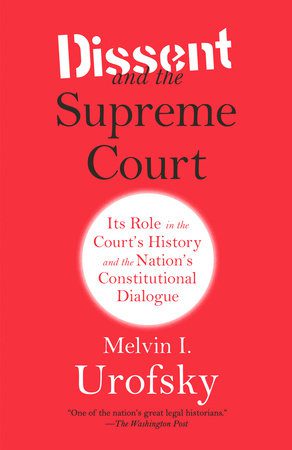 In the meantime, one among many great books from this perspective is The Case Against the Supreme Court. It was published a few years ago by the brilliant legal scholar Erwin Chemerinsky, who has argued cases before the Supreme Court, and is the author of the leading law school textbook about constitutional law (5). (If you want to dive into the history of Supreme Court dissents that came to be vindicated over time, a good next step is Melvin Urofsky’s Dissent and the Supreme Court: Its Role in the Court’s History and the Nation’s Constitutional Dialogue.) To share with you just one early passage from Chemerinsky’s book, he writes:
Each year, as I teach first-year law students, I have the strong sense that many, maybe even most, come to law school believing that the law exists external to what the courts say and that the role of the Justices is to find it and mechanically apply it…. But that is an illusion that has no relationship to reality. Let’s admit that this emperor has no clothes. (342)
He is challenging us to be honest that Supreme Court justices are human. And the evidence is clear that we humans rarely weigh all sides without bias. Rather, we have preexisting “values, views, and prejudices” that warp our perceptions (10).
We are most open to arguments that support our current line of thinking, and we are most defensive against arguments that might undermine our self-interest. By and large, all Supreme Court justices—liberal, moderate, or conservative—are extremely well-qualified. They disagree “not because one of them is smarter or knows the Constitution better. They diverge because of their ideologies” (14). That fact, of course, is why it is so significant that Neil Gorsuch, not Merrick Garland, is the latest Associate Justice to the highest court in our land.
To be clear, Chemerinsky is not intending to be unduly cynical. He was drawn to becoming a lawyer in the first place because of the power of the law at its best to create social change. But after more than three decades of teaching, writing, and litigating about the law at some of the highest levels, he has come to believe that—despite the many significant times when the U.S. Supreme Court has sided with justice and equality—we need to be honest that:
the Supreme Court usually sides with big business and government power and fails to protect people’s rights, Now, and throughout American history, the court has been far more likely to rule in favor of corporations than workers or consumers; it has been far more likely to uphold government abuses of power than to stop them. (6)
By becoming more conscious of the real record of the Supreme Court, we can better discern when and why we might be called to dissent.
To begin with an even larger perspective, it is sometimes helpful to remember that our system of governance is not the only way: “Great Britain, for example, has no written constitution. In the Netherlands, no court has the power to declare any law unconstitutional; in fact, its judiciary is prohibited from doing so” (7). Even in U.S. history, the co-equal power the Supreme Court enjoys today was far from clear in Article III, Section 1 of the Constitution. We could have ended up with a system more like the Netherlands if not for the leadership of John Marshall (1755-1835), the fourth Chief Justice, whose majority opinion in the 1803 case Marbury v. Madison established the precedent of judicial review, the authority of our high court to declare a law unconstitutional (Urofsky 45-46).
Moreover, the Supreme Court did not start becoming the full-fledged “Constitutional tribunal” that we know today until around 1925—less than a hundred years ago—under the leadership of chief justice William Howard Taft, a Unitarian (212-216). Before 1925, the court was much more of a “forum that corrected errors in ordinary private litigation” (211). My point is that the system has changed and it can and will change again. The question is whether it will change to be further in support of powerful, monied interests or whether it will change in the direction of due process and equal protection under the law.
And as we begin to reflect more directly on the promises and perils of dissent, it is important to remember that not all dissents are either righteous or vindicated. Indeed, most dissents end up in the “dustbin of history.” So why bother? Because, in the words of Charles Hughes (1862-1948), the 11th Chief Justice (1930–1941), “A dissent in a court of last resort is an appeal to the brooding spirit of the law, to the intelligence of a future day…” (Urofsky 112).
Or as the recently retired Justice John Paul Stevens (1920-) said when asked “If you could fix one thing about the American judicial system, what would it be?” He replied, “I would make all my dissents into majority opinions” (339). Another American Judge, William Hirt, said it this way: “Dissents, like homicides, fall into three categories—excusable, justifiable, and reprehensible.” So when considering a dissent, we should ask ourselves whether what we are doing is excusable (people will understand why we dissented even if we’re wrong), justifiable (our dissent will likely be vindicated by history), or reprehensible (dissenting on the wrong side of history) (3).
(I will continue this theme in tomorrow’s post on “Dissent–for such a time as this.”)
The Rev. Dr. Carl Gregg is a certified spiritual director, a D.Min. graduate of San Francisco Theological Seminary, and the minister of the Unitarian Universalist Congregation of Frederick, Maryland. Follow him on Facebook (facebook.com/carlgregg) and Twitter (@carlgregg).
Learn more about Unitarian Universalism: http://www.uua.org/beliefs/principles
Next Post

July 21, 2017 Dissent: For Such a Time as This
Browse Our Archives
Select a Category Advent Anti-Racism Archaeology Atheism Baptism Best of the Year List Book Reviews Buddhism Catholicism Christian Education Church and State Church Planting Climate Change Conscientious Objection to War Creation Spirituality Death Penalty Didache Disability Rights Discernment Easter Ecology Emergent Church Movement Empire-Critical Ethics Evolution Feminist Theology Film Reviews Gandhi Gospel of Mark Gun Control Hinduism Immigration Reform Interfaith Islam JFK Judaism Jungian Spirituality Lectionary Commentary Lent Letters to the Editor LGBT Marriage MLK Multiculturalism Mysticism Nonviolent Activism Occupy Paganism (Earth-centered Religions) Parables Paul Pluralism Politics Process Theology Quantum Physics Requiescat In Pace Seminary and Divinity School Sermon Series Retrospective Sermons Spiritual Direction Spiritual Practices Stewardship (Fundraising) The Book of J The Wheel of the Year (Paganism) Theoblogger Challenge Triathlon Uncategorized Unitarian Universalism Worship Resources Youth Ministry
Select a Month July 2026 May 2026 March 2026 November 2025 October 2025 August 2025 February 2025 December 2024 October 2024 March 2024 January 2024 December 2023 November 2023 March 2023 February 2023 January 2023 December 2022 November 2022 August 2022 March 2022 February 2022 January 2022 December 2021 September 2021 August 2021 July 2021 June 2021 May 2021 February 2021 January 2021 December 2020 August 2020 June 2020 May 2020 April 2020 March 2020 February 2020 January 2020 December 2019 November 2019 October 2019 September 2019 July 2019 June 2019 March 2019 February 2019 January 2019 December 2018 November 2018 October 2018 September 2018 June 2018 May 2018 April 2018 March 2018 February 2018 January 2018 December 2017 November 2017 October 2017 September 2017 August 2017 July 2017 June 2017 May 2017 April 2017 March 2017 February 2017 January 2017 December 2016 November 2016 October 2016 September 2016 August 2016 June 2016 May 2016 April 2016 March 2016 February 2016 January 2016 December 2015 November 2015 October 2015 September 2015 August 2015 July 2015 June 2015 May 2015 April 2015 March 2015 February 2015 January 2015 December 2014 November 2014 October 2014 August 2014 July 2014 June 2014 May 2014 April 2014 March 2014 February 2014 January 2014 December 2013 November 2013 October 2013 September 2013 August 2013 July 2013 June 2013 May 2013 April 2013 March 2013 February 2013 January 2013 December 2012 November 2012 October 2012 September 2012 August 2012 July 2012 June 2012 May 2012 April 2012 March 2012 February 2012 January 2012 December 2011 November 2011 October 2011 September 2011 August 2011 July 2011 June 2011 May 2011 April 2011 March 2011 February 2011 January 2011 December 2010 November 2010 October 2010 August 2009 July 2009 May 2009
Follow Us!
TAKE THE
Religious Wisdom Quiz
What did Jesus do right after being baptized?
Select your answer to see how you score.
Started preaching Went into the wilderness Returned to Galilee Visited the temple
Related posts from Carl Gregg

Reading America at 250: A Nation Wrestles With...


Andrew Holocek on the Power of Darkness

The Stories That Shape Us: Myths, Archetypes, &...
TRENDING AT PATHEOS More Voices

Reading America at 250: A Nation Wrestles With...
As part of my own reflection on the 250th anniversary of the...

Whenever I am reading a book or listening to an argument, I...

President Trump Ban Animal Torture Videos on Facebook
Call for Stricter Regulations of Animal Abuse Content on Facebook Although President...

Draft Amendments to Address Ritual Abuse in New...
The proposed changes would make it illegal for individuals in domestic partnerships...

How Bans on LGBTQ+ Student Clubs Threaten Religious...
On June 20, 2025, the State of Texas passed Senate Bill 12....

The Truth About the Gen Z Revival
This past year, there has been a lot of media buzz surrounding...
view all More Voices blogs
Ad-Free & Subscriber Log-In Subscription Support
- About Us
- 2026 Calendar
- Videos
- Podcasts
- Library of World Religions
- Faith In Media Tracker
- Advertise With Us
- Write for Us
- Privacy Policy
- Terms of Service
- Do Not Sell My Data
- Contact Us
- Radiant Digital
- Manage Newsletter Subscriptions
- Unsubscribe From Notifications
- Sitemap
Copyright 2008-2026, Patheos. All rights reserved.
Subscription Support Ad-Free & Subscriber Log-In
Follow Patheos