
BuddhistCatholicContemplativeEvangelicalGeneral ChristianHinduJewishLatter-day SaintMuslimNew VisionsProgressive Christian
Beliefs
- Buddhist
- Catholic
- Contemplative
- Evangelical
- General Christian
- Hindu
- Jewish
- Latter-day Saint
- More Voices
- Muslim
- New Visions
- Pagan
- Progressive Christian
Topics
- Religion News
- Food and Religion
- Sports and Religion
- Religious Art
- Religious Music and Entertainment
- Religious Events
- History and Religion
- Style and Religion
- Politics and Religion
- Women in Religion
- Recreation Outdoors and Religion
- Business Finance and Religion
- Careers Workplace and Religion
- Education and Religion
- Family Parenting and Religion
- Health Fitness and Religion
- Home and Religion
- Relationships and Religion
- Technology and Religion
- Travel and Religion
Columnists
- Buddhist Columnists
- Business Finance and Religion Columnists
- Careers Workplace and Religion Columnists
- Catholic Columnists
- Contemplative Columnists
- Education and Religion Columnists
- Evangelists Columnists
- Family Parenting and Religion Columnists
- General Christian Columnists
- Health Fitness and Religion Columnists
- Hindu Columnists
- History and Religion Columnists
- Home and Religion Columnists
- Jewish Columnists
- More Voices Columnists
- Latter Day Columnists
- Muslim Columnists
- New Visions Columnists
- Nonreligious Columnists
- Pagan Columnists
- Politics and Religion Columnists
- Progressive Columnists
- Recreation Outdoors and Religion Columnists
- Relationships and Religion Columnists
- Religion News Columnists
- Religious Art Columnists
- Religious Events Columnists
- Religious Music and Entertainment Columnists
- Sports and Religion Columnists
- Style and Religion Columnists
- Technology and Religion Columnists
- Travel and Religion Columnists
- Women in Religion Columnists
Resource Library
- 2026 Calendar
- Library of World Religions
- The 100 Most Holy Places on Earth
- Patheos Answers
- Podcasts
- Videos
- Faith Leaders Database
- Anglican Episcopalian
- Bahai
- Baptist
- Buddhism
- Christianity
- Confucianism
- Eastern Orthodoxy
- Hinduism
- Holiness and Pentecostal
- ISKCON
- Islam
- Judaism
- Lutheran
- Methodist
- The Church of Jesus Christ of Latter-day Saints
- New Age
- Paganism
- Presbytarian and Reformed
- Protestantism
- Religion Behind the Scenes
- Roman Catholic
- Scientology
- Shia Islam
- Sikhism
- Sufism
- Sunni Islam
- Taoism
- Zen
- See all religions
Research Tools
 Ad-Free & Subscriber Log-In Subscription Support
Ad-Free & Subscriber Log-In Subscription Support
Follow Patheos 

- Trending:
- Forgiveness
- |
- Marriage
- |
- Consciousness
- |
- Death Penalty
- |
- Election
- |
- Halloween

- Home
- More Voices
- Chögyam Trungpa & the Level/Line Fallacy
Chögyam Trungpa & the Level/Line Fallacy
Last updated on: June 15, 2017 at 8:50 am by Carl Gregg
Chögyam Trungpa & the Level/Line Fallacy 2017-06-14T08:59:21-04:00 Carl Gregg
Patheos Explore the world's faith through different perspectives on religion and spirituality! Patheos has the views of the prevalent religions and spiritualities of the world.
(This post is a continuation of yesterday’s post on “Chögyam Trungpa & Pragmatic, Modern Meditation.”)
Given my post yesterday about Trungpa’s shortcomings, why mention him at all today? The main reason is that despite his seeming ethical violations in some areas, it is nevertheless true that he had a particular genius for presenting traditional Buddhist teachings in a way that was accessible to a Western audience. He was a trailblazer in bringing Buddhism to the West.
One significant part of that legacy was founding Naropa University in 1974 in Boulder, Colorado. Named after an 11th-century Indian Buddhist sage, Naropa University became the first Buddhist-inspired academic institution in the United States to become accredited. It is centered on a paradigm of “contemplative education.” The school began making a name for itself immediately when, for the first summer session, Trungpa invited Beat poets—including Allen Ginsberg, Anne Waldman, John Cage, and Diane di Prima—to lead sessions. They called themselves the “Jack Kerouac School of Disembodied Poetics.” (Kerouac had died a few years earlier in 1969 at the age of 47.)
A few years after founding Naropa, another significant part of Trungpa’s legacy was founding the Shambhala Training program, named after a legendary kingdom that was said to be founded on the Enlightenment principles. One of the main goals was to teach Westerners that meditation was about far more than what happened on your meditation cushion. Trungpa taught that the practices of meditation should be integrated into all aspects of everyday life in our modern, secularized world. There are now hundreds of Shambhala centers around the globe, including one in Baltimore and one in D.C.
Trungpa’s final move was to Nova Scotia, Canada in 1986, not long before his death in 1987. Some of you may be familiar with the teachings of Pema Chödrön (1936-), who was a student of Chögyam Trungpa. Pema Chödrön, author of many beloved Buddhist books, is the director of Gampo Abbey in Nova Scotia which Trungpa founded. Today, Sakyong Mipham (1962-), the eldest son of Diana Mukpo and Chögyam Trungpa, runs the Shambala organization.
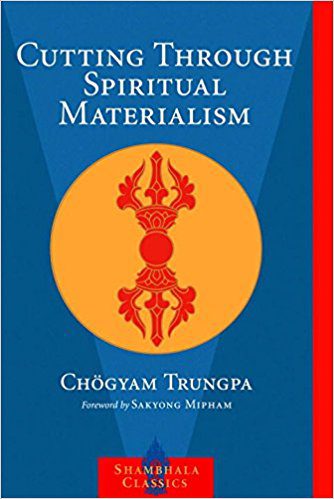 Depending on how deeply you want to dive into this perspective, there is a ten-part Collected Works of Chögyam Trungpa, each volume of which weighs in at many hundreds of pages—totaling well over 5,000 pages.The advice I received from people much more familiar than I am with the Shambala tradition was to start with Volume 3 of his Collected Works, which skips over some of his early writings in England and starts with some of his best material when he was coming into his own in the United States and discerning how to teach at the intersection of traditional Buddhism and the modern West. Or for a much shorter version, you can start with the two most important books collected in that volume, Cutting through Spiritual Materialism (based on lectures from 1970 to 1971), and The Myth of Freedom and the Way of Meditation (based on lectures from 1971 to 1973). They are each only about 200 pages.
In reflecting on the mixed legacy of figures like Chögyam Trungpa, one of the most helpful frameworks I have found is what the philosopher Ken Wilber called the “Level/Line Fallacy.” Each of us has the potential to progress through stages of development along many different parallel lines. There are stages of kinesthetic development as babies learn to first hold their neck up, then roll over, crawl, walk, and run—and some people even reach Olympic levels of kinesthetic development that are honestly beyond either the aptitude or inclination of most of us. There are also stages of cognitive development as babies learn to differentiate their sense of self from their environment, then to talk, read, and write—leading all the way up to world-class levels of cognitive development that most of us will never reach, such as winning a Nobel Prize. There are similar stages of spiritual development, moral development, emotional development, aesthetic development, and more.
And here’s the key insight of the “Level/Line Fallacy”: though each of these lines of development are in many ways parallel to one another; they are non-intersecting. This framework helps explain how we can have, for example, an NFL football player with world-class kinesthetic development, who is arrested for domestic violence—a serious deficit in certain levels of spiritual, moral, and emotional development. Or consider how an artist might have heightened emotional and aesthetic develop, but not be the most skilled athlete. (Of course, this is not a commentary on all athletes or all artists. Please, no emails.) Rather, the point is to recognize that someone like Chögyam Trungpa might have legitimate, world-class spiritual insight, but be tragically underdeveloped in other areas. There can be a seductive temptation to think that someone who excels in one area must be great in all areas. But if we pause for a moment, we might begin to perceive that it is perhaps predictably the case that a maniacal focus upon one area—or a few areas—will leave one almost inevitably underdeveloped in other areas. The “Level/Line Fallacy” is a reminder to be more realistic about those lifted up on pedestals in one area. For each of us, this insight is an invitation to hold a mirror up to ourselves.
For me, learning more about Trungpa has been an important process of wrestling with the legacy of someone who was at the forefront of teaching meditation in a way that is pragmatic, Westernized, and deeply transformative in a positive way for many students then and now. But it is also important to be honest about the shadow sides our histories.
The Rev. Dr. Carl Gregg is a certified spiritual director, a D.Min. graduate of San Francisco Theological Seminary, and the minister of the Unitarian Universalist Congregation of Frederick, Maryland. Follow him on Facebook (facebook.com/carlgregg) and Twitter (@carlgregg).
Learn more about Unitarian Universalism: http://www.uua.org/beliefs/principles
Previous Post

June 14, 2017
Chögyam Trungpa & Pragmatic, Modern Meditation
Browse Our Archives
Select a Category Advent Anti-Racism Archaeology Atheism Baptism Best of the Year List Book Reviews Buddhism Catholicism Christian Education Church and State Church Planting Climate Change Conscientious Objection to War Creation Spirituality Death Penalty Didache Disability Rights Discernment Easter Ecology Emergent Church Movement Empire-Critical Ethics Evolution Feminist Theology Film Reviews Gandhi Gospel of Mark Gun Control Hinduism Immigration Reform Interfaith Islam JFK Judaism Jungian Spirituality Lectionary Commentary Lent Letters to the Editor LGBT Marriage MLK Multiculturalism Mysticism Nonviolent Activism Occupy Paganism (Earth-centered Religions) Parables Paul Pluralism Politics Process Theology Quantum Physics Requiescat In Pace Seminary and Divinity School Sermon Series Retrospective Sermons Spiritual Direction Spiritual Practices Stewardship (Fundraising) The Book of J The Wheel of the Year (Paganism) Theoblogger Challenge Triathlon Uncategorized Unitarian Universalism Worship Resources Youth Ministry
Select a Month July 2026 May 2026 March 2026 November 2025 October 2025 August 2025 February 2025 December 2024 October 2024 March 2024 January 2024 December 2023 November 2023 March 2023 February 2023 January 2023 December 2022 November 2022 August 2022 March 2022 February 2022 January 2022 December 2021 September 2021 August 2021 July 2021 June 2021 May 2021 February 2021 January 2021 December 2020 August 2020 June 2020 May 2020 April 2020 March 2020 February 2020 January 2020 December 2019 November 2019 October 2019 September 2019 July 2019 June 2019 March 2019 February 2019 January 2019 December 2018 November 2018 October 2018 September 2018 June 2018 May 2018 April 2018 March 2018 February 2018 January 2018 December 2017 November 2017 October 2017 September 2017 August 2017 July 2017 June 2017 May 2017 April 2017 March 2017 February 2017 January 2017 December 2016 November 2016 October 2016 September 2016 August 2016 June 2016 May 2016 April 2016 March 2016 February 2016 January 2016 December 2015 November 2015 October 2015 September 2015 August 2015 July 2015 June 2015 May 2015 April 2015 March 2015 February 2015 January 2015 December 2014 November 2014 October 2014 August 2014 July 2014 June 2014 May 2014 April 2014 March 2014 February 2014 January 2014 December 2013 November 2013 October 2013 September 2013 August 2013 July 2013 June 2013 May 2013 April 2013 March 2013 February 2013 January 2013 December 2012 November 2012 October 2012 September 2012 August 2012 July 2012 June 2012 May 2012 April 2012 March 2012 February 2012 January 2012 December 2011 November 2011 October 2011 September 2011 August 2011 July 2011 June 2011 May 2011 April 2011 March 2011 February 2011 January 2011 December 2010 November 2010 October 2010 August 2009 July 2009 May 2009
Follow Us!
TAKE THE
Religious Wisdom Quiz
Who lamented Saul and Jonathan's death with a song?
Select your answer to see how you score.
Nathan Abiathar David Samuel
Related posts from Carl Gregg

Reading America at 250: A Nation Wrestles With...


Andrew Holocek on the Power of Darkness

The Stories That Shape Us: Myths, Archetypes, &...
TRENDING AT PATHEOS More Voices

Reading America at 250: A Nation Wrestles With...
As part of my own reflection on the 250th anniversary of the...

Whenever I am reading a book or listening to an argument, I...

President Trump Ban Animal Torture Videos on Facebook
Call for Stricter Regulations of Animal Abuse Content on Facebook Although President...

Draft Amendments to Address Ritual Abuse in New...
The proposed changes would make it illegal for individuals in domestic partnerships...

How Bans on LGBTQ+ Student Clubs Threaten Religious...
On June 20, 2025, the State of Texas passed Senate Bill 12....

The Truth About the Gen Z Revival
This past year, there has been a lot of media buzz surrounding...
view all More Voices blogs
Ad-Free & Subscriber Log-In Subscription Support
- About Us
- 2026 Calendar
- Videos
- Podcasts
- Library of World Religions
- Faith In Media Tracker
- Advertise With Us
- Write for Us
- Privacy Policy
- Terms of Service
- Do Not Sell My Data
- Contact Us
- Radiant Digital
- Manage Newsletter Subscriptions
- Unsubscribe From Notifications
- Sitemap
Copyright 2008-2026, Patheos. All rights reserved.
Subscription Support Ad-Free & Subscriber Log-In
Follow Patheos