
BuddhistCatholicContemplativeEvangelicalGeneral ChristianHinduJewishLatter-day SaintMuslimNew VisionsProgressive Christian
Beliefs
- Buddhist
- Catholic
- Contemplative
- Evangelical
- General Christian
- Hindu
- Jewish
- Latter-day Saint
- More Voices
- Muslim
- New Visions
- Pagan
- Progressive Christian
Topics
- Religion News
- Food and Religion
- Sports and Religion
- Religious Art
- Religious Music and Entertainment
- Religious Events
- History and Religion
- Style and Religion
- Politics and Religion
- Women in Religion
- Recreation Outdoors and Religion
- Business Finance and Religion
- Careers Workplace and Religion
- Education and Religion
- Family Parenting and Religion
- Health Fitness and Religion
- Home and Religion
- Relationships and Religion
- Technology and Religion
- Travel and Religion
Columnists
- Buddhist Columnists
- Business Finance and Religion Columnists
- Careers Workplace and Religion Columnists
- Catholic Columnists
- Contemplative Columnists
- Education and Religion Columnists
- Evangelists Columnists
- Family Parenting and Religion Columnists
- General Christian Columnists
- Health Fitness and Religion Columnists
- Hindu Columnists
- History and Religion Columnists
- Home and Religion Columnists
- Jewish Columnists
- More Voices Columnists
- Latter Day Columnists
- Muslim Columnists
- New Visions Columnists
- Nonreligious Columnists
- Pagan Columnists
- Politics and Religion Columnists
- Progressive Columnists
- Recreation Outdoors and Religion Columnists
- Relationships and Religion Columnists
- Religion News Columnists
- Religious Art Columnists
- Religious Events Columnists
- Religious Music and Entertainment Columnists
- Sports and Religion Columnists
- Style and Religion Columnists
- Technology and Religion Columnists
- Travel and Religion Columnists
- Women in Religion Columnists
Resource Library
- 2026 Calendar
- Library of World Religions
- The 100 Most Holy Places on Earth
- Patheos Answers
- Podcasts
- Videos
- Faith Leaders Database
- Anglican Episcopalian
- Bahai
- Baptist
- Buddhism
- Christianity
- Confucianism
- Eastern Orthodoxy
- Hinduism
- Holiness and Pentecostal
- ISKCON
- Islam
- Judaism
- Lutheran
- Methodist
- The Church of Jesus Christ of Latter-day Saints
- New Age
- Paganism
- Presbytarian and Reformed
- Protestantism
- Religion Behind the Scenes
- Roman Catholic
- Scientology
- Shia Islam
- Sikhism
- Sufism
- Sunni Islam
- Taoism
- Zen
- See all religions
Research Tools
 Ad-Free & Subscriber Log-In Subscription Support
Ad-Free & Subscriber Log-In Subscription Support
Follow Patheos 

- Trending:
- Forgiveness
- |
- Marriage
- |
- Consciousness
- |
- Death Penalty
- |
- Election
- |
- Halloween

- Home
- More Voices
- Chögyam Trungpa & Pragmatic, Modern Meditation
Chögyam Trungpa & Pragmatic, Modern Meditation
Last updated on: June 14, 2017 at 8:50 am by Carl Gregg
Chögyam Trungpa & Pragmatic, Modern Meditation 2017-06-13T23:37:01-04:00 Carl Gregg
Patheos Explore the world's faith through different perspectives on religion and spirituality! Patheos has the views of the prevalent religions and spiritualities of the world.
I have posted previously about my interest in pragmatic approaches to meditation. Such approaches seek to balance the best of traditional Buddhism with all that we know here in the early twenty-first century. One significant figure in this movement (broadly speaking) is Chögyam Trungpa, who died in 1987 at the far too young age of 48 from health complications followings a heart attack. You’ll sometimes hear a title added at the end of his name, Chögyam Trungpa Rinpoche, a Tibetan honorific that means “precious one.”
Today he is remembered as an inspiring, charismatic, and controversial teacher. Drawing from his online biography, he was the “11th descendent in a line of important teachers in one of four main schools of Tibetan Buddhism. And he helped promote a “non-sectarian” approach within the Tibetan tradition, which sought to “bring together and make available all the valuable teachings of the different schools, free of sectarian rivalry.”
In his early years, he received a thorough, traditional monastic education and was named the head of a group of monasteries in Tibet. But a major turning point came in 1959, when he twenty years old. The Chinese Communist party took control of Tibet, and he was forced to flee his native country. Along with a few other monks, he was able to escape over the Himalayas to India. (Tenzin Gyatso, the 14th Dalai Lama, was forced into exile the same year.)
Trungpa moved to England in 1963, where he studied “comparative religion, philosophy, and fine arts at Oxford University.” In 1967, he moved to Scotland and founded the first Tibetan Buddhist practice center in the West. “Shortly thereafter, a variety of experiences—including a car accident that left him partially paralyzed on the left side of his body—led to his decision to give up his monastic vows and work as a lay teacher.”
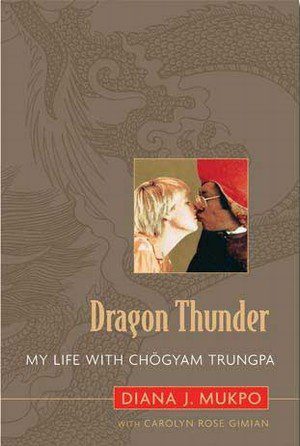 During his lifetime, he published fourteen books. The first of these appeared in 1969, titled Meditation in Action. The next year, 1970, was another major turning point. He got married, moved to the United States, and opened a meditation center in Vermont. Now, it is important to be honest that the person he married was a sixteen-year-old from an upper-class English family who was one of his students. For anyone curious, you can read her perspective in her memoir, Dragon Thunder: My Life with Chögyam Trungpa. Part of what she has said for herself is that:
For him there was a slightly different cultural context, because people in Tibet tended to get married a lot younger than they do in the West. From my perspective, I really was not attached to the conceptual norms I had grown up with; to a certain extent I’d rather radically rejected my culture. I really wasn’t looking at it from the reference point of whether it was appropriate or not. I simply had this unbelievable connection with him that felt to me very natural. I think you can say the proof is in the pudding. I don’t feel I was exploited because this was not a casual encounter. This is something that developed into a deep, meaningful, lifelong relationship.… On the other hand…I’m certainly not saying that I would condone 28-year-olds sleeping with 15-year-olds.
They did stay married, had four sons together, and it was 1970, in the wake of the countercultural movements of the 1960s. But Trungpa also reportedly had sexual relationships with many other students, and seriously abused alcohol over many years (The Other Side of Eden xiv – xv, 31, 34, 40-41, 176).
In the spirit of fairness, it may be important to name that some similar clergy/congregant dynamics were happening in my own tradition of Unitarian Universalism, as well as many other religious movements at that time (including into the present) which parallel abusive guru/student relationships. And while much good has come from the Sexual Revolution of the 1960s, there has also been a shadow side in which sexual freedom created opportunities for abuse. The blasé attitude was often along the lines of, “Stop being so puritanical, it’ll be fine.” In a few cases perhaps it was fine, but in many cases it was not fine. Abuse of power and betrayal of sacred trust caused lasting harm to individuals and religious communities. If you are interested in learning more, I strongly recommend the courageous lecture delivered last year at UU General Assembly by my colleague The Rev. Gail Seavey titled “If Our Secrets Define Us.”
As the UU movement has sought to learn from misconduct in the past, a few years ago the UU Minister’s Association distilled our sexual ethics guidelines to a simple, clear set of twenty-one words: “I will not engage in sexual contact, sexualized behavior, or a sexual relationship with any person I serve as a minister.” If a minister chooses to enter into a relationship with someone for whom they have served as a minister, the ministerial relationship must end. And there are recommended best practices for transparency and accountability to increase the chance of avoiding harm when transitioning to a non-ministerial relationship.
At this point, I have in some ways moved afield from the life and teachings of Chögyam Trungpa, but as I have begun to explore his life and teachings more deeply, I do not know how to talk about him responsibly without addressing the larger context of power dynamics and sexual misconduct that we have greater clarity about today than we did in the 1970s and 1980s—although perhaps lack of clarity was less a factor than a lack of processes for holding abusers accountable, processes much more accessible today in the wake of the Anita Hill hearings and related movements, even as the current system remains far from perfect.
(I will continue tomorrow in a post on “Chögyam Trungpa & the Level/Line Fallacy.”)
The Rev. Dr. Carl Gregg is a certified spiritual director, a D.Min. graduate of San Francisco Theological Seminary, and the minister of the Unitarian Universalist Congregation of Frederick, Maryland. Follow him on Facebook (facebook.com/carlgregg) and Twitter (@carlgregg).
Learn more about Unitarian Universalism: http://www.uua.org/beliefs/principles
Previous Post

June 8, 2017
The Religion of the Rose
Next Post
June 15, 2017 Chögyam Trungpa & the Level/Line Fallacy
Browse Our Archives
Select a Category Advent Anti-Racism Archaeology Atheism Baptism Best of the Year List Book Reviews Buddhism Catholicism Christian Education Church and State Church Planting Climate Change Conscientious Objection to War Creation Spirituality Death Penalty Didache Disability Rights Discernment Easter Ecology Emergent Church Movement Empire-Critical Ethics Evolution Feminist Theology Film Reviews Gandhi Gospel of Mark Gun Control Hinduism Immigration Reform Interfaith Islam JFK Judaism Jungian Spirituality Lectionary Commentary Lent Letters to the Editor LGBT Marriage MLK Multiculturalism Mysticism Nonviolent Activism Occupy Paganism (Earth-centered Religions) Parables Paul Pluralism Politics Process Theology Quantum Physics Requiescat In Pace Seminary and Divinity School Sermon Series Retrospective Sermons Spiritual Direction Spiritual Practices Stewardship (Fundraising) The Book of J The Wheel of the Year (Paganism) Theoblogger Challenge Triathlon Uncategorized Unitarian Universalism Worship Resources Youth Ministry
Select a Month July 2026 May 2026 March 2026 November 2025 October 2025 August 2025 February 2025 December 2024 October 2024 March 2024 January 2024 December 2023 November 2023 March 2023 February 2023 January 2023 December 2022 November 2022 August 2022 March 2022 February 2022 January 2022 December 2021 September 2021 August 2021 July 2021 June 2021 May 2021 February 2021 January 2021 December 2020 August 2020 June 2020 May 2020 April 2020 March 2020 February 2020 January 2020 December 2019 November 2019 October 2019 September 2019 July 2019 June 2019 March 2019 February 2019 January 2019 December 2018 November 2018 October 2018 September 2018 June 2018 May 2018 April 2018 March 2018 February 2018 January 2018 December 2017 November 2017 October 2017 September 2017 August 2017 July 2017 June 2017 May 2017 April 2017 March 2017 February 2017 January 2017 December 2016 November 2016 October 2016 September 2016 August 2016 June 2016 May 2016 April 2016 March 2016 February 2016 January 2016 December 2015 November 2015 October 2015 September 2015 August 2015 July 2015 June 2015 May 2015 April 2015 March 2015 February 2015 January 2015 December 2014 November 2014 October 2014 August 2014 July 2014 June 2014 May 2014 April 2014 March 2014 February 2014 January 2014 December 2013 November 2013 October 2013 September 2013 August 2013 July 2013 June 2013 May 2013 April 2013 March 2013 February 2013 January 2013 December 2012 November 2012 October 2012 September 2012 August 2012 July 2012 June 2012 May 2012 April 2012 March 2012 February 2012 January 2012 December 2011 November 2011 October 2011 September 2011 August 2011 July 2011 June 2011 May 2011 April 2011 March 2011 February 2011 January 2011 December 2010 November 2010 October 2010 August 2009 July 2009 May 2009
Follow Us!
TAKE THE
Religious Wisdom Quiz
True or False: Paul taught the Galatians that circumcision is necessary for salvation.
Select your answer to see how you score.
FALSE TRUE
Related posts from Carl Gregg

Reading America at 250: A Nation Wrestles With...


Andrew Holocek on the Power of Darkness

The Stories That Shape Us: Myths, Archetypes, &...
TRENDING AT PATHEOS More Voices

Reading America at 250: A Nation Wrestles With...
As part of my own reflection on the 250th anniversary of the...

Whenever I am reading a book or listening to an argument, I...

President Trump Ban Animal Torture Videos on Facebook
Call for Stricter Regulations of Animal Abuse Content on Facebook Although President...

Draft Amendments to Address Ritual Abuse in New...
The proposed changes would make it illegal for individuals in domestic partnerships...

How Bans on LGBTQ+ Student Clubs Threaten Religious...
On June 20, 2025, the State of Texas passed Senate Bill 12....

The Truth About the Gen Z Revival
This past year, there has been a lot of media buzz surrounding...
view all More Voices blogs
Ad-Free & Subscriber Log-In Subscription Support
- About Us
- 2026 Calendar
- Videos
- Podcasts
- Library of World Religions
- Faith In Media Tracker
- Advertise With Us
- Write for Us
- Privacy Policy
- Terms of Service
- Do Not Sell My Data
- Contact Us
- Radiant Digital
- Manage Newsletter Subscriptions
- Unsubscribe From Notifications
- Sitemap
Copyright 2008-2026, Patheos. All rights reserved.
Subscription Support Ad-Free & Subscriber Log-In
Follow Patheos