
BuddhistCatholicContemplativeEvangelicalGeneral ChristianHinduJewishLatter-day SaintMuslimNew VisionsProgressive Christian
Beliefs
- Buddhist
- Catholic
- Contemplative
- Evangelical
- General Christian
- Hindu
- Jewish
- Latter-day Saint
- More Voices
- Muslim
- New Visions
- Pagan
- Progressive Christian
Topics
- Religion News
- Food and Religion
- Sports and Religion
- Religious Art
- Religious Music and Entertainment
- Religious Events
- History and Religion
- Style and Religion
- Politics and Religion
- Women in Religion
- Recreation Outdoors and Religion
- Business Finance and Religion
- Careers Workplace and Religion
- Education and Religion
- Family Parenting and Religion
- Health Fitness and Religion
- Home and Religion
- Relationships and Religion
- Technology and Religion
- Travel and Religion
Columnists
- Buddhist Columnists
- Business Finance and Religion Columnists
- Careers Workplace and Religion Columnists
- Catholic Columnists
- Contemplative Columnists
- Education and Religion Columnists
- Evangelists Columnists
- Family Parenting and Religion Columnists
- General Christian Columnists
- Health Fitness and Religion Columnists
- Hindu Columnists
- History and Religion Columnists
- Home and Religion Columnists
- Jewish Columnists
- More Voices Columnists
- Latter Day Columnists
- Muslim Columnists
- New Visions Columnists
- Nonreligious Columnists
- Pagan Columnists
- Politics and Religion Columnists
- Progressive Columnists
- Recreation Outdoors and Religion Columnists
- Relationships and Religion Columnists
- Religion News Columnists
- Religious Art Columnists
- Religious Events Columnists
- Religious Music and Entertainment Columnists
- Sports and Religion Columnists
- Style and Religion Columnists
- Technology and Religion Columnists
- Travel and Religion Columnists
- Women in Religion Columnists
Resource Library
- 2026 Calendar
- Library of World Religions
- The 100 Most Holy Places on Earth
- Patheos Answers
- Podcasts
- Videos
- Faith Leaders Database
- Anglican Episcopalian
- Bahai
- Baptist
- Buddhism
- Christianity
- Confucianism
- Eastern Orthodoxy
- Hinduism
- Holiness and Pentecostal
- ISKCON
- Islam
- Judaism
- Lutheran
- Methodist
- The Church of Jesus Christ of Latter-day Saints
- New Age
- Paganism
- Presbytarian and Reformed
- Protestantism
- Religion Behind the Scenes
- Roman Catholic
- Scientology
- Shia Islam
- Sikhism
- Sufism
- Sunni Islam
- Taoism
- Zen
- See all religions
Research Tools
 Ad-Free & Subscriber Log-In Subscription Support
Ad-Free & Subscriber Log-In Subscription Support
Follow Patheos 

- Trending:
- Forgiveness
- |
- Marriage
- |
- Consciousness
- |
- Death Penalty
- |
- Election
- |
- Halloween

- Home
- More Voices
- Spiritual Practices of Curiosity & Commitment #UUWhiteSupremacyTeachIn
Spiritual Practices of Curiosity & Commitment #UUWhiteSupremacyTeachIn
Last updated on: May 3, 2017 at 8:45 am by Carl Gregg
Spiritual Practices of Curiosity & Commitment #UUWhiteSupremacyTeachIn 2017-05-02T21:25:24-04:00 Carl Gregg
Patheos Explore the world's faith through different perspectives on religion and spirituality! Patheos has the views of the prevalent religions and spiritualities of the world.
Two years ago, I was trained as a facilitator for a Unitarian Universalist Minister’s Association program on “Where Leads Our Call?” As the first part of that program, I co-led a three-day retreat last year in Delaware for UU ministers on “Call & Excellence,” reflecting on both the promises and perils of pursuing “excellence in ministry.” This past week, I co-led the second part of the program on “Call & Accountability.”
When this curriculum was written, there was no way to anticipate just how relevant the topic of “Call & Accountability” would be today in the larger Unitarian Universalist movement. As it turned out, three weeks before the second retreat began, news began breaking of a series of resignations in the upper levels of UUA leadership in response to a controversy around diversity in hiring practices. Depending on how deeply you want to dive into the details around this controversy, there is considerable coverage on the UU World website.
In response, the Black Lives of UU Organizing Collective called on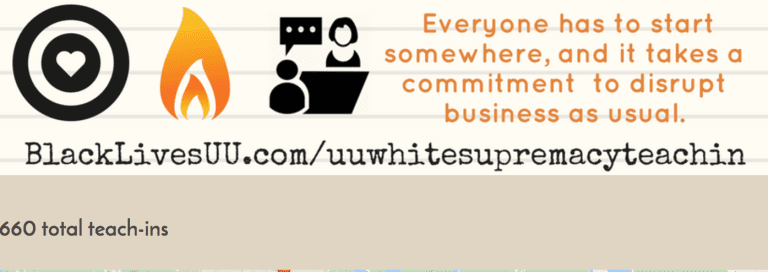 UU congregations to host a #UUWhiteSupremacyTeachIn. (A “teach-in” is a play on the protest strategy of a “sit-in,” adding a connotation of an educational forum equipping activists for social change.) The congregation I serve as minister is one of 633 UU congregations who accepted this challenge to host a #UUWhiteSupremacyTeachIn.
When leaders in a progressive religious movement begin resigning around accusations of perpetuating White Supremacy, a lot of people get triggered for a confluence of different reasons. So as I prepared last week, to co-lead a retreat for nearby UU ministers on “Call & Accountability,” the following is an excerpt of the opening reading we used for the opening session on creating a covenant of how we were committing to be together during the retreat. It’s called “An Invitation to Brave Space”:
Because there is no such thing as a “safe space”
We all carry scars and we have all caused wounds.
That challenge to co-create “brave space” reminds me of the quote that I reference each time we welcome new members of the congregation I serve. We reflect on what it means, that Unitarian Universalism is a covenantal rather than a creedal religious movement. Our word “creed” derives from the Latin credo, meaning “I believe.” And creedal religious movements seek to create unity around a set a beliefs. In contrast, as Unitarian Universalists, we sometimes say that “We believe in deeds not creeds,” and that, “We don’t have to believe alike to love alike.” So, in the words of a former president of the UUA from back in the 1990s:
The memory we seek to embody is of forebears wise enough to put aside the creedal question…“What do we all believe in common?” for more profound, covenantal questions: “How shall we treat and help one another here? What hopes might we share? What promises shall we make to help deepen one another’s lives in the time we have?”
Through creating “brave space,” our goal is neither to enforce a creedal orthodoxy, nor to make people feel shame. Rather, the goal is to cultivate greater awareness of where one another is coming from—to become more conscious of perspectives of which we are currently unconscious—so that we might more authentically build a beloved community.
In the brave space we sought to create in the retreat this last week, as part of how we reflected on how we are called to hold one another accountable as UU ministers, part of what we did was closely study the Covenant of the UU Minister’s Association. Some parts of that covenant are more uniquely applicable to ministers, but there are three parts of it that particularly stood out to me as potentially helpful for the larger progressive movement at such a time as this:
We covenant together…
-
To [be] mindful of our potential unconsciously to perpetuate systems of oppression;
-
To seek justice and right relations according to our evolving collective wisdom…
-
To cultivate practices of deepening awareness, understanding, humility, and commitment to our ideals;
I’ll say more about each in turn.
First, covenanting together “To seek justice and right relations according to our evolving collective wisdom” is a reminder that none of us has it all figured out. I would even go one step further to say that there is not even the possibility of perfection. Rather, at our best, we are ever-evolving—seeking to learn from the past to avoid repeating the same mistakes, and to draw increasingly wide circles of inclusion.
And often, it only becomes possible to draw those increasingly wide concentric circles of inclusion once we become more aware of ways we have unintentionally excluded others in the past. (As the saying goes, “Intention does not equal impact.”) Or in the second of our three points, we covenant together “to [be] mindful of our potential unconsciously to perpetuate systems of oppression.” This commitment is perhaps the biggest paradigm shift we are invited to wrestle with regarding the #UUWhiteSupremacyTeachIn.
We are not talking about the common understanding of White Supremacy as people “out there” like the Ku Klux Klan, who are conscious, aspirational White Supremacists, seeking to intentionally create a more racist society. You might think of learning to denounce conscious, aspirational White Supremacy as the entry level of dismantling racism. It is a vitally important starting point, and I’m all for it.
But I want to invite you to consider that there may also be a more advanced level of dismantling racism in which we are asked not only to condemn the blatant, conscious White Supremacy “out there,” but also to look in the mirror and investigate the ways that being raised in a racist, sexist, classist society has caused each of us to sometimes “unconsciously perpetuate systems of oppression” in various ways.
I invite you to notice not only that word unconscious, but also the word system—because the problem is so much larger than any of our individual perspectives. It is about the systems and institutions, laws and attitudes all around us. We need to do the work of dismantling on both the individual and systemic level: interrogating our own implicit bias as well as working together to write more equitable laws. We are called to an increased awareness that if we do not set up accountable processes for dismantling systems of oppression, then we reinforce and perpetuate those systems of oppression, both unconsciously and consciously.
The third part of the covenant that I am inviting us to consider is “To cultivate practices of deepening awareness, understanding, humility, and commitment to our ideals.” What sorts of practices might that refer to? When approaching difficult topics like racism, practicing humility can mean reminding oneself that we are entering into brave space to seek evolving collective wisdom. None of us has all the answers, and a practice of humility can invite us to move from defensiveness to curiosity. If you hearing the term #UUWhiteSupremacyTeachIn makes you feel anger, sadness, confusion or shame, those are understandable human responses. I invite you to both feel those emotions and to consider experimenting with the spiritual practice of curiosity. Ask yourself, what might I have to learn from reflecting on “our potential unconsciously to perpetuate systems of oppression.” I am not telling you that you have to embrace some pre-determined orthodox perspective. Rather, I’m inviting you to take a new perspective for a test drive, open to what new realizations you might potentially become aware of.
Also, with respect to covenanting “To cultivate practices of deepening awareness, understanding, humility, and commitment to our ideals,” I am struck by that word “commitment.” When discussing difficult topics, a spiritual practice of commitment can mean staying at the table and cultivating a capacity for just “being with” our discomfort. That’s the different between safe space and brave space. There are certainly times when we need safe spaces, but I invite you to consider that there are also times when we need brave spaces, when we are willing to show up and listen to new perspectives and be willing to sit with our discomfort rather than retreating. Co-creating such a space together is not easy, but it is the authentic, life-affirming soul work of building a beloved community. I’m grateful to be on that journey with so many of you.
The Rev. Dr. Carl Gregg is a certified spiritual director, a D.Min. graduate of San Francisco Theological Seminary, and the minister of the Unitarian Universalist Congregation of Frederick, Maryland. Follow him on Facebook (facebook.com/carlgregg) and Twitter (@carlgregg).
Learn more about Unitarian Universalism: http://www.uua.org/beliefs/principles
Previous Post

April 29, 2017
The Earth Challenge & the Spiritual Practice of Earth Breathing
Next Post
May 10, 2017 Countercultural Spirituality, Then & Now
Browse Our Archives
Select a Category Advent Anti-Racism Archaeology Atheism Baptism Best of the Year List Book Reviews Buddhism Catholicism Christian Education Church and State Church Planting Climate Change Conscientious Objection to War Creation Spirituality Death Penalty Didache Disability Rights Discernment Easter Ecology Emergent Church Movement Empire-Critical Ethics Evolution Feminist Theology Film Reviews Gandhi Gospel of Mark Gun Control Hinduism Immigration Reform Interfaith Islam JFK Judaism Jungian Spirituality Lectionary Commentary Lent Letters to the Editor LGBT Marriage MLK Multiculturalism Mysticism Nonviolent Activism Occupy Paganism (Earth-centered Religions) Parables Paul Pluralism Politics Process Theology Quantum Physics Requiescat In Pace Seminary and Divinity School Sermon Series Retrospective Sermons Spiritual Direction Spiritual Practices Stewardship (Fundraising) The Book of J The Wheel of the Year (Paganism) Theoblogger Challenge Triathlon Uncategorized Unitarian Universalism Worship Resources Youth Ministry
Select a Month July 2026 May 2026 March 2026 November 2025 October 2025 August 2025 February 2025 December 2024 October 2024 March 2024 January 2024 December 2023 November 2023 March 2023 February 2023 January 2023 December 2022 November 2022 August 2022 March 2022 February 2022 January 2022 December 2021 September 2021 August 2021 July 2021 June 2021 May 2021 February 2021 January 2021 December 2020 August 2020 June 2020 May 2020 April 2020 March 2020 February 2020 January 2020 December 2019 November 2019 October 2019 September 2019 July 2019 June 2019 March 2019 February 2019 January 2019 December 2018 November 2018 October 2018 September 2018 June 2018 May 2018 April 2018 March 2018 February 2018 January 2018 December 2017 November 2017 October 2017 September 2017 August 2017 July 2017 June 2017 May 2017 April 2017 March 2017 February 2017 January 2017 December 2016 November 2016 October 2016 September 2016 August 2016 June 2016 May 2016 April 2016 March 2016 February 2016 January 2016 December 2015 November 2015 October 2015 September 2015 August 2015 July 2015 June 2015 May 2015 April 2015 March 2015 February 2015 January 2015 December 2014 November 2014 October 2014 August 2014 July 2014 June 2014 May 2014 April 2014 March 2014 February 2014 January 2014 December 2013 November 2013 October 2013 September 2013 August 2013 July 2013 June 2013 May 2013 April 2013 March 2013 February 2013 January 2013 December 2012 November 2012 October 2012 September 2012 August 2012 July 2012 June 2012 May 2012 April 2012 March 2012 February 2012 January 2012 December 2011 November 2011 October 2011 September 2011 August 2011 July 2011 June 2011 May 2011 April 2011 March 2011 February 2011 January 2011 December 2010 November 2010 October 2010 August 2009 July 2009 May 2009
Follow Us!
TAKE THE
Religious Wisdom Quiz
Who cried out, "My God, my God, why have you forsaken me?" while dying?
Select your answer to see how you score.
Jesus Paul Stephen David
Related posts from Carl Gregg

Reading America at 250: A Nation Wrestles With...


Andrew Holocek on the Power of Darkness

The Stories That Shape Us: Myths, Archetypes, &...
TRENDING AT PATHEOS More Voices

Reading America at 250: A Nation Wrestles With...
As part of my own reflection on the 250th anniversary of the...

Whenever I am reading a book or listening to an argument, I...

President Trump Ban Animal Torture Videos on Facebook
Call for Stricter Regulations of Animal Abuse Content on Facebook Although President...

Draft Amendments to Address Ritual Abuse in New...
The proposed changes would make it illegal for individuals in domestic partnerships...

How Bans on LGBTQ+ Student Clubs Threaten Religious...
On June 20, 2025, the State of Texas passed Senate Bill 12....

The Truth About the Gen Z Revival
This past year, there has been a lot of media buzz surrounding...
view all More Voices blogs
Ad-Free & Subscriber Log-In Subscription Support
- About Us
- 2026 Calendar
- Videos
- Podcasts
- Library of World Religions
- Faith In Media Tracker
- Advertise With Us
- Write for Us
- Privacy Policy
- Terms of Service
- Do Not Sell My Data
- Contact Us
- Radiant Digital
- Manage Newsletter Subscriptions
- Unsubscribe From Notifications
- Sitemap
Copyright 2008-2026, Patheos. All rights reserved.
Subscription Support Ad-Free & Subscriber Log-In
Follow Patheos