
BuddhistCatholicContemplativeEvangelicalGeneral ChristianHinduJewishLatter-day SaintMuslimNew VisionsProgressive Christian
Beliefs
- Buddhist
- Catholic
- Contemplative
- Evangelical
- General Christian
- Hindu
- Jewish
- Latter-day Saint
- More Voices
- Muslim
- New Visions
- Pagan
- Progressive Christian
Topics
- Religion News
- Food and Religion
- Sports and Religion
- Religious Art
- Religious Music and Entertainment
- Religious Events
- History and Religion
- Style and Religion
- Politics and Religion
- Women in Religion
- Recreation Outdoors and Religion
- Business Finance and Religion
- Careers Workplace and Religion
- Education and Religion
- Family Parenting and Religion
- Health Fitness and Religion
- Home and Religion
- Relationships and Religion
- Technology and Religion
- Travel and Religion
Columnists
- Buddhist Columnists
- Business Finance and Religion Columnists
- Careers Workplace and Religion Columnists
- Catholic Columnists
- Contemplative Columnists
- Education and Religion Columnists
- Evangelists Columnists
- Family Parenting and Religion Columnists
- General Christian Columnists
- Health Fitness and Religion Columnists
- Hindu Columnists
- History and Religion Columnists
- Home and Religion Columnists
- Jewish Columnists
- More Voices Columnists
- Latter Day Columnists
- Muslim Columnists
- New Visions Columnists
- Nonreligious Columnists
- Pagan Columnists
- Politics and Religion Columnists
- Progressive Columnists
- Recreation Outdoors and Religion Columnists
- Relationships and Religion Columnists
- Religion News Columnists
- Religious Art Columnists
- Religious Events Columnists
- Religious Music and Entertainment Columnists
- Sports and Religion Columnists
- Style and Religion Columnists
- Technology and Religion Columnists
- Travel and Religion Columnists
- Women in Religion Columnists
Resource Library
- 2026 Calendar
- Library of World Religions
- The 100 Most Holy Places on Earth
- Patheos Answers
- Podcasts
- Videos
- Faith Leaders Database
- Anglican Episcopalian
- Bahai
- Baptist
- Buddhism
- Christianity
- Confucianism
- Eastern Orthodoxy
- Hinduism
- Holiness and Pentecostal
- ISKCON
- Islam
- Judaism
- Lutheran
- Methodist
- The Church of Jesus Christ of Latter-day Saints
- New Age
- Paganism
- Presbytarian and Reformed
- Protestantism
- Religion Behind the Scenes
- Roman Catholic
- Scientology
- Shia Islam
- Sikhism
- Sufism
- Sunni Islam
- Taoism
- Zen
- See all religions
Research Tools
 Ad-Free & Subscriber Log-In Subscription Support
Ad-Free & Subscriber Log-In Subscription Support
Follow Patheos 

- Trending:
- Forgiveness
- |
- Marriage
- |
- Consciousness
- |
- Death Penalty
- |
- Election
- |
- Halloween

- Home
- More Voices
- Countercultural Spirituality, Then & Now
Countercultural Spirituality, Then & Now
Last updated on: May 10, 2017 at 1:25 pm by Carl Gregg
Countercultural Spirituality, Then & Now 2017-05-10T13:25:54-04:00 Carl Gregg
Patheos Explore the world's faith through different perspectives on religion and spirituality! Patheos has the views of the prevalent religions and spiritualities of the world.
Over the past few years, I have written three posts inspired by the scholarship of Jeffrey Kripal:
- Mystical Humanism – on the intersection of the scientific method with more-subjective firsthand spiritual experiences.
- Eve Was Framed, the Serpent Was Right! Gnostic Reflections on Religion
- Reflexive Re-Readings of Religion – connected to a class on “Comparing Religions: Coming to Terms.”
Kripal is a religion professor at Rice University in Houston, and one of my favorite contemporary religion scholars.
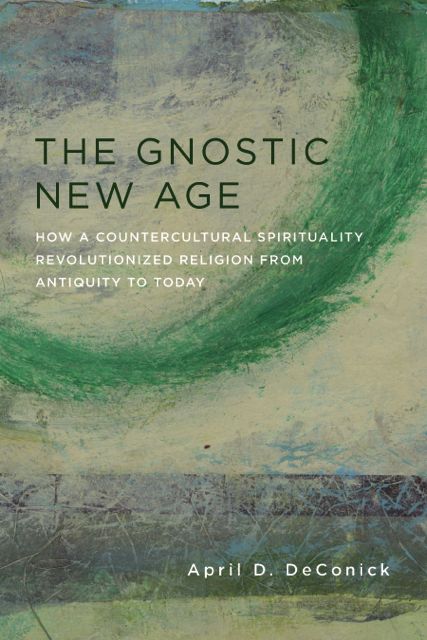 I am bringing up Kripal today because he shares some areas of research with his colleague April DeConick, Chair of the Religion Department at Rice. And today’s post is inspired by DeConick’s new book on The Gnostic New Age: How a Countercultural Spirituality Revolutionized Religion from Antiquity to Today. I would like to invite you to consider some of the important connections between ancient Gnosticism and the “Spiritual But Not Religious” phenomenon today.
To share some of DeConick’s story, in 1982 she entered college with plans to be a nurse. But that same year, her mother handed her a book she had just finished reading, saying, “I bet you will like this.” It was a new book that had just been published, titled The Other Gospels. It was described as, “Gospels that never made it into the New Testament. Unknown saying of Jesus.” Her mother was right: DeConick was intrigued (1).
She was particularly struck by the third verse of The Gospel of Thomas, which she had never heard of previously, in which Jesus says:
The kingdom is inside of you, and it is outside of you. When you come to know yourself, then you will become known, and you will realize that it is you who are the sons of the living father. But if you will not know yourself you dwell in poverty and it is you who are that poverty. (20, my emphasis)
DeConick wanted to know about this perspective on religion and spirituality, which taught “Know yourself” and “Seek the divine within yourself—or risk living an impoverished life” (1).
In her quest to learn more, she next found Elaine Pagels’s book The Gnostic Gospels, which had been published three years earlier in 1979. Pagels was one of the first scholars to write a book that was scholarly, accessible, and popular about the Gnostic manuscripts, which had been discovered in 1945 near Nag Hammadi, Egypt. Soon afterward, DeConick found James Robinson’s 1977 book The Nag Hammadi Library in English, which was a primary source translation of the texts themselves (2).
For the almost two thousand years of Christian history, most Christians only had access to orthodox writings against Gnosticism. Suddenly in 1945 we were able to read what the Gnostics had to say about themselves. And scholars have increasingly come to see that there was not a simple, direct, unbroken line of succession from Jesus of Nazareth to Peter as the first pope straight through until Pope Francis today. According to that traditional view, any alternative perspective was a heretical deviation from the one, correct, orthodox way. The truth turns out to be much messier and more complex than that. The orthodox perspective was merely one among many groups competing against one another to be considered a legitimate extension of the Jesus movement (3). (I’m tempted to go into more detail here, but I have blogged about this previously in a post titled, Lost Christianities and Banned Books of the Bible.)
For now, I will say just a little more to emphasize the huge shift that comes from reading what a group says about itself in comparison to what its opponents say about them. Consider, for example, if the only access you had to the outside world was Fox News. That’s essentially the situation we were in prior to the 1945 discovery of Gnostic texts near Nag Hammadi: we only had the Fox News version of Gnosticism.
As a college freshman in 1982, when DeConick was first reading these newly-released, paradigm-shifting books about Gnosticismshe began to realize that as valuable as these early interpretations of Gnosticism were, she was not convinced they were fully reading the Gnostics correctly. Some of the previous biases about Gnosticsm seemed to be skewing the interpretations of these new texts. In particular, the Gnostics were consistently described as unorganized and anti-ritual, but as she read the Gnostic texts closely for herself, the opposite seemed to be the case. The Gnostic texts explicitly described rituals for cultivating “intense religious experiences of spiritual transformation…. And they were doing so in organized groups with guru-type leaders.” This realization was a turning point for DeConick that lead her on a decades-long study of Gnosticism which included earning a Ph.D. in Near Eastern studies at the University of Michigan (3).
As it turns out, long before Marx was condemning religion as the “opiate of the masses,” the Gnostics were questioning the ways that much of conventional religion supported the status quo. In contrast, Gnostic approaches to spirituality were about transcending conventional conceptions through ritualized, firsthand spiritual experiences of union with the Sacred, the Holy, the numinous—beyond ideas about “God” (4). Consider the difference between writing about apples and actually taking your first bite of an apple—and thus coming to know an apple, not intellectually, but existentially.
Part of DeConick’s contribution to contemporary scholarship to invite us to consider Gnosticism as more than a one among many early Christian sects. Instead, it is more of a “countercultural orientation”**—an approach to spirituality that could potentially be present in almost any religious movement (4-5). Gnosticism (from the Greek “to know”) derives its name from the special “knowledge” about reality attained through firsthand religious experiences. Our silent “k” in knowledge is due to the silent “g” in gnostic.
To cultivate a state of ecstasy, the rituals were often extensive and highly participatory. To give you just one example, one Gnostic initiation ritual involved an individual going through a total of twenty-two baptisms (225). Compared to a single individual public Sunday morning baptism, consider the impact of an all-night private ritual of chanting, increased sleep deprivation, and immersion after immersion in water.
Gnostics claimed to have discovered in their own firsthand experience a much more powerful, unifying spirituality beyond the “God” described in the Bible. And many orthodox Christian leaders perceived these claims as a threat. They were terrified of people questioning religious hierarchy based on their own firsthand experience. And to give just one example of the anti-Gnostic polemics, in the late second century, an early orthodox Christian bishop named Irenaus wrote a five-volume series of books titled Against the Heresies (54).
To be clear, the Gnostics were literally heretics. The word heretic comes from the Greek αἵρεσις, meaning “choice.” Rather than unquestioningly accepting the secondhand teachings of tradition, they chose for themselves what to believe, based on their own firsthand experience. In that spirit, Unitarian Universalism is sometimes called a “chosen faith.”
In the ancient world, part of why the Gnostics were so threatening to orthodoxy is that they used the Hebrew and Christian Scriptures to bolster their own claims. They pointed to passages such as Genesis 3 where God is described as “walking” through the Garden of Eden and “calling” for Adam and Eve, who are hiding. The Gnostic asked: what kind of God walks around like a human? And what kind of God are humans able to hide from? For the Gnostics, these—and many other similar passages from the Bible—were evidence that the God of the Bible was, at most, a lesser god—distinct from the “Ground of All Being” they had experienced (91). They pointed to all the times that the God of the Bible is capricious, petty, jealous, even genocidal at points—credited with killing large numbers of people for various different reasons (93).
Whereas the biblical God punished Adam and Eve for eating from the “Tree of the Knowledge of Good and Evil,” the Gnostics saw this transgressive act as the means of salvation. They admired the serpent, who tells Eve in Genesis 3 that if she eats of the fruit, “You will not die…. Your eyes will be opened, and you will be like God” (55). Indeed, some of the Gnostics are known as Sethians—because they identified with Adam and Eve’s third son Seth, after Cain and Abel. Seth “is the only early character in the Bible who never interacts with or worships YHWH” (97).
(I will continue this theme tomorrow in a post on “How to Move from Secondhand Theology to Firsthand Spiritual Experience.”)
The Rev. Dr. Carl Gregg is a certified spiritual director, a D.Min. graduate of San Francisco Theological Seminary, and the minister of the Unitarian Universalist Congregation of Frederick, Maryland. Follow him on Facebook (facebook.com/carlgregg) and Twitter (@carlgregg).
Learn more about Unitarian Universalism: http://www.uua.org/beliefs/principles
Previous Post

May 3, 2017
Spiritual Practices of Curiosity & Commitment #UUWhiteSupremacyTeachIn
Next Post
May 11, 2017 How to Move from Secondhand Theology to Firsthand Spiritual Experience
Browse Our Archives
Select a Category Advent Anti-Racism Archaeology Atheism Baptism Best of the Year List Book Reviews Buddhism Catholicism Christian Education Church and State Church Planting Climate Change Conscientious Objection to War Creation Spirituality Death Penalty Didache Disability Rights Discernment Easter Ecology Emergent Church Movement Empire-Critical Ethics Evolution Feminist Theology Film Reviews Gandhi Gospel of Mark Gun Control Hinduism Immigration Reform Interfaith Islam JFK Judaism Jungian Spirituality Lectionary Commentary Lent Letters to the Editor LGBT Marriage MLK Multiculturalism Mysticism Nonviolent Activism Occupy Paganism (Earth-centered Religions) Parables Paul Pluralism Politics Process Theology Quantum Physics Requiescat In Pace Seminary and Divinity School Sermon Series Retrospective Sermons Spiritual Direction Spiritual Practices Stewardship (Fundraising) The Book of J The Wheel of the Year (Paganism) Theoblogger Challenge Triathlon Uncategorized Unitarian Universalism Worship Resources Youth Ministry
Select a Month July 2026 May 2026 March 2026 November 2025 October 2025 August 2025 February 2025 December 2024 October 2024 March 2024 January 2024 December 2023 November 2023 March 2023 February 2023 January 2023 December 2022 November 2022 August 2022 March 2022 February 2022 January 2022 December 2021 September 2021 August 2021 July 2021 June 2021 May 2021 February 2021 January 2021 December 2020 August 2020 June 2020 May 2020 April 2020 March 2020 February 2020 January 2020 December 2019 November 2019 October 2019 September 2019 July 2019 June 2019 March 2019 February 2019 January 2019 December 2018 November 2018 October 2018 September 2018 June 2018 May 2018 April 2018 March 2018 February 2018 January 2018 December 2017 November 2017 October 2017 September 2017 August 2017 July 2017 June 2017 May 2017 April 2017 March 2017 February 2017 January 2017 December 2016 November 2016 October 2016 September 2016 August 2016 June 2016 May 2016 April 2016 March 2016 February 2016 January 2016 December 2015 November 2015 October 2015 September 2015 August 2015 July 2015 June 2015 May 2015 April 2015 March 2015 February 2015 January 2015 December 2014 November 2014 October 2014 August 2014 July 2014 June 2014 May 2014 April 2014 March 2014 February 2014 January 2014 December 2013 November 2013 October 2013 September 2013 August 2013 July 2013 June 2013 May 2013 April 2013 March 2013 February 2013 January 2013 December 2012 November 2012 October 2012 September 2012 August 2012 July 2012 June 2012 May 2012 April 2012 March 2012 February 2012 January 2012 December 2011 November 2011 October 2011 September 2011 August 2011 July 2011 June 2011 May 2011 April 2011 March 2011 February 2011 January 2011 December 2010 November 2010 October 2010 August 2009 July 2009 May 2009
Follow Us!
TAKE THE
Religious Wisdom Quiz
What book comes directly after Lamentations?
Select your answer to see how you score.
Hosea Daniel Jeremiah Ezekiel
Related posts from Carl Gregg

Reading America at 250: A Nation Wrestles With...


Andrew Holocek on the Power of Darkness

The Stories That Shape Us: Myths, Archetypes, &...
TRENDING AT PATHEOS More Voices

Reading America at 250: A Nation Wrestles With...
As part of my own reflection on the 250th anniversary of the...

Whenever I am reading a book or listening to an argument, I...

President Trump Ban Animal Torture Videos on Facebook
Call for Stricter Regulations of Animal Abuse Content on Facebook Although President...

Draft Amendments to Address Ritual Abuse in New...
The proposed changes would make it illegal for individuals in domestic partnerships...

How Bans on LGBTQ+ Student Clubs Threaten Religious...
On June 20, 2025, the State of Texas passed Senate Bill 12....

The Truth About the Gen Z Revival
This past year, there has been a lot of media buzz surrounding...
view all More Voices blogs
Ad-Free & Subscriber Log-In Subscription Support
- About Us
- 2026 Calendar
- Videos
- Podcasts
- Library of World Religions
- Faith In Media Tracker
- Advertise With Us
- Write for Us
- Privacy Policy
- Terms of Service
- Do Not Sell My Data
- Contact Us
- Radiant Digital
- Manage Newsletter Subscriptions
- Unsubscribe From Notifications
- Sitemap
Copyright 2008-2026, Patheos. All rights reserved.
Subscription Support Ad-Free & Subscriber Log-In
Follow Patheos