
BuddhistCatholicContemplativeEvangelicalGeneral ChristianHinduJewishLatter-day SaintMuslimNew VisionsProgressive Christian
Beliefs
- Buddhist
- Catholic
- Contemplative
- Evangelical
- General Christian
- Hindu
- Jewish
- Latter-day Saint
- More Voices
- Muslim
- New Visions
- Pagan
- Progressive Christian
Topics
- Religion News
- Food and Religion
- Sports and Religion
- Religious Art
- Religious Music and Entertainment
- Religious Events
- History and Religion
- Style and Religion
- Politics and Religion
- Women in Religion
- Recreation Outdoors and Religion
- Business Finance and Religion
- Careers Workplace and Religion
- Education and Religion
- Family Parenting and Religion
- Health Fitness and Religion
- Home and Religion
- Relationships and Religion
- Technology and Religion
- Travel and Religion
Columnists
- Buddhist Columnists
- Business Finance and Religion Columnists
- Careers Workplace and Religion Columnists
- Catholic Columnists
- Contemplative Columnists
- Education and Religion Columnists
- Evangelists Columnists
- Family Parenting and Religion Columnists
- General Christian Columnists
- Health Fitness and Religion Columnists
- Hindu Columnists
- History and Religion Columnists
- Home and Religion Columnists
- Jewish Columnists
- More Voices Columnists
- Latter Day Columnists
- Muslim Columnists
- New Visions Columnists
- Nonreligious Columnists
- Pagan Columnists
- Politics and Religion Columnists
- Progressive Columnists
- Recreation Outdoors and Religion Columnists
- Relationships and Religion Columnists
- Religion News Columnists
- Religious Art Columnists
- Religious Events Columnists
- Religious Music and Entertainment Columnists
- Sports and Religion Columnists
- Style and Religion Columnists
- Technology and Religion Columnists
- Travel and Religion Columnists
- Women in Religion Columnists
Resource Library
- 2026 Calendar
- Library of World Religions
- The 100 Most Holy Places on Earth
- Patheos Answers
- Podcasts
- Videos
- Faith Leaders Database
- Anglican Episcopalian
- Bahai
- Baptist
- Buddhism
- Christianity
- Confucianism
- Eastern Orthodoxy
- Hinduism
- Holiness and Pentecostal
- ISKCON
- Islam
- Judaism
- Lutheran
- Methodist
- The Church of Jesus Christ of Latter-day Saints
- New Age
- Paganism
- Presbytarian and Reformed
- Protestantism
- Religion Behind the Scenes
- Roman Catholic
- Scientology
- Shia Islam
- Sikhism
- Sufism
- Sunni Islam
- Taoism
- Zen
- See all religions
Research Tools
 Ad-Free & Subscriber Log-In Subscription Support
Ad-Free & Subscriber Log-In Subscription Support
Follow Patheos 

- Trending:
- Forgiveness
- |
- Marriage
- |
- Consciousness
- |
- Death Penalty
- |
- Election
- |
- Halloween

- Home
- More Voices
- How the Christian Gospels Became Increasingly Pro-Roman & Anti-Jewish
How the Christian Gospels Became Increasingly Pro-Roman & Anti-Jewish
Last updated on: April 21, 2017 at 9:11 am by Carl Gregg
How the Christian Gospels Became Increasingly Pro-Roman & Anti-Jewish 2017-04-21T09:11:23-04:00 Carl Gregg
Patheos Explore the world's faith through different perspectives on religion and spirituality! Patheos has the views of the prevalent religions and spiritualities of the world.
(This post is a continuation of yesterday’s post on Is the Bible “History Remembered” or “Prophecy Historicized?”)
To give you a thumbnail sketch of how the canonical Christian Gospels of Matthew, Mark, Luke, and John came to be, Jesus died around the year 30 C.E. The earliest of the four Gospels is Mark, written four decades later around 70 C.E. The next two were Matthew and Luke, written around 80 C.E. The last to be written chronologically was John, written around 90 C.E. or later.
If, instead of reading the four canonical Gospel in sequence, you read them comparatively in parallel columns, you can begin to notice trends such as:
- “80% of Mark’s verses are reproduced in Matthew”
- “65% of Marks’ verses are reproduced in Luke”—with both Matthew and Luke consistently correcting Mark in ways that are idiosyncratic to their respective editorial styles.
- “90% of the Gospel of John is unique to John,” but the 10% that John has in common with the Synoptic (“see together”) Gospels of Matthew, Mark, and Luke, are the passion narratives.
From their reconstructions of evidence, most respected biblical scholars tentatively conclude that both Mark and John independently had on their respective desks a passion narrative source that is now lost to us. Matthew and Luke, in turn, had on their desks both Mark as a source as well as the Q Gospel (from the German word Quelle, meaning “source”) that was primarily a list of Jesus’s sayings.
Another pattern you notice if you read the Gospels not in the order they appear canonically, but in the order they were written chronologically is that the later the Gospel was written, the earlier Jesus is declared to be divine and the more divine he is declared to be:
- In Romans, written three decades after the historical Jesus, Paul depicts Jesus as being exalted at his resurrection.
- A decade later, in the first chapter of Mark, we see Jesus declared to be divine at his adult baptism.
- Moving another decade forward in time, Matthew and Mark mark Jesus’ divinization at his birth from a virgin.
- Moving forward yet another decade, John declares Jesus as divine since before Creation.
Keep that pattern in mind.
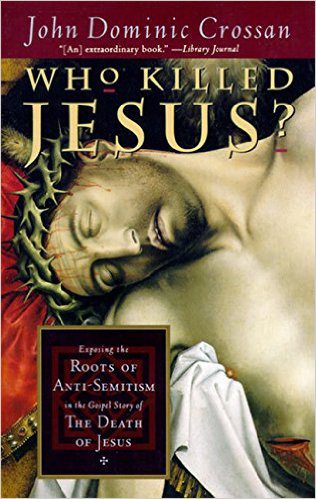 There is a similar but more pernicious trajectory that inspired Crossan’s book title Who Killed Jesus? Over the centuries, the accusations have grown increasingly loud that “The Jews killed Jesus.” However—even if there were in all likelihood some Jewish collaborators with the Romans—ultimately the Romans killed Jesus for disturbing the peace. The inciting incident was Jesus’s nonviolent activism at the Temple during Passover, when many pilgrims were in town and the Romans had a particularly low threshold for potential signs of insurrection. Jews did not crucify people; the Romans did. But as we progress chronologically, the Gospels—and the Christian tradition generally—becomes increasingly pro-Roman and anti-Jewish:
- In Mark, the Jewish authorities are bad, and a Jewish crowd is bad.
- In Matthew and Luke, not only are the Jewish authorities are bad, but the Jewish people at that time as a whole are bad.
- In John, Jews are bad without distinction. (90).
Pilate has even been canonized as a saint in some streams of the Christian tradition.
The truth is that there would have been standing order from a Roman official such as Pilate to crucify any peasant inciting insurrection, particularly during Passover. All the increasingly complex Christian narratives about Pilate (and/or his wife) wringing their hands in duress about potentially having to crucify a Jewish peasant are not history, but propaganda—as Christians sought increasing to distinguish themselves as independent from Judaism and as acceptable to the Romans (150-151). At first, when the early Jesus followers were marginal, this pro-Roman, Anti-Jewish trend was benign. But by the fourth century, when the Roman Empire became Christian, these seeds of Anti-Judaism grew into the virulent Anti-Semitism of the Middle Ages, the Inquisition, and the Holocaust—including Anti-Semitic and Anti-Jewish movements that continue today (152). Here in the twenty-first century, there remains much spiritual and ethical wisdom in the Christian tradition, but we are long past the point at which one can responsibly defend the claim that the Gospels should be read as literal “history remembered.” We must be honest about the original context and all that we have learned about how prophecy became historicized.
To summarize Crossan’s perspective:
- “The first stage is the historical passion…. It is what actually happened. But, because those who knew did not care [the Roman authorities] and those who cared did not know,” [the early followers of Jesus, who scattered after Jesus’s arrest] the actual historical facts “come to us today as little more than barest minimum: [Jesus of Nazareth was] crucified by a conjunction of Jewish and Roman authority under Pontius Pilate in Jerusalem at Passover….”
- “The second stage is the prophetic passion. It is the work of learned followers of Jesus, not from the [illiterate peasant class] but from literate scholars. They searched their Scripture seeking understanding of what had happened to Jesus and to themselves…. Would they find in their sacred writings certain texts, themes, and types that would explain it all…?”
- “The third stage is the narrative passion, which took that somewhat esoteric scholarly exegesis and turned it into a popular story,” which circulated independently and was used by both Mark and John as a source for their respective Gospels.
- “The fourth stage is the polemical passion,” which claimed that the third stage of narrative was synonymous with the first stage of history. That cruel twist turned Jesus’s mystical and prophetic reform movement within Judaism into a state religion that was anti-Jewish and pro-empire.
In light of what we know about prophecy historicized, we can now see the absurdity of citing the “Old Testament” as proof that the Gospels are history remembered. “Of course, the narrative passion agreed in details with the prophetic passion; it had been quarried from its contents” (219-221).
So, more than two thousand years later, can we still find hope and transformation in the passion narratives? In many ways, our invitation parallels second and third generation of Jesus followers. They searched their scriptures to better understand themselves and their situation—and to create meaning in a way that might inspire a better life and a better world. Too often, however, later generations have been content to unquestioningly perpetuate whatever created meaning and community to a subset of people two millennia ago. Instead, in the search for hope and transformation, the challenge to us—and for every new generation— is to do what our path-breaking, creative ancestors did, but in our own time and place. To draw from the sources of wisdom available to us—from all the world’s religions and from modern science—in our own “free and responsible search for truth and meaning.”
The Rev. Dr. Carl Gregg is a certified spiritual director, a D.Min. graduate of San Francisco Theological Seminary, and the minister of the Unitarian Universalist Congregation of Frederick, Maryland. Follow him on Facebook (facebook.com/carlgregg) and Twitter (@carlgregg).
Learn more about Unitarian Universalism: http://www.uua.org/beliefs/principles
Previous Post

April 20, 2017
Is the Bible “History Remembered” or “Prophecy Historicized?”
Next Post
April 28, 2017 Balancing "People, Planet, & Profit" #ClimateMarch
Browse Our Archives
Select a Category Advent Anti-Racism Archaeology Atheism Baptism Best of the Year List Book Reviews Buddhism Catholicism Christian Education Church and State Church Planting Climate Change Conscientious Objection to War Creation Spirituality Death Penalty Didache Disability Rights Discernment Easter Ecology Emergent Church Movement Empire-Critical Ethics Evolution Feminist Theology Film Reviews Gandhi Gospel of Mark Gun Control Hinduism Immigration Reform Interfaith Islam JFK Judaism Jungian Spirituality Lectionary Commentary Lent Letters to the Editor LGBT Marriage MLK Multiculturalism Mysticism Nonviolent Activism Occupy Paganism (Earth-centered Religions) Parables Paul Pluralism Politics Process Theology Quantum Physics Requiescat In Pace Seminary and Divinity School Sermon Series Retrospective Sermons Spiritual Direction Spiritual Practices Stewardship (Fundraising) The Book of J The Wheel of the Year (Paganism) Theoblogger Challenge Triathlon Uncategorized Unitarian Universalism Worship Resources Youth Ministry
Select a Month July 2026 May 2026 March 2026 November 2025 October 2025 August 2025 February 2025 December 2024 October 2024 March 2024 January 2024 December 2023 November 2023 March 2023 February 2023 January 2023 December 2022 November 2022 August 2022 March 2022 February 2022 January 2022 December 2021 September 2021 August 2021 July 2021 June 2021 May 2021 February 2021 January 2021 December 2020 August 2020 June 2020 May 2020 April 2020 March 2020 February 2020 January 2020 December 2019 November 2019 October 2019 September 2019 July 2019 June 2019 March 2019 February 2019 January 2019 December 2018 November 2018 October 2018 September 2018 June 2018 May 2018 April 2018 March 2018 February 2018 January 2018 December 2017 November 2017 October 2017 September 2017 August 2017 July 2017 June 2017 May 2017 April 2017 March 2017 February 2017 January 2017 December 2016 November 2016 October 2016 September 2016 August 2016 June 2016 May 2016 April 2016 March 2016 February 2016 January 2016 December 2015 November 2015 October 2015 September 2015 August 2015 July 2015 June 2015 May 2015 April 2015 March 2015 February 2015 January 2015 December 2014 November 2014 October 2014 August 2014 July 2014 June 2014 May 2014 April 2014 March 2014 February 2014 January 2014 December 2013 November 2013 October 2013 September 2013 August 2013 July 2013 June 2013 May 2013 April 2013 March 2013 February 2013 January 2013 December 2012 November 2012 October 2012 September 2012 August 2012 July 2012 June 2012 May 2012 April 2012 March 2012 February 2012 January 2012 December 2011 November 2011 October 2011 September 2011 August 2011 July 2011 June 2011 May 2011 April 2011 March 2011 February 2011 January 2011 December 2010 November 2010 October 2010 August 2009 July 2009 May 2009
Follow Us!
TAKE THE
Religious Wisdom Quiz
What tax collector wrote a Gospel and was called by Jesus?
Select your answer to see how you score.
Matthew Luke Mark Barnabas
Related posts from Carl Gregg

Reading America at 250: A Nation Wrestles With...


Andrew Holocek on the Power of Darkness

The Stories That Shape Us: Myths, Archetypes, &...
TRENDING AT PATHEOS More Voices

Reading America at 250: A Nation Wrestles With...
As part of my own reflection on the 250th anniversary of the...

Whenever I am reading a book or listening to an argument, I...

President Trump Ban Animal Torture Videos on Facebook
Call for Stricter Regulations of Animal Abuse Content on Facebook Although President...

Draft Amendments to Address Ritual Abuse in New...
The proposed changes would make it illegal for individuals in domestic partnerships...

How Bans on LGBTQ+ Student Clubs Threaten Religious...
On June 20, 2025, the State of Texas passed Senate Bill 12....

The Truth About the Gen Z Revival
This past year, there has been a lot of media buzz surrounding...
view all More Voices blogs
Ad-Free & Subscriber Log-In Subscription Support
- About Us
- 2026 Calendar
- Videos
- Podcasts
- Library of World Religions
- Faith In Media Tracker
- Advertise With Us
- Write for Us
- Privacy Policy
- Terms of Service
- Do Not Sell My Data
- Contact Us
- Radiant Digital
- Manage Newsletter Subscriptions
- Unsubscribe From Notifications
- Sitemap
Copyright 2008-2026, Patheos. All rights reserved.
Subscription Support Ad-Free & Subscriber Log-In
Follow Patheos