
BuddhistCatholicContemplativeEvangelicalGeneral ChristianHinduJewishLatter-day SaintMuslimNew VisionsProgressive Christian
Beliefs
- Buddhist
- Catholic
- Contemplative
- Evangelical
- General Christian
- Hindu
- Jewish
- Latter-day Saint
- More Voices
- Muslim
- New Visions
- Pagan
- Progressive Christian
Topics
- Religion News
- Food and Religion
- Sports and Religion
- Religious Art
- Religious Music and Entertainment
- Religious Events
- History and Religion
- Style and Religion
- Politics and Religion
- Women in Religion
- Recreation Outdoors and Religion
- Business Finance and Religion
- Careers Workplace and Religion
- Education and Religion
- Family Parenting and Religion
- Health Fitness and Religion
- Home and Religion
- Relationships and Religion
- Technology and Religion
- Travel and Religion
Columnists
- Buddhist Columnists
- Business Finance and Religion Columnists
- Careers Workplace and Religion Columnists
- Catholic Columnists
- Contemplative Columnists
- Education and Religion Columnists
- Evangelists Columnists
- Family Parenting and Religion Columnists
- General Christian Columnists
- Health Fitness and Religion Columnists
- Hindu Columnists
- History and Religion Columnists
- Home and Religion Columnists
- Jewish Columnists
- More Voices Columnists
- Latter Day Columnists
- Muslim Columnists
- New Visions Columnists
- Nonreligious Columnists
- Pagan Columnists
- Politics and Religion Columnists
- Progressive Columnists
- Recreation Outdoors and Religion Columnists
- Relationships and Religion Columnists
- Religion News Columnists
- Religious Art Columnists
- Religious Events Columnists
- Religious Music and Entertainment Columnists
- Sports and Religion Columnists
- Style and Religion Columnists
- Technology and Religion Columnists
- Travel and Religion Columnists
- Women in Religion Columnists
Resource Library
- 2026 Calendar
- Library of World Religions
- The 100 Most Holy Places on Earth
- Patheos Answers
- Podcasts
- Videos
- Faith Leaders Database
- Anglican Episcopalian
- Bahai
- Baptist
- Buddhism
- Christianity
- Confucianism
- Eastern Orthodoxy
- Hinduism
- Holiness and Pentecostal
- ISKCON
- Islam
- Judaism
- Lutheran
- Methodist
- The Church of Jesus Christ of Latter-day Saints
- New Age
- Paganism
- Presbytarian and Reformed
- Protestantism
- Religion Behind the Scenes
- Roman Catholic
- Scientology
- Shia Islam
- Sikhism
- Sufism
- Sunni Islam
- Taoism
- Zen
- See all religions
Research Tools
 Ad-Free & Subscriber Log-In Subscription Support
Follow Patheos 

- Trending:
- Advent
- |
- Forgiveness
- |
- Thanksgiving
- |
- Election
- |
- Seasonal Holidays
- |
- Marriage

- Home
- More Voices
- Is the Bible “History Remembered” or “Prophecy Historicized?”
Is the Bible “History Remembered” or “Prophecy Historicized?”
Last updated on: April 21, 2017 at 9:05 am by Carl Gregg
Is the Bible “History Remembered” or “Prophecy Historicized?” 2017-04-21T09:05:18-04:00 Carl Gregg
Patheos Explore the world's faith through different perspectives on religion and spirituality! Patheos has the views of the prevalent religions and spiritualities of the world.
From the theologically conservative Christianity of my childhood, I learned to read the Bible literally—as a record of history as it had actually happened. And although I would occasionally question details that did not make sense, I was also influenced by the signifiant number of people around me who seemed to unquestioningly accept the Bible as factual. Only later did I come to see that likely many more people in my childhood congregation did have questions about the Bible’s historicity, but did not feel comfortable asking them aloud.
I was also taught to read the Hebrew Bible as the Christian “Old Testament.” Instead of studying the original context of these books within the Jewish tradition, I was taught that they were valuable primarily for the ways they were understood to have predicted events in the life of Jesus. As a child, placing Jesus at the center of “life, the universe, and everything” did not seem strange. After all, the calendar in widespread use around the world literally counted the years from before and after Jesus’s birth.
But as I grew up, I began to encounter other perspectives. And I was increasingly struck by the differences between how Jews and Christians often read the exact same sentences in irreconcilably different ways. Along these lines, the Yale literary critic Harold Bloom has said, “Christianity stole our watch and has spent 2,000 years telling us what time it is.”
Today, the western calendar may tell us that the year is 2017 A.D. (Anno Domini, meaning “in the year of our lord” in reference to Jesus), but some of you will recall the challenge of the evolutionary evangelist Michael Dowd, who spoke here a few years ago, that from our twenty-first century perspective, we need to shift our paradigm of “B.C.” from “Before Christ” to “Before Copernicus,” the astronomer whose 1543 book On the Revolutions of the Heavenly Spheres presented scientific evidence that the Earth is not the center of the Universe.
In the 500 years since, we have come to see that the de-centerings we face as a species are far more profound than Heliocentrism, After Darwin, we know that we humans are not “a little lower than the angels,” but merely a “little higher than the apes.” After Einstein, we know that even space and time are relative to one another. Science tells us that rather than Jesus being at the center of history, we humans are an infinitesimal part of a much larger universe story that has been unfolding for more than 13.8 billion years across more than two trillion galaxies.
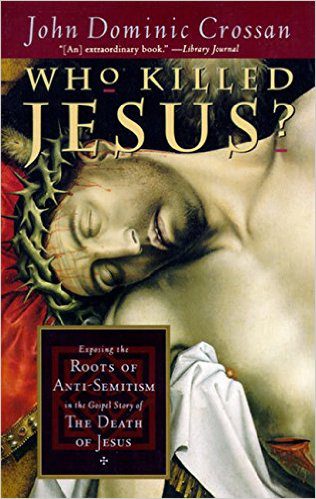 So if Jesus is not at the center of history, then what does twenty-first century scholarship tell us about the Quest for the Historical Jesus and how we might best understand the original context of the texts that we know today as the Bible? One of the turning points in my own understanding came from reading John Dominic Crossan’s book Who Killed Jesus? which asks if the passion narratives—the stories about Jesus’s death (from the Latin passio, meaning “suffering”)—are “history remembered” or “prophecy historicized” (x)?
As a child, I was only taught the perspective of “history remembered”: that the Christian scriptures were accurate historical records passed down from generation to generation. Part of the alleged “proof” that was often cited is that hundreds of years before Jesus, the Hebrew prophets claimed to have predicted with shocking accuracy the events around Jesus’s death. In contrast, the perspective of “prophecy historicized” holds that the direction of influence is reversed. Instead of the prophets predicting the future, Christian authors—decades after Jesus’s death—reached back to draw on words, themes, and sequences from the Hebrew Bible in drafting their Gospels (4). So passages in the Hebrew Bible, which originally had been about their own time and place—hundreds of years before Jesus—later became seen as proof of predicting details about Jesus’s death in the future. The prophecy became historicized.
Let me give you some examples. I was raised to read Jesus’s final words from the cross in Mark 15:34 as if a journalist had been there taking notes for posterity: “At three o’clock Jesus cried out with a loud voice, ‘Eloi, Eloi, lema sabachthani?’ which means, ‘My God, my God, why have you forsaken me?’” Later, as I began a more academic investigation into the Bible, it was pointed out to me that those precise words are at the beginning of Psalm 22: “1 My God, my God, why have you forsaken me? Why are you so far from helping me, from the words of my groaning? 2 O my God, I cry by day, but you do not answer; and by night, but find no rest” (133-134). A “history remembered” view would argue that Jesus must have been quoting the words of the Psalmist in his hour of distress. That’s possible. But a “prophecy historicized” view would invite us to consider that, tragically, no one knows what Jesus’s last words were. Jesus’s followers scattered after his arrest, and likely would not have been present at his death.
Another exact parallel from the crucifixion jumps out, one chapter later, in Psalm 22:18: “They divide my clothes among themselves, and for my clothing they cast lots.” Again, was this an early prediction of what became history remembered—or were these details from the Psalm woven into a later reconstruction of what Jesus’s death may have been like? Maintaining a “history remembered” perspective becomes increasingly difficult to maintain as one studies example after example of the many places from the Hebrew Bible where exact words, phrases, and sequences were imported into the passion narratives.
Even many theologically orthodox biblical scholars will admit that at least 20% of the stories about the death of Jesus are prophecy historicized, while still maintaining that about 80% are history remembered. But more progressive scholars such as Crossan go much further, convinced that the passion narratives are approximately 80% prophecy historicized and only 20% history remembered (1). That percentage is in line with the Jesus Seminar’s famous pronouncement that Jesus only said about 20% of the words attributed to him in the Gospels. In some ways these statistics are not surprising: the Gospels are almost entirely written in the third-person, do not claim to be composed by eyewitnesses to the historical Jesus, and were written at least four decades after Jesus’s death. To give you another example, looking again at Mark, the earliest of the four canonical Gospels: Mark 15:33, in isolation from a “history remembered” point of view, can seem like a straightforward recording of events: “When it was noon, darkness came over the whole land until three in the afternoon.” But a perspective of prophecy historicized invites us to consider the ways that Amos 8:9-10 was used to craft the narrative of how the crucifixion might have happened: “On that day, says the Lord God, I will make the sun go down at noon and darken the earth in broad daylight…. I will make it like the mourning for an only son…” (2-3).
Or consider the way the story of Judas betraying Jesus during the Last Supper may have been inspired by Psalm 41:9: “Even my bosom friend in whom I trusted, who ate of my bread, has lifted the heel against me” (69-70). Or regarding the words allegedly spoken from heaven at Jesus’s baptism, those come from Psalm 2:7: “I will tell of the decree of the Lord: He said to me, ‘You are my son; today I have begotten you” (82-83). Are these examples of history remembered—or prophecy historicized?
As you start to closely compare the passion narratives and the Hebrew Bible, the case becomes strong that:
- any mention of spitting and nudging comes from the popular scapegoat ritual;
- any mention of scourging, buffeting, and spitting comes from Isaiah 50:6
- any mention of piercing, seeing, mourning comes from Zechariah 12:10;
- any mention of disrobing, rerobing, or crowning comes from Zechariah 3:1-5. (132)
Crossan lays out these and many other examples in his book in ways that allow his readers to compare precisely how the earlier texts influenced the later ones. Hopefully, the examples I have given offer a taste of this perspective. His book Who Killed Jesus? is an accessible read if you are interested in learning more.
(I will continue this topic tomorrow in a post on “How the Christian Gospels Became Increasingly Pro-Roman & Anti-Jewish.”)
The Rev. Dr. Carl Gregg is a certified spiritual director, a D.Min. graduate of San Francisco Theological Seminary, and the minister of the Unitarian Universalist Congregation of Frederick, Maryland. Follow him on Facebook (facebook.com/carlgregg) and Twitter (@carlgregg).
Learn more about Unitarian Universalism: http://www.uua.org/beliefs/principles
Previous Post

April 13, 2017
What Happens If We Withdraw Our Consent to Be Governed?
Next Post
April 21, 2017 How the Christian Gospels Became Increasingly Pro-Roman & Anti-Jewish
Browse Our Archives
Select a Category Advent Anti-Racism Archaeology Atheism Baptism Best of the Year List Book Reviews Buddhism Catholicism Christian Education Church and State Church Planting Climate Change Conscientious Objection to War Creation Spirituality Death Penalty Didache Disability Rights Discernment Easter Ecology Emergent Church Movement Empire-Critical Ethics Evolution Feminist Theology Film Reviews Gandhi Gospel of Mark Gun Control Hinduism Immigration Reform Interfaith Islam JFK Judaism Jungian Spirituality Lectionary Commentary Lent Letters to the Editor LGBT Marriage MLK Multiculturalism Mysticism Nonviolent Activism Occupy Paganism (Earth-centered Religions) Parables Paul Pluralism Politics Process Theology Quantum Physics Requiescat In Pace Seminary and Divinity School Sermon Series Retrospective Sermons Spiritual Direction Spiritual Practices Stewardship (Fundraising) The Book of J The Wheel of the Year (Paganism) Theoblogger Challenge Triathlon Uncategorized Unitarian Universalism Worship Resources Youth Ministry
Select a Month October 2026 July 2026 May 2026 March 2026 November 2025 October 2025 August 2025 February 2025 December 2024 October 2024 March 2024 January 2024 December 2023 November 2023 March 2023 February 2023 January 2023 December 2022 November 2022 August 2022 March 2022 February 2022 January 2022 December 2021 September 2021 August 2021 July 2021 June 2021 May 2021 February 2021 January 2021 December 2020 August 2020 June 2020 May 2020 April 2020 March 2020 February 2020 January 2020 December 2019 November 2019 October 2019 September 2019 July 2019 June 2019 March 2019 February 2019 January 2019 December 2018 November 2018 October 2018 September 2018 June 2018 May 2018 April 2018 March 2018 February 2018 January 2018 December 2017 November 2017 October 2017 September 2017 August 2017 July 2017 June 2017 May 2017 April 2017 March 2017 February 2017 January 2017 December 2016 November 2016 October 2016 September 2016 August 2016 June 2016 May 2016 April 2016 March 2016 February 2016 January 2016 December 2015 November 2015 October 2015 September 2015 August 2015 July 2015 June 2015 May 2015 April 2015 March 2015 February 2015 January 2015 December 2014 November 2014 October 2014 August 2014 July 2014 June 2014 May 2014 April 2014 March 2014 February 2014 January 2014 December 2013 November 2013 October 2013 September 2013 August 2013 July 2013 June 2013 May 2013 April 2013 March 2013 February 2013 January 2013 December 2012 November 2012 October 2012 September 2012 August 2012 July 2012 June 2012 May 2012 April 2012 March 2012 February 2012 January 2012 December 2011 November 2011 October 2011 September 2011 August 2011 July 2011 June 2011 May 2011 April 2011 March 2011 February 2011 January 2011 December 2010 November 2010 October 2010 August 2009 July 2009 May 2009
Follow Us!
TAKE THE
Religious Wisdom Quiz
Who was Jesus' earthly father?
Select your answer to see how you score.
Joseph Isaac Jacob Abraham
Related posts from Carl Gregg
Liberal Religion for Earthlings: My First Book!

Reading America at 250: A Nation Wrestles With...


Andrew Holocek on the Power of Darkness
TRENDING AT PATHEOS More Voices

Liberal Religion for Earthlings: My First Book!
I'm thrilled to share that my first book, Liberal Religion for Earthlings:...

Reading America at 250: A Nation Wrestles With...
As part of my own reflection on the 250th anniversary of the...

President Trump Ban Animal Torture Videos on Facebook
Call for Stricter Regulations of Animal Abuse Content on Facebook Although President...

Draft Amendments to Address Ritual Abuse in New...
The proposed changes would make it illegal for individuals in domestic partnerships...

How Bans on LGBTQ+ Student Clubs Threaten Religious...
On June 20, 2025, the State of Texas passed Senate Bill 12....

The Truth About the Gen Z Revival
This past year, there has been a lot of media buzz surrounding...
view all More Voices blogs
Ad-Free & Subscriber Log-In Subscription Support
- About Us
- 2026 Calendar
- Videos
- Podcasts
- Library of World Religions
- Faith In Media Tracker
- Advertise With Us
- Write for Us
- Privacy Policy
- Terms of Service
- Do Not Sell My Data
- Contact Us
- Radiant Digital
- Manage Newsletter Subscriptions
- Unsubscribe From Notifications
- Sitemap
Copyright 2008-2026, Patheos, part of the Radiant Digital network of media brands. All rights reserved.
Subscription Support Ad-Free & Subscriber Log-In
Follow Patheos