
BuddhistCatholicContemplativeEvangelicalGeneral ChristianHinduJewishLatter-day SaintMuslimNew VisionsProgressive Christian
Beliefs
- Buddhist
- Catholic
- Contemplative
- Evangelical
- General Christian
- Hindu
- Jewish
- Latter-day Saint
- More Voices
- Muslim
- New Visions
- Pagan
- Progressive Christian
Topics
- Religion News
- Food and Religion
- Sports and Religion
- Religious Art
- Religious Music and Entertainment
- Religious Events
- History and Religion
- Style and Religion
- Politics and Religion
- Women in Religion
- Recreation Outdoors and Religion
- Business Finance and Religion
- Careers Workplace and Religion
- Education and Religion
- Family Parenting and Religion
- Health Fitness and Religion
- Home and Religion
- Relationships and Religion
- Technology and Religion
- Travel and Religion
Columnists
- Buddhist Columnists
- Business Finance and Religion Columnists
- Careers Workplace and Religion Columnists
- Catholic Columnists
- Contemplative Columnists
- Education and Religion Columnists
- Evangelists Columnists
- Family Parenting and Religion Columnists
- General Christian Columnists
- Health Fitness and Religion Columnists
- Hindu Columnists
- History and Religion Columnists
- Home and Religion Columnists
- Jewish Columnists
- More Voices Columnists
- Latter Day Columnists
- Muslim Columnists
- New Visions Columnists
- Nonreligious Columnists
- Pagan Columnists
- Politics and Religion Columnists
- Progressive Columnists
- Recreation Outdoors and Religion Columnists
- Relationships and Religion Columnists
- Religion News Columnists
- Religious Art Columnists
- Religious Events Columnists
- Religious Music and Entertainment Columnists
- Sports and Religion Columnists
- Style and Religion Columnists
- Technology and Religion Columnists
- Travel and Religion Columnists
- Women in Religion Columnists
Resource Library
- 2026 Calendar
- Library of World Religions
- The 100 Most Holy Places on Earth
- Patheos Answers
- Podcasts
- Videos
- Faith Leaders Database
- Anglican Episcopalian
- Bahai
- Baptist
- Buddhism
- Christianity
- Confucianism
- Eastern Orthodoxy
- Hinduism
- Holiness and Pentecostal
- ISKCON
- Islam
- Judaism
- Lutheran
- Methodist
- The Church of Jesus Christ of Latter-day Saints
- New Age
- Paganism
- Presbytarian and Reformed
- Protestantism
- Religion Behind the Scenes
- Roman Catholic
- Scientology
- Shia Islam
- Sikhism
- Sufism
- Sunni Islam
- Taoism
- Zen
- See all religions
Research Tools
 Ad-Free & Subscriber Log-In Subscription Support
Ad-Free & Subscriber Log-In Subscription Support
Follow Patheos 

- Trending:
- Forgiveness
- |
- Marriage
- |
- Consciousness
- |
- Death Penalty
- |
- Election
- |
- Halloween

- Home
- More Voices
- From “The Market as God” to “People, Planet, & Profit”
From “The Market as God” to “People, Planet, & Profit”
Last updated on: March 10, 2017 at 8:50 am by Carl Gregg
From “The Market as God” to “People, Planet, & Profit” 2017-03-09T09:17:07-05:00 Carl Gregg
Patheos Explore the world's faith through different perspectives on religion and spirituality! Patheos has the views of the prevalent religions and spiritualities of the world.
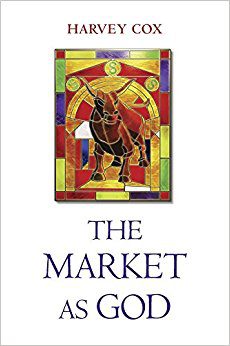
(This post is a follow-up to my previous post on “The Market as God”: What Happens with a Theologian Starts Reading the Business Section?)
From a historical perspective, the late eighteenth-century philosopher Adam Smith could be considered the patron saint of free market religion. The theologian Harvey Cox jokes that perhaps we should call him “St. Adam of Glasgow” (145). Smith taught that the best way to create a good society is for every person to act selfishly to advance their self-interest (145). Counter-intuitively, Smith tell us, if we are all individually selfish, more good will be created overall for everyone because, looking back, it will seem to us as if that self-interested individual were “led by an invisible hand.” (Does an “invisible hand” sound a lot like a theological claim about God to anyone else?!) Moreover, Smith assures his adherents that, “By pursuing [one’s] own interest [one] frequently promotes that of the society more efficiently than when [one] really intends to promote it” (Gustafson 40).
Here is the point where being a religious progressive can be helpful. Theological liberals helped paved in the way in saying that it is insufficient to say that orthodox religious claims must be believed because of hierarchy or tradition. Instead, our liberal religious forebears insisted that reason and experience are equally (or more) legitimate criteria of authority. We can apply those same approaches to faith claims made about the Market as God.
The truth is, we have tried faith in an unregulated free market, and we have seen repeated evidence of the devastation it can wreak:
The Mortgage and Housing Bubble and Crash 2004-2009
The U.S. Bubble in Over-the-Counter Stocks 1995-2000
The Asian Stock and Real Estate Bubble 1992-1997
The U.S. Savings and Loan Crisis of the Late 1980s
The Stock Market Crash of 1929
The Mississippi Bubble of 1720
The South Sea Bubble of 1720
The Dutch Tulip Bulb Debacle of 1636 (42)
Now, I don’t have time to go into the history of all of those financial crises, or even to try to explain credit default swaps and the collateralized debt obligation bubble behind our most recent crisis (45-46). However, the best, clearest, and most interesting explanation I have seen is the excellent 2015 film The Big Short. If you haven’t seen it, I highly recommend it.
I should also be clear that I am not advocating that we should shift from one extreme to the other, dissolve private property, and have state ownership of everything. Profit-motive is a powerful, productive force that we should continue to harness, but we need to do so responsibly. We need a balance somewhere between “Conscious Capitalism” (that is more aware of its shadow side and capacity to harm) and “Democratic Socialism” (which empowers people—not a totalitarian, fascistic socialism). But our world is currently in thrall to the extremes of a barely-regulated capitalism that profits through the exploitation of people and planet. And neither the 99% nor the climate can withstand much more abuse.
Here in the early twenty-first century, too much irrational faith in the “invisible hand” of the free market has created an unhealthy wealth gap in our world: “the richest tenth of a percent of American households now control as much wealth as the bottom 90 percent combined—and the chasm widens every year” (Cox 103). There are, of course, people who have worked incredibly hard to move from “rags to riches” in our society, but an orthodox free market faith would have you believe that the “invisible hand” of the market has ensured that the only reason anyone is rich is that they worked hard—and the only reason someone is poor is that they are lazy. The opposite can just as often be true, especially in the case of inherited wealth—people who are “born on third base and think they hit a triple.”
By inviting you to see the ways that economics has co-opted the language of religion, my point has been that we need to pull back the curtain and reveal that far from being “God,” the engines of the economy are all-too-human, which means we can change them. In Cox’s words:
The Market system is not a part of nature. We as human beings constructed it and we can renovate, dismantle, or transform it if we want to. Laying hands on it might not make one widely popular but, unlike the Ark of the Covenant, it will not be punished by instant death. [Of course, it turns out that story isn’t true either!] The Market must be deprived of its sacred aura so we can think about it clearly. We do not need to take off our shoes or our hats when we enter its sanctuary. (256-257)
Our invitation is make our religion and our economics align with our deepest values and our true ultimate concerns—not false, idolatrous ones.
We must demand more than a single “bottom line” of profit, which exploits labor and disregards environmental costs as “externalities,” side effects which are not paid for. To use a traditional theological formulation, we need the Market to confess that it “has done things it ought not to have done” and “left undone things it ought to have done” (Cox 261). Instead of profit alone, we need a “triple bottom line” that accounts for people, planet, and profit. Profit is still a major part of the equation, but it must be balanced against the needs of people (human rights) and the longterm sustainability of life on this planet.
Currently, instead of a triple-bottom line, we have abominations—desolating sacrileges!—like the claim that, “Corporations are people” (Gustafson 89). And there is no guarantee that we will successfully transition to a more humane and green economy. However, the study of history tells us that predicting the future is a difficult game that is rarely successful. For example, if I were a contemporary of Thomas Malthus (1766 – 1834), I might well have agreed with the rational argument of his 1798 book An Essay on the Principle of Population that the demands of a growing human population would inevitably overcome the limited supply of Earth’s resources. But the Industrial Revolution proved Malthus’s “Iron Law of Population” to be wrong—at least in the short term. Previously unforeseen innovations created sufficient food to feed the growing number of our species, allowing our species to septuple to more than 7 billion people today. Of course, now the side effects of carbon dioxide emissions from that same Industrial Revolution and population explosion are causing global climate change on an unprecedented scale.
A techno-utopian today might tell us that, looking at the history of the economy,
in 1860 it was impossible to predict the sort of economic growth that would occur in the next century and a half. No one predicted electricity becoming as ubiquitous as it is. Air travel and space travel were imagined by very few. Automobiles, roads, television, radio, the discovery of microbes, recombinant DNA technologies, air conditioning, central heating, and a host of other inventions we now consider essential to life were not even imagined. The next 150 years could easily contain innovation of even greater magnitude. For example, what would happen if we could mimic photosynthesis or harness the energy of the sun in efficient ways? The implications to food production and energy…are quite staggering and could lead to Economic expansion of exponential proportions! (144)
That being said, even if economic expansion continues in unpredictable ways (of which there is no guarantee), there is also no guarantee that it will be fairly distributed. But the more conscious we are of the dynamics swirling around us—and the more equipped we are to debunk false claims—the more hope there is that we can do our part to build a world in which people, planet, and profit are kept in greater balance. Together, may we continue to seek “The goal of world community with peace, liberty, and justice” not merely for some or only a few, but “for all.”
The Rev. Dr. Carl Gregg is a certified spiritual director, a D.Min. graduate of San Francisco Theological Seminary, and the minister of the Unitarian Universalist Congregation of Frederick, Maryland. Follow him on Facebook (facebook.com/carlgregg) and Twitter (@carlgregg).
Learn more about Unitarian Universalism: http://www.uua.org/beliefs/principles

Browse Our Archives
Select a Category Advent Anti-Racism Archaeology Atheism Baptism Best of the Year List Book Reviews Buddhism Catholicism Christian Education Church and State Church Planting Climate Change Conscientious Objection to War Creation Spirituality Death Penalty Didache Disability Rights Discernment Easter Ecology Emergent Church Movement Empire-Critical Ethics Evolution Feminist Theology Film Reviews Gandhi Gospel of Mark Gun Control Hinduism Immigration Reform Interfaith Islam JFK Judaism Jungian Spirituality Lectionary Commentary Lent Letters to the Editor LGBT Marriage MLK Multiculturalism Mysticism Nonviolent Activism Occupy Paganism (Earth-centered Religions) Parables Paul Pluralism Politics Process Theology Quantum Physics Requiescat In Pace Seminary and Divinity School Sermon Series Retrospective Sermons Spiritual Direction Spiritual Practices Stewardship (Fundraising) The Book of J The Wheel of the Year (Paganism) Theoblogger Challenge Triathlon Uncategorized Unitarian Universalism Worship Resources Youth Ministry
Select a Month July 2026 May 2026 March 2026 November 2025 October 2025 August 2025 February 2025 December 2024 October 2024 March 2024 January 2024 December 2023 November 2023 March 2023 February 2023 January 2023 December 2022 November 2022 August 2022 March 2022 February 2022 January 2022 December 2021 September 2021 August 2021 July 2021 June 2021 May 2021 February 2021 January 2021 December 2020 August 2020 June 2020 May 2020 April 2020 March 2020 February 2020 January 2020 December 2019 November 2019 October 2019 September 2019 July 2019 June 2019 March 2019 February 2019 January 2019 December 2018 November 2018 October 2018 September 2018 June 2018 May 2018 April 2018 March 2018 February 2018 January 2018 December 2017 November 2017 October 2017 September 2017 August 2017 July 2017 June 2017 May 2017 April 2017 March 2017 February 2017 January 2017 December 2016 November 2016 October 2016 September 2016 August 2016 June 2016 May 2016 April 2016 March 2016 February 2016 January 2016 December 2015 November 2015 October 2015 September 2015 August 2015 July 2015 June 2015 May 2015 April 2015 March 2015 February 2015 January 2015 December 2014 November 2014 October 2014 August 2014 July 2014 June 2014 May 2014 April 2014 March 2014 February 2014 January 2014 December 2013 November 2013 October 2013 September 2013 August 2013 July 2013 June 2013 May 2013 April 2013 March 2013 February 2013 January 2013 December 2012 November 2012 October 2012 September 2012 August 2012 July 2012 June 2012 May 2012 April 2012 March 2012 February 2012 January 2012 December 2011 November 2011 October 2011 September 2011 August 2011 July 2011 June 2011 May 2011 April 2011 March 2011 February 2011 January 2011 December 2010 November 2010 October 2010 August 2009 July 2009 May 2009
Follow Us!
TAKE THE
Religious Wisdom Quiz
What symbol is most commonly associated with Christianity worldwide?
Select your answer to see how you score.
The fish The lamb The dove The cross
Related posts from Carl Gregg

Reading America at 250: A Nation Wrestles With...


Andrew Holocek on the Power of Darkness

The Stories That Shape Us: Myths, Archetypes, &...
TRENDING AT PATHEOS More Voices

Reading America at 250: A Nation Wrestles With...
As part of my own reflection on the 250th anniversary of the...

Whenever I am reading a book or listening to an argument, I...

President Trump Ban Animal Torture Videos on Facebook
Call for Stricter Regulations of Animal Abuse Content on Facebook Although President...

Draft Amendments to Address Ritual Abuse in New...
The proposed changes would make it illegal for individuals in domestic partnerships...

How Bans on LGBTQ+ Student Clubs Threaten Religious...
On June 20, 2025, the State of Texas passed Senate Bill 12....

The Truth About the Gen Z Revival
This past year, there has been a lot of media buzz surrounding...
view all More Voices blogs
Ad-Free & Subscriber Log-In Subscription Support
- About Us
- 2026 Calendar
- Videos
- Podcasts
- Library of World Religions
- Faith In Media Tracker
- Advertise With Us
- Write for Us
- Privacy Policy
- Terms of Service
- Do Not Sell My Data
- Contact Us
- Radiant Digital
- Manage Newsletter Subscriptions
- Unsubscribe From Notifications
- Sitemap
Copyright 2008-2026, Patheos. All rights reserved.
Subscription Support Ad-Free & Subscriber Log-In
Follow Patheos