
BuddhistCatholicContemplativeEvangelicalGeneral ChristianHinduJewishLatter-day SaintMuslimNew VisionsProgressive Christian
Beliefs
- Buddhist
- Catholic
- Contemplative
- Evangelical
- General Christian
- Hindu
- Jewish
- Latter-day Saint
- More Voices
- Muslim
- New Visions
- Pagan
- Progressive Christian
Topics
- Religion News
- Food and Religion
- Sports and Religion
- Religious Art
- Religious Music and Entertainment
- Religious Events
- History and Religion
- Style and Religion
- Politics and Religion
- Women in Religion
- Recreation Outdoors and Religion
- Business Finance and Religion
- Careers Workplace and Religion
- Education and Religion
- Family Parenting and Religion
- Health Fitness and Religion
- Home and Religion
- Relationships and Religion
- Technology and Religion
- Travel and Religion
Columnists
- Buddhist Columnists
- Business Finance and Religion Columnists
- Careers Workplace and Religion Columnists
- Catholic Columnists
- Contemplative Columnists
- Education and Religion Columnists
- Evangelists Columnists
- Family Parenting and Religion Columnists
- General Christian Columnists
- Health Fitness and Religion Columnists
- Hindu Columnists
- History and Religion Columnists
- Home and Religion Columnists
- Jewish Columnists
- More Voices Columnists
- Latter Day Columnists
- Muslim Columnists
- New Visions Columnists
- Nonreligious Columnists
- Pagan Columnists
- Politics and Religion Columnists
- Progressive Columnists
- Recreation Outdoors and Religion Columnists
- Relationships and Religion Columnists
- Religion News Columnists
- Religious Art Columnists
- Religious Events Columnists
- Religious Music and Entertainment Columnists
- Sports and Religion Columnists
- Style and Religion Columnists
- Technology and Religion Columnists
- Travel and Religion Columnists
- Women in Religion Columnists
Resource Library
- 2026 Calendar
- Library of World Religions
- The 100 Most Holy Places on Earth
- Patheos Answers
- Podcasts
- Videos
- Faith Leaders Database
- Anglican Episcopalian
- Bahai
- Baptist
- Buddhism
- Christianity
- Confucianism
- Eastern Orthodoxy
- Hinduism
- Holiness and Pentecostal
- ISKCON
- Islam
- Judaism
- Lutheran
- Methodist
- The Church of Jesus Christ of Latter-day Saints
- New Age
- Paganism
- Presbytarian and Reformed
- Protestantism
- Religion Behind the Scenes
- Roman Catholic
- Scientology
- Shia Islam
- Sikhism
- Sufism
- Sunni Islam
- Taoism
- Zen
- See all religions
Research Tools
 Ad-Free & Subscriber Log-In Subscription Support
Ad-Free & Subscriber Log-In Subscription Support
Follow Patheos 

- Trending:
- Forgiveness
- |
- Marriage
- |
- Consciousness
- |
- Death Penalty
- |
- Election
- |
- Halloween

- Home
- More Voices
- Why Eugenics Is Wrong and Why It Still Matters Today
Why Eugenics Is Wrong and Why It Still Matters Today
Last updated on: March 30, 2017 at 9:00 am by Carl Gregg
Why Eugenics Is Wrong and Why It Still Matters Today 2017-03-29T14:40:26-04:00 Carl Gregg
Patheos Explore the world's faith through different perspectives on religion and spirituality! Patheos has the views of the prevalent religions and spiritualities of the world.

(This post is a follow-up to my post from yesterday on “Eugenics, Then & Now: Immigration, Health Care, & Illiberal Progressives.”)
The supporters of the eugenics movement were primarily “progressives, intellectuals, and professionals” who strongly believed in both Darwinian Evolution and the power of modern science to reshape society for the better (Cohen 71). Without getting into all the intricacies of genetic engineering, one vital distinction is whether one is making this choice for oneself or whether someone else—such as the government—is imposing it on you. To consider a map of the U.S. in 1913, the twelve states that had passed eugenic sterilization laws were an interesting collection of states: Indiana, Washington, California, Connecticut, Nevada, Iowa, New Jersey, New York, North Dakota, Michigan, Kansas, and Wisconsin (70). So-called “defective” traits that were potential targets for compulsory sterilization were “epilepsy, criminality, alcoholism, or dependency”—another word for poverty.” Their greatest target was the purportedly ‘feebleminded’” (6). Some of those state laws began to be struck down on “equal protection” or “due process” grounds, which is one reason the Supreme Court’s 1927 decision of Buck v. Bell was so tragic; it reversed those trends (100, 121).
From his elite Boston Brahim perspective, Oliver Wendell Holmes, Jr. looked down on Carrie Buck, her mother, and her daughter, and judged them with the infamous sentence that, “Three generations of imbeciles are enough.” The truth is that Carrie Buck’s family, on her father’s side, had owned both property and people who were enslaved before the Civil War, but their family had been on a downward economic trajectory since the war’s end (19-20).
The story Carrie’s foster parents told about her is that she became pregnant at seventeen because her alleged feeblemindedness led to loose morals (16). Carrie’s side of the story, which she was never given the chance to tell in court, was that her foster mother’s nephew forced himself on her. By institutionalizing Carrie, it seems that the family sought to protect their nephew’s crime from being discovered (24). Both Carrie and her mother before her were deemed to be feebleminded by the Binet-Simon test, which it turns out was never intended for such a use (30, 34). Carrie’s daughter Vivian was even more absurdly evaluated to be feebleminded at only six months of age (95).
The truth is that Carrie did well academically and made it to the sixth grade before her foster parents forced her to quit, so that she could help more around the house (196-197). And although her daughter Vivian died tragically from a stomach infection following the measles at age eight, it turns out that Vivian’s school records show her to have been a “quite average student” and “perfectly normal” (290-291). Carrie herself died in 1983 at age 76, but many letters that she wrote still exist. They are “Neatly written and well composed.” She read the newspaper daily and enjoyed crossword puzzles (297-298). If Carrie Buck was “guilty” of anything it of being female in a sexist society, poor in a classist society, and trusting of “experts” in a system that was patriarchal, arrogant, and elitist (96).
By 1931, four years after Buck v. Bell, “twenty-eight of our nation’s forty-eight states had laws authorizing eugenic sterilization” (300). It was not until two years later in 1933 that Nazi Germany passed its Law for the Prevention of Hereditary Diseased Offspring which would be enforced by the Hereditary Health Courts. Nor did the trend stop with the U.S. and Germany: “Denmark enacted…forced sterilization of ‘mental defectives’ in 1934. Sweden and Norway also enacted sterilization laws in 1934, followed by Finland in 1935, Estonia in 1936, and Iceland in 1938” (302). Seemingly, it took the extremes of Naziism and the Holocaust to taint eugenics as unethical (Rosen 181).
That being said, Buck v. Bell has never been overturned (Cohen 217). And it is more than one of those archaic laws that remains on the books without negative impact:
In 2001, Margaret Vaughn, a young woman who had been labeled mildly mentally retarded, sued Columbia County, Missouri, for trying to force her to be sterilized. In Vaughn v. Ruoff, the U.S. Court of Appeals for the Eighth Circuit explained that ‘involuntary sterilization is not always unconstitutional…..’ As an authority…[they] cited Buck v. Bell. (318)
- More recently, the news broke in 2013 that as recently as 2010, some officials in California had been coercing female prisons to get sterilizations.
- In 2014, a former state senator in Arizona “was forced to resign” the vice-chairmanship of his political party “after he publicly called for the sterilization of women on public assistance.”
- In 2015, news broke that, “Nashville prosecutors were making sterilization part of plea negotiations with female defendants” (Cohen 320).
- And in 2016, echoes of eugenic arguments have been strongly present in debates around immigration and health care.
These issues are still with us, and will be even more so in coming decades as the science of genetic engineering continues to advance (Rosen 187).
With twenty-first century bioethics, there are legitimately messy and complex ethical quandaries. But eugenics has often been based on pseudoscience. Even before Buck v. Bell, geneticists had started to speak out (Cohen 252-253). During human reproduction, “genes combine and are expressed in complex ways.” And “intelligence, indolence, dependency, and other human qualities are not ‘unit characters’—traits passed on in a single gene from parent to child.” Said more simply, it is neither true that “brilliant parents produce brilliant children” or that “criminals produce criminals.” Rather, both genetics and reality are more complicated than that. In particular, eugenicists almost always failed to account for “demoralizing social conditions”—the ways that poverty, lack of access to education and health care are more much likely to cause negative social outcomes than genetics (Cohen 51-52).
In my tradition of Unitarian Universalism, our Fifth Source includes “guidance of reason and the results of science.” And we do seek to balance the wisdom of the world’s religious with the insights of modern science. But an equally important factor is the UU First Principle, “The inherent worth and dignity of every person”—which comes from the preamble to the U.N.’s Universal Declaration of Human Rights, passed in the wake of World War II, when we witnessed some of the worst of what we humans can do to one another.
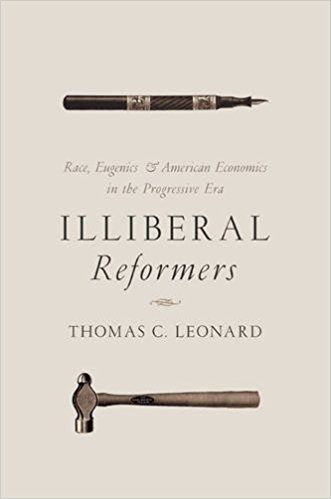 Unitarian Universalism is a liberal religion, from the Latin root liber, meaning “free.” And at the heart of classical liberalism is the equal right of every individual to choose how to think and how to act. And although there is the classic caveat that, “My right to swing my fist ends when it hits your nose,” involuntary sterilization is a serious invasion of an individual’s privacy and liberty. Such an act is a strong step toward totalitarianism, in which the state claims the right of total control over an individual’s body (Cohen 274). As detailed in Illiberal Reformers: Race, Eugenics, and American Economics in the Progressive Era by Thomas Leonard (Princeton University Press 2016), the challenge of eugenics in the early twentieth century is that it was progressive reformers, who perceived themselves as acting for the best interests of society, who instead acted illiberally in the name of “efficiency,” “expertise,” and “science” (Leonard 190).
Many of these illiberal progressives saw themselves as following in the footsteps of Charles Darwin’s evolutionary biology. But a close reading of Darwin shows otherwise. In Chapter 5 of The Descent of Man, Darwin shows that he was well aware of the implications of his theory of natural selection for what later came to be called eugenics. He confesses that he can understand the temptation, but he cautions his readers that we cannot:
check our sympathy, even at the urging of hard reason, without deterioration in the noblest part of our nature. The surgeon may harden himself whilst performing an operation, for he knows that he is acting for the good of his patient; but if we were intentionally to neglect the weak and helpless, it could only be for a contingent benefit, with an overwhelming present evil. (Cohen 48, 323)
The Rev. Dr. Carl Gregg is a certified spiritual director, a D.Min. graduate of San Francisco Theological Seminary, and the minister of the Unitarian Universalist Congregation of Frederick, Maryland. Follow him on Facebook (facebook.com/carlgregg) and Twitter (@carlgregg).
Learn more about Unitarian Universalism: http://www.uua.org/beliefs/principles
Next Post

April 5, 2017 Is There a Hidden Political Allegory in The Wizard of Oz?
Browse Our Archives
Select a Category Advent Anti-Racism Archaeology Atheism Baptism Best of the Year List Book Reviews Buddhism Catholicism Christian Education Church and State Church Planting Climate Change Conscientious Objection to War Creation Spirituality Death Penalty Didache Disability Rights Discernment Easter Ecology Emergent Church Movement Empire-Critical Ethics Evolution Feminist Theology Film Reviews Gandhi Gospel of Mark Gun Control Hinduism Immigration Reform Interfaith Islam JFK Judaism Jungian Spirituality Lectionary Commentary Lent Letters to the Editor LGBT Marriage MLK Multiculturalism Mysticism Nonviolent Activism Occupy Paganism (Earth-centered Religions) Parables Paul Pluralism Politics Process Theology Quantum Physics Requiescat In Pace Seminary and Divinity School Sermon Series Retrospective Sermons Spiritual Direction Spiritual Practices Stewardship (Fundraising) The Book of J The Wheel of the Year (Paganism) Theoblogger Challenge Triathlon Uncategorized Unitarian Universalism Worship Resources Youth Ministry
Select a Month July 2026 May 2026 March 2026 November 2025 October 2025 August 2025 February 2025 December 2024 October 2024 March 2024 January 2024 December 2023 November 2023 March 2023 February 2023 January 2023 December 2022 November 2022 August 2022 March 2022 February 2022 January 2022 December 2021 September 2021 August 2021 July 2021 June 2021 May 2021 February 2021 January 2021 December 2020 August 2020 June 2020 May 2020 April 2020 March 2020 February 2020 January 2020 December 2019 November 2019 October 2019 September 2019 July 2019 June 2019 March 2019 February 2019 January 2019 December 2018 November 2018 October 2018 September 2018 June 2018 May 2018 April 2018 March 2018 February 2018 January 2018 December 2017 November 2017 October 2017 September 2017 August 2017 July 2017 June 2017 May 2017 April 2017 March 2017 February 2017 January 2017 December 2016 November 2016 October 2016 September 2016 August 2016 June 2016 May 2016 April 2016 March 2016 February 2016 January 2016 December 2015 November 2015 October 2015 September 2015 August 2015 July 2015 June 2015 May 2015 April 2015 March 2015 February 2015 January 2015 December 2014 November 2014 October 2014 August 2014 July 2014 June 2014 May 2014 April 2014 March 2014 February 2014 January 2014 December 2013 November 2013 October 2013 September 2013 August 2013 July 2013 June 2013 May 2013 April 2013 March 2013 February 2013 January 2013 December 2012 November 2012 October 2012 September 2012 August 2012 July 2012 June 2012 May 2012 April 2012 March 2012 February 2012 January 2012 December 2011 November 2011 October 2011 September 2011 August 2011 July 2011 June 2011 May 2011 April 2011 March 2011 February 2011 January 2011 December 2010 November 2010 October 2010 August 2009 July 2009 May 2009
Follow Us!
TAKE THE
Religious Wisdom Quiz
Who built the first temple for God?
Select your answer to see how you score.
Moses Solomon David Pilate
Related posts from Carl Gregg

Reading America at 250: A Nation Wrestles With...


Andrew Holocek on the Power of Darkness

The Stories That Shape Us: Myths, Archetypes, &...
TRENDING AT PATHEOS More Voices

Reading America at 250: A Nation Wrestles With...
As part of my own reflection on the 250th anniversary of the...

Whenever I am reading a book or listening to an argument, I...

President Trump Ban Animal Torture Videos on Facebook
Call for Stricter Regulations of Animal Abuse Content on Facebook Although President...

Draft Amendments to Address Ritual Abuse in New...
The proposed changes would make it illegal for individuals in domestic partnerships...

How Bans on LGBTQ+ Student Clubs Threaten Religious...
On June 20, 2025, the State of Texas passed Senate Bill 12....

The Truth About the Gen Z Revival
This past year, there has been a lot of media buzz surrounding...
view all More Voices blogs
Ad-Free & Subscriber Log-In Subscription Support
- About Us
- 2026 Calendar
- Videos
- Podcasts
- Library of World Religions
- Faith In Media Tracker
- Advertise With Us
- Write for Us
- Privacy Policy
- Terms of Service
- Do Not Sell My Data
- Contact Us
- Radiant Digital
- Manage Newsletter Subscriptions
- Unsubscribe From Notifications
- Sitemap
Copyright 2008-2026, Patheos. All rights reserved.
Subscription Support Ad-Free & Subscriber Log-In
Follow Patheos