
BuddhistCatholicContemplativeEvangelicalGeneral ChristianHinduJewishLatter-day SaintMuslimNew VisionsProgressive Christian
Beliefs
- Buddhist
- Catholic
- Contemplative
- Evangelical
- General Christian
- Hindu
- Jewish
- Latter-day Saint
- More Voices
- Muslim
- New Visions
- Pagan
- Progressive Christian
Topics
- Religion News
- Food and Religion
- Sports and Religion
- Religious Art
- Religious Music and Entertainment
- Religious Events
- History and Religion
- Style and Religion
- Politics and Religion
- Women in Religion
- Recreation Outdoors and Religion
- Business Finance and Religion
- Careers Workplace and Religion
- Education and Religion
- Family Parenting and Religion
- Health Fitness and Religion
- Home and Religion
- Relationships and Religion
- Technology and Religion
- Travel and Religion
Columnists
- Buddhist Columnists
- Business Finance and Religion Columnists
- Careers Workplace and Religion Columnists
- Catholic Columnists
- Contemplative Columnists
- Education and Religion Columnists
- Evangelists Columnists
- Family Parenting and Religion Columnists
- General Christian Columnists
- Health Fitness and Religion Columnists
- Hindu Columnists
- History and Religion Columnists
- Home and Religion Columnists
- Jewish Columnists
- More Voices Columnists
- Latter Day Columnists
- Muslim Columnists
- New Visions Columnists
- Nonreligious Columnists
- Pagan Columnists
- Politics and Religion Columnists
- Progressive Columnists
- Recreation Outdoors and Religion Columnists
- Relationships and Religion Columnists
- Religion News Columnists
- Religious Art Columnists
- Religious Events Columnists
- Religious Music and Entertainment Columnists
- Sports and Religion Columnists
- Style and Religion Columnists
- Technology and Religion Columnists
- Travel and Religion Columnists
- Women in Religion Columnists
Resource Library
- 2026 Calendar
- Library of World Religions
- The 100 Most Holy Places on Earth
- Patheos Answers
- Podcasts
- Videos
- Faith Leaders Database
- Anglican Episcopalian
- Bahai
- Baptist
- Buddhism
- Christianity
- Confucianism
- Eastern Orthodoxy
- Hinduism
- Holiness and Pentecostal
- ISKCON
- Islam
- Judaism
- Lutheran
- Methodist
- The Church of Jesus Christ of Latter-day Saints
- New Age
- Paganism
- Presbytarian and Reformed
- Protestantism
- Religion Behind the Scenes
- Roman Catholic
- Scientology
- Shia Islam
- Sikhism
- Sufism
- Sunni Islam
- Taoism
- Zen
- See all religions
Research Tools
 Ad-Free & Subscriber Log-In Subscription Support
Ad-Free & Subscriber Log-In Subscription Support
Follow Patheos 

- Trending:
- Forgiveness
- |
- Marriage
- |
- Consciousness
- |
- Death Penalty
- |
- Election
- |
- Halloween

- Home
- More Voices
- Eugenics, Then & Now: Immigration, Health Care, & Illiberal Progressives
Eugenics, Then & Now: Immigration, Health Care, & Illiberal Progressives
Last updated on: March 30, 2017 at 12:48 pm by Carl Gregg
Eugenics, Then & Now: Immigration, Health Care, & Illiberal Progressives 2017-03-30T12:48:38-04:00 Carl Gregg
Patheos Explore the world's faith through different perspectives on religion and spirituality! Patheos has the views of the prevalent religions and spiritualities of the world.
Last week, we explored the life and legacy of one of our famous Unitarian ancestors, the Supreme Court Justice Oliver Wendell Holmes, Jr. When Holmes died in 1935, his obituary was featured on the front page of the New York Times under the headline, “Chief Liberal” (Cohen 317). But as we explored last week, although Holmes did occasionally help lead the court to a strong defense of civil liberties and individual freedom, he was not as progressive as his admirers sometimes let themselves think. And his most illiberal opinion, Buck v. Bell, was not even mentioned in his New York Times obituary (317).
 In 1927—only ninety years ago —Justice Holmes wrote the majority opinion in the Supreme Court case Buck v. Bell. (If you are curious to learn more, I highly recommend the accessible book published last year from Penguin Press, Imbeciles: The Supreme Court, American Eugenics, and the Sterilization of Carrie Buck by Adam Cohen.) The full case name was Carrie Buck v. John Hendren Bell, Superintendent of State Colony for Epileptics and Feeble Minded. In this infamous decision, our nation’s highest court upheld as Constitutional a state law allowing the compulsory sterilization of U.S. citizens deemed unfit to reproduce. In the annals of Supreme Court history, this case has been deemed perhaps “the highest ratio of injustice per word ever signed on to by eight Supreme Court Justices” (266-267).
The opinion is barely more than thousand words long, and worth reading in full, but here is a brief excerpt to give you a sense of its harsh tone:
It is better for all the world if, instead of waiting to execute degenerate offspring for crime or to let them starve for their imbecility, society can prevent those who are manifestly unfit from continuing their kind. The principle that sustains compulsory vaccination is broad enough to cover cutting the Fallopian tubes…. Three generations of imbeciles are enough. (269-271)
Among the eight Justices signing in support of this decision were Holmes’s fellow Unitarian, Chief Justice William Howard Taft, and the progressive Jewish Justice Louis Brandeis.
In reconstructing how this 8-1 decision was formed,
It was no great surprise that some of the justices signed Holmes’s opinion…. Chief Justice Taft had already lent his name to promoting eugenic ideas. The bigoted and mean-spirited Justice McReynolds, who would not sit next to Brandeis might have been expected to support eugenics—and the same could be said for Justice Van Devanter, who reportedly would join McReynolds in asking the president not to “afflict the Court with another Jew.” Justices Sutherland’s and Stone’s exposure in college to intellectual mentors with strong social Darwinist beliefs could explain their votes. (277-278)
The sole “no” vote came from Justice Butler, the only Roman Catholic on the court at the time, but even he did not write a dissenting opinion (Cohen 278). And although there are some indications that Brandeis was troubled by his support of the decision, Holmes was not. He said, that Buck v. Bell was “one decision that I wrote that gave me pleasure” (Cohen 277).
For the most part, newspapers as well as major medical and legal publications supported the decision. “The New York Times reported it on page 19, alongside a story of Harvard’s decision to build a new dining hall. The front page was filled with stories the editors considered more significant, including one on a 222-year-old tree being cut down in New Haven, Connecticut, to allow for street widening” (280-281). Not everyone was so cavalier. At the time, one of the more prominent voices to denounce the decision was the Governor of Pennsylvania, who said that involuntary sterilization was “cruelty upon a helpless class in the community, which the State has undertaken to protect” (278).
So why bring this topic up today? To be honest, there are strong parallels between the language and logic used in some parts of the immigration and health care debates today and those that led to the 1927 Supreme Court decision of Bell v. Buck. That case is also a challenge to wrestle with the ways that well-intentioned liberals can sometimes become unintentionally illiberal. And exploring the ways we have erred in the past may help us avoid repeating those mistakes in the present and future.
The term “eugenics” derives from the Greek words of εὖ/eu (“good, well”) and γένος/genos (“race, stock, kin”), and refers to various approaches of controlling human breeding to favor so-called “desirable characteristics.” As with many ethical dilemmas, crucial questions to ask are “What’s fair?” and “Who decides?” Who gets to choose what is desirable, what are their motivations, and to what end? The short answer is that many eugenicists—either implicitly or explicitly—were motivated by white supremacy, classism, and related factors. including many liberals who understood themselves as “progressives.” The scary part is that many of these progressives perceived their support for eugenics as simply following the “objective” logic of science. But they were unable to see the ways that, in truth, their white privilege, economic privilege, and other related factors biased their understandings of science.
Confronting the history of Buck v. Bell is also a troubling reminder that the Nazis were not the only proponents of eugenics in the first half of the twentieth century. Rather, the Nazi party “used America as a model for its own eugenic sterilization program…and at the Nuremberg trials that followed World War II, Nazis cited Buck v. Bell in defense of their actions (10-11).
Consider that:
- John D. Rockefeller (1839-1937), the oil magnate and world’s wealthiest man, donated generously to scientific research into breeding out, in his words, the “defective human.”
- Alexander Graham Bell (1847-1922), inventor of the telephone, was also chairman of the Board of Scientific Directors of the Eugenics’ Record Office, “the leading organization advocating eugenic sterilization” (2).
- Teddy Roosevelt (1858-1919), former President of the United States, said publicly that the unfit must be “forbidden to leave offspring behind them” (3).
- “When Connecticut enacted the nation’s first eugenics law in 1895—a ban on certain marriages—the American Bar Association’s president praised it as a necessary ‘practical determent’…that government must ‘prevent unhealthy progeny’ to protect ‘future generations from the evil operation of the laws of heredity.”
- “At the American Academy of Medicine’s first meeting of the twentieth century in June 1900, its president…argued that medicine as was currently practiced was counterproductive. ‘We prolong the lives of weaklings, and make it possible for them to transmit their characteristics to future generations” (56).
- “Eugenics was taught at 376 universities and colleges, including Harvard, Columbia, Berkeley, and Cornell. Prominent professors were outspoken in support” (4).
- The feminist Margaret Sanger (1879-1966), rightly celebrated for opening the first birth control clinic in the U.S. in 1916, was also a prominent eugenicist (57).
There are many more examples.
Ho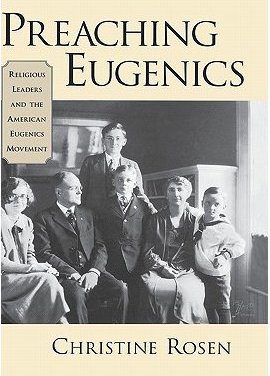 wever, I wanted to explore this topic not only because of the history of progressives generally supporting eugenics, but also because the more I have researched the history of the eugenics movement in the U.S., the more I keep stumbling upon the names of Unitarians and Universalists beyond the aforementioned Unitarian Super Court Justices Oliver Wendell Holmes, Jr, and William Howard Taft.
As explored in Christine Rosen’s important book Preaching Eugenics: Religious Leaders and the American Eugenics Movement, one significant example includes the Unitarian minister John Haynes Holmes, who is rightly remembered by many for his progressive activism and his principled pacifism, but who also helped form a Eugenics Committee of the Liberal Ministers’ Association in New York. One of their goals was to encourage their fellow ministers to agree only to perform “health marriages”—unions which would lead to eugenically approved offspring (Rosen 58-59). Another example is The Rev. Phillips Osgood, who was an Episcopalian at the time that he won the 1926 American Eugenics Society’s “Eugenics Sermon Contest.” But he later became a Unitarian minister (Rosen 124-126). In addition to Unitarians and Universalists, many other progressive ministers were part of the eugenics movement, including Harry Emerson Fosdick (minister of the historic Riverside Church in New York City) and notable numbers of rabbis within Reform Judaism.
I will explore further tomorrow in a post on “Why Eugenics Is Wrong and Why It Still Matters Today.”
The Rev. Dr. Carl Gregg is a certified spiritual director, a D.Min. graduate of San Francisco Theological Seminary, and the minister of the Unitarian Universalist Congregation of Frederick, Maryland. Follow him on Facebook (facebook.com/carlgregg) and Twitter (@carlgregg).
Learn more about Unitarian Universalism: http://www.uua.org/beliefs/principles
Previous Post

March 26, 2017
What Legacy Are We Leaving? Reflections on Oliver Wendell Holmes, Jr.
Next Post
March 30, 2017 Why Eugenics Is Wrong and Why It Still Matters Today
Browse Our Archives
Select a Category Advent Anti-Racism Archaeology Atheism Baptism Best of the Year List Book Reviews Buddhism Catholicism Christian Education Church and State Church Planting Climate Change Conscientious Objection to War Creation Spirituality Death Penalty Didache Disability Rights Discernment Easter Ecology Emergent Church Movement Empire-Critical Ethics Evolution Feminist Theology Film Reviews Gandhi Gospel of Mark Gun Control Hinduism Immigration Reform Interfaith Islam JFK Judaism Jungian Spirituality Lectionary Commentary Lent Letters to the Editor LGBT Marriage MLK Multiculturalism Mysticism Nonviolent Activism Occupy Paganism (Earth-centered Religions) Parables Paul Pluralism Politics Process Theology Quantum Physics Requiescat In Pace Seminary and Divinity School Sermon Series Retrospective Sermons Spiritual Direction Spiritual Practices Stewardship (Fundraising) The Book of J The Wheel of the Year (Paganism) Theoblogger Challenge Triathlon Uncategorized Unitarian Universalism Worship Resources Youth Ministry
Select a Month July 2026 May 2026 March 2026 November 2025 October 2025 August 2025 February 2025 December 2024 October 2024 March 2024 January 2024 December 2023 November 2023 March 2023 February 2023 January 2023 December 2022 November 2022 August 2022 March 2022 February 2022 January 2022 December 2021 September 2021 August 2021 July 2021 June 2021 May 2021 February 2021 January 2021 December 2020 August 2020 June 2020 May 2020 April 2020 March 2020 February 2020 January 2020 December 2019 November 2019 October 2019 September 2019 July 2019 June 2019 March 2019 February 2019 January 2019 December 2018 November 2018 October 2018 September 2018 June 2018 May 2018 April 2018 March 2018 February 2018 January 2018 December 2017 November 2017 October 2017 September 2017 August 2017 July 2017 June 2017 May 2017 April 2017 March 2017 February 2017 January 2017 December 2016 November 2016 October 2016 September 2016 August 2016 June 2016 May 2016 April 2016 March 2016 February 2016 January 2016 December 2015 November 2015 October 2015 September 2015 August 2015 July 2015 June 2015 May 2015 April 2015 March 2015 February 2015 January 2015 December 2014 November 2014 October 2014 August 2014 July 2014 June 2014 May 2014 April 2014 March 2014 February 2014 January 2014 December 2013 November 2013 October 2013 September 2013 August 2013 July 2013 June 2013 May 2013 April 2013 March 2013 February 2013 January 2013 December 2012 November 2012 October 2012 September 2012 August 2012 July 2012 June 2012 May 2012 April 2012 March 2012 February 2012 January 2012 December 2011 November 2011 October 2011 September 2011 August 2011 July 2011 June 2011 May 2011 April 2011 March 2011 February 2011 January 2011 December 2010 November 2010 October 2010 August 2009 July 2009 May 2009
Follow Us!
TAKE THE
Religious Wisdom Quiz
Who opened the first seal to release the White Horse in Revelation?
Select your answer to see how you score.
The 24 Elders John The Lamb (Jesus) An angel
Related posts from Carl Gregg

Reading America at 250: A Nation Wrestles With...


Andrew Holocek on the Power of Darkness

The Stories That Shape Us: Myths, Archetypes, &...
TRENDING AT PATHEOS More Voices

Reading America at 250: A Nation Wrestles With...
As part of my own reflection on the 250th anniversary of the...

Whenever I am reading a book or listening to an argument, I...

President Trump Ban Animal Torture Videos on Facebook
Call for Stricter Regulations of Animal Abuse Content on Facebook Although President...

Draft Amendments to Address Ritual Abuse in New...
The proposed changes would make it illegal for individuals in domestic partnerships...

How Bans on LGBTQ+ Student Clubs Threaten Religious...
On June 20, 2025, the State of Texas passed Senate Bill 12....

The Truth About the Gen Z Revival
This past year, there has been a lot of media buzz surrounding...
view all More Voices blogs
Ad-Free & Subscriber Log-In Subscription Support
- About Us
- 2026 Calendar
- Videos
- Podcasts
- Library of World Religions
- Faith In Media Tracker
- Advertise With Us
- Write for Us
- Privacy Policy
- Terms of Service
- Do Not Sell My Data
- Contact Us
- Radiant Digital
- Manage Newsletter Subscriptions
- Unsubscribe From Notifications
- Sitemap
Copyright 2008-2026, Patheos. All rights reserved.
Subscription Support Ad-Free & Subscriber Log-In
Follow Patheos