
BuddhistCatholicContemplativeEvangelicalGeneral ChristianHinduJewishLatter-day SaintMuslimNew VisionsProgressive Christian
Beliefs
- Buddhist
- Catholic
- Contemplative
- Evangelical
- General Christian
- Hindu
- Jewish
- Latter-day Saint
- More Voices
- Muslim
- New Visions
- Pagan
- Progressive Christian
Topics
- Religion News
- Food and Religion
- Sports and Religion
- Religious Art
- Religious Music and Entertainment
- Religious Events
- History and Religion
- Style and Religion
- Politics and Religion
- Women in Religion
- Recreation Outdoors and Religion
- Business Finance and Religion
- Careers Workplace and Religion
- Education and Religion
- Family Parenting and Religion
- Health Fitness and Religion
- Home and Religion
- Relationships and Religion
- Technology and Religion
- Travel and Religion
Columnists
- Buddhist Columnists
- Business Finance and Religion Columnists
- Careers Workplace and Religion Columnists
- Catholic Columnists
- Contemplative Columnists
- Education and Religion Columnists
- Evangelists Columnists
- Family Parenting and Religion Columnists
- General Christian Columnists
- Health Fitness and Religion Columnists
- Hindu Columnists
- History and Religion Columnists
- Home and Religion Columnists
- Jewish Columnists
- More Voices Columnists
- Latter Day Columnists
- Muslim Columnists
- New Visions Columnists
- Nonreligious Columnists
- Pagan Columnists
- Politics and Religion Columnists
- Progressive Columnists
- Recreation Outdoors and Religion Columnists
- Relationships and Religion Columnists
- Religion News Columnists
- Religious Art Columnists
- Religious Events Columnists
- Religious Music and Entertainment Columnists
- Sports and Religion Columnists
- Style and Religion Columnists
- Technology and Religion Columnists
- Travel and Religion Columnists
- Women in Religion Columnists
Resource Library
- 2026 Calendar
- Library of World Religions
- The 100 Most Holy Places on Earth
- Patheos Answers
- Podcasts
- Videos
- Faith Leaders Database
- Anglican Episcopalian
- Bahai
- Baptist
- Buddhism
- Christianity
- Confucianism
- Eastern Orthodoxy
- Hinduism
- Holiness and Pentecostal
- ISKCON
- Islam
- Judaism
- Lutheran
- Methodist
- The Church of Jesus Christ of Latter-day Saints
- New Age
- Paganism
- Presbytarian and Reformed
- Protestantism
- Religion Behind the Scenes
- Roman Catholic
- Scientology
- Shia Islam
- Sikhism
- Sufism
- Sunni Islam
- Taoism
- Zen
- See all religions
Research Tools
 Ad-Free & Subscriber Log-In Subscription Support
Ad-Free & Subscriber Log-In Subscription Support
Follow Patheos 

- Trending:
- Forgiveness
- |
- Marriage
- |
- Consciousness
- |
- Death Penalty
- |
- Election
- |
- Halloween

- Home
- More Voices
- How to Cultivate a Culture of Dignity
How to Cultivate a Culture of Dignity
Last updated on: February 25, 2017 at 2:34 pm by Carl Gregg
How to Cultivate a Culture of Dignity 2017-02-25T14:34:00-05:00 Carl Gregg
Patheos Explore the world's faith through different perspectives on religion and spirituality! Patheos has the views of the prevalent religions and spiritualities of the world.
The opening lines of the Roman Catholic Catechism affirm that, “The dignity of man rests above all on the fact that he is called to communion with God.” The First Principle of Unitarian Universalism makes an even more radical claim for “the inherent worth and dignity of every person,” irrespective of anything else.
In 1961, when the American Unitarian Association consolidated with the Universalist Church of America to form the Unitarian Universalist Association, we originally had Six Principles that were similar, but in a different order that the ones we know today. The Principles were revised in 1985, in particular to make them more gender inclusive. And in 1961 when the UUA affirmed “the supreme worth of every human personality, the dignity of man,” a major influence on that choice was the 1948 United Nations’s “Universal Declaration of Human Rights.” The very first line of its preamble recognizes that, “the inherent dignity and the equal and inalienable rights of all members of the human family is the foundation of freedom, justice and peace in the world….” Likewise, following the preamble, the very first sentence of Article I says, “All human beings are born free and equal in dignity and rights.” The writing and passage of a “Universal Declaration of Human Rights,”a direct result of the horrors of World War II, which ended in 1945, was a terrifying reminder of our capacity as a species to violate the dignity of our fellow human beings in horrific ways.
Respect and support for human dignity are also foundational to the Geneva Convention, which was passed the next year in 1949, and reminds us that 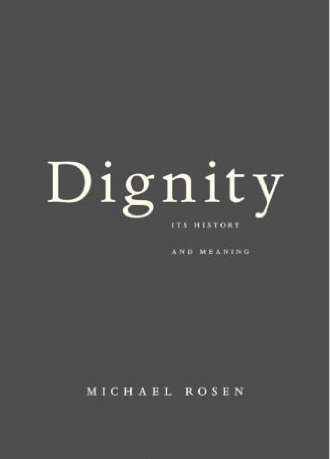 “all human beings” and “every person” really means everyone, even prisoners of war. The Geneva Convention prohibits both “cruel treatment and torture” as well as “outrages upon personal dignity, in particular, humiliating and degrading treatment” such as the now infamous Abu Ghraib prison scandal. (The exception to “every person” is active combatants.) This background is one reason that human rights organizations such as the UU Service Committee have spoken out against torture — including when torture is veiled behind Orwellian double-speak and called “enhanced interrogation techniques.” When we violate one another’s dignity, we risk devolving into a world of violence, cruelty, and “might makes right.” As Harvard professor Michael Rosen said in his short but important 2012 book Dignity: Its History and Meaning, “the barriers that separate…modern liberal democracy from the barbarism and atrocity that disfigured the twentieth century (and show every sign of counting through the twenty-first) are very, very fragile” (159).
Rosen also fascinatingly traces the ways that what is seen to follow from the starting point of human dignity is very different, depending on one’s perspective. For example:
- Many conservative theologians argue that human dignity means that from conception through death, one should not artificially end a human life. At the same time, the internationally-known organization Dignitas argues that human dignity requires allowing the choice of physician-assisted “death with dignity” in the right circumstances.
- Similarly, many conservative theologians argue that human dignity does not conflict with their opposition to same-sex relationships, whereas the organization Dignity USA holds that the only way to respect the dignity of Lesbian, Gay, Bisexual, and Transgender people is to recognize the full legitimacy of their relationships.
- Or there is the student who was expelled from a university for wearing a very short dress, which the school characterized as “a flagrant lack of respect for…academic dignity.” The student countersued on the basis of her “trampled dignity.” (6-7).
Rosen summarizes these two sides ends of the spectrum:
For [many religious conservatives], human dignity gives life a value that may properly override the choices made by the individual living it. On the other hand, for liberals in the United States in particular, dignity is identified with autonomy in the sense of individuals’ right to choose for themselves how to live (and die). (126)
Some of you may recall echoes of my Election post on the differences between Edmund Burke and Thomas Paine as paradigmatic of our contemporary left and right. Perhaps the most important point that is behind both of those sides of the coin is that we as a species are increasingly choosing to universalize dignity to all human beings, which was by no means an inevitable choice then or now (8). Historically, dignity has much more often been the privilege of the aristocratic few rather than a characteristic of every human being (38-39).
In that spirit, allow me to bring one more 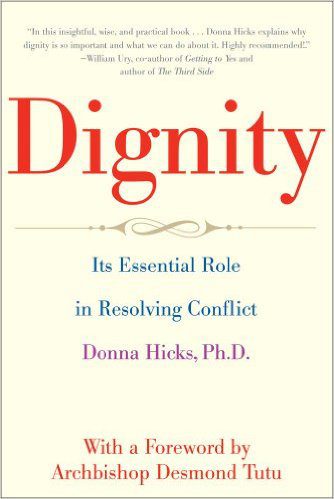 book into the conversation: Dr. Donna Hicks’ book with Yale University Press, Dignity: Its Essential Role in Resolving Conflict. Dr. Hicks has been working with international conflict resolution for decades, and the forward to her book is written by Archbishop Emeritus Desmond Tutu. She has seen many global conflicts begin to be transformed when past indignities are named aloud, and when both parties begin to again see the other side as no longer subhuman, but instead, as possessing worth and dignity. She writes that her essential message is simple: “Demonstrate the care and attention for yourself and others than anything of value deserves…. Don’t miss an opportunity to exert the power you have to remind others of who they are: invaluable, priceless, and irreplaceable. Remind yourself, too” (3). Indeed, one of the most powerful lines in her book is a testimony from a Latin American political official who said, regarding Hicks’ Dignity Model of negotiations: “Not only did you help the relationships in this room — I think you also saved my marriage” (2)
From a UU perspective, the challenge of these two books is to live more fully into our First Principle, what Donna Hicks calls creating “a ‘culture of dignity’ in which everyone would be aware of how easy it is to inflict painful wounds on one anothers’s dignity”—and accordingly, to “learn how to extend dignity to one another and create an environment in which people look forward to being together because they feel valued” (16). Related to the need to be intentional about creating a “culture of dignity,” consider just one study of 2,500 people imprisoned for murder. “When asked why they felt compelled to kill, the majority of the inmates responded, ‘Because I felt disrespected’” (38). Conversely, Nelson Mandela, although not an exemplar of nonviolence in his early days, became a stunning example of sustaining a culture of dignity even in some of the worst circumstances. After being wrongfully imprisoned for more than twenty-seven years by the apartheid government, Mandela said a day after his release in 1990, “I knew that people expected me to harbor anger toward whites. But I had none. In prison, my anger toward whites decreased, but my hatred for the system grew. I wanted South Africa to see that I loved even my enemies while I hated the system that turned us against one another…. Whites are fellow South Africans and we want them to feel safe and to know that we appreciate the contribution that they have made toward the development of this country” (75). What a powerful testimony of the inherent worth and dignity of every person — even the many persons on both sides of that struggle who committed terrible injustices.
What, then, might it look like in more everyday circumstances to help create a culture of dignity? One crucial piece of advice Hicks gives is, “Don’t take the bait. Don’t let the bad behavior of others determine your own. Restraint is the better part of dignity. Don’t justify getting even. Do not do unto others as they do unto you if it will cause harm” (93). But when conflicts inevitably happen, the following recommendations summarize her framework for reconciliation—one that honors each person’s dignity:
First, both parties must agree that sitting down together is worthy of their time and attention. Isn’t it much more common to withdraw from those with whom we have been in conflict and refuse to talk to them?
Second, listen without interrupting or challenging each other’s story…. Listen to seek understanding. Isn’t it much more common for us to listen to our adversaries only to one-up them or to prepare our attack on what they have said?
Third, acknowledge and recognize what the other has been through. Isn’t it much more common to stare without expression at the person we have injured in the heat of a conflict and feel defensive or justified?
Fourth, honor and acknowledge each other’s integrity, and in so doing, create a mutual bond. (185)
And so, in the days to come, I invite you to experiment with what it feels like with the many different people you encounter to hear echoing in your ear: “the inherent worth and dignity of every person,” which includes both yourself and the other facing you.
To close with a blessing from Desmond Tutu, may we all become “agents of dignity” — of the inherent worth and dignity of every person: “accept it in yourself, discover and encourage it in others, and peace may just be possible” (x).
The Rev. Dr. Carl Gregg is a certified spiritual director, a D.Min. graduate of San Francisco Theological Seminary, and the minister of the Unitarian Universalist Congregation of Frederick, Maryland. Follow him on Facebook (facebook.com/carlgregg) and Twitter (@carlgregg).
Learn more about Unitarian Universalism: http://www.uua.org/beliefs/principles
Next Post

February 15, 2017 What Does It Mean that We Are Sapiens? Reflections on Darwin Day
Browse Our Archives
Select a Category Advent Anti-Racism Archaeology Atheism Baptism Best of the Year List Book Reviews Buddhism Catholicism Christian Education Church and State Church Planting Climate Change Conscientious Objection to War Creation Spirituality Death Penalty Didache Disability Rights Discernment Easter Ecology Emergent Church Movement Empire-Critical Ethics Evolution Feminist Theology Film Reviews Gandhi Gospel of Mark Gun Control Hinduism Immigration Reform Interfaith Islam JFK Judaism Jungian Spirituality Lectionary Commentary Lent Letters to the Editor LGBT Marriage MLK Multiculturalism Mysticism Nonviolent Activism Occupy Paganism (Earth-centered Religions) Parables Paul Pluralism Politics Process Theology Quantum Physics Requiescat In Pace Seminary and Divinity School Sermon Series Retrospective Sermons Spiritual Direction Spiritual Practices Stewardship (Fundraising) The Book of J The Wheel of the Year (Paganism) Theoblogger Challenge Triathlon Uncategorized Unitarian Universalism Worship Resources Youth Ministry
Select a Month July 2026 May 2026 March 2026 November 2025 October 2025 August 2025 February 2025 December 2024 October 2024 March 2024 January 2024 December 2023 November 2023 March 2023 February 2023 January 2023 December 2022 November 2022 August 2022 March 2022 February 2022 January 2022 December 2021 September 2021 August 2021 July 2021 June 2021 May 2021 February 2021 January 2021 December 2020 August 2020 June 2020 May 2020 April 2020 March 2020 February 2020 January 2020 December 2019 November 2019 October 2019 September 2019 July 2019 June 2019 March 2019 February 2019 January 2019 December 2018 November 2018 October 2018 September 2018 June 2018 May 2018 April 2018 March 2018 February 2018 January 2018 December 2017 November 2017 October 2017 September 2017 August 2017 July 2017 June 2017 May 2017 April 2017 March 2017 February 2017 January 2017 December 2016 November 2016 October 2016 September 2016 August 2016 June 2016 May 2016 April 2016 March 2016 February 2016 January 2016 December 2015 November 2015 October 2015 September 2015 August 2015 July 2015 June 2015 May 2015 April 2015 March 2015 February 2015 January 2015 December 2014 November 2014 October 2014 August 2014 July 2014 June 2014 May 2014 April 2014 March 2014 February 2014 January 2014 December 2013 November 2013 October 2013 September 2013 August 2013 July 2013 June 2013 May 2013 April 2013 March 2013 February 2013 January 2013 December 2012 November 2012 October 2012 September 2012 August 2012 July 2012 June 2012 May 2012 April 2012 March 2012 February 2012 January 2012 December 2011 November 2011 October 2011 September 2011 August 2011 July 2011 June 2011 May 2011 April 2011 March 2011 February 2011 January 2011 December 2010 November 2010 October 2010 August 2009 July 2009 May 2009
Follow Us!
TAKE THE
Religious Wisdom Quiz
How many commandments were written on stone tablets?
Select your answer to see how you score.
Ten Thirteen Twelve Seven
Related posts from Carl Gregg

Reading America at 250: A Nation Wrestles With...


Andrew Holocek on the Power of Darkness

The Stories That Shape Us: Myths, Archetypes, &...
TRENDING AT PATHEOS More Voices

Reading America at 250: A Nation Wrestles With...
As part of my own reflection on the 250th anniversary of the...

Whenever I am reading a book or listening to an argument, I...

President Trump Ban Animal Torture Videos on Facebook
Call for Stricter Regulations of Animal Abuse Content on Facebook Although President...

Draft Amendments to Address Ritual Abuse in New...
The proposed changes would make it illegal for individuals in domestic partnerships...

How Bans on LGBTQ+ Student Clubs Threaten Religious...
On June 20, 2025, the State of Texas passed Senate Bill 12....

The Truth About the Gen Z Revival
This past year, there has been a lot of media buzz surrounding...
view all More Voices blogs
Ad-Free & Subscriber Log-In Subscription Support
- About Us
- 2026 Calendar
- Videos
- Podcasts
- Library of World Religions
- Faith In Media Tracker
- Advertise With Us
- Write for Us
- Privacy Policy
- Terms of Service
- Do Not Sell My Data
- Contact Us
- Radiant Digital
- Manage Newsletter Subscriptions
- Unsubscribe From Notifications
- Sitemap
Copyright 2008-2026, Patheos. All rights reserved.
Subscription Support Ad-Free & Subscriber Log-In
Follow Patheos