
BuddhistCatholicContemplativeEvangelicalGeneral ChristianHinduJewishLatter-day SaintMuslimNew VisionsProgressive Christian
Beliefs
- Buddhist
- Catholic
- Contemplative
- Evangelical
- General Christian
- Hindu
- Jewish
- Latter-day Saint
- More Voices
- Muslim
- New Visions
- Pagan
- Progressive Christian
Topics
- Religion News
- Food and Religion
- Sports and Religion
- Religious Art
- Religious Music and Entertainment
- Religious Events
- History and Religion
- Style and Religion
- Politics and Religion
- Women in Religion
- Recreation Outdoors and Religion
- Business Finance and Religion
- Careers Workplace and Religion
- Education and Religion
- Family Parenting and Religion
- Health Fitness and Religion
- Home and Religion
- Relationships and Religion
- Technology and Religion
- Travel and Religion
Columnists
- Buddhist Columnists
- Business Finance and Religion Columnists
- Careers Workplace and Religion Columnists
- Catholic Columnists
- Contemplative Columnists
- Education and Religion Columnists
- Evangelists Columnists
- Family Parenting and Religion Columnists
- General Christian Columnists
- Health Fitness and Religion Columnists
- Hindu Columnists
- History and Religion Columnists
- Home and Religion Columnists
- Jewish Columnists
- More Voices Columnists
- Latter Day Columnists
- Muslim Columnists
- New Visions Columnists
- Nonreligious Columnists
- Pagan Columnists
- Politics and Religion Columnists
- Progressive Columnists
- Recreation Outdoors and Religion Columnists
- Relationships and Religion Columnists
- Religion News Columnists
- Religious Art Columnists
- Religious Events Columnists
- Religious Music and Entertainment Columnists
- Sports and Religion Columnists
- Style and Religion Columnists
- Technology and Religion Columnists
- Travel and Religion Columnists
- Women in Religion Columnists
Resource Library
- 2026 Calendar
- Library of World Religions
- The 100 Most Holy Places on Earth
- Patheos Answers
- Podcasts
- Videos
- Faith Leaders Database
- Anglican Episcopalian
- Bahai
- Baptist
- Buddhism
- Christianity
- Confucianism
- Eastern Orthodoxy
- Hinduism
- Holiness and Pentecostal
- ISKCON
- Islam
- Judaism
- Lutheran
- Methodist
- The Church of Jesus Christ of Latter-day Saints
- New Age
- Paganism
- Presbytarian and Reformed
- Protestantism
- Religion Behind the Scenes
- Roman Catholic
- Scientology
- Shia Islam
- Sikhism
- Sufism
- Sunni Islam
- Taoism
- Zen
- See all religions
Research Tools
 Ad-Free & Subscriber Log-In Subscription Support
Ad-Free & Subscriber Log-In Subscription Support
Follow Patheos 

- Trending:
- Forgiveness
- |
- Marriage
- |
- Consciousness
- |
- Death Penalty
- |
- Election
- |
- Halloween

- Home
- More Voices
- Cesar Chavez: How David Can Win in the Age of #Trump
Cesar Chavez: How David Can Win in the Age of #Trump
Last updated on: January 31, 2017 at 5:09 pm by Carl Gregg
Cesar Chavez: How David Can Win in the Age of #Trump 2017-01-31T17:09:19-05:00 Carl Gregg
Patheos Explore the world's faith through different perspectives on religion and spirituality! Patheos has the views of the prevalent religions and spiritualities of the world.
For seven years, I had the privilege each summer of being a counselor at a two-week Summer Institute for incoming college freshmen. The title of the program was “You Bet Your Life: Theological Explorations of Vocation,” and our goal was to equip these young people with tools, frameworks, and experiences to begin discerning both their gifts and how they might best be able to change the world for the better. (We are “betting our life” with each choice that we make on how to spend our time and talent.)
One classic definition of vocation is that you are called to that place “where your deep gladness and the world’s deep hunger meet.” Each year, one of the most powerful ways that we invited these young people to encounter the world’s deep hunger was through a “poverty tour” of the city we were in of Greenville, South Carolina. Up to this point, most of the campers had experienced Greenville as a beautiful city in the foothills of the Blue Ridge Mountains with a revitalized and flourishing downtown.
A different view would emerge as we loaded the campers onto a bus driven by the director of a local nonprofit who had been working for decades to understand and address poverty issues in the region. He would drive us down a major thoroughfare with wide, smooth roads and landscaped sidewalks. Then, he would turn just one block off that major street, where no one would have any reason to go if they didn’t live in the neighborhood. Suddenly the sidewalks disappear, the road narrows in many places to one lane, and dilapidated buildings hidden from most citizens’s view come) into focus. He would also show us the clear evidence of where the homeless individuals had slept the night before under bridges and in bamboo fields just on the periphery of the bustling and revitalized downtown.
The summer of 2001 was the first year of this camp on “You Bet Your Life,” and we were figuring out many of details as we went along. As the Poverty Tour was ending, we realized we had failed to anticipated the level of devastation some of the campers experienced on the tour. Learning about the city’s barely hidden poverty hit them both emotionally and viscerally.
Before returning to campus, we gathered them in the parking lot to debrief. The real breakthrough moment came when one of the counselors stepped forward and shared about his experience. He had volunteered the previous two years at this nonprofit, and in the face of so many individuals and families with overwhelming needs, he had found some reassurance in reminding himself periodically of this story:
A child is walking along the ocean and sees a beach on which thousands and thousands of starfish have washed ashore. Further along she sees a woman, walking slowly and stooping often, picking up one starfish after another and tossing each one gently into the ocean. “Why are you throwing starfish into the ocean?” she asks. “Because the sun is up and the tide is going out and if I don’t throw them further in they will die.” “But, the child says, there are so many starfish! You can barely make a difference.” The woman listened calmly and then bent down to pick up another starfish and threw it into the sea. “It made a difference to that one.”
My friend found comfort in that story. When he was overwhelmed with the immensity of poverty as an issue, he would spend some time making a concrete difference for at least one person: getting at least one person enough food for the next month, getting the water turned back on at one person’s house, giving his full attention to one person who is feeling lost, getting one person clothes for their first job interview, getting a desperately-needed prescription filled for one person, or visiting one person who is in prison.
There’s a lot of wisdom in the starfish story. But here’s another story that has also become a touchstone for me as I’ve continued to reflect on large-scale social problems:
Imagine a large river with a high waterfall. At the bottom of this waterfall, hundreds of people are working frantically trying to save those who have fallen into the river and have fallen down the waterfall, many of them drowning. As the people along the shore are trying to rescue as many as possible one individual looks up and sees a seemingly never-ending stream of people falling down the waterfall and begins to run upstream. One of other rescuers hollers, “Where are you going? There are so many people that need help here.” To which the man replied, “I’m going upstream to find out why so many people are falling into the river.”
The starfish story reminds us that we can make real immediate differences in people’s lives through simple acts of loving kindness. But the river story reminds us that it’s not enough simply to throw back individual starfish. We may need to start there. But in addition to working on a one-to-one level, we also need to consider working to “change corrupt institutions and unjust systems. We need to co-create “the change we want to see in the world”—at both levels of involvement. However, moving from the individual level to the systemic is significantly more difficult. In the words of a Catholic liberation theologian and former archbishop of Brazil, “When I give food to the poor, they call me a saint. When I ask why so many people are poor, they call me a communist.”
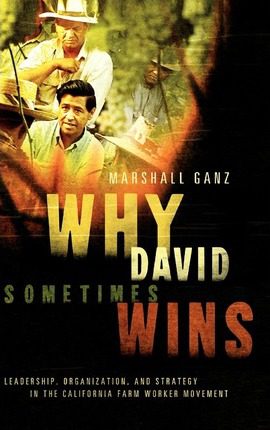 Along these lines, at a recent UU General Assembly, I was challenged in particular by Dr. Marshall Ganz, the Senior Lecturer in Public Policy at Harvard University’s Center for Democratic Governance and Innovation. Ganz’s father was a rabbi and his mother a teacher. As Ganz describes in his book Why David Sometimes Wins: Leadership, Organization, and Strategy in the California Farm Worker Movement, he grew up in the San Joaquin Valley of California, the end point of the “‘dustbowl’ migration memorialized by John Steinbeck in his novel Grapes of Wrath” (vii). Ganz graduated “from high school in 1960, the year John F. Kennedy was elected president.” In those heady times, Ganz dropped out of Harvard as an undergraduate after his junior year to join the Civil Rights Movement as an organizer for the Student Nonviolent Coordinating Committee. Then, following the passage of the Voting Rights Act, he returned to his home state in the fall of 1965 and “joined Cesar Chavez in his effort to unionize California farm workers.” And after 16 years with the United Farm Workers, Ganz felt the need to “deepen his intellectual understanding” to supplement and extend his on-the-ground experience organizing. After a 28-year ‘leave of absence,’ Ganz returned to Harvard, “completed his undergraduate degree in history and government…a Masters in Public Administration…and [a] Ph.D. in sociology in 2000.” He jokes that he is part of Harvard’s “class of 1964/1992.”
More recently, Ganz famously consulted with the Obama campaign in late spring 2007 to help then-candidate Obama better tell his story and to learn from Ganz’s experience in order to set-up “intensive community organizing–style training camps in which young people would be taught to tell Obama’s story, to spread a message and generate the enthusiasm of a true grassroots movement.” The rest, of course, is history. Also worth noting is that President Obama’s famous slogan “Yes We Can!” is a direct translation of César Chávez’s United Farm Workers rallying cry in the face of adversity that dates back to 1972. Before “Yes, We Can!” there was “¡Sí se puede!”
And Ganz, reflecting on his decades of organizing experience through his doctoral work and teaching at Harvard, titled his book Why David Sometimes Wins, as an allusion to that ancient biblical tale he likely first heard from his father the rabbi, of David and Goliath. In that classic story, the Philistine champion and giant, Goliath has been taunting the Israelites for forty days. Finally, David, a young shepherd, courageously offers to confront Goliath. At first, the soldiers try to equip David with the king’s own armor, but the small boy was so weighed down by the helmet, coat of mail, and sword that he couldn’t even walk. He realizes that he can’t take on the giant on Goliath’s own terms. Looking around, he sees “five smooth stones” from a nearby riverbed, and defeats Goliath by surprising him with a rock to the forehead care of a young shepherd boy’s slingshot.
Prior to Chavez’s work in California, there had been “Three waves of farm-labor organizing…since 1900” (23). But, Ganz reflects that, like David, Chavez succeeded where others had failed because he “thinks about it differently,” was “more motivated,” and applied the resources at hand in “novel” ways (13). Cesar Chavez used to say, “Power makes you stupid.” In Ganz’s words, the Goliaths of this world arrogantly “come to rely on an overwhelming resources advantage, which is exactly what creates opportunity for the Davids of the world” (Gladwell 253). These insights seem more relevant than ever for resistance and resilience to injustices from Trump Administration.
What, then, are some approaches we might learn from the archetypal David — and from Chavez, Ganz, Obama, and others — if in our own eras we find the boldness and courage to take on a large, systemic Goliath of a social problem? From my own tradition of Unitarian Universalism, James Luther Adams (often referred to affectionately by UUs as “JLA”) was the most influential Unitarian Universalist theologian of the twentieth century. He offers us one framework for “thinking differently” and applying resources in “novel” way using what he called the “Five Smooth Stones of Religious Liberalism,” an explicit allusion to the “five smooth stones” David fished from the riverbed to defeat Goliath. Those five stones are:
- “‘Revelation’ is continuous”: as a theologically liberal religious tradition, we are not locked into traditions from the past, making us particularly David-like in our openness to creative innovations.
- “Mutual, free consent…not coercion”: Goliath-models rely on a top-down hierarchy, but the commitment to the democratic process in progressive movements keeps us open to all voices, including those small David-like voices from the margins who can point toward previously-unforeseen ways forward.
- “Moral obligation to direct one’s effort toward the establishment of a just and loving community”: The Goliaths of this world insist that the way things are — which unduly favor Goliaths — are the way things have always been. But you may recall Ganz’s point that the successful Davids of this world commit to changing the world for the better and persist until they shift the system closer to a realization of the Beloved Community.
- “[W]e deny the immaculate conception of virtue” In other words, the world does not magically “bend toward justice”; only through collective human effort does positive social change happen.
- “Optimism”: we persist in the hope that is the possibility of moving incrementally toward a more peaceful and just world.
The Rev. Dr. Carl Gregg is a certified spiritual director, a D.Min. graduate of San Francisco Theological Seminary, and the minister of the Unitarian Universalist Congregation of Frederick, Maryland. Follow him on Facebook (facebook.com/carlgregg) and Twitter (@carlgregg).
Learn more about Unitarian Universalism: http://www.uua.org/beliefs/principles
Previous Post

January 27, 2017
Comparing Religions: Reflexive Re-Readings
Next Post
February 1, 2017 How Ordinary Spirituality Can Transform Your Life
Browse Our Archives
Select a Category Advent Anti-Racism Archaeology Atheism Baptism Best of the Year List Book Reviews Buddhism Catholicism Christian Education Church and State Church Planting Climate Change Conscientious Objection to War Creation Spirituality Death Penalty Didache Disability Rights Discernment Easter Ecology Emergent Church Movement Empire-Critical Ethics Evolution Feminist Theology Film Reviews Gandhi Gospel of Mark Gun Control Hinduism Immigration Reform Interfaith Islam JFK Judaism Jungian Spirituality Lectionary Commentary Lent Letters to the Editor LGBT Marriage MLK Multiculturalism Mysticism Nonviolent Activism Occupy Paganism (Earth-centered Religions) Parables Paul Pluralism Politics Process Theology Quantum Physics Requiescat In Pace Seminary and Divinity School Sermon Series Retrospective Sermons Spiritual Direction Spiritual Practices Stewardship (Fundraising) The Book of J The Wheel of the Year (Paganism) Theoblogger Challenge Triathlon Uncategorized Unitarian Universalism Worship Resources Youth Ministry
Select a Month July 2026 May 2026 March 2026 November 2025 October 2025 August 2025 February 2025 December 2024 October 2024 March 2024 January 2024 December 2023 November 2023 March 2023 February 2023 January 2023 December 2022 November 2022 August 2022 March 2022 February 2022 January 2022 December 2021 September 2021 August 2021 July 2021 June 2021 May 2021 February 2021 January 2021 December 2020 August 2020 June 2020 May 2020 April 2020 March 2020 February 2020 January 2020 December 2019 November 2019 October 2019 September 2019 July 2019 June 2019 March 2019 February 2019 January 2019 December 2018 November 2018 October 2018 September 2018 June 2018 May 2018 April 2018 March 2018 February 2018 January 2018 December 2017 November 2017 October 2017 September 2017 August 2017 July 2017 June 2017 May 2017 April 2017 March 2017 February 2017 January 2017 December 2016 November 2016 October 2016 September 2016 August 2016 June 2016 May 2016 April 2016 March 2016 February 2016 January 2016 December 2015 November 2015 October 2015 September 2015 August 2015 July 2015 June 2015 May 2015 April 2015 March 2015 February 2015 January 2015 December 2014 November 2014 October 2014 August 2014 July 2014 June 2014 May 2014 April 2014 March 2014 February 2014 January 2014 December 2013 November 2013 October 2013 September 2013 August 2013 July 2013 June 2013 May 2013 April 2013 March 2013 February 2013 January 2013 December 2012 November 2012 October 2012 September 2012 August 2012 July 2012 June 2012 May 2012 April 2012 March 2012 February 2012 January 2012 December 2011 November 2011 October 2011 September 2011 August 2011 July 2011 June 2011 May 2011 April 2011 March 2011 February 2011 January 2011 December 2010 November 2010 October 2010 August 2009 July 2009 May 2009
Follow Us!
TAKE THE
Religious Wisdom Quiz
Who cried out, "My God, my God, why have you forsaken me?" while dying?
Select your answer to see how you score.
Jesus Paul Stephen David
Related posts from Carl Gregg

Reading America at 250: A Nation Wrestles With...


Andrew Holocek on the Power of Darkness

The Stories That Shape Us: Myths, Archetypes, &...
TRENDING AT PATHEOS More Voices

Reading America at 250: A Nation Wrestles With...
As part of my own reflection on the 250th anniversary of the...

Whenever I am reading a book or listening to an argument, I...

President Trump Ban Animal Torture Videos on Facebook
Call for Stricter Regulations of Animal Abuse Content on Facebook Although President...

Draft Amendments to Address Ritual Abuse in New...
The proposed changes would make it illegal for individuals in domestic partnerships...

How Bans on LGBTQ+ Student Clubs Threaten Religious...
On June 20, 2025, the State of Texas passed Senate Bill 12....

The Truth About the Gen Z Revival
This past year, there has been a lot of media buzz surrounding...
view all More Voices blogs
Ad-Free & Subscriber Log-In Subscription Support
- About Us
- 2026 Calendar
- Videos
- Podcasts
- Library of World Religions
- Faith In Media Tracker
- Advertise With Us
- Write for Us
- Privacy Policy
- Terms of Service
- Do Not Sell My Data
- Contact Us
- Radiant Digital
- Manage Newsletter Subscriptions
- Unsubscribe From Notifications
- Sitemap
Copyright 2008-2026, Patheos. All rights reserved.
Subscription Support Ad-Free & Subscriber Log-In
Follow Patheos