
BuddhistCatholicContemplativeEvangelicalGeneral ChristianHinduJewishLatter-day SaintMuslimNew VisionsProgressive Christian
Beliefs
- Buddhist
- Catholic
- Contemplative
- Evangelical
- General Christian
- Hindu
- Jewish
- Latter-day Saint
- More Voices
- Muslim
- New Visions
- Pagan
- Progressive Christian
Topics
- Religion News
- Food and Religion
- Sports and Religion
- Religious Art
- Religious Music and Entertainment
- Religious Events
- History and Religion
- Style and Religion
- Politics and Religion
- Women in Religion
- Recreation Outdoors and Religion
- Business Finance and Religion
- Careers Workplace and Religion
- Education and Religion
- Family Parenting and Religion
- Health Fitness and Religion
- Home and Religion
- Relationships and Religion
- Technology and Religion
- Travel and Religion
Columnists
- Buddhist Columnists
- Business Finance and Religion Columnists
- Careers Workplace and Religion Columnists
- Catholic Columnists
- Contemplative Columnists
- Education and Religion Columnists
- Evangelists Columnists
- Family Parenting and Religion Columnists
- General Christian Columnists
- Health Fitness and Religion Columnists
- Hindu Columnists
- History and Religion Columnists
- Home and Religion Columnists
- Jewish Columnists
- More Voices Columnists
- Latter Day Columnists
- Muslim Columnists
- New Visions Columnists
- Nonreligious Columnists
- Pagan Columnists
- Politics and Religion Columnists
- Progressive Columnists
- Recreation Outdoors and Religion Columnists
- Relationships and Religion Columnists
- Religion News Columnists
- Religious Art Columnists
- Religious Events Columnists
- Religious Music and Entertainment Columnists
- Sports and Religion Columnists
- Style and Religion Columnists
- Technology and Religion Columnists
- Travel and Religion Columnists
- Women in Religion Columnists
Resource Library
- 2026 Calendar
- Library of World Religions
- The 100 Most Holy Places on Earth
- Patheos Answers
- Podcasts
- Videos
- Faith Leaders Database
- Anglican Episcopalian
- Bahai
- Baptist
- Buddhism
- Christianity
- Confucianism
- Eastern Orthodoxy
- Hinduism
- Holiness and Pentecostal
- ISKCON
- Islam
- Judaism
- Lutheran
- Methodist
- The Church of Jesus Christ of Latter-day Saints
- New Age
- Paganism
- Presbytarian and Reformed
- Protestantism
- Religion Behind the Scenes
- Roman Catholic
- Scientology
- Shia Islam
- Sikhism
- Sufism
- Sunni Islam
- Taoism
- Zen
- See all religions
Research Tools
 Ad-Free & Subscriber Log-In Subscription Support
Ad-Free & Subscriber Log-In Subscription Support
Follow Patheos 

- Trending:
- Forgiveness
- |
- Marriage
- |
- Consciousness
- |
- Death Penalty
- |
- Election
- |
- Halloween

- Home
- More Voices
- Shadow Work: How to Be More Interesting to Yourself & Less Dangerous to Others
Shadow Work: How to Be More Interesting to Yourself & Less Dangerous to Others
Last updated on: December 20, 2016 at 10:11 am by Carl Gregg
Shadow Work: How to Be More Interesting to Yourself & Less Dangerous to Others 2016-12-20T10:11:23-05:00 Carl Gregg
Patheos Explore the world's faith through different perspectives on religion and spirituality! Patheos has the views of the prevalent religions and spiritualities of the world.
Tomorrow is Winter Solstice, the shortest day and longest night of the year in the Northern Hemisphere. These days around Winter Solstice are an auspicious time to consider the spirituality of winter and darkness, night and shadow. What might these archetypes have to teach us in this season of our lives?
We live in an age of nearly continual temptation to distraction: the siren call of smart phones to constantly check the Internet, the misinformation of fake news, and the diversion of spectacle over substance. But the cold, dark days of winter beckon us to slow down and look beneath the surface. And one of the most fruitful spiritual practices for a spirituality of darkness, night, and winter is shadow work.
Our ego is the part of that we are conscious of. Our shadow is that part of ourself of which we are unconscious, but which nonetheless affects us. From the Christian tradition of my childhood, one of the best-known examples of the shadow is a passage from Paul’s letter to the church in Rome in which he confesses, “I do not understand my own actions. For I do not do what I want, but I do the very thing I hate.”
Think back to this past January — or previous Januarys — in which you have made a New Year’s Resolution such as 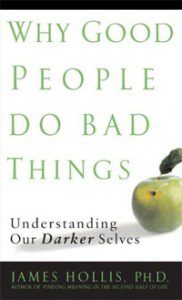 exercising daily, sticking to a diet, or committing to a daily spiritual practice. How’s that working out now that we are eleven-and-a-half months into the year? From the perspective of mid-December, I suspect many of us (including myself) can testify that setting a conscious intention to act in a certain way is no guarantee of long term success. And part of what often undermines our conscious intentions is the parts of ourself that remain unconscious (Hollis xii).
Regarding the importance of shadow work for spiritual growth and psychological maturity, the psychologist Carl Jung said, “One does not become enlightened by imagining figures of light, but by making the darkness conscious” (xvii). Our invitation is to become more conscious of what is currently unconscious. And the promise of shadow work is that as we become more aware of our own complexity, we become “more interesting” to ourselves — and “less dangerous” to ourselves and others (xiii).
Consider these real-life examples of the shadow at play:
- A well-respected accountant is secretly embezzling from a charity.
- A politician who is infamous for voting against equal rights for Lesbian, Gay, Bisexual, and Transgender citizens, then is himself caught having illicit sex with a man.
- A woman sees her wealthy neighbor slip and fall embarrassingly into a puddle. The woman grows hysterical with laughter. She cannot stop laughing — to the mortification of her husband, her son, and later, herself.
- “An educator secretly pillages his children’s college savings to fuel a gambling addiction.”
- A priest who has vowed to devote his life to humbly serving “the least of these” manipulates and abuses children entrusted to his care.
- Our country spends billions on its military budget “while slashing health, legal, and educational services” to our most vulnerable citizens, and cutting taxes on the wealthy.
- Jesus’s example of love, mercy, and forgiveness metastasizes into the harsh persecution of the Crusades, Inquisition, and Holocaust.
These are only a few among many manifestations of the shadow: the “discrepancies between our professed values, our presumptive virtues, and our many embarrassing, often destructive behaviors” (1).
In popular culture, one of the most famous example of the shadow manifesting itself are so-called “Freudian slips” — in which an unconscious slip of the tongue potentially betrays more truth than you had consciously intended (8). Now, of course, there are times when a slip of the tongue is simply that: a verbal confusion that is nothing more than, in the words of one of psychologist, “banana peels in the path of a sentence, accidental shifts of linguistic units.” Sometimes “a cigar is just a cigar”; other times, there is a surplus of meaning that can be a clue into the unconscious.
The trick is discerning which is which. So what are we to make of gaffes such as the following:
- Mayor Richard Daley: “The police aren’t here to create disorder, they’re here to preserve disorder.” (His intention was to say “order.”)
- Dan Quayle: “Republicans understand the importance of bondage between mother and child.” (Presumably, he intended to say “bonding,”)
- George W. Bush: “I’d like to spank all teachers.” (I assume he meant to say “thank.”)
- Condoleezza Rice: “As I was telling my husb — as I was telling President Bush.” (Husband?!)
Are these merely slips of the tongue or are they examples of the unconscious surreptitiously exposing a glimpse of itself?
If you find yourself on the other side of making (or witnessing) a Freudian slip, that is an invitation to reflect on whether there is any deeper truth to what was said. But since Freudian slips by definition are accidental slips of the tongue, they cannot be planned in advance. In contrast, two of the most reliable and helpful sources of shadow material that I have found are repeated patterns and exaggerated reactions.
If you look back and see a repeated negative pattern in your life, I invite you to reflect on what might be underneath that. What is your earliest memory of that pattern (203)? What might be the currently unconscious shadow about which you might become more conscious, potentially breaking the strength of that unconscious pattern which keeps negatively replicating itself? Relatedly, I should note that negative patterns to look for are not merely things that you wish you could stop doing, but also things that you consistently avoid doing, to your detriment (68, 79).
A second reliable source of shadow material are exaggerated reactions — any hypersensitive reaction to a person or situation that in retrospect seems out of proportion to the situation at hand. If a person or situation triggers you, that is an invitation to ask yourself, “What was that about?!” What is potentially being triggered from your unconscious that is augmenting your reaction? Am I just tired, hungry, or stressed? Or, for example, does the way a colleague reminds me of my sister cause me to overreact in a way that is really much more about my fraught relationship with my sister than anything that the colleague said or did? (Note: I’m an only child, and that is a hypothetical example about a nonexistent sister — not a passive aggressive hint at anyone.) The point is that a manifestation of one’s unconscious shadow can warp relationships if you don’t slow down, figure out what’s really going on, and become more conscious of what is currently unconscious.
If you are interested in an accessible introduction to shadow work, there is a good chapter on working with your shadow in Ken Wilber’s book Integral Life Practice. A good short book on the topic is James Hollis’s Why Good People Do Bad Things: Understanding Our Darker Selves. And if you are interested in going even deeper into shadow work, three classic ways of beginning to engage your shadow self more fully are: working with your dreams, journaling, and various forms of therapy.
For now, I’ll share with you just a few of the five questions Hollis suggests as fruitful starting points for shadow work:
- “Can you imagine the opposite of your virtues?” Can you see the ways that your strengths — those things you do well and easily — are also often a clue to your weaknesses? To give one common example, the virtue of selflessly caring for others can have a shadow of neglecting one’s self, which can cause resentment or burnout. Conversely, someone with boundaries that are too rigid might be great at self-care, but have a shadow of not connecting well with others. Becoming more aware of your shadow is an invitation for more balance.
- “What are the key patterns of your relationships?” — especially avoidance, aggression, or repetition? How have these played out again and again in your relationships with your parents, siblings, significant others, children, and coworkers?
- “What annoys you the most about your partner, or others in general?” Why that trait in particular? What’s underneath that consistent annoyance? What’s the shadow? What does it remind you of?
- “Where do you repeatedly undermine yourself, create harmful replications, produce the same old, same old? Where do you flee from your best, riskiest self?” Unless we become incrementally more conscious of the parts of ourselves that are currently unconscious, the default tends to be unconsciously replicating the same patterns we have been repeating for decades.
- “Where do your parents still govern your life — through repetition or overcompensation?” What messages from your childhood have you unconsciously internalized, but never fully interrogated as to whether they are still serving you today (207-232)?
These questions are not easy, but if you are feeling dissatisfied or “stuck” in your life — or if someone close to you is feeling dissatisfied or “stuck” with your life — shadow work can be a powerful source of insight and liberation.
Before moving to my conclusion, I should also be sure to mention that the shadow — the unconscious — manifests itself not only on in our individual lives, but also at the institutional and cultural level. For instance, unreflective American Exceptionalism that proclaims us the “greatest country in the world” can block us from seeing all the areas in which we lag behind other countries and could learn from them; it can also block us from seeing the way that our good intentions around the world often have had tragic unintended consequences.
Relatedly, technological progress has helped us feed increasing numbers of people, cure increasing numbers of diseases, and connect us globally in astounding ways. Among the many corresponding shadows of technological progress are atom bombs (the potential to blow up the world), climate change (the growing threat of making the world uninhabitable), and the ways that our technology is often made affordable through exploitative labor practices in the third world (158-159).
The more I explore shadow work, the more I am suspicious of quick fixes, easy promises, and simplistic certainty — because all such approaches tend to willfully deny (or be oblivious to) the shadow side. Instead, I think James Hollis is on the right track that, “the psychological and spiritual maturity of an individual, of a group, even of a nation, is found precisely in its capacity to tolerate ambiguity and ambivalence, and the anxiety generated by both of them” (201).
Looking toward that greater complexity, for the next few days, we will continue to approach Winter Solstice, the shortest day and longest night of the year. But then the Wheel of the Year will slowly begin turning again in the opposite direction — the pendulum will begin swinging back, as it always does. An invitation of shadow work is to see that when dark days are approaching, that portends a time in which the light of resilience and resistance will grow stronger in response. I look forward to that journey “On The Other Side of Solstice.”
The Rev. Dr. Carl Gregg is a certified spiritual director, a D.Min. graduate of San Francisco Theological Seminary, and the minister of the Unitarian Universalist Congregation of Frederick, Maryland. Follow him on Facebook (facebook.com/carlgregg) and Twitter (@carlgregg).
Learn more about Unitarian Universalism: http://www.uua.org/beliefs/principles
Previous Post

December 13, 2016
What Is “Religion”? (Who Benefits? Who Decides?)
Next Post
December 27, 2016 Reflections on Chrismukah (Christmas+Chanukah) in an Age of Trump
Browse Our Archives
Select a Category Advent Anti-Racism Archaeology Atheism Baptism Best of the Year List Book Reviews Buddhism Catholicism Christian Education Church and State Church Planting Climate Change Conscientious Objection to War Creation Spirituality Death Penalty Didache Disability Rights Discernment Easter Ecology Emergent Church Movement Empire-Critical Ethics Evolution Feminist Theology Film Reviews Gandhi Gospel of Mark Gun Control Hinduism Immigration Reform Interfaith Islam JFK Judaism Jungian Spirituality Lectionary Commentary Lent Letters to the Editor LGBT Marriage MLK Multiculturalism Mysticism Nonviolent Activism Occupy Paganism (Earth-centered Religions) Parables Paul Pluralism Politics Process Theology Quantum Physics Requiescat In Pace Seminary and Divinity School Sermon Series Retrospective Sermons Spiritual Direction Spiritual Practices Stewardship (Fundraising) The Book of J The Wheel of the Year (Paganism) Theoblogger Challenge Triathlon Uncategorized Unitarian Universalism Worship Resources Youth Ministry
Select a Month July 2026 May 2026 March 2026 November 2025 October 2025 August 2025 February 2025 December 2024 October 2024 March 2024 January 2024 December 2023 November 2023 March 2023 February 2023 January 2023 December 2022 November 2022 August 2022 March 2022 February 2022 January 2022 December 2021 September 2021 August 2021 July 2021 June 2021 May 2021 February 2021 January 2021 December 2020 August 2020 June 2020 May 2020 April 2020 March 2020 February 2020 January 2020 December 2019 November 2019 October 2019 September 2019 July 2019 June 2019 March 2019 February 2019 January 2019 December 2018 November 2018 October 2018 September 2018 June 2018 May 2018 April 2018 March 2018 February 2018 January 2018 December 2017 November 2017 October 2017 September 2017 August 2017 July 2017 June 2017 May 2017 April 2017 March 2017 February 2017 January 2017 December 2016 November 2016 October 2016 September 2016 August 2016 June 2016 May 2016 April 2016 March 2016 February 2016 January 2016 December 2015 November 2015 October 2015 September 2015 August 2015 July 2015 June 2015 May 2015 April 2015 March 2015 February 2015 January 2015 December 2014 November 2014 October 2014 August 2014 July 2014 June 2014 May 2014 April 2014 March 2014 February 2014 January 2014 December 2013 November 2013 October 2013 September 2013 August 2013 July 2013 June 2013 May 2013 April 2013 March 2013 February 2013 January 2013 December 2012 November 2012 October 2012 September 2012 August 2012 July 2012 June 2012 May 2012 April 2012 March 2012 February 2012 January 2012 December 2011 November 2011 October 2011 September 2011 August 2011 July 2011 June 2011 May 2011 April 2011 March 2011 February 2011 January 2011 December 2010 November 2010 October 2010 August 2009 July 2009 May 2009
Follow Us!
TAKE THE
Religious Wisdom Quiz
Who was the slave who became a Christian and whose master was Philemon?
Select your answer to see how you score.
Tychicus Sosthenes Barnabas Onesimus
Related posts from Carl Gregg

Reading America at 250: A Nation Wrestles With...


Andrew Holocek on the Power of Darkness

The Stories That Shape Us: Myths, Archetypes, &...
TRENDING AT PATHEOS More Voices

Reading America at 250: A Nation Wrestles With...
As part of my own reflection on the 250th anniversary of the...

Whenever I am reading a book or listening to an argument, I...

President Trump Ban Animal Torture Videos on Facebook
Call for Stricter Regulations of Animal Abuse Content on Facebook Although President...

Draft Amendments to Address Ritual Abuse in New...
The proposed changes would make it illegal for individuals in domestic partnerships...

How Bans on LGBTQ+ Student Clubs Threaten Religious...
On June 20, 2025, the State of Texas passed Senate Bill 12....

The Truth About the Gen Z Revival
This past year, there has been a lot of media buzz surrounding...
view all More Voices blogs
Ad-Free & Subscriber Log-In Subscription Support
- About Us
- 2026 Calendar
- Videos
- Podcasts
- Library of World Religions
- Faith In Media Tracker
- Advertise With Us
- Write for Us
- Privacy Policy
- Terms of Service
- Do Not Sell My Data
- Contact Us
- Radiant Digital
- Manage Newsletter Subscriptions
- Unsubscribe From Notifications
- Sitemap
Copyright 2008-2026, Patheos. All rights reserved.
Subscription Support Ad-Free & Subscriber Log-In
Follow Patheos