
BuddhistCatholicContemplativeEvangelicalGeneral ChristianHinduJewishLatter-day SaintMuslimNew VisionsProgressive Christian
Beliefs
- Buddhist
- Catholic
- Contemplative
- Evangelical
- General Christian
- Hindu
- Jewish
- Latter-day Saint
- More Voices
- Muslim
- New Visions
- Pagan
- Progressive Christian
Topics
- Religion News
- Food and Religion
- Sports and Religion
- Religious Art
- Religious Music and Entertainment
- Religious Events
- History and Religion
- Style and Religion
- Politics and Religion
- Women in Religion
- Recreation Outdoors and Religion
- Business Finance and Religion
- Careers Workplace and Religion
- Education and Religion
- Family Parenting and Religion
- Health Fitness and Religion
- Home and Religion
- Relationships and Religion
- Technology and Religion
- Travel and Religion
Columnists
- Buddhist Columnists
- Business Finance and Religion Columnists
- Careers Workplace and Religion Columnists
- Catholic Columnists
- Contemplative Columnists
- Education and Religion Columnists
- Evangelists Columnists
- Family Parenting and Religion Columnists
- General Christian Columnists
- Health Fitness and Religion Columnists
- Hindu Columnists
- History and Religion Columnists
- Home and Religion Columnists
- Jewish Columnists
- More Voices Columnists
- Latter Day Columnists
- Muslim Columnists
- New Visions Columnists
- Nonreligious Columnists
- Pagan Columnists
- Politics and Religion Columnists
- Progressive Columnists
- Recreation Outdoors and Religion Columnists
- Relationships and Religion Columnists
- Religion News Columnists
- Religious Art Columnists
- Religious Events Columnists
- Religious Music and Entertainment Columnists
- Sports and Religion Columnists
- Style and Religion Columnists
- Technology and Religion Columnists
- Travel and Religion Columnists
- Women in Religion Columnists
Resource Library
- 2026 Calendar
- Library of World Religions
- The 100 Most Holy Places on Earth
- Patheos Answers
- Podcasts
- Videos
- Faith Leaders Database
- Anglican Episcopalian
- Bahai
- Baptist
- Buddhism
- Christianity
- Confucianism
- Eastern Orthodoxy
- Hinduism
- Holiness and Pentecostal
- ISKCON
- Islam
- Judaism
- Lutheran
- Methodist
- The Church of Jesus Christ of Latter-day Saints
- New Age
- Paganism
- Presbytarian and Reformed
- Protestantism
- Religion Behind the Scenes
- Roman Catholic
- Scientology
- Shia Islam
- Sikhism
- Sufism
- Sunni Islam
- Taoism
- Zen
- See all religions
Research Tools
 Ad-Free & Subscriber Log-In Subscription Support
Ad-Free & Subscriber Log-In Subscription Support
Follow Patheos 

- Trending:
- Forgiveness
- |
- Marriage
- |
- Consciousness
- |
- Death Penalty
- |
- Election
- |
- Halloween

- Home
- More Voices
- How to Be Happy (Even in the Age of Trump)
How to Be Happy (Even in the Age of Trump)
Last updated on: December 8, 2016 at 1:57 pm by Carl Gregg
How to Be Happy (Even in the Age of Trump) 2016-12-08T13:57:08-05:00 Carl Gregg
Patheos Explore the world's faith through different perspectives on religion and spirituality! Patheos has the views of the prevalent religions and spiritualities of the world.
I initially planned this post about happiness as a potentially helpful topic in these days of increasing darkness as we approach Winter Solstice, the longest night of the year. Now, there is the additional trauma of the coming Trump Administration. So this post is one among many reflections to come on resistance and resilience in the age of Trump.
Happiness is a broad word with meanings that can range from the more even-keeled positive emotions of contentment, peacefulness, and gratitude to the more volcanic experiences of joy, delight, and ecstasy. In the founding documents of this country, Thomas Jefferson named “Life, liberty, and the pursuit of Happiness” as “unalienable Rights.” And many books and articles are written each year about happiness: what it is and how can you get more of it?!
But happiness is only one of the major emotions — sometimes listed as glad, sad, mad, and bad (meaning fear and shame). The 13th-century Sufi mystic poet Jalāl ad-Dīn Rūmi wrote about how these different emotions sweep through our lives in a poem titled “The Guest House”:
This being human is a guest house.
Every morning a new arrival.
A joy, a depression, a meanness,
some momentary awareness comes
as an unexpected visitor.
Welcome and entertain them all!
There is wisdom in Rumi’s advice: seek to witness without judgement whatever emotions arise within you, knowing that even the most intense will eventually fade. As the saying goes, “The only way out is through.” At the same time, it is also true that some among us are more naturally optimistic, others are more naturally melancholic, and still others of us have a more natural baseline of equanimity.
What are some activities that made you happy as a child? That may give you some clues about potential sources of happiness you might be able to reclaim even as an adult. Science has shown that activities that are totally immersive — that put us in a state that psychologists call “flow” — are reliable sources of happiness. But giving yourself permission to be fully absorbed in an activity without any distractions can be elusive in our age of smart phones and other technologies. Think of the differences in immersion between (1) going to the movie theater, turning off your phone, watching a truly excellent and engaging film and (2) watching a TV show, while scrolling through Facebook, Twitter, and Instagram on your laptop and replying to periodic texts on your phones.
As Jonathan Haidt has detailed in his book The Happiness Hypothesis: Finding Modern Truth in Ancient Wisdom (2006), some of the many immersive activities that can cultivate flow are:
- savoring an excellent meal,
- dancing,
- an intense conversation with a friend,
- creating art (painting, sculpting, writing, photography),
- hiking,
- cooking,
- hosting a dinner party,
- gardening,
- singing in a choir,
- reading a great novel. (95)
Your personality and proclivities will determine which of these activities is most absorbing for you.
This insight about the importance of carving out time and space in your life for activities you find fully absorbing doesn’t mean you have to spend all your time trying to be “in the zone.” Rather, it’s an encouragement to discern if there are ways to have more immersive experiences in your life. One of my favorite stories along these lines is about the physicist A. A. Michelson as told by the novelist Norman Maclean in his book Young Men and Fire:
When I was a young teacher and still thought of myself as a billiards player, I had the pleasure of watching Michelson play billiards nearly every noon. He was by then one of our national idols, having been the first American to win the Nobel Prize in science (for the measurement of the speed of light, among other things). To me, he took on added luster because he was the best amateur billiards player I had ever seen. One noon, while he was still shaking his head at himself for missing an easy shot after he had had a run of thirty-five or thirty-six, I said to him, “You are a fine billiards play, Mr. Michelson.” He shook his head at himself and said, “No, I am getting old. I can still make the long three-cushion shots, but I’m losing my touch on the short ones. He chalked up, but instead of taking the next shot, he finished what he had to say, “Billiards, though is a good game, but billiards is not as good a game as chess.” Still chalking his cue, he said, “Chess, though, is not as good a game as painting.” He made it final by saying, “But painting is not as good a game as physics.” Then he hung up his cue and went home to spend the afternoon painting under the large tree on his front lawn.
For me, the equivalent might be to say that Ultimate Frisbee is a good game. But frisbee is not as good a game as watching and discussing excellent films. And film criticism is not as good a game as preaching sermons, teaching classes, and writing books. Then perhaps I would go home and watch a film (145). What are some parallels in your life?
Many of the approaches we’ve explored so far for the pursuit of happiness are relatively mundane. What about more extreme potential sources of happiness and unhappiness? Consider, for example, scientific studies into the comparative effect on happiness from major, life changing events such as winning the lottery or becoming paralyzed. Studies show that humans are terrible at what psychologists call affective forecasting: “predicting how we will feel in the future.” (Remember that opening line from the Rumi poem: “This being human is a guest house. / Every morning a new arrival.”)
Although there are outliers to every trend, in studying the long-term effects of two life changing events — winning the lottery or becoming paralyzed — it turns out that most of us “grossly overestimate the intensity and the duration of our emotional reactions.” I have had close friends become paralyzed, so I do not say this lightly. But studies show that “Within a year, both lottery winners and paraplegics have both (on average) returned most of the way to their baseline levels of happiness” (Haidt 85).
In that first year after winning a multi-million dollar jackpot, lottery winners often get significant short-term boosts in happiness from the newly-acquired ability to buy a new house, take an exotic vacation, or quit their job. But even within a few months, all those new acquisitions become a new normal. And after that short-term happiness boost from the change in status fades, lottery winners tend to return to their former level of happiness. And there is often conflict with family and friends over whether one is willing to share the winnings, conflict that causes unhappiness. As the saying goes, “Wherever you go, there you are”: you are still the same person with all your emotional baggage even if you are $20 million dollars richer. All that being said, studies also show that, “Nearly all lottery winner are still glad that they won” (85).
On the other side of the spectrum are studies of people who become paralyzed and face initial devastation. But just as the lottery winner had an initial surge in happiness that leveled out, people who become paralyzed tend to have an initial surge in depression that levels out over the first year. Our human brains tend to have both an incredible short-term sensitivity to changes and a tremendous long-term capacity to adapt to whatever the new normal is in ways that are difficult for us to see in advance. As the physicist Stephen Hawkins has said about his motor neuron disease, “My expectations were reduced to zero when I was twenty-one. Everything since then has been a bonus” (85).
Lottery winners tend to assume at first that they will never be sad again, and people who are suddenly paralyzed often assume they will never be happy again. Neither of those tend to be true. Relatedly, our human capacity to adjust in a relatively short time to a “new normal” also means, for example, that the warnings about “normalizing” some of President-elect Trump’s erratic behavior are important to heed. History has shown us that we humans can become adjusted to horrors. As The Rev. Dr. Martin Luther King, Jr. said, “There are certain things in our nation and in the world which I am proud to be maladjusted and which I hope all men of good‐will will be maladjusted until the good societies realize.”
For now, having considered two more extreme examples of the unexpected roller coasters on which we can find ourselves in 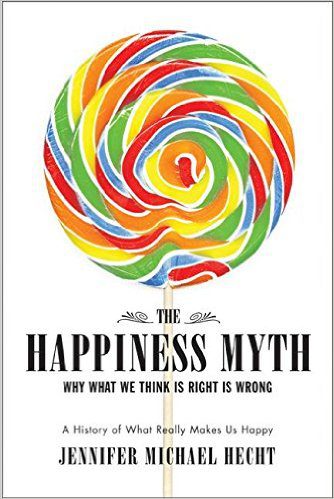 this life, I would like to expand our view to three different types of happiness. As historian Jennifer Hecht has written about in her book The Happiness Myth: An Expose, when considering the pursuit of happiness, one’s response might look very different in regard to pursing a happy moment, a happy day, and a happy life.
A euphoric, ecstatic, joyous moment might come from listening to an amazing song (or going to an incredible concert). It could come from seeing a particular beautiful vista, having great sex, or taking drugs — or the exhilaration of engaging in dangerous behavior. These sources of euphoria are intense, but fleeting — and have diminishing marginal effectiveness over time. Although there’s a lot to be said about the virtues of pleasurable moments, we need to be honest that they are not building blocks for a happy life and that they sometimes carry the risk of prematurely ending a life (Hecht 314).
Expanding beyond intensely happy moments — which might skyrocket you to peaks of rapture, but then send you plummeting back down — what might contribute to a happy day? In a post back in August, I talked about the ways that our brains have evolved to be like “like Velcro for negative experiences and Teflon for positive experiences.” Pausing, even for a few seconds, to savor positive experiences can tip the scales toward having more overall happiness. Examples might include:
- spending time with friends,
- eating dessert,
- having a leisurely morning,
- reading a good book,
- solving a puzzle,
- playing a sport,
- taking time for a hobby, or
- watching your favorite form of entertainment (315).
Any one of these can make the difference in whether a day overall feels like a “Terrible, Horrible, No Good, Very Bad Day” or a “Good Enough, Occasionally Great, Very Good Day.”
Over time, the effect is cumulative. In the words of the writer Annie Dillard, “How we spend our days is, of course, how we spend our lives.” There is significant benefit that can come from delayed gratification, but it’s a dangerous game to risk decades of unhappy days for the hope of happiness in some abstract future that you may never reach. Instead, the invitation is to consider how you might carve out some happiness within the life you already have.
Expanding our view one more time, consider this list of what can contribute toward a happy life over the course of decades:
- Family
- Friendships
- Celebrations and rituals
- Travel
- Study
- Skills mastered
- Money in the bank
- Community service
- An attractive appearance
- Adventure
- Serving as an inspiration
- A history of a lot of good days
- A history of some euphoria (315)
Which of these do you feel led to cultivate in this season of your life?
The Rev. Dr. Carl Gregg is a certified spiritual director, a D.Min. graduate of San Francisco Theological Seminary, and the minister of the Unitarian Universalist Congregation of Frederick, Maryland. Follow him on Facebook (facebook.com/carlgregg) and Twitter (@carlgregg).
Learn more about Unitarian Universalism: http://www.uua.org/beliefs/principles
Previous Post

November 22, 2016
What’s Fair? Who Decides?
Next Post
December 13, 2016 What Is “Religion”? (Who Benefits? Who Decides?)
Browse Our Archives
Select a Category Advent Anti-Racism Archaeology Atheism Baptism Best of the Year List Book Reviews Buddhism Catholicism Christian Education Church and State Church Planting Climate Change Conscientious Objection to War Creation Spirituality Death Penalty Didache Disability Rights Discernment Easter Ecology Emergent Church Movement Empire-Critical Ethics Evolution Feminist Theology Film Reviews Gandhi Gospel of Mark Gun Control Hinduism Immigration Reform Interfaith Islam JFK Judaism Jungian Spirituality Lectionary Commentary Lent Letters to the Editor LGBT Marriage MLK Multiculturalism Mysticism Nonviolent Activism Occupy Paganism (Earth-centered Religions) Parables Paul Pluralism Politics Process Theology Quantum Physics Requiescat In Pace Seminary and Divinity School Sermon Series Retrospective Sermons Spiritual Direction Spiritual Practices Stewardship (Fundraising) The Book of J The Wheel of the Year (Paganism) Theoblogger Challenge Triathlon Uncategorized Unitarian Universalism Worship Resources Youth Ministry
Select a Month July 2026 May 2026 March 2026 November 2025 October 2025 August 2025 February 2025 December 2024 October 2024 March 2024 January 2024 December 2023 November 2023 March 2023 February 2023 January 2023 December 2022 November 2022 August 2022 March 2022 February 2022 January 2022 December 2021 September 2021 August 2021 July 2021 June 2021 May 2021 February 2021 January 2021 December 2020 August 2020 June 2020 May 2020 April 2020 March 2020 February 2020 January 2020 December 2019 November 2019 October 2019 September 2019 July 2019 June 2019 March 2019 February 2019 January 2019 December 2018 November 2018 October 2018 September 2018 June 2018 May 2018 April 2018 March 2018 February 2018 January 2018 December 2017 November 2017 October 2017 September 2017 August 2017 July 2017 June 2017 May 2017 April 2017 March 2017 February 2017 January 2017 December 2016 November 2016 October 2016 September 2016 August 2016 June 2016 May 2016 April 2016 March 2016 February 2016 January 2016 December 2015 November 2015 October 2015 September 2015 August 2015 July 2015 June 2015 May 2015 April 2015 March 2015 February 2015 January 2015 December 2014 November 2014 October 2014 August 2014 July 2014 June 2014 May 2014 April 2014 March 2014 February 2014 January 2014 December 2013 November 2013 October 2013 September 2013 August 2013 July 2013 June 2013 May 2013 April 2013 March 2013 February 2013 January 2013 December 2012 November 2012 October 2012 September 2012 August 2012 July 2012 June 2012 May 2012 April 2012 March 2012 February 2012 January 2012 December 2011 November 2011 October 2011 September 2011 August 2011 July 2011 June 2011 May 2011 April 2011 March 2011 February 2011 January 2011 December 2010 November 2010 October 2010 August 2009 July 2009 May 2009
Follow Us!
TAKE THE
Religious Wisdom Quiz
What does "Hosanna" mean?
Select your answer to see how you score.
Save us Praise Rejoice Hurry
Related posts from Carl Gregg

Reading America at 250: A Nation Wrestles With...


Andrew Holocek on the Power of Darkness

The Stories That Shape Us: Myths, Archetypes, &...
TRENDING AT PATHEOS More Voices

Reading America at 250: A Nation Wrestles With...
As part of my own reflection on the 250th anniversary of the...

Whenever I am reading a book or listening to an argument, I...

President Trump Ban Animal Torture Videos on Facebook
Call for Stricter Regulations of Animal Abuse Content on Facebook Although President...

Draft Amendments to Address Ritual Abuse in New...
The proposed changes would make it illegal for individuals in domestic partnerships...

How Bans on LGBTQ+ Student Clubs Threaten Religious...
On June 20, 2025, the State of Texas passed Senate Bill 12....

The Truth About the Gen Z Revival
This past year, there has been a lot of media buzz surrounding...
view all More Voices blogs
Ad-Free & Subscriber Log-In Subscription Support
- About Us
- 2026 Calendar
- Videos
- Podcasts
- Library of World Religions
- Faith In Media Tracker
- Advertise With Us
- Write for Us
- Privacy Policy
- Terms of Service
- Do Not Sell My Data
- Contact Us
- Radiant Digital
- Manage Newsletter Subscriptions
- Unsubscribe From Notifications
- Sitemap
Copyright 2008-2026, Patheos. All rights reserved.
Subscription Support Ad-Free & Subscriber Log-In
Follow Patheos