
BuddhistCatholicContemplativeEvangelicalGeneral ChristianHinduJewishLatter-day SaintMuslimNew VisionsProgressive Christian
Beliefs
- Buddhist
- Catholic
- Contemplative
- Evangelical
- General Christian
- Hindu
- Jewish
- Latter-day Saint
- More Voices
- Muslim
- New Visions
- Pagan
- Progressive Christian
Topics
- Religion News
- Food and Religion
- Sports and Religion
- Religious Art
- Religious Music and Entertainment
- Religious Events
- History and Religion
- Style and Religion
- Politics and Religion
- Women in Religion
- Recreation Outdoors and Religion
- Business Finance and Religion
- Careers Workplace and Religion
- Education and Religion
- Family Parenting and Religion
- Health Fitness and Religion
- Home and Religion
- Relationships and Religion
- Technology and Religion
- Travel and Religion
Columnists
- Buddhist Columnists
- Business Finance and Religion Columnists
- Careers Workplace and Religion Columnists
- Catholic Columnists
- Contemplative Columnists
- Education and Religion Columnists
- Evangelists Columnists
- Family Parenting and Religion Columnists
- General Christian Columnists
- Health Fitness and Religion Columnists
- Hindu Columnists
- History and Religion Columnists
- Home and Religion Columnists
- Jewish Columnists
- More Voices Columnists
- Latter Day Columnists
- Muslim Columnists
- New Visions Columnists
- Nonreligious Columnists
- Pagan Columnists
- Politics and Religion Columnists
- Progressive Columnists
- Recreation Outdoors and Religion Columnists
- Relationships and Religion Columnists
- Religion News Columnists
- Religious Art Columnists
- Religious Events Columnists
- Religious Music and Entertainment Columnists
- Sports and Religion Columnists
- Style and Religion Columnists
- Technology and Religion Columnists
- Travel and Religion Columnists
- Women in Religion Columnists
Resource Library
- 2026 Calendar
- Library of World Religions
- The 100 Most Holy Places on Earth
- Patheos Answers
- Podcasts
- Videos
- Faith Leaders Database
- Anglican Episcopalian
- Bahai
- Baptist
- Buddhism
- Christianity
- Confucianism
- Eastern Orthodoxy
- Hinduism
- Holiness and Pentecostal
- ISKCON
- Islam
- Judaism
- Lutheran
- Methodist
- The Church of Jesus Christ of Latter-day Saints
- New Age
- Paganism
- Presbytarian and Reformed
- Protestantism
- Religion Behind the Scenes
- Roman Catholic
- Scientology
- Shia Islam
- Sikhism
- Sufism
- Sunni Islam
- Taoism
- Zen
- See all religions
Research Tools
 Ad-Free & Subscriber Log-In Subscription Support
Ad-Free & Subscriber Log-In Subscription Support
Follow Patheos 

- Trending:
- Forgiveness
- |
- Marriage
- |
- Consciousness
- |
- Death Penalty
- |
- Election
- |
- Halloween

- Home
- More Voices
- Voting on the Side of Love
Voting on the Side of Love
Last updated on: November 7, 2016 at 3:04 pm by Carl Gregg
Voting on the Side of Love 2016-11-07T15:04:15-05:00 Carl Gregg
Patheos Explore the world's faith through different perspectives on religion and spirituality! Patheos has the views of the prevalent religions and spiritualities of the world.
Hillary Clinton announced her candidacy for President of the United States on April 12, 2015. Donald Trump announced his presidential bid the next month, on June 16. So if you feel like this campaign has been going on forever, it has been going for a year-and-a-half. But as you may have heard a little something about, Election Day will finally arrive tomorrow!
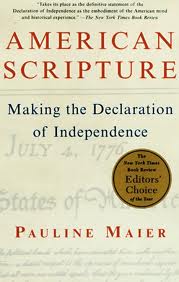 The volatility of this election season inspired me to take a step back from the daily headlines and consider the history of our democratic process. (But stick with me, and I will pivot halfway through this post to how this relates to voting on the side of love today.) In reading Pauline Maier’s excellent book American Scripture: Making the Declaration of Independence, I was reminded that less than a year before the Second Continental Congress would gather in Philadelphia to sign the Declaration of Independence on July 4, 1776, “Even the most radical members of Congress professed a strong preference for remaining in the [British] Empire” (21). As late as August 25, 1775, Jefferson himself, future author of our Declaration of Independence, wrote in a private letter that his strong preference was to mend ties with Britain. At that time, there remained hope that a middle way might be found so that the thirteen colonies would become free from the control of the British Parliament, but would retain an allegiance to the British Crown. But Parliament was unwilling to compromise: the colonists could be either entirely under Parliament, or they could fight to be outside the British system (23).
So we declared our independence with these opening words:
When in the Course of human events, it becomes necessary for one people to dissolve the political bands which have connected them with another, and to assume among the powers of the earth, the separate and equal station to which the Laws of Nature and of Nature’s God entitle them, a decent respect to the opinions of mankind requires that they should declare the causes which impel them to the separation.
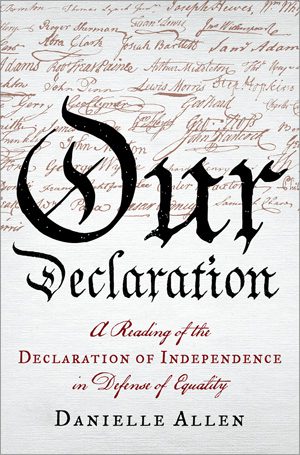 Consider how bold a claim that was. The U.S. may be a global superpower today, but 240 years ago, Britain’s population was three times larger, the British navy was the military superpower, and Britain had far more financial resources — whereas “The Continental Congress had no power to tax and consequently, little power to borrow.” Nevertheless, as Danielle Allen has explored in her important book, Declaration: A Reading of the Declaration of Independence in Defense of Equality, we — thirteen colonies with a Continental Congress that had been operating a mere two years — declared ourselves to hold a “separate and equal station” to a British political and legal system which dated back more than seven centuries to the 1066 invasion of William the Conqueror (119-120).
And that was just the opening sentence. Turning to the even more famous — and much longer! — second sentence:
We hold these truths to be self-evident, that all men are created equal, that they are endowed by their Creator with certain unalienable Rights, that among these are Life, Liberty and the pursuit of Happiness, — That to secure these rights, Governments are instituted among Men, deriving their just powers from the consent of the governed, — That whenever any Form of Government becomes destructive of these ends, it is the Right of the People to alter or to abolish it, and to institute new Government, laying its foundation on such principles and organizing its powers in such form, as to them shall seem most likely to effect their Safety and Happiness.
That is all one sentence. I have taken the time to quote it in the midst of this brutal presidential election to remind us of some of our highest values: that at our best in this country we have continued to expand the circle of who is included and who has access to life, liberty, and the pursuit of happiness.
In that spirit, I want to invite you to reflect on just one more sentence from the Declaration of Independence, which also seems particularly resonant at this time in our nation’s history. The Declaration’s third sentence reminds us that our founders, who themselves wanted to avoid division from Britain, also cautioned against further declarations of independence. As we saw 150 years ago in the Civil War, this is no abstract concern. The Confederates States of America tried to declare independence from the union. But in the words of our original Declaration: “Prudence, indeed, will dictate that Governments long established should not be changed for light and transient causes; and accordingly all experience hath shewn, that mankind are more disposed to suffer, while evils are sufferable, than to right themselves by abolishing the forms to which they are accustomed.”
There’s a lot more to say about the history and significance of the Declaration of Independence. I would love, for instance, to get into the details of how Jefferson’s original draft was changed by both a drafting committee as well as the Continental Congress itself (67-76). I would also love to say more about how the bold claim that we have a “separate and equal station” to Britain was perverted by the Supreme Court’s 1896 “Plessy v. Ferguson” decision to use “separate but equal” as a cynical justification for racial segregation. But instead, I would like to invite us to shift our focus to potential parallels today.
We have been exploring the boldness of the fledgling thirteen colonies declaring themselves “separate and equal” to the British Empire. But I invite you to consider that the boldness we need today is not another Declaration of Independence. We are already too divided from one another, too separate, too individualistic. We need a similarly bold Declaration of Interdependence that reminds us how much we need each other, helps us take better care of one another, and assures each of us that we will be taken care of.
As one example of what such a Declaration of Interdependence might look like, I invite you to consider the nonpartisan Higher Ground Moral Declaration, collaboratively written in this midst of this presidential election season by many progressive religious leaders in our country:
We declare that the deepest public concerns of our nation and faith traditions are how our society treats the poor, those on the margins, the least of these, women, children, workers, immigrants and the sick; equality and representation under the law; and the desire for peace, love and harmony within and among nations. Together, we lift up and defend the most sacred moral principles of our faith and constitutional values, which are:
- the economic liberation of all people;
- ensuring every child receives access to quality education;
- healthcare access for all;
- criminal justice reform; and
- ensuring historically marginalized communities have equal protection under the law.
Our moral traditions have a firm foundation upon which to stand against the divide-and-conquer strategies of extremists. We believe in a moral agenda that stands against systemic racism, classism, poverty, xenophobia, and any attempt to promote hate towards any members of the human family. We claim a higher ground in partisan debate by returning public discourse to our deepest moral and constitutional values.
The “Higher Ground Moral Declaration” is an attempt to start not with defending a political candidate (or defaming a political opponent) — but instead to start with discerning the moral and ethical values that our conscience calls us toward, and then allowing individuals to use those values, in whatever way feels right to them, to determine which candidate to support.
To translate this perspective into a the language of my own Unitarian Universalist tradition, we talk a lot about “Standing on the Side of Love” or “Answering the Call of Love;” so what might it look like to “vote on the side of love?” Here’s one response that transforms the UU Seven Principles into questions for political candidates:
-
Do your policy proposals reflect the inherent worth and dignity of every person?
-
If elected, how will your everyday decisions demonstrate justice, equity and compassion in human relations?
-
How will you encourage acceptance and growth in one another across party lines?
-
What insights have you learned from your own search for truth and meaning that will guide you as a political leader?
-
What ideas do you have to improve our democratic process?
-
Within our international community, how will you work towards a goal of world community with peace, liberty and justice for all?
-
Acknowledging our interdependence, how will your decisions impact our planet and future generations?
There may well be other factors that influence your choice of candidate, and that is your right. But the Higher Ground Moral Declaration and these questions for “voting on the side of love” are ways to factor progressive religious values into our discernment of conscience and our democratic process.
As The Rev. Dr. Martin Luther King, Jr. said in his book The Strength to Love:
The church must be reminded that it is not the master or the servant of the state, but rather the conscience of the state. It must be the guide and the critic of the state, and never its tool. If the church does not recapture its prophetic zeal, it will become an irrelevant social club without moral or spiritual authority.
In the words of the High Ground Moral Declaration, recapturing our prophetic zeal for such a time as this means taking action for causes such as “economic democracy, equality in education, healthcare for all, criminal justice reform, and equal protection under the law” — though ultimately the details are left up to the discernment of your conscience. In that spirit, on Election Day and beyond, may we each continue to discern how we are called to act for peace and justice in the world.
The Rev. Dr. Carl Gregg is a trained spiritual director, a D.Min. graduate of San Francisco Theological Seminary, and the minister of the Unitarian Universalist Congregation of Frederick, Maryland. Follow him on Facebook (facebook.com/carlgregg) and Twitter (@carlgregg).
Learn more about Unitarian Universalism: http://www.uua.org/beliefs/principles
Previous Post

November 1, 2016
“Witches of America”
Next Post
November 17, 2016 "No Permanent Waves": Rising Up Again after an Election
Browse Our Archives
Select a Category Advent Anti-Racism Archaeology Atheism Baptism Best of the Year List Book Reviews Buddhism Catholicism Christian Education Church and State Church Planting Climate Change Conscientious Objection to War Creation Spirituality Death Penalty Didache Disability Rights Discernment Easter Ecology Emergent Church Movement Empire-Critical Ethics Evolution Feminist Theology Film Reviews Gandhi Gospel of Mark Gun Control Hinduism Immigration Reform Interfaith Islam JFK Judaism Jungian Spirituality Lectionary Commentary Lent Letters to the Editor LGBT Marriage MLK Multiculturalism Mysticism Nonviolent Activism Occupy Paganism (Earth-centered Religions) Parables Paul Pluralism Politics Process Theology Quantum Physics Requiescat In Pace Seminary and Divinity School Sermon Series Retrospective Sermons Spiritual Direction Spiritual Practices Stewardship (Fundraising) The Book of J The Wheel of the Year (Paganism) Theoblogger Challenge Triathlon Uncategorized Unitarian Universalism Worship Resources Youth Ministry
Select a Month July 2026 May 2026 March 2026 November 2025 October 2025 August 2025 February 2025 December 2024 October 2024 March 2024 January 2024 December 2023 November 2023 March 2023 February 2023 January 2023 December 2022 November 2022 August 2022 March 2022 February 2022 January 2022 December 2021 September 2021 August 2021 July 2021 June 2021 May 2021 February 2021 January 2021 December 2020 August 2020 June 2020 May 2020 April 2020 March 2020 February 2020 January 2020 December 2019 November 2019 October 2019 September 2019 July 2019 June 2019 March 2019 February 2019 January 2019 December 2018 November 2018 October 2018 September 2018 June 2018 May 2018 April 2018 March 2018 February 2018 January 2018 December 2017 November 2017 October 2017 September 2017 August 2017 July 2017 June 2017 May 2017 April 2017 March 2017 February 2017 January 2017 December 2016 November 2016 October 2016 September 2016 August 2016 June 2016 May 2016 April 2016 March 2016 February 2016 January 2016 December 2015 November 2015 October 2015 September 2015 August 2015 July 2015 June 2015 May 2015 April 2015 March 2015 February 2015 January 2015 December 2014 November 2014 October 2014 August 2014 July 2014 June 2014 May 2014 April 2014 March 2014 February 2014 January 2014 December 2013 November 2013 October 2013 September 2013 August 2013 July 2013 June 2013 May 2013 April 2013 March 2013 February 2013 January 2013 December 2012 November 2012 October 2012 September 2012 August 2012 July 2012 June 2012 May 2012 April 2012 March 2012 February 2012 January 2012 December 2011 November 2011 October 2011 September 2011 August 2011 July 2011 June 2011 May 2011 April 2011 March 2011 February 2011 January 2011 December 2010 November 2010 October 2010 August 2009 July 2009 May 2009
Follow Us!
TAKE THE
Religious Wisdom Quiz
Which was the day that God ended His creation and rested?
Select your answer to see how you score.
He never rested On the 6th day On the 7th day On the 5th day
Related posts from Carl Gregg

Reading America at 250: A Nation Wrestles With...


Andrew Holocek on the Power of Darkness

The Stories That Shape Us: Myths, Archetypes, &...
TRENDING AT PATHEOS More Voices

Reading America at 250: A Nation Wrestles With...
As part of my own reflection on the 250th anniversary of the...

Whenever I am reading a book or listening to an argument, I...

President Trump Ban Animal Torture Videos on Facebook
Call for Stricter Regulations of Animal Abuse Content on Facebook Although President...

Draft Amendments to Address Ritual Abuse in New...
The proposed changes would make it illegal for individuals in domestic partnerships...

How Bans on LGBTQ+ Student Clubs Threaten Religious...
On June 20, 2025, the State of Texas passed Senate Bill 12....

The Truth About the Gen Z Revival
This past year, there has been a lot of media buzz surrounding...
view all More Voices blogs
Ad-Free & Subscriber Log-In Subscription Support
- About Us
- 2026 Calendar
- Videos
- Podcasts
- Library of World Religions
- Faith In Media Tracker
- Advertise With Us
- Write for Us
- Privacy Policy
- Terms of Service
- Do Not Sell My Data
- Contact Us
- Radiant Digital
- Manage Newsletter Subscriptions
- Unsubscribe From Notifications
- Sitemap
Copyright 2008-2026, Patheos. All rights reserved.
Subscription Support Ad-Free & Subscriber Log-In
Follow Patheos