
BuddhistCatholicContemplativeEvangelicalGeneral ChristianHinduJewishLatter-day SaintMuslimNew VisionsProgressive Christian
Beliefs
- Buddhist
- Catholic
- Contemplative
- Evangelical
- General Christian
- Hindu
- Jewish
- Latter-day Saint
- More Voices
- Muslim
- New Visions
- Pagan
- Progressive Christian
Topics
- Religion News
- Food and Religion
- Sports and Religion
- Religious Art
- Religious Music and Entertainment
- Religious Events
- History and Religion
- Style and Religion
- Politics and Religion
- Women in Religion
- Recreation Outdoors and Religion
- Business Finance and Religion
- Careers Workplace and Religion
- Education and Religion
- Family Parenting and Religion
- Health Fitness and Religion
- Home and Religion
- Relationships and Religion
- Technology and Religion
- Travel and Religion
Columnists
- Buddhist Columnists
- Business Finance and Religion Columnists
- Careers Workplace and Religion Columnists
- Catholic Columnists
- Contemplative Columnists
- Education and Religion Columnists
- Evangelists Columnists
- Family Parenting and Religion Columnists
- General Christian Columnists
- Health Fitness and Religion Columnists
- Hindu Columnists
- History and Religion Columnists
- Home and Religion Columnists
- Jewish Columnists
- More Voices Columnists
- Latter Day Columnists
- Muslim Columnists
- New Visions Columnists
- Nonreligious Columnists
- Pagan Columnists
- Politics and Religion Columnists
- Progressive Columnists
- Recreation Outdoors and Religion Columnists
- Relationships and Religion Columnists
- Religion News Columnists
- Religious Art Columnists
- Religious Events Columnists
- Religious Music and Entertainment Columnists
- Sports and Religion Columnists
- Style and Religion Columnists
- Technology and Religion Columnists
- Travel and Religion Columnists
- Women in Religion Columnists
Resource Library
- 2026 Calendar
- Library of World Religions
- The 100 Most Holy Places on Earth
- Patheos Answers
- Podcasts
- Videos
- Faith Leaders Database
- Anglican Episcopalian
- Bahai
- Baptist
- Buddhism
- Christianity
- Confucianism
- Eastern Orthodoxy
- Hinduism
- Holiness and Pentecostal
- ISKCON
- Islam
- Judaism
- Lutheran
- Methodist
- The Church of Jesus Christ of Latter-day Saints
- New Age
- Paganism
- Presbytarian and Reformed
- Protestantism
- Religion Behind the Scenes
- Roman Catholic
- Scientology
- Shia Islam
- Sikhism
- Sufism
- Sunni Islam
- Taoism
- Zen
- See all religions
Research Tools
 Ad-Free & Subscriber Log-In Subscription Support
Ad-Free & Subscriber Log-In Subscription Support
Follow Patheos 

- Trending:
- Forgiveness
- |
- Marriage
- |
- Consciousness
- |
- Death Penalty
- |
- Election
- |
- Halloween

- Home
- More Voices
- “No Permanent Waves”: Rising Up Again after an Election
“No Permanent Waves”: Rising Up Again after an Election
Last updated on: November 17, 2016 at 11:10 am by Carl Gregg
“No Permanent Waves”: Rising Up Again after an Election 2016-11-17T11:10:11-05:00 Carl Gregg
Patheos Explore the world's faith through different perspectives on religion and spirituality! Patheos has the views of the prevalent religions and spiritualities of the world.
What do we do when the President-elect of the United States is a bully and a serial liar, who has fanned the flames of racism, anti-Semitism, misogyny, and Islamophobia in our country? My first impulse as a progressive religious leader was to reaffirm that regardless of this or any other election, the congregation I serve will continue to be in solidarity with Muslims, women, refugees, people of color, and people with disabilities. We will continue to advocate for the equal rights of Lesbians, Gay, Bisexual, Transgender, Queer and Questioning citizens of this county**.**
Hillary Clinton’s candidacy inspired me to read A History of U.S. Feminisms, and in the wake of her defeat, I take some  solace in the wave-like pattern of the feminist movement in our country. There are no permanent waves. But when a wave crashes, another begins the process of rising up again.
Historians have named three periods, or “waves” of feminism in describing the cresting and crashing waves of gendered protest and backlash that have brought us to this present moment. The first wave of the women’s movement in the U.S. began to rise almost 170 years ago, in 1848 in Seneca Falls, New York, with the first women’s rights convention. That first wave crested ninety-six years ago in 1920 with the passage of the Nineteenth Amendment to the Constitution: “The right of citizens of the United States to vote shall not be denied or abridged by the United States or by any State on account of sex” (Dicker 6). There’s a wonderful story that when:
“Tennessee became the thirty-sixth and final state to ratify the Nineteenth Amendment, the final and deciding vote in Tennessee belonged to twenty-four-year-old Harry Burns, who changed his vote after receiving a telegram from his mother reminding him to “be a good boy” and “vote for suffrage.” (54-55)
As an example of how long political waves can take to crest, only one of the original signers of the 1848 Declaration of Sentiments lived to see women win the right to vote in this country in 1920, but that 1848 groundwork was vital to the victory that came seven decades later (55).
After four decades of rebuilding, the second wave of the women’s movement began in the early 1960s, emerging alongside many other counter-cultural movements. And that wave grew in size and strength to achieve many successes including the passage of Title IX in 1972, which “prohibited sex discrimination in schools receiving federal funding” and created a sea change in athletic opportunities for girls and women (98). And 1973’s Supreme Court decision of Roe v. Wade advanced reproductive justice for women.
But despite these and other successes, second-wave feminism began tragically crashing with the slow death of the Equal Rights Amendment, which said: “Equality of rights under the law shall not be denied or abridged by the United States or by any state on account of sex.” Although the ERA passed the House of Representatives and the Senate to triumphant celebration in 1971 and 1972 respectively, it was ultimately defeated a decade later in 1982 when “North Carolina tabled the amendment and Florida and Illinois rejected it” (100).
After a backlash to the women’s movement in the 1980s, many historians date the resurgent third wave of the women’s movement to the rise in consciousness about sexual harassment triggered by law professor Anita Hill’s allegations against Supreme Court nominee Clarence Thomas in 1991 (103). The sexist way the all-male Senate Judiciary Committee treated Professor Hill inspired many women to run for Congress the next year, resulting in the election of five new female senators and twenty-four new women members in the House of Representatives (118). The second and third waves of the women’s movement have also become increasingly intersectional, embracing race, class, sexual orientation, and transgender perspectives. (The word intersectional uses the analogy of a traffic intersection in which oncoming traffic is coming from many different directions at once.)
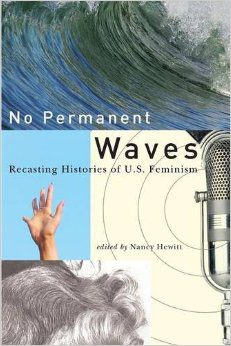 We’re still too close historically to declare an end to third wave feminism and/or a beginning to a fourth wave. But the more important point is that there are no permanent waves in any justice movement. As explored in the anthology, No Permanent Waves: Recasting Histories of U.S. Feminism, the wave metaphor also does not mean that “The decades excluded from the wave — before 1948 or from 1920 to 1960 — are feminist-free zones” (5). When a wave crashes, another begins the process of rising up again. Any surfer will tell you that as glorious as it is to ride a wave, you can’t continually spend all your time on top of a wave; that’s not how the ocean works.
But in the words of my colleague, The Rev. Rebecca Gordon: “Our job is to keep scanning the horizon for the next wave. It will come.” And our call is the contribute to building that wave. We are in this together, and I am grateful to be on this journey with you.
For now, I’ll conclude with these words of support from my colleague The Rev. Ashley Horan:
You are enough, you are precious, your work and your life matter, and you are not alone. You are part of a “we,” a great cloud of witnesses living and dead who have insisted that this beautiful, broken world of ours is a blessing worthy of both deep gratitude and fierce protection. Whatever happens [in the wake of this or any other political election], our ancestors and our descendants are beckoning us, compelling us onward toward greater connection, greater compassion, greater commitment to one another and to the earth. Together, we are resilient and resourceful enough to say “yes” to that call, to make it our life’s work in a thousand different ways, knowing that we can do no other than bind ourselves more tightly together, and throw ourselves into the holy work of showing up, again and again, to be part of building that world of which we dream but which we have not yet seen.
The Rev. Dr. Carl Gregg is a trained spiritual director, a D.Min. graduate of San Francisco Theological Seminary, and the minister of the Unitarian Universalist Congregation of Frederick, Maryland. Follow him on Facebook (facebook.com/carlgregg) and Twitter (@carlgregg).
Learn more about Unitarian Universalism: http://www.uua.org/beliefs/principles
Previous Post

November 7, 2016
Voting on the Side of Love
Next Post
November 22, 2016 What’s Fair? Who Decides?
Browse Our Archives
Select a Category Advent Anti-Racism Archaeology Atheism Baptism Best of the Year List Book Reviews Buddhism Catholicism Christian Education Church and State Church Planting Climate Change Conscientious Objection to War Creation Spirituality Death Penalty Didache Disability Rights Discernment Easter Ecology Emergent Church Movement Empire-Critical Ethics Evolution Feminist Theology Film Reviews Gandhi Gospel of Mark Gun Control Hinduism Immigration Reform Interfaith Islam JFK Judaism Jungian Spirituality Lectionary Commentary Lent Letters to the Editor LGBT Marriage MLK Multiculturalism Mysticism Nonviolent Activism Occupy Paganism (Earth-centered Religions) Parables Paul Pluralism Politics Process Theology Quantum Physics Requiescat In Pace Seminary and Divinity School Sermon Series Retrospective Sermons Spiritual Direction Spiritual Practices Stewardship (Fundraising) The Book of J The Wheel of the Year (Paganism) Theoblogger Challenge Triathlon Uncategorized Unitarian Universalism Worship Resources Youth Ministry
Select a Month July 2026 May 2026 March 2026 November 2025 October 2025 August 2025 February 2025 December 2024 October 2024 March 2024 January 2024 December 2023 November 2023 March 2023 February 2023 January 2023 December 2022 November 2022 August 2022 March 2022 February 2022 January 2022 December 2021 September 2021 August 2021 July 2021 June 2021 May 2021 February 2021 January 2021 December 2020 August 2020 June 2020 May 2020 April 2020 March 2020 February 2020 January 2020 December 2019 November 2019 October 2019 September 2019 July 2019 June 2019 March 2019 February 2019 January 2019 December 2018 November 2018 October 2018 September 2018 June 2018 May 2018 April 2018 March 2018 February 2018 January 2018 December 2017 November 2017 October 2017 September 2017 August 2017 July 2017 June 2017 May 2017 April 2017 March 2017 February 2017 January 2017 December 2016 November 2016 October 2016 September 2016 August 2016 June 2016 May 2016 April 2016 March 2016 February 2016 January 2016 December 2015 November 2015 October 2015 September 2015 August 2015 July 2015 June 2015 May 2015 April 2015 March 2015 February 2015 January 2015 December 2014 November 2014 October 2014 August 2014 July 2014 June 2014 May 2014 April 2014 March 2014 February 2014 January 2014 December 2013 November 2013 October 2013 September 2013 August 2013 July 2013 June 2013 May 2013 April 2013 March 2013 February 2013 January 2013 December 2012 November 2012 October 2012 September 2012 August 2012 July 2012 June 2012 May 2012 April 2012 March 2012 February 2012 January 2012 December 2011 November 2011 October 2011 September 2011 August 2011 July 2011 June 2011 May 2011 April 2011 March 2011 February 2011 January 2011 December 2010 November 2010 October 2010 August 2009 July 2009 May 2009
Follow Us!
TAKE THE
Religious Wisdom Quiz
What was the rider of the Red Horse in Revelation given?
Select your answer to see how you score.
A balance scale A large sword A crown A bow
Related posts from Carl Gregg

Reading America at 250: A Nation Wrestles With...


Andrew Holocek on the Power of Darkness

The Stories That Shape Us: Myths, Archetypes, &...
TRENDING AT PATHEOS More Voices

Reading America at 250: A Nation Wrestles With...
As part of my own reflection on the 250th anniversary of the...

Whenever I am reading a book or listening to an argument, I...

President Trump Ban Animal Torture Videos on Facebook
Call for Stricter Regulations of Animal Abuse Content on Facebook Although President...

Draft Amendments to Address Ritual Abuse in New...
The proposed changes would make it illegal for individuals in domestic partnerships...

How Bans on LGBTQ+ Student Clubs Threaten Religious...
On June 20, 2025, the State of Texas passed Senate Bill 12....

The Truth About the Gen Z Revival
This past year, there has been a lot of media buzz surrounding...
view all More Voices blogs
Ad-Free & Subscriber Log-In Subscription Support
- About Us
- 2026 Calendar
- Videos
- Podcasts
- Library of World Religions
- Faith In Media Tracker
- Advertise With Us
- Write for Us
- Privacy Policy
- Terms of Service
- Do Not Sell My Data
- Contact Us
- Radiant Digital
- Manage Newsletter Subscriptions
- Unsubscribe From Notifications
- Sitemap
Copyright 2008-2026, Patheos. All rights reserved.
Subscription Support Ad-Free & Subscriber Log-In
Follow Patheos