
BuddhistCatholicContemplativeEvangelicalGeneral ChristianHinduJewishLatter-day SaintMuslimNew VisionsProgressive Christian
Beliefs
- Buddhist
- Catholic
- Contemplative
- Evangelical
- General Christian
- Hindu
- Jewish
- Latter-day Saint
- More Voices
- Muslim
- New Visions
- Pagan
- Progressive Christian
Topics
- Religion News
- Food and Religion
- Sports and Religion
- Religious Art
- Religious Music and Entertainment
- Religious Events
- History and Religion
- Style and Religion
- Politics and Religion
- Women in Religion
- Recreation Outdoors and Religion
- Business Finance and Religion
- Careers Workplace and Religion
- Education and Religion
- Family Parenting and Religion
- Health Fitness and Religion
- Home and Religion
- Relationships and Religion
- Technology and Religion
- Travel and Religion
Columnists
- Buddhist Columnists
- Business Finance and Religion Columnists
- Careers Workplace and Religion Columnists
- Catholic Columnists
- Contemplative Columnists
- Education and Religion Columnists
- Evangelists Columnists
- Family Parenting and Religion Columnists
- General Christian Columnists
- Health Fitness and Religion Columnists
- Hindu Columnists
- History and Religion Columnists
- Home and Religion Columnists
- Jewish Columnists
- More Voices Columnists
- Latter Day Columnists
- Muslim Columnists
- New Visions Columnists
- Nonreligious Columnists
- Pagan Columnists
- Politics and Religion Columnists
- Progressive Columnists
- Recreation Outdoors and Religion Columnists
- Relationships and Religion Columnists
- Religion News Columnists
- Religious Art Columnists
- Religious Events Columnists
- Religious Music and Entertainment Columnists
- Sports and Religion Columnists
- Style and Religion Columnists
- Technology and Religion Columnists
- Travel and Religion Columnists
- Women in Religion Columnists
Resource Library
- 2026 Calendar
- Library of World Religions
- The 100 Most Holy Places on Earth
- Patheos Answers
- Podcasts
- Videos
- Faith Leaders Database
- Anglican Episcopalian
- Bahai
- Baptist
- Buddhism
- Christianity
- Confucianism
- Eastern Orthodoxy
- Hinduism
- Holiness and Pentecostal
- ISKCON
- Islam
- Judaism
- Lutheran
- Methodist
- The Church of Jesus Christ of Latter-day Saints
- New Age
- Paganism
- Presbytarian and Reformed
- Protestantism
- Religion Behind the Scenes
- Roman Catholic
- Scientology
- Shia Islam
- Sikhism
- Sufism
- Sunni Islam
- Taoism
- Zen
- See all religions
Research Tools
 Ad-Free & Subscriber Log-In Subscription Support
Ad-Free & Subscriber Log-In Subscription Support
Follow Patheos 

- Trending:
- Forgiveness
- |
- Marriage
- |
- Consciousness
- |
- Death Penalty
- |
- Election
- |
- Halloween

- Home
- More Voices
- Whose Side Are You On? The Legacy of Anne Braden for Today
Whose Side Are You On? The Legacy of Anne Braden for Today
Last updated on: September 22, 2016 at 10:00 am by Carl Gregg
Whose Side Are You On? The Legacy of Anne Braden for Today 2016-09-22T10:00:19-04:00 Carl Gregg
Patheos Explore the world's faith through different perspectives on religion and spirituality! Patheos has the views of the prevalent religions and spiritualities of the world.
This summer at UU General Assembly, the author and activist Chris Crass (1973 – ) facilitated a workshop on “Collective Liberation.” One of his questions that stuck with me is, “Who was it that got you involved in the movement for justice?” That question made me pause in gratitude for all the activists whose sacrifices made possible the social progress we enjoy today. I also experience that question as an invitation to consider the way that we can inspire others to join the movement toward “peace, liberty, and justice for all.”
Crass’s question reminds me that as a straight, white, able-bodied, heterosexual male from South Carolina, it was not inevitable that I would become involved in the struggle for Collective Liberation — by which I mean the movement to dismantle racism, sexism, homophobia, ableism (and other forms of oppression) that we all might be free. Last week in a post on “Toxic Masculinity,” one point I invited you to consider is that many straight white men have become so accustomed to the unfair advantages conferred on them by systemic racism, sexism, and homophobia that, “equality feels like oppression.” But “loss of privilege, the loss of unfair entitlements, is not the same as reverse discrimination.”
Along those lines, I invite you to consider an excerpt from a reflection written by Chris Crass about his experience as a white male who has chosen to wear a #BlackLivesMatter button as he goes about his daily life in Knoxville, Tennessee — a city not exactly known as a liberal mecca. He writes:
This is about breaking a centuries-old code of white silence and white consent for…racist violence…white privilege and white entitlement. Entitlement to safety and comfort, at the expense of people of color having the same. Entitlement to our children not needing to think about the color of their skin or wondering if the color of their skin puts them at risk of socially- and state-sanctioned violence.
(As one of my colleagues wrote about the headline this past week, “13-year-old shot and killed by police in Columbus, Ohio”: “Anyone who pays attention knows — without even clicking on the story — that the dead 13-year-old is black.”) Crass continues about his choice to daily wear a #BlackLivesMatter button:
This is about choosing what side of justice we put our bodies on.… I want to stand in the tradition of…abolitionists and Civil Rights workers…. I want to stand on the side of love, like we did on Marriage Equality, even when it was illegal in every state and scary for many of us to be publicly out for LGBT rights….
I reflect on the moments I’m scared wearing this button, recognize how minuscule it is, and mediate on the daily devastation of anti-Black racism on the lives of Black people in my life and in society.
And then I pray for my four year old son…and his little one-month old brother…. I remember how when I grew up, the most vocal people in the white community speaking about race, were racists. I pray that my sons grow up with courageous, passionate, visionary, white anti-racists leaders in every part of this society.
I pray and call forward the names of ancestors from Harriet Tubman and William Lloyd Garrison to Ella Baker and Anne Braden. I pray for the leadership of Alicia Garza, Patrisse Cullors, Opal Tometi, Elandria Williams, Carla Wallace, Tufara Muhammad…and the many others who are building this deeply life-affirming movement, everyday.
I have heard Crass speak a few times now, and I’ve read both his books. Part of what impresses me is that he’s done his homework. He has immersed himself in the history of the struggle for Collective Liberation and in building relationships with those on the frontline of justice movements today.
I’m a fairly well-read person, but in getting to know Crass’s work, on more than one occasion, he named a series of people, and I had no idea whom he was talking about. The names are well-known in some activist circles, but there are many ways that our culture is biased toward dead white aristocratic males. I’m not saying we should throw out European culture. Rather, the invitation is to continue expanding our horizons to learn more about the perspectives of women, the working class, African-Americans, American Indians, the working poor, and immigrant laborers — both historically and today.
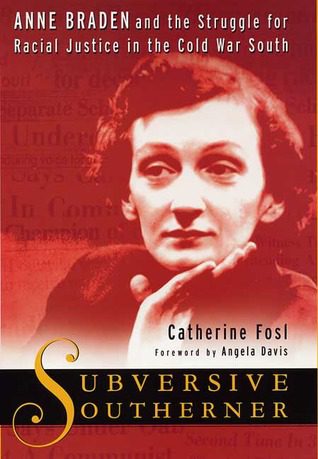 I don’t have time to go through all of those activists named earlier. Some of them I recognized as leaders of the #BlackLivesMatter movement. But the name that most stood out to me from Crass’s list was from the opening line: “I call forward the names of ancestors from Harriet Tubman and William Lloyd Garrison to Ella Baker and Anne Braden.” I knew those first three names, but Anne Braden was new to me. Seeing her name mentioned in the same breath as those other three luminaries of the struggle for racial justice inspired me to read her biography, Subversive Southerner: Anne Braden and the Struggle for Racial Justice in the Cold War South by Catherine Fosl (University Press of Kentucky, 2006).
To give a brief overview of her fascinating life, she was born in 1924 in Louisville, Kentucky to a family with deep roots in that state (13). “Anne’s great-great-great-great-great-grandmother — also named Anne — was one of the first few dozen pioneers to settle Kentucky with Daniel Boone in 1775” (4). Braden had what could be called a fairly privileged “white southern childhood” (30). She was groomed to be a debutante, and was in a sorority (48). She graduated from college in 1945, which meant that she “came of age at the end of WWII, part of the last generation of southern whites to grow up under Jim Crow segregation so blatant and static that, for Anne, it took an internal explosion to throw off the lessons of her childhood (xxi)”
The turning point for Braden was becoming a journalist and meeting colleagues — including her future husband — who were activists for racial and economic justice (95-96). Looking back on 1948, when she was just a few years out of college and in the early stages of her professional career, Braden wrote:
I had grown up in a totally restricted world, a world that was passé, a world that was morally wrong. In ways that I didn’t analyze then, I was already questioning that world. On the other hand, everything in my life had geared me toward becoming a success in that world according to its standards….
I came to identify with the oppressed instead of the oppressor, which changed my whole worldview. When I realized that I had grown up part of a privileged class that enjoyed its place in society because not only black people but [also] because most of the rest of the population was subjugated, I really had to turn the world as I saw it and the world within myself inside out. (95-96)
Anne got married that same paradigm-shifting year — in a Unitarian church! — although she was not an active church attender (110).
Part of what is most impressive about Anne Braden is her steadfast commitment to social justice for almost six decades from that pivotal year of 1948 through the end of her life in 2006 at age 81. “She and several peers such as Ella Baker and Fannie Lou Hamer were among the few adult women to whom young student activists…could look in the early 1960s for elders who possessed capacities they could admire rather than reject as either too conservative or too subservient to men” (131). To give just one example on how her decades-long commitment to activism continued late into her life, at age 72, she was arrested “with nine others demonstrating to protest lack of minority hiring for the Professional Golfers’ Association tournament in Louisville.” They were successful because when the PGA returned to Louisville in 2000, one-third of the vending contracts went to minority firms.
Also impressive is that the early years of her activism for social and economic justice were in the late 1940s and early 1950s, before the Civil Rights Movement. Indeed, a week before the Supreme Court 1954 ruling (in Brown v. Board of Education) that school segregation was unconstitutional, Anne Braden and her husband served as a front to help a young black family, the Wades, buy their dream home. Andrew Wade was a WWII veteran and electrical contractor, but “there was not a single ready-built stone ranch-type house for sale to blacks in the entire Louisville metropolitan area.” When the Wades had been told no by all the white families they knew, they asked the Bradens because of their reputation as white allies for black freedom (136-137). The lesson here is that if you want to become a more multicultural person or group, become known as an ally in the struggle for justice — and you will find yourself increasingly in relationship with a wide diversity of people.
There were consequences for their courage, including death threats. But with the anti-Communist hysteria of the McCarthy period, the most impactful consequence was that Anne’s husband served two prison sentences (both many months long) on trumped-up charges of sedition that were really about silencing dissent against the racist status quo (173). But because the Bradens had long proven themselves allies in the struggle for racial justice, in 1961, when they were seeking clemency for Anne’s husband, The Rev. Dr. Martin Luther King, Jr. signed the petition, which was a risk for King who himself faced unfair and exaggerated charges as a Communist sympathizer.
Indeed, I was stunned to learn that Chris Crass was actually not the first time I had ever heard Anne Braden’s name in a litany of social justice luminaries. Consider this paragraph from Dr. King’s famous 1963 “Letter from a Birmingham Jail”:
Oppressed people cannot remain oppressed forever….. I had hoped that the white moderate would see this need. Perhaps I was too optimistic; perhaps I expected too much. I suppose I should have realized that few members of the oppressor race can understand the deep groans and passionate yearnings of the oppressed race, and still fewer have the vision to see that injustice must be rooted out by strong, persistent and determined action. I am thankful, however, that some of our white brothers in the South have grasped the meaning of this social revolution and committed themselves to it. They are still all too few in quantity, but they are big in quality. Some—such as Ralph McGill, Lillian Smith, Harry Golden, James McBride Dabbs, Anne Braden and Sarah Patton Boyle—have written about our struggle in eloquent and prophetic terms. Others have marched with us down nameless streets of the South…. Unlike so many of their moderate brothers and sisters, they have recognized the urgency of the moment and sensed the need for powerful “action” antidotes to combat the disease of segregation.
May we each find our way to recognizing the urgency of our cultural moment and sensing the ways that we can act in our spheres of influence for peace and justice.
Specifically regarding the #BlackLivesMatter movement, if you look back at what Braden said regarding the Black Power movement in her own day, I think it’s safe to say that if she were alive she would be a supporter of #BlackLivesMatter. In Braden’s words, “Our society has lived by white power. Unless black people create their own power, there can never be a meeting ground” (302).
The Second Source in my tradition of Unitarian Universalism is the “Words and deeds of prophetic women and men which challenge us to confront powers and structures of evil with justice, compassion, and the transforming power of love.” Anne Braden is one of those modern-day social prophets. In 2002, looking back on her life from the perspective of her late 70s, Anne said:
Often people say to me nowadays, “Oh, you gave up so much,” referring to the fact that I left a life of privilege and became an outcast. But I think I was lucky because I was able to escape from the prisons I’d grown up in and join the human race. What more can you ask of life than that? (336)
In the coming days, I invite you to reflect on those people whose life stories inspire you. Jungians call that a “Golden Shadow”: when someone’s life story particularly resonates with you, the invitation is to see the ways you are being called to live into the untapped potential within you. And I look forward to exploring along with you in the future such figures as Audre Lorde, Gloria Anzaldúa, Suzanne Pharr, Angela Davis, Barbara Smith, Elizabeth ‘Betita’ Martínez, Ida B. Wells, Abby Kelley, Septima Clark and Ai-Jen Poo. For each of us to whom those are not household names, including myself with some of those names, we’ve got some homework to do. But it’s good work, and I’m grateful to be with you on the journey.
The Rev. Dr. Carl Gregg is a trained spiritual director, a D.Min. graduate of San Francisco Theological Seminary, and the minister of the Unitarian Universalist Congregation of Frederick, Maryland. Follow him on Facebook (facebook.com/carlgregg) and Twitter (@carlgregg).
Learn more about Unitarian Universalism: http://www.uua.org/beliefs/principles
Previous Post

September 13, 2016
Trump & Toxic Masculinity
Next Post
September 29, 2016 Challenging Trump's Islamophobia: Demagoguery & Democracy
Browse Our Archives
Select a Category Advent Anti-Racism Archaeology Atheism Baptism Best of the Year List Book Reviews Buddhism Catholicism Christian Education Church and State Church Planting Climate Change Conscientious Objection to War Creation Spirituality Death Penalty Didache Disability Rights Discernment Easter Ecology Emergent Church Movement Empire-Critical Ethics Evolution Feminist Theology Film Reviews Gandhi Gospel of Mark Gun Control Hinduism Immigration Reform Interfaith Islam JFK Judaism Jungian Spirituality Lectionary Commentary Lent Letters to the Editor LGBT Marriage MLK Multiculturalism Mysticism Nonviolent Activism Occupy Paganism (Earth-centered Religions) Parables Paul Pluralism Politics Process Theology Quantum Physics Requiescat In Pace Seminary and Divinity School Sermon Series Retrospective Sermons Spiritual Direction Spiritual Practices Stewardship (Fundraising) The Book of J The Wheel of the Year (Paganism) Theoblogger Challenge Triathlon Uncategorized Unitarian Universalism Worship Resources Youth Ministry
Select a Month July 2026 May 2026 March 2026 November 2025 October 2025 August 2025 February 2025 December 2024 October 2024 March 2024 January 2024 December 2023 November 2023 March 2023 February 2023 January 2023 December 2022 November 2022 August 2022 March 2022 February 2022 January 2022 December 2021 September 2021 August 2021 July 2021 June 2021 May 2021 February 2021 January 2021 December 2020 August 2020 June 2020 May 2020 April 2020 March 2020 February 2020 January 2020 December 2019 November 2019 October 2019 September 2019 July 2019 June 2019 March 2019 February 2019 January 2019 December 2018 November 2018 October 2018 September 2018 June 2018 May 2018 April 2018 March 2018 February 2018 January 2018 December 2017 November 2017 October 2017 September 2017 August 2017 July 2017 June 2017 May 2017 April 2017 March 2017 February 2017 January 2017 December 2016 November 2016 October 2016 September 2016 August 2016 June 2016 May 2016 April 2016 March 2016 February 2016 January 2016 December 2015 November 2015 October 2015 September 2015 August 2015 July 2015 June 2015 May 2015 April 2015 March 2015 February 2015 January 2015 December 2014 November 2014 October 2014 August 2014 July 2014 June 2014 May 2014 April 2014 March 2014 February 2014 January 2014 December 2013 November 2013 October 2013 September 2013 August 2013 July 2013 June 2013 May 2013 April 2013 March 2013 February 2013 January 2013 December 2012 November 2012 October 2012 September 2012 August 2012 July 2012 June 2012 May 2012 April 2012 March 2012 February 2012 January 2012 December 2011 November 2011 October 2011 September 2011 August 2011 July 2011 June 2011 May 2011 April 2011 March 2011 February 2011 January 2011 December 2010 November 2010 October 2010 August 2009 July 2009 May 2009
Follow Us!
TAKE THE
Religious Wisdom Quiz
What tax collector wrote a Gospel and was called by Jesus?
Select your answer to see how you score.
Matthew Luke Mark Barnabas
Related posts from Carl Gregg

Reading America at 250: A Nation Wrestles With...


Andrew Holocek on the Power of Darkness

The Stories That Shape Us: Myths, Archetypes, &...
TRENDING AT PATHEOS More Voices

Reading America at 250: A Nation Wrestles With...
As part of my own reflection on the 250th anniversary of the...

Whenever I am reading a book or listening to an argument, I...

President Trump Ban Animal Torture Videos on Facebook
Call for Stricter Regulations of Animal Abuse Content on Facebook Although President...

Draft Amendments to Address Ritual Abuse in New...
The proposed changes would make it illegal for individuals in domestic partnerships...

How Bans on LGBTQ+ Student Clubs Threaten Religious...
On June 20, 2025, the State of Texas passed Senate Bill 12....

The Truth About the Gen Z Revival
This past year, there has been a lot of media buzz surrounding...
view all More Voices blogs
Ad-Free & Subscriber Log-In Subscription Support
- About Us
- 2026 Calendar
- Videos
- Podcasts
- Library of World Religions
- Faith In Media Tracker
- Advertise With Us
- Write for Us
- Privacy Policy
- Terms of Service
- Do Not Sell My Data
- Contact Us
- Radiant Digital
- Manage Newsletter Subscriptions
- Unsubscribe From Notifications
- Sitemap
Copyright 2008-2026, Patheos. All rights reserved.
Subscription Support Ad-Free & Subscriber Log-In
Follow Patheos