
BuddhistCatholicContemplativeEvangelicalGeneral ChristianHinduJewishLatter-day SaintMuslimNew VisionsProgressive Christian
Beliefs
- Buddhist
- Catholic
- Contemplative
- Evangelical
- General Christian
- Hindu
- Jewish
- Latter-day Saint
- More Voices
- Muslim
- New Visions
- Pagan
- Progressive Christian
Topics
- Religion News
- Food and Religion
- Sports and Religion
- Religious Art
- Religious Music and Entertainment
- Religious Events
- History and Religion
- Style and Religion
- Politics and Religion
- Women in Religion
- Recreation Outdoors and Religion
- Business Finance and Religion
- Careers Workplace and Religion
- Education and Religion
- Family Parenting and Religion
- Health Fitness and Religion
- Home and Religion
- Relationships and Religion
- Technology and Religion
- Travel and Religion
Columnists
- Buddhist Columnists
- Business Finance and Religion Columnists
- Careers Workplace and Religion Columnists
- Catholic Columnists
- Contemplative Columnists
- Education and Religion Columnists
- Evangelists Columnists
- Family Parenting and Religion Columnists
- General Christian Columnists
- Health Fitness and Religion Columnists
- Hindu Columnists
- History and Religion Columnists
- Home and Religion Columnists
- Jewish Columnists
- More Voices Columnists
- Latter Day Columnists
- Muslim Columnists
- New Visions Columnists
- Nonreligious Columnists
- Pagan Columnists
- Politics and Religion Columnists
- Progressive Columnists
- Recreation Outdoors and Religion Columnists
- Relationships and Religion Columnists
- Religion News Columnists
- Religious Art Columnists
- Religious Events Columnists
- Religious Music and Entertainment Columnists
- Sports and Religion Columnists
- Style and Religion Columnists
- Technology and Religion Columnists
- Travel and Religion Columnists
- Women in Religion Columnists
Resource Library
- 2026 Calendar
- Library of World Religions
- The 100 Most Holy Places on Earth
- Patheos Answers
- Podcasts
- Videos
- Faith Leaders Database
- Anglican Episcopalian
- Bahai
- Baptist
- Buddhism
- Christianity
- Confucianism
- Eastern Orthodoxy
- Hinduism
- Holiness and Pentecostal
- ISKCON
- Islam
- Judaism
- Lutheran
- Methodist
- The Church of Jesus Christ of Latter-day Saints
- New Age
- Paganism
- Presbytarian and Reformed
- Protestantism
- Religion Behind the Scenes
- Roman Catholic
- Scientology
- Shia Islam
- Sikhism
- Sufism
- Sunni Islam
- Taoism
- Zen
- See all religions
Research Tools
 Ad-Free & Subscriber Log-In Subscription Support
Follow Patheos 

- Trending:
- Advent
- |
- Forgiveness
- |
- Thanksgiving
- |
- Election
- |
- Seasonal Holidays
- |
- Marriage

- Home
- More Voices
- People, Planet, Profit: Money Is Not the Only Bottom Line
People, Planet, Profit: Money Is Not the Only Bottom Line
Last updated on: September 21, 2016 at 3:10 pm by Carl Gregg
People, Planet, Profit: Money Is Not the Only Bottom Line 2016-09-21T15:10:09-04:00 Carl Gregg
Patheos Explore the world's faith through different perspectives on religion and spirituality! Patheos has the views of the prevalent religions and spiritualities of the world.
In addition to spending time with family and friends on Labor Day Weekend, I try to be mindful that Labor Day is about much more than a three-day weekend, symbolically marking the end of summer. The first Monday in September was set apart as a time to celebrate the labor movement’s role in securing worker’s rights. In the late nineteenth century, an increasing number of states officially recognized Labor Day as a holiday, culminating in Congress declaring Labor Day a federal holiday in 1894.
And the struggles that Labor Day commemorates are not over. Although we might wish that it were otherwise, it is important to be honest that our current economy is not designed to allow everyone to be well paid to do their dream job. Instead, to borrow a term from Karl Marx, the vast majority of humans earn a living through “alienated labor”: work that is not personally fulfilling but must be done to afford even a basic minimum of food and shelter. (There is a whole other discussion for those of us who love our work, do not feel alienated from our labor, yet need to draw boundaries for our longterm health and to make time for our families. But I’d like to set aside those concerns for now.)
It can be easy to forget how much we owe organized labor. As one popular bumper sticker says, “From the People that Brought You the Weekend.” Historically, many people used to spend 12 (or more) hours/day working for six (or seven) days/week. But “in the early nineteenth century and continuing for over a hundred years, working hours in America were gradually reduced — cut in half according to most accounts” (vii). The labor movement pushed back against the exploitation of workers through union organizing and other related collective action.
But here is another oft-forgotten twist. As historian Benjamin Honnicutt has detailed in his fascinating book Free Time: The Forgotten American Dream (Temple University Press, 2013), in the late nineteenth century, extrapolating from the successes of the labor movement, many of the best economists “regularly predicted that, well before the twentieth century ended, a Golden Age of Leisure would arrive, when no one would have to work more than two hours a day” (vii). For those forced to earn a living through alienated labor, working only two hours a day (for a total of ten-hours/week) would mean having time to pursue the American Dream of “Life, Liberty, and the pursuit of Happiness” instead of returning home from work too exhausted to do anything but rest briefly before dragging yourself out to go back to work the next day.
Labor activists did help secure a five-day work week — and in some industries even a six-hour work day. But starting with the Great Depression in the 1930s, the trend of shortening work hours reversed. A new emphasis arose on the perceived need to grow the economy through perpetually increasing consumer demand. So we find ourselves working more and more to buy more and more stuff — but not having any free time to enjoy that stuff, much less our family and friends.
Today we know that the labor rights movement has continued to lose ground on many fronts. Here in the early twenty-first century, many of us work not a ten-hour week, but a 10- or 12-hour day, building to a 50-hour, 60-hour (or more) work week (viii). And ironically, as our collective productivity at work has grown 72.2 percent over the past four decades, hourly compensation has grown only 9.2 percent (Rieger 34-35).
With the decline of the labor rights movement, many corporations now perceive themselves as responsible not to their workers, but solely to their stockholders (38). And at the same time that labor rights for us human beings have been rolling back, Supreme Court decisions like Citizens United have been busy defending the rights of corporate personhood, making the playing field even more unequal. If anyone is curious, I will readily grant that organized labor has also had a sizable share of corruption in its history.
But overall, the balance of political power in the U.S. has shifted away from worker’s rights and toward corporate rights.
To name one vision for what we could choose to move toward as a society, I invite you to consider Article 23 of the U.N. Declaration of Human Rights:
(1) Everyone has the right to work, to free choice of employment, to just and favorable conditions of work and to protection against unemployment.
(2) Everyone, without any discrimination, has the right to equal pay for equal work.
(3) Everyone who works has the right to just and favorable remuneration ensuring for himself and his family an existence worthy of human dignity, and supplemented, if necessary, by other means of social protection.
(4) Everyone has the right to form and to join trade unions for the protection of his interests.
The Rev. Dr. Martin Luther King, Jr.’s name for a world founded on a respect for human rights was the “beloved community.” And in addition to all the ways that Dr. King talked about his dream of beloved community, he also reminded his audiences that the greatest hindrance to building the Beloved Community is not racism alone, but the interlocking “triple threats” of racism, materialism, and militarism (91).
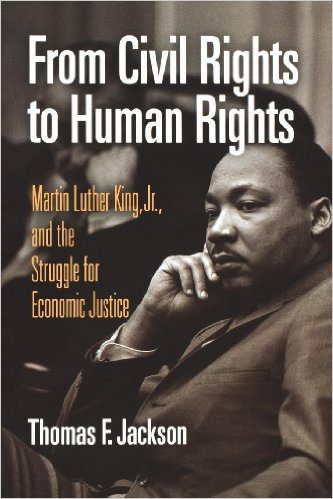 So on this day after Labor Day, I’d like to reflect on Dr. King’s journey in conversation with the book From Civil Rights to Human Rights: Martin Luther King, Jr., and the Struggle for Economic Justice (University of Pennsylvania Press, 2009) by Thomas F. Jackson for the ways in which MLK’s increasing focus on both racial and economic justice can inform and inspire us today.
In tracing the arc of Dr. King’s life, it is significant to remember that despite the indelible mark he left behind on our society and around the world, his public ministry lasted for barely more than a decade from 1956 until his assassination in 1968 at the far too young an age of 39. (It is stunning to me that when King was killed, he was only one year older than I am now.)
Dr. King’s strong commitment to economic justice was clear at the end of his life. When he was killed in Memphis, he was in town helping lead a sanitation workers’ strike. And later that month he was scheduled to lead a Poor People’s Campaign to protest in Washington, D.C. But the twin themes of both racial and economic justice were also there from the beginning. Consider, for example, that the full name of that famous 1963 protest in D.C. was the “March on Washington for Jobs and Freedom.” If you go back and look at archival photos and footage from that march, you’ll see not only signs for “End segregated rules in public schools” and “We demand voting rights now!” but also signs demanding “Full employment” and “We march for jobs for all now” (173).
And in King’s famous “I Have a Dream” speech, he didn’t just talk about a future of children playing together across color lines, he said:
In a sense we’ve come to our nation’s capital to cash a check. When the architects of our republic wrote the magnificent words of the Constitution and the Declaration of Independence, they were signing a promissory note…that all men…would be guaranteed the “unalienable Rights” of “Life, Liberty and the pursuit of Happiness.” It is obvious today that America has defaulted on this promissory note…. Instead of honoring this sacred obligation, America has given the Negro people a bad check, a check which has come back marked “insufficient funds.” But we refuse to believe that the bank of justice is bankrupt. We refuse to believe that there are insufficient funds in the great vaults of opportunity of this nation. And so, we’ve come to cash this check, a check that will give us upon demand the riches of freedom and the security of justice.
Or as King would say later: “What does it profit a man to be able to eat at an integrated lunch counter if he doesn’t earn enough money to buy a hamburger and a cup of coffee” (Rieger 4)?
And here’s a vital point. If you continue to trace the logic of how King’s speeches evolved, he increasingly followed a model similar to the one Thomas Jefferson used centuries earlier. Jefferson did not declare our independence from the King of England based on the reasoning of British Common Law. He claimed our freedom based on “self-evident” truths and “certain unalienable Rights.” Likewise, more than merely seeking to get laws passed by civil government (which is important), King came to see the struggle against poverty and racism as part of a worldwide human rights movement that supersedes mere laws. As the saying goes, “An unjust law is no law at all.”
Part of what is most significant to me about King’s life is that his path to becoming a Civil Rights leader and human rights activist was neither inevitable nor even predictable. And one theme I want us to explore this fall from a few different angles in forthcoming posts is how people with power and privilege come to be in authentic solidarity with oppressed groups. Specifically in the life of MLK, although The Rev. Martin Luther King, Sr. was born into an exploitative sharecropping system, by the time King, Jr. was born in 1929, his father was a minister in Atlanta who was doing well financially (25). King, Jr. could have chosen to follow in his father’s footsteps, spending his life preaching from a well-paying pulpit.
As had his father before him, King, Jr. attended the historically black Morehouse College, graduating at age 19 with a degree in sociology (32). He went on to earn a masters of divinity from the predominantly white seminary in 1951 before earning a Ph.D. from Boston University (33). One of the ways that King began to discern a call to movement for justice far larger than himself is through his education. In 1951, the same year he graduated seminary, “He told his then-girlfriend, Coretta Scott, that he was not pro-capitalist like his father and had no ambitions to wealth.” In his ringing turn of phrase, capitalism took “necessities from the masses to give luxuries to the classes” (42).
At the same time, I should be clear that King also criticized extreme socialism or collectivism as neglecting the ways that “life is individual and personal” (42-43). In many ways, King’s maturing views can be seen as moving toward what is sometimes called the “Triple Bottom Line” of People, Planet, and Profit. Profit motive is still a major factor, but instead of seeing profit for stockholders as the only “bottom line,” financial gain is balanced with people (labor rights) and planet (environmental sustainability). That Triple Bottom Line of People, Planet, and Profit is one vision of what a twenty-first century labor movement might look like.
By understanding how much has changed in the past through the labor movement (moving from a 12-hour day and a 6-7 day work week to an 8-hour day and a 40-hour work week), we can begin to imagine the ways that our current relationship with work can also change for the future — so that increasingly numbers of us might have less alienated labor and more free time for “life, liberty, and the pursuit of happiness. Perhaps too like Dr. King many years ago, you may be feeling the inkling of a call within you to act for a cause great than yourself — to join (or increase your commitment to) the work of building beloved community. May we support one another in the struggle for Collective Liberation!
The Rev. Dr. Carl Gregg is a trained spiritual director, a D.Min. graduate of San Francisco Theological Seminary, and the minister of the Unitarian Universalist Congregation of Frederick, Maryland. Follow him on Facebook (facebook.com/carlgregg) and Twitter (@carlgregg).
Learn more about Unitarian Universalism: http://www.uua.org/beliefs/principles
Previous Post

September 1, 2016
“Becoming Wise”: The Practice of Generous Listening
Browse Our Archives
Select a Category Advent Anti-Racism Archaeology Atheism Baptism Best of the Year List Book Reviews Buddhism Catholicism Christian Education Church and State Church Planting Climate Change Conscientious Objection to War Creation Spirituality Death Penalty Didache Disability Rights Discernment Easter Ecology Emergent Church Movement Empire-Critical Ethics Evolution Feminist Theology Film Reviews Gandhi Gospel of Mark Gun Control Hinduism Immigration Reform Interfaith Islam JFK Judaism Jungian Spirituality Lectionary Commentary Lent Letters to the Editor LGBT Marriage MLK Multiculturalism Mysticism Nonviolent Activism Occupy Paganism (Earth-centered Religions) Parables Paul Pluralism Politics Process Theology Quantum Physics Requiescat In Pace Seminary and Divinity School Sermon Series Retrospective Sermons Spiritual Direction Spiritual Practices Stewardship (Fundraising) The Book of J The Wheel of the Year (Paganism) Theoblogger Challenge Triathlon Uncategorized Unitarian Universalism Worship Resources Youth Ministry
Select a Month October 2026 July 2026 May 2026 March 2026 November 2025 October 2025 August 2025 February 2025 December 2024 October 2024 March 2024 January 2024 December 2023 November 2023 March 2023 February 2023 January 2023 December 2022 November 2022 August 2022 March 2022 February 2022 January 2022 December 2021 September 2021 August 2021 July 2021 June 2021 May 2021 February 2021 January 2021 December 2020 August 2020 June 2020 May 2020 April 2020 March 2020 February 2020 January 2020 December 2019 November 2019 October 2019 September 2019 July 2019 June 2019 March 2019 February 2019 January 2019 December 2018 November 2018 October 2018 September 2018 June 2018 May 2018 April 2018 March 2018 February 2018 January 2018 December 2017 November 2017 October 2017 September 2017 August 2017 July 2017 June 2017 May 2017 April 2017 March 2017 February 2017 January 2017 December 2016 November 2016 October 2016 September 2016 August 2016 June 2016 May 2016 April 2016 March 2016 February 2016 January 2016 December 2015 November 2015 October 2015 September 2015 August 2015 July 2015 June 2015 May 2015 April 2015 March 2015 February 2015 January 2015 December 2014 November 2014 October 2014 August 2014 July 2014 June 2014 May 2014 April 2014 March 2014 February 2014 January 2014 December 2013 November 2013 October 2013 September 2013 August 2013 July 2013 June 2013 May 2013 April 2013 March 2013 February 2013 January 2013 December 2012 November 2012 October 2012 September 2012 August 2012 July 2012 June 2012 May 2012 April 2012 March 2012 February 2012 January 2012 December 2011 November 2011 October 2011 September 2011 August 2011 July 2011 June 2011 May 2011 April 2011 March 2011 February 2011 January 2011 December 2010 November 2010 October 2010 August 2009 July 2009 May 2009
Follow Us!
TAKE THE
Religious Wisdom Quiz
According to 1 Peter, Jesus bore our sins in his body where?
Select your answer to see how you score.
On the mountain In the tomb On the tree (cross) In the garden
Related posts from Carl Gregg
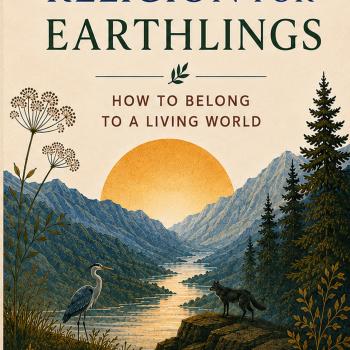
Liberal Religion for Earthlings: My First Book!

Reading America at 250: A Nation Wrestles With...


Andrew Holocek on the Power of Darkness
TRENDING AT PATHEOS More Voices

Liberal Religion for Earthlings: My First Book!
I'm thrilled to share that my first book, Liberal Religion for Earthlings:...

Reading America at 250: A Nation Wrestles With...
As part of my own reflection on the 250th anniversary of the...

President Trump Ban Animal Torture Videos on Facebook
Call for Stricter Regulations of Animal Abuse Content on Facebook Although President...

Draft Amendments to Address Ritual Abuse in New...
The proposed changes would make it illegal for individuals in domestic partnerships...

How Bans on LGBTQ+ Student Clubs Threaten Religious...
On June 20, 2025, the State of Texas passed Senate Bill 12....
The Truth About the Gen Z Revival
This past year, there has been a lot of media buzz surrounding...
view all More Voices blogs
Ad-Free & Subscriber Log-In Subscription Support
- About Us
- 2026 Calendar
- Videos
- Podcasts
- Library of World Religions
- Faith In Media Tracker
- Advertise With Us
- Write for Us
- Privacy Policy
- Terms of Service
- Do Not Sell My Data
- Contact Us
- Radiant Digital
- Manage Newsletter Subscriptions
- Unsubscribe From Notifications
- Sitemap
Copyright 2008-2026, Patheos, part of the Radiant Digital network of media brands. All rights reserved.
Subscription Support Ad-Free & Subscriber Log-In
Follow Patheos