
BuddhistCatholicContemplativeEvangelicalGeneral ChristianHinduJewishLatter-day SaintMuslimNew VisionsProgressive Christian
Beliefs
- Buddhist
- Catholic
- Contemplative
- Evangelical
- General Christian
- Hindu
- Jewish
- Latter-day Saint
- More Voices
- Muslim
- New Visions
- Pagan
- Progressive Christian
Topics
- Religion News
- Food and Religion
- Sports and Religion
- Religious Art
- Religious Music and Entertainment
- Religious Events
- History and Religion
- Style and Religion
- Politics and Religion
- Women in Religion
- Recreation Outdoors and Religion
- Business Finance and Religion
- Careers Workplace and Religion
- Education and Religion
- Family Parenting and Religion
- Health Fitness and Religion
- Home and Religion
- Relationships and Religion
- Technology and Religion
- Travel and Religion
Columnists
- Buddhist Columnists
- Business Finance and Religion Columnists
- Careers Workplace and Religion Columnists
- Catholic Columnists
- Contemplative Columnists
- Education and Religion Columnists
- Evangelists Columnists
- Family Parenting and Religion Columnists
- General Christian Columnists
- Health Fitness and Religion Columnists
- Hindu Columnists
- History and Religion Columnists
- Home and Religion Columnists
- Jewish Columnists
- More Voices Columnists
- Latter Day Columnists
- Muslim Columnists
- New Visions Columnists
- Nonreligious Columnists
- Pagan Columnists
- Politics and Religion Columnists
- Progressive Columnists
- Recreation Outdoors and Religion Columnists
- Relationships and Religion Columnists
- Religion News Columnists
- Religious Art Columnists
- Religious Events Columnists
- Religious Music and Entertainment Columnists
- Sports and Religion Columnists
- Style and Religion Columnists
- Technology and Religion Columnists
- Travel and Religion Columnists
- Women in Religion Columnists
Resource Library
- 2026 Calendar
- Library of World Religions
- The 100 Most Holy Places on Earth
- Patheos Answers
- Podcasts
- Videos
- Faith Leaders Database
- Anglican Episcopalian
- Bahai
- Baptist
- Buddhism
- Christianity
- Confucianism
- Eastern Orthodoxy
- Hinduism
- Holiness and Pentecostal
- ISKCON
- Islam
- Judaism
- Lutheran
- Methodist
- The Church of Jesus Christ of Latter-day Saints
- New Age
- Paganism
- Presbytarian and Reformed
- Protestantism
- Religion Behind the Scenes
- Roman Catholic
- Scientology
- Shia Islam
- Sikhism
- Sufism
- Sunni Islam
- Taoism
- Zen
- See all religions
Research Tools
 Ad-Free & Subscriber Log-In Subscription Support
Ad-Free & Subscriber Log-In Subscription Support
Follow Patheos 

- Trending:
- Forgiveness
- |
- Marriage
- |
- Consciousness
- |
- Death Penalty
- |
- Election
- |
- Halloween

- Home
- More Voices
- Challenging Trump’s Islamophobia: Demagoguery & Democracy
Challenging Trump’s Islamophobia: Demagoguery & Democracy
Last updated on: September 29, 2016 at 9:45 am by Carl Gregg
Challenging Trump’s Islamophobia: Demagoguery & Democracy 2016-09-28T22:04:35-04:00 Carl Gregg
Patheos Explore the world's faith through different perspectives on religion and spirituality! Patheos has the views of the prevalent religions and spiritualities of the world.
The Huffington Post adds the following Editor’s note to every article they publish about Donald Trump: “Donald Trump regularly incites political violence and is a serial liar, rampant xenophobe, racist, misogynist and birther who has repeatedly pledged to ban all Muslims — 1.6 billion members of an entire religion — from entering the U.S.” When I encounter this line of fear-mongering, I am both angered and saddened that the normal everyday lives of most of the world’s 1.6 billion Muslims too often gets lost amongst headlines about the horrifying acts committed by a few.
 An extensive study of media coverage of Islam showed that in the first decade of the twenty-first century, stories about Islam related to Muslim militants and extremists rose from 2 percent to 25 percent. But the number of stories about ordinary Muslim lives remained the same at 0.1 percent. As the religion professor Todd Green has showed in his important book The Fear of Islam: An Introduction to Islamophobia in the West (Fortress Press, 2015), while we are increasingly confronted with the worst aspects of Islam, we continue to learn almost nothing about the lives of the vast majority of Muslims (239-240).
As Eboo Patel, an Muslim interfaith leader, said:
I gave a talk in Kansas City some years ago, and somebody stood up and said, “What the heck is wrong with you Muslims?” My response was if the only thing I new about Kansas City was the first minute of the local news every night, I would say to you, “What the heck is wrong with you people in Kansas City?” If the only thing I know is the murders and [other crimes] I hear about on the evening news, then I have a very skewed view of who you are. (316)
When thinking about the words Muslim or Islam, the first association for many Westerners is someone along the lines of Osama bin Laden. Most Americans don’t think of Tawakkol Karman, who in 2011 became the first Arab woman, and the second Muslim woman, to win a Nobel Peace Prize for her work as a Yemeni journalist and human rights activist during the Arab Spring — or Sadiq Khan, the mayor of London and the first Muslim to become mayor of a major Western capital (Green 319).
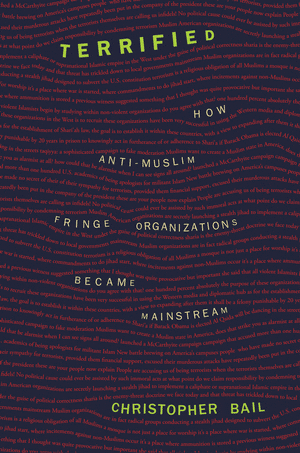 Sadly, the media covers extremists on all sides of religions and ideologies often to the exclusion of the huge numbers of moderates in the middle. I’ll limit myself to two examples, drawing on sociologist Christopher Bail’s excellent study Terrified: How Anti-Muslim Fringe Organizations Became Mainstream (Princeton University Press, 2014). On the extreme Islamophobia side, a few years ago it was disheartening to witness all the media attention given to Terry Jones, a fundamentalist pastor of a congregation with only a handful of members, when he decided to try and create “International Burn a Koran Day.” Why do we amplify the voice of obscure hate mongers (1-3)?
On the other side of extreme Islamism, most of you can likely recall the video of a small group of Palestinians celebrating in the streets after September 11, 2001 (54). Yes, that small group should be condemned, but the clip was frequently replayed as if it were representative of how all Muslims felt. Here’s the missing context: “Of the twenty-seven press releases produced by U.S. Muslim organizations that condemned terrorism between 2001 and 2003, only two received any media influence. One of those two was released the day of 9/11, but it was overshadowed by the coverage of 9/11 generally (55).
In the years since 9/11, there has been regular criticism of moderate Muslims for failing to condemn radical Islam. Here’s the problem: many moderate Muslim have frequently condemned radical Islam, but often no one is paying attention (or remembering) when they do:
The New York Times published a full-page ad one month after the attacks that contained statements from prominent Muslim leaders denouncing the attacks…. Three days after the attacks, more than forty prominent Muslim scholars released a statement [that], ‘We condemn, in the strongest terms, the incidents, which are against all human and Islamic norms….’ Signatories included the general guide of the Muslim Brotherhood in Egypt…and a founder of Hamas in Palestine…. Moreover, according to a Gallup poll, 93 percent of Muslims in Muslim-majority countries believed the attacks to be unjustified. (Green 125)
Tragically, we in the U.S. have squandered much of that goodwill in our extended response to 9/11. Fifteen years later, we are still embroiled in wars in the Middle Eastern countries whose citizens are resentful after years-long occupations by foreign soldiers.
Now, don’t get me wrong, there are legitimate criticisms to be made of fundamentalist Islam, just as there are legitimate criticisms to be made of the literalist, absolutist, and reactionary aspects of fundamentalist Christianity, fundamentalist Judaism, or fundamentalist Hinduism (xi). But Islamophobia is not about legitimate criticism; it is about unfounded fear, anxiety, and hostility about Muslims (3). I am interested in defusing Islamophobia because it is irrational, encourages anti-Muslim hate crimes, and increases misunderstandings that unnecessarily embolden potential future terrorists.
Islamophobia, like homophobia, plays on the word phobia because it is a fear that is exaggerated out of proportion to reality. I want our government to investigate terrorist threats, but not in an unreasonable, phobic way that sacrifices our freedom, civil liberties, and ability to recognize that the “inherent worth and dignity of every person” includes Muslims.
The case of Islamophobia that has gotten the most attention recently is the bans on “burkinis” in France. A burkini (from the words “burqa and bikini”) is a full body swimsuit for women that maintain modesty standards according to some interpretations of Islam. As someone who identifies as a feminist, I both think it is sexist when a culture requires women (and not men) to dress with extreme modesty and I think women should ultimately have the freedom to dress however they want. And here’s the more important point: you can tell that French politicians are being irrational and phobic when they began empowering police to order women wearing burkinis on beaches to take off more of their clothes or be expelled. The only way it can seem like a good idea to have police officers ordering women to take off any layer of clothing is from a warped perspective like Islamophobia, in which fear is overriding rationality.
All that being said, I strongly support the liberal turn in religion for both Islam and other traditions: the turn toward  individual freedom in religion — taking religion “seriously, but not literally” and incorporating the insights of twenty-first century science into our practice of religion and spirituality. And as I seek to reflect on the future of Islam, from a more rational, informed — and less Islamophobic — perspective, I look to books such as Islam and Democracy After the Arab Spring by John Esposito, et al (2015):
by summer 2013 it had become evident that the Arab Spring uprisings had failed to produce democracy everywhere except where they began, in Tunisia.
- Egypt’s first democratic government had been overthrown in a military coup that was ostensibly popularly supported.
- Syria had descended into a brutal and protracted civil war….
- And Libya has simply fragmented; it has two mutually hostile elected governments, one in Tripoli and one in Tobruk, while various militias control different sectors of the country.
These developments demonstrate…that there is no inevitable transition from a popular uprising— youth bulge and new social media or not — to a sustainable social or political movement…. And, as the queue of ISIS videos indicates, not all tech-savvy youth are pro-democracy. (3)
It is also, however, not the case that Islam and democracy are incompatible, despite what misinformed Islamophobic pundits will sometimes claim. After all, “The world’s third-largest democracy is Indonesia, the world’s largest Muslim country” (116).
As I posted two years ago on “The Future of Islam,” not only are the overwhelming majority of Muslims not terrorists or terrorist sympathizers, but also — contrary to the popular stereotypes — most Muslims aren’t Arab, only 20% are. And the countries with the largest Muslim populations (Indonesia, Bangladesh, Pakistan, India, and Nigeria) are all democracies. Along these lines, consider that, “Saudi Arabia…has only the sixteenth largest Muslim population, behind countries such as Uzbekistan, Ethiopia, Turkey, and Iran…. Saudi Arabia’s Muslim population is roughly equivalent to China’s.…” The huge numbers of Muslims outside the Middle East show both the diversity of Islam in the present as well as hope for an increasingly pluralistic and progressive Islam in the future.
And here’s an even more important twist. Many commentators and politicians claim from a biased, Islamophobia perspective that Islam and democracy are incompatible. But one only has to look around the world to see many examples of Muslim-majority countries actively engaged in democracy (254). However, I invite you to consider that the question of whether Islam is compatible with democracy is itself a distraction from seeing that the opposite is the case: Islamophobia and democracy are incompatible. Islamophobia is a poison on our body politic being used in both Europe and the U.S. to scapegoat Muslims and other immigrants. Yes, terrorism is a threat to democracy. But the next time you hear a politician or pundit scapegoating Muslims (or other immigrants), notice the ways that their demagoguery is fueling nativist, authoritarian politics, undermining civil liberties, and decreasing pluralism, diversity, and tolerance — all of which are also serious threats to our freedom and democracy (Green 214-217).
In contrast, what might we do to help bring about a more hopeful future? On the systemic level, supporting the transition to clean, renewable energy is not only vital to slowing climate change, but also necessary to stop petro-dictators, who fund radical Islam using money from our oil-based cars and economy (Green 330). On the individual level, we can:
-
Speak out whenever we witness Islamophobia,
-
Cultivate interpersonal and interfaith relationships between Muslims and non-Muslims,
-
Educate the public about Islam, particular its diversity and the common ground it shares with the West and other religious traditions. (312)
Perhaps the greatest hope that Islamophobia will be increasingly overcome is our history of anti-Catholic, anti-Jewish, anti-same sex marriage, anti-interracial marriage, and other forms of intolerance, bigotry, and prejudice slowly giving way to acceptance, inclusion, and eventually celebration (332-333).
In that spirit, the poet Naomi Shihab Nye tells a moving story of unexpectedly encountering a Muslim woman in distress and how a group of strangers — separated by language and culture and in the midst of a stressful situation — found simple ways to connect and communicate. At the end of that story, she concludes:
I looked around that gate of late and weary ones and thought, This is the world I want to live in. The shared world. Not a single person in that gate— once the crying of confusion stopped— seemed apprehensive about any other person. They took the cookies. I wanted to hug all those other [people] too. This can still happen anywhere. Not everything is lost.
The Rev. Dr. Carl Gregg is a trained spiritual director, a D.Min. graduate of San Francisco Theological Seminary, and the minister of the Unitarian Universalist Congregation of Frederick, Maryland. Follow him on Facebook (facebook.com/carlgregg) and Twitter (@carlgregg).
Learn more about Unitarian Universalism: http://www.uua.org/beliefs/principles
Previous Post

September 22, 2016
Whose Side Are You On? The Legacy of Anne Braden for Today
Browse Our Archives
Select a Category Advent Anti-Racism Archaeology Atheism Baptism Best of the Year List Book Reviews Buddhism Catholicism Christian Education Church and State Church Planting Climate Change Conscientious Objection to War Creation Spirituality Death Penalty Didache Disability Rights Discernment Easter Ecology Emergent Church Movement Empire-Critical Ethics Evolution Feminist Theology Film Reviews Gandhi Gospel of Mark Gun Control Hinduism Immigration Reform Interfaith Islam JFK Judaism Jungian Spirituality Lectionary Commentary Lent Letters to the Editor LGBT Marriage MLK Multiculturalism Mysticism Nonviolent Activism Occupy Paganism (Earth-centered Religions) Parables Paul Pluralism Politics Process Theology Quantum Physics Requiescat In Pace Seminary and Divinity School Sermon Series Retrospective Sermons Spiritual Direction Spiritual Practices Stewardship (Fundraising) The Book of J The Wheel of the Year (Paganism) Theoblogger Challenge Triathlon Uncategorized Unitarian Universalism Worship Resources Youth Ministry
Select a Month July 2026 May 2026 March 2026 November 2025 October 2025 August 2025 February 2025 December 2024 October 2024 March 2024 January 2024 December 2023 November 2023 March 2023 February 2023 January 2023 December 2022 November 2022 August 2022 March 2022 February 2022 January 2022 December 2021 September 2021 August 2021 July 2021 June 2021 May 2021 February 2021 January 2021 December 2020 August 2020 June 2020 May 2020 April 2020 March 2020 February 2020 January 2020 December 2019 November 2019 October 2019 September 2019 July 2019 June 2019 March 2019 February 2019 January 2019 December 2018 November 2018 October 2018 September 2018 June 2018 May 2018 April 2018 March 2018 February 2018 January 2018 December 2017 November 2017 October 2017 September 2017 August 2017 July 2017 June 2017 May 2017 April 2017 March 2017 February 2017 January 2017 December 2016 November 2016 October 2016 September 2016 August 2016 June 2016 May 2016 April 2016 March 2016 February 2016 January 2016 December 2015 November 2015 October 2015 September 2015 August 2015 July 2015 June 2015 May 2015 April 2015 March 2015 February 2015 January 2015 December 2014 November 2014 October 2014 August 2014 July 2014 June 2014 May 2014 April 2014 March 2014 February 2014 January 2014 December 2013 November 2013 October 2013 September 2013 August 2013 July 2013 June 2013 May 2013 April 2013 March 2013 February 2013 January 2013 December 2012 November 2012 October 2012 September 2012 August 2012 July 2012 June 2012 May 2012 April 2012 March 2012 February 2012 January 2012 December 2011 November 2011 October 2011 September 2011 August 2011 July 2011 June 2011 May 2011 April 2011 March 2011 February 2011 January 2011 December 2010 November 2010 October 2010 August 2009 July 2009 May 2009
Follow Us!
TAKE THE
Religious Wisdom Quiz
Which was the day that God ended His creation and rested?
Select your answer to see how you score.
He never rested On the 6th day On the 7th day On the 5th day
Related posts from Carl Gregg

Reading America at 250: A Nation Wrestles With...


Andrew Holocek on the Power of Darkness

The Stories That Shape Us: Myths, Archetypes, &...
TRENDING AT PATHEOS More Voices

Reading America at 250: A Nation Wrestles With...
As part of my own reflection on the 250th anniversary of the...

Whenever I am reading a book or listening to an argument, I...

President Trump Ban Animal Torture Videos on Facebook
Call for Stricter Regulations of Animal Abuse Content on Facebook Although President...

Draft Amendments to Address Ritual Abuse in New...
The proposed changes would make it illegal for individuals in domestic partnerships...

How Bans on LGBTQ+ Student Clubs Threaten Religious...
On June 20, 2025, the State of Texas passed Senate Bill 12....

The Truth About the Gen Z Revival
This past year, there has been a lot of media buzz surrounding...
view all More Voices blogs
Ad-Free & Subscriber Log-In Subscription Support
- About Us
- 2026 Calendar
- Videos
- Podcasts
- Library of World Religions
- Faith In Media Tracker
- Advertise With Us
- Write for Us
- Privacy Policy
- Terms of Service
- Do Not Sell My Data
- Contact Us
- Radiant Digital
- Manage Newsletter Subscriptions
- Unsubscribe From Notifications
- Sitemap
Copyright 2008-2026, Patheos. All rights reserved.
Subscription Support Ad-Free & Subscriber Log-In
Follow Patheos