
BuddhistCatholicContemplativeEvangelicalGeneral ChristianHinduJewishLatter-day SaintMuslimNew VisionsProgressive Christian
Beliefs
- Buddhist
- Catholic
- Contemplative
- Evangelical
- General Christian
- Hindu
- Jewish
- Latter-day Saint
- More Voices
- Muslim
- New Visions
- Pagan
- Progressive Christian
Topics
- Religion News
- Food and Religion
- Sports and Religion
- Religious Art
- Religious Music and Entertainment
- Religious Events
- History and Religion
- Style and Religion
- Politics and Religion
- Women in Religion
- Recreation Outdoors and Religion
- Business Finance and Religion
- Careers Workplace and Religion
- Education and Religion
- Family Parenting and Religion
- Health Fitness and Religion
- Home and Religion
- Relationships and Religion
- Technology and Religion
- Travel and Religion
Columnists
- Buddhist Columnists
- Business Finance and Religion Columnists
- Careers Workplace and Religion Columnists
- Catholic Columnists
- Contemplative Columnists
- Education and Religion Columnists
- Evangelists Columnists
- Family Parenting and Religion Columnists
- General Christian Columnists
- Health Fitness and Religion Columnists
- Hindu Columnists
- History and Religion Columnists
- Home and Religion Columnists
- Jewish Columnists
- More Voices Columnists
- Latter Day Columnists
- Muslim Columnists
- New Visions Columnists
- Nonreligious Columnists
- Pagan Columnists
- Politics and Religion Columnists
- Progressive Columnists
- Recreation Outdoors and Religion Columnists
- Relationships and Religion Columnists
- Religion News Columnists
- Religious Art Columnists
- Religious Events Columnists
- Religious Music and Entertainment Columnists
- Sports and Religion Columnists
- Style and Religion Columnists
- Technology and Religion Columnists
- Travel and Religion Columnists
- Women in Religion Columnists
Resource Library
- 2026 Calendar
- Library of World Religions
- The 100 Most Holy Places on Earth
- Patheos Answers
- Podcasts
- Videos
- Faith Leaders Database
- Anglican Episcopalian
- Bahai
- Baptist
- Buddhism
- Christianity
- Confucianism
- Eastern Orthodoxy
- Hinduism
- Holiness and Pentecostal
- ISKCON
- Islam
- Judaism
- Lutheran
- Methodist
- The Church of Jesus Christ of Latter-day Saints
- New Age
- Paganism
- Presbytarian and Reformed
- Protestantism
- Religion Behind the Scenes
- Roman Catholic
- Scientology
- Shia Islam
- Sikhism
- Sufism
- Sunni Islam
- Taoism
- Zen
- See all religions
Research Tools
 Ad-Free & Subscriber Log-In Subscription Support
Ad-Free & Subscriber Log-In Subscription Support
Follow Patheos 

- Trending:
- Forgiveness
- |
- Marriage
- |
- Consciousness
- |
- Death Penalty
- |
- Election
- |
- Halloween

- Home
- More Voices
- “Becoming Wise”: The Practice of Generous Listening
“Becoming Wise”: The Practice of Generous Listening
Last updated on: September 1, 2016 at 9:54 am by Carl Gregg
“Becoming Wise”: The Practice of Generous Listening 2016-08-30T13:52:00-04:00 Carl Gregg
Patheos Explore the world's faith through different perspectives on religion and spirituality! Patheos has the views of the prevalent religions and spiritualities of the world.
“What do you want to be when you grow up?” I’ve responded to that question many different ways over the year. As I approach middle age, I’m beginning to consider that one thing I might want to become one day is an elder — with the connotation not only of being “older than I once was,” but also of being wiser. Our invitation is to move from “Age-ing to Sage-ing.”
Have you ever been in the middle of a meeting — especially a heated debate — and heard an elder speak? In the midst of sparks flying and wounded egos battling, I’ve seen elders speak a word of wisdom — born out of a lifetime of experience — that suddenly calmed the storm of debate and allowed the community to move forward together. Elders serve as a ballast: the heavy material placed low in the vessel that gives it stability. Part of what gives an elder gravitas is the perception that they are speaking authentically, with the interest of the whole community at heart — without an ulterior motive.
Wisdom does not come easily. As a mentor once told me, “Maturity does not come automatically with age. Rather, it demands ongoing and ardent work on the part of the individual.” That same mentor recommended an excellent book for which I’ve always been grateful: the 1961 book On Becoming a Person by psychologist Carl Rogers (1902 – 1987). I invite you to hear just one excerpt about the “General Direction” of moving toward maturity—toward becoming an elder, toward becoming wise:
-
The individual moves toward being, knowingly and acceptingly, the process which he inwardly and actually is.
-
away from being what [they are] not, from being a façade.
-
not trying to be more than [they are], with the attendant feelings of insecurity or bombastic defensiveness.
-
not trying to be less than [they are], with the attendant feelings of guilt or self-depreciation.
-
increasingly listening to the deepest recesses of [their] physiological and emotional being, and…
-
increasingly willing to be, with greater accuracy and depth, that self which [they] most truly [are] (175-176).
By embracing who we are, we are able to be in this world with increasing authenticity and wisdom.
This idea of seeking wisdom appeals to me, and is part of why I was a double major in college in religion and philosophy. The word philosophy (philia – sophia) literally means “love of wisdom.” A similar love of wisdom is part of what drew me to Unitarian Universalism: permission not to limit myself to only one religious tradition, but instead encouragement to draw from the best of the world’s religions, the best of modern science, as well as my own direct experience — for whatever offers us wisdom for living in our twenty-first century globalized pluralistic postmodern world.
A related love of wisdom — drawn from a wide variety of sources — led to inviting Krista Tippet, host of the popular public 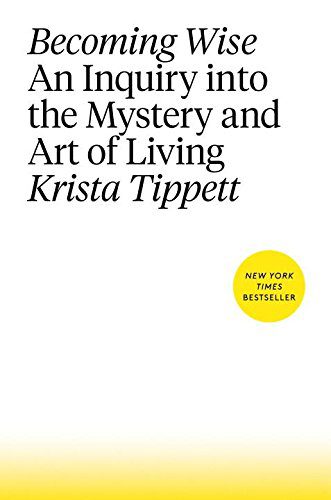 radio show On Being, to deliver this year’s Ware Lecture at UU General Assembly. Tippet’s new book is titled Becoming Wise: An Inquiry into the Mystery and Art of Living. Regarding her own journey toward becoming wiser, Tippet writes, “I’m a person who listens for a living. I listen for wisdom, and beauty, and for voices not shouting to be heard” (2).
In my training to become a spiritual director, I was taught that one definition of spiritual direction is “listening someone into speech.” Have you ever experienced someone being so fully present to you — so deeply listening to you — that you found yourself articulating new insights about yourself and the world? When was the last time you set aside your own agenda — thinking about what you want to say next — to listen to someone else that deeply, to listen someone into speech?
Tippet describes her approach to interviewing as “generous listening.” What might we learn from Tippet about how we can listen more generously to sources of wisdom in our world. She writes:
Generous listening is powered by curiosity…. It involves a kind of vulnerability — a willingness to be surprised, to let go of assumptions and take in ambiguity. The listener wants to understand the humanity behind the words of the other, and patiently summons one’s own best self and one’s own best words and questions. (29)
Given all the tragic events in recent weeks and months, what occasions might you have in the coming days to offer generous listening to others? How might we also cultivate more opportunities in which all of us might experience the gift of being fully heard?
We must also continue to ask ourselves, “To whom are we listening?” One of the many reasons that the #BlackLivesMatter movement is so important is that in the founding document of our country, in article I., section 2 of our Constitution, our leaders counted black lives as only “three-fifths” of a person. That law was not changed until 1868 with the Fourteenth Amendment. Even then, women were not allowed to vote until 1920 with the passage of the Nineteenth Amendment. We need increasingly to listen generously to women, to people of color, and to other historically oppressed groups if we are to have any hope of dismantling the systems of oppression that are imprisoning us all in the descending cycle of violence in which we are all caught.
Consider these statistics reported recently in The Washington Post:
-
About two-thirds of black Americans say they support Black Lives Matter…. Among white Americans, support for the protest movement drops to about 40 percent.…
-
Black and white Americans [also] disagree about whether there is still work to be done for blacks to achieve equal rights (88 percent of black respondents said there is, compared with 53 percent of whites).
-
About 58 percent of black Americans say there is too little attention paid to racial issues in America, while 41 percent of white Americans say there is too much.
-
And, while 40 percent of black Americans say systemic racism is the bigger problem, 70 percent of white Americans insist that the bigger issue is racist incidents based on the prejudice of individuals.
To add some data to these perceptions, a recently-completed three-year study reported in The New York Times, showed that, “although officers employ force in less than 2 percent of all police-civilian interactions, the use of police force is disproportionately high for African-Americans — more than three times greater than for whites.” We need to listen generously to one another across cultural divides because we experience the world differently.
Along these lines, I was heartened to read the many dissents this term written by the relatively-new Supreme Court Justice Sonya Sotomayer, which showed her deep engagement with both the history of the African-American experience in this country and her awareness of the current #BlackLivesMatter movement. Among the many sources quoted in her dissents include W. E. B. Du Bois’s The Souls of Black Folk, James Baldwin’s The Fire Next Time, Michelle Alexander’s The New Jim Crow, and Ta-Nehisi Coates’s Between the World and Me.
If you are interested in a deeper understanding of the #BlackLivesMatter movement, a good starting point might be those books that Justice Sotomayer chose to listen generously to as sources of wisdom for our country’s present and future. And the most accessible way to read them might be in reverse chronological order:
- Ta-Nehisi Coates’s Between the World and Me
- Michelle Alexander’s The New Jim Crow
- James Baldwin’s The Fire Next Time,
- W. E. B. Du Bois’s The Souls of Black Folk
It is worth reminding ourselves that race is “real in the same way that Wednesday is real. But it’s also made up in the same way that Wednesday is made up.” Learning about the ways that race is a social construction can empower our work in dismantling racism.
We know that race is a social construction because science has shown us that “All humans are 99.9 percent identical” at the DNA level: “Race is a social concept, not a scientific one…. We all evolved in the last 100,000 years from the same small number of tribes that migrated out of Africa and colonized the world….” There is only one race — the human race. But despite what science tells us about the universal kinship of all human beings, there are powerful forces in our world perpetuating the illusion that racial differences are more than skin deep. And given that history, it remains vital to affirm that #BlackLivesMatter.
For now, I’ll leave you with one final quote from Krista Tippet’s book. She reminded me of an important quote from the twentieth-century theologian Dietrich Bonhoeffer regarding the practice of listening generously or ungenerously: “The person who’s in love with their vision of community will destroy community. But the person who loves the people around them will create community everywhere they go.” In how we treat ourselves and others, may we each contribute toward the building of beloved community.
The Rev. Dr. Carl Gregg is a trained spiritual director, a D.Min. graduate of San Francisco Theological Seminary, and the minister of the Unitarian Universalist Congregation of Frederick, Maryland. Follow him on Facebook (facebook.com/carlgregg) and Twitter (@carlgregg).
Learn more about Unitarian Universalism: http://www.uua.org/beliefs/principles
Previous Post

August 30, 2016
Falling Down & Rising Strong
Next Post
September 6, 2016 People, Planet, Profit: Money Is Not the Only Bottom Line
Browse Our Archives
Select a Category Advent Anti-Racism Archaeology Atheism Baptism Best of the Year List Book Reviews Buddhism Catholicism Christian Education Church and State Church Planting Climate Change Conscientious Objection to War Creation Spirituality Death Penalty Didache Disability Rights Discernment Easter Ecology Emergent Church Movement Empire-Critical Ethics Evolution Feminist Theology Film Reviews Gandhi Gospel of Mark Gun Control Hinduism Immigration Reform Interfaith Islam JFK Judaism Jungian Spirituality Lectionary Commentary Lent Letters to the Editor LGBT Marriage MLK Multiculturalism Mysticism Nonviolent Activism Occupy Paganism (Earth-centered Religions) Parables Paul Pluralism Politics Process Theology Quantum Physics Requiescat In Pace Seminary and Divinity School Sermon Series Retrospective Sermons Spiritual Direction Spiritual Practices Stewardship (Fundraising) The Book of J The Wheel of the Year (Paganism) Theoblogger Challenge Triathlon Uncategorized Unitarian Universalism Worship Resources Youth Ministry
Select a Month July 2026 May 2026 March 2026 November 2025 October 2025 August 2025 February 2025 December 2024 October 2024 March 2024 January 2024 December 2023 November 2023 March 2023 February 2023 January 2023 December 2022 November 2022 August 2022 March 2022 February 2022 January 2022 December 2021 September 2021 August 2021 July 2021 June 2021 May 2021 February 2021 January 2021 December 2020 August 2020 June 2020 May 2020 April 2020 March 2020 February 2020 January 2020 December 2019 November 2019 October 2019 September 2019 July 2019 June 2019 March 2019 February 2019 January 2019 December 2018 November 2018 October 2018 September 2018 June 2018 May 2018 April 2018 March 2018 February 2018 January 2018 December 2017 November 2017 October 2017 September 2017 August 2017 July 2017 June 2017 May 2017 April 2017 March 2017 February 2017 January 2017 December 2016 November 2016 October 2016 September 2016 August 2016 June 2016 May 2016 April 2016 March 2016 February 2016 January 2016 December 2015 November 2015 October 2015 September 2015 August 2015 July 2015 June 2015 May 2015 April 2015 March 2015 February 2015 January 2015 December 2014 November 2014 October 2014 August 2014 July 2014 June 2014 May 2014 April 2014 March 2014 February 2014 January 2014 December 2013 November 2013 October 2013 September 2013 August 2013 July 2013 June 2013 May 2013 April 2013 March 2013 February 2013 January 2013 December 2012 November 2012 October 2012 September 2012 August 2012 July 2012 June 2012 May 2012 April 2012 March 2012 February 2012 January 2012 December 2011 November 2011 October 2011 September 2011 August 2011 July 2011 June 2011 May 2011 April 2011 March 2011 February 2011 January 2011 December 2010 November 2010 October 2010 August 2009 July 2009 May 2009
Follow Us!
TAKE THE
Religious Wisdom Quiz
Who was known as the doubter among Jesus' disciples?
Select your answer to see how you score.
Thomas James Peter John
Related posts from Carl Gregg

Reading America at 250: A Nation Wrestles With...


Andrew Holocek on the Power of Darkness

The Stories That Shape Us: Myths, Archetypes, &...
TRENDING AT PATHEOS More Voices

Reading America at 250: A Nation Wrestles With...
As part of my own reflection on the 250th anniversary of the...

Whenever I am reading a book or listening to an argument, I...

President Trump Ban Animal Torture Videos on Facebook
Call for Stricter Regulations of Animal Abuse Content on Facebook Although President...

Draft Amendments to Address Ritual Abuse in New...
The proposed changes would make it illegal for individuals in domestic partnerships...

How Bans on LGBTQ+ Student Clubs Threaten Religious...
On June 20, 2025, the State of Texas passed Senate Bill 12....

The Truth About the Gen Z Revival
This past year, there has been a lot of media buzz surrounding...
view all More Voices blogs
Ad-Free & Subscriber Log-In Subscription Support
- About Us
- 2026 Calendar
- Videos
- Podcasts
- Library of World Religions
- Faith In Media Tracker
- Advertise With Us
- Write for Us
- Privacy Policy
- Terms of Service
- Do Not Sell My Data
- Contact Us
- Radiant Digital
- Manage Newsletter Subscriptions
- Unsubscribe From Notifications
- Sitemap
Copyright 2008-2026, Patheos. All rights reserved.
Subscription Support Ad-Free & Subscriber Log-In
Follow Patheos