
BuddhistCatholicContemplativeEvangelicalGeneral ChristianHinduJewishLatter-day SaintMuslimNew VisionsProgressive Christian
Beliefs
- Buddhist
- Catholic
- Contemplative
- Evangelical
- General Christian
- Hindu
- Jewish
- Latter-day Saint
- More Voices
- Muslim
- New Visions
- Pagan
- Progressive Christian
Topics
- Religion News
- Food and Religion
- Sports and Religion
- Religious Art
- Religious Music and Entertainment
- Religious Events
- History and Religion
- Style and Religion
- Politics and Religion
- Women in Religion
- Recreation Outdoors and Religion
- Business Finance and Religion
- Careers Workplace and Religion
- Education and Religion
- Family Parenting and Religion
- Health Fitness and Religion
- Home and Religion
- Relationships and Religion
- Technology and Religion
- Travel and Religion
Columnists
- Buddhist Columnists
- Business Finance and Religion Columnists
- Careers Workplace and Religion Columnists
- Catholic Columnists
- Contemplative Columnists
- Education and Religion Columnists
- Evangelists Columnists
- Family Parenting and Religion Columnists
- General Christian Columnists
- Health Fitness and Religion Columnists
- Hindu Columnists
- History and Religion Columnists
- Home and Religion Columnists
- Jewish Columnists
- More Voices Columnists
- Latter Day Columnists
- Muslim Columnists
- New Visions Columnists
- Nonreligious Columnists
- Pagan Columnists
- Politics and Religion Columnists
- Progressive Columnists
- Recreation Outdoors and Religion Columnists
- Relationships and Religion Columnists
- Religion News Columnists
- Religious Art Columnists
- Religious Events Columnists
- Religious Music and Entertainment Columnists
- Sports and Religion Columnists
- Style and Religion Columnists
- Technology and Religion Columnists
- Travel and Religion Columnists
- Women in Religion Columnists
Resource Library
- 2026 Calendar
- Library of World Religions
- The 100 Most Holy Places on Earth
- Patheos Answers
- Podcasts
- Videos
- Faith Leaders Database
- Anglican Episcopalian
- Bahai
- Baptist
- Buddhism
- Christianity
- Confucianism
- Eastern Orthodoxy
- Hinduism
- Holiness and Pentecostal
- ISKCON
- Islam
- Judaism
- Lutheran
- Methodist
- The Church of Jesus Christ of Latter-day Saints
- New Age
- Paganism
- Presbytarian and Reformed
- Protestantism
- Religion Behind the Scenes
- Roman Catholic
- Scientology
- Shia Islam
- Sikhism
- Sufism
- Sunni Islam
- Taoism
- Zen
- See all religions
Research Tools
 Ad-Free & Subscriber Log-In Subscription Support
Ad-Free & Subscriber Log-In Subscription Support
Follow Patheos 

- Trending:
- Forgiveness
- |
- Marriage
- |
- Consciousness
- |
- Death Penalty
- |
- Election
- |
- Halloween

- Home
- More Voices
- Modern Uncertainty: “Meeting the Universe Halfway”
Modern Uncertainty: “Meeting the Universe Halfway”
Last updated on: August 25, 2016 at 9:55 am by Carl Gregg
Modern Uncertainty: “Meeting the Universe Halfway” 2016-08-23T09:17:39-04:00 Carl Gregg
Patheos Explore the world's faith through different perspectives on religion and spirituality! Patheos has the views of the prevalent religions and spiritualities of the world.
A member of the congregation I serve emailed me recently on the topic about modern uncertainty:
In the nineteenth century, Robert Browning could write, “God ‘s in His heaven — All’s right with the world!” There was a high level of certainty that we were on the path to an earthly paradise. At the dawn of the twentieth century, quantum effects disrupted the view of science that nature was predictable at the most basic level. Wittgenstein questioned whether there indeed were any philosophical questions or only misunderstandings from the ambiguity of language. Goedel, then Turing and von Neumann shook the foundations of mathematics. Rorty points out that all is contingent, and the ascendency of Europe and America was only an accident of timing.”
Almost 2,500 years ago Socrates loved to expose the ways that many people are deluded about how much they think they know. In contrast, Socrates used to brag that he was the wisest person in Athens not because he knew a lot, but because he was aware of how much he did not know. His advantage was in not fooling himself about his level of certain knowledge about the world. Twenty-five hundred years later, here in the early twenty-first century, we know that Socrates didn’t know the half of it! There’s so much more that we “know we don’t know” than Socrates could’ve ever dreamed of not knowing!
To quote one of the few lines from Donald Rumsfeld that is worth remembering: “There are known knowns…. There are known unknowns… But there are also unknown unknowns.” In the early twenty-first century, despite all we know, we are also increasingly aware of all the known unknowns — much of which is related to our finite human capacities of perception. As the scientist J.S. Haldane said about the implications of quantum mechanics: “The universe is not only queerer than we suppose, but queerer than we can suppose.”
And it is indeed true that when Browning published that poem in 1841, in the wake of the Industrial Revolution, it was much easier to make the argument that we were on our way, as a species, toward building a utopia on this planet. Relatedly to consider one of the nineteenth-century forebears to my Unitarian Universalist tradition (many of whom held utopian ideals), in 1886 the Unitarian minister James Freeman Clarke published his famous “Five Points of the New Theology” that were meant as both a rejection of the Five Points of Calvinism and touchstones for religion in a modern age. (Keep in mind that he was writing almost a century before Second-Wave Feminism):
-
-
- the fatherhood of God,
- the brotherhood of man,
- the leadership of Jesus,
- salvation by character, and…
- the progress of mankind onward and upward forever.
-
To elaborate briefly on what he meant:
-
-
- the fatherhood of God, [we share a common source]
- the brotherhood of man, [we are all part of the same family]
- the leadership of Jesus, [through emulating his ethics]
- salvation by character, [human freedom and responsibility]
- the progress of mankind onward and upward forever.
-
You can particularly see nineteenth-century optimism in that final point.
But during World War I in the early twentieth century, we saw that the technology of the Industrial Revolution not only had great promise for increasing our quality of life, but also had potential to cause carnage on a previously unimagined scale. Compared to Clarke’s optimism about the inevitable “progress of mankind onward and upward forever,” consider the first stanza of William Butler Yeats’ poem “The Second Coming,” written in 1919 in the immediate aftermath of World War I:
Turning and turning in the widening gyre
The falcon cannot hear the falconer;
Things fall apart; the centre cannot hold;
Mere anarchy is loosed upon the world,
The blood-dimmed tide is loosed, and everywhere
The ceremony of innocence is drowned;
The best lack all conviction, while the worst
Are full of passionate intensity.
One common way of tracing the history of ideas is that the turn from Modernism to Postmodernism began with the global trauma of the First World War — the move from a trust in One Grand, Overarching Narrative of Progress to many competing (and often contradictory) narratives about how the world is or should be.
It used to be more reasonable to understand our species and our planet as at the center of “life, the universe, and everything.” But in the sixteenth-century, Copernicus decentered our planet, showing through careful observations that Earth is not the center of the universe, but instead merely the third rock from the sun. In the nineteenth century, Darwin decentered our species, showing through careful observations that we are not special creations “a little lower than the angels,” but merely a species “a little higher than the apes” and deeply interconnected to the ecosystems of this planet.
In the early twentieth century, our place in the universe got even wilder, when Einstein decentered space and time, showing the relativity of space and time, written now as one hyphenated word: space-time. As the particle physicist Karen 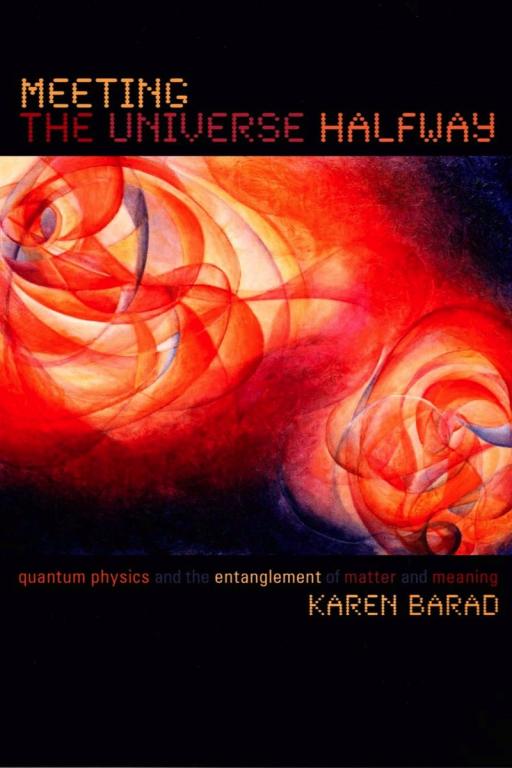 Barad explores in her excellent — but challenging — book titled Meeting the Universe Halfway: Quantum Physics and the Entanglement of Matter and Meaning, it turns out that, “Time is not a succession of evenly spaced individual moments…. Similarly, space is not a collection of preexisting points set out in a…container, as it were, for matter to inhabit.” Rather, in the words of one physicist, “Spaciality is intra-activity produced” (180-181). Not interactively — as if space and time were two separate things that come together. Rather, they are always already intra-active. Think about the different between inter-murals (“between” two rival schools) and intra-murals (competition from “within” a school). I’ll come back to this point soon.
In the seventeenth century, Isaac Newton (1642 – 1727) was a giant figure in the Scientific Revolution. He helped solidify the field of classical mechanics, hugely advancing our understanding of the laws of motion and of gravitation. Within the Newtonian paradigm, science in many ways seemed clear-cut and objective (107). Everything seemed to sort naturally into one category or another. A phenomena being observed might be, for example, either a particle or a wave (100).
But as scientists looked closer and closer, it turns out the universe is a lot messier and more complex than previously thought. We have well-documented, experimental results that “light manifests particle behavior under certain circumstances and wave behavior under other circumstances.” Similarly, “matter — not just light — manifests wave behavior under the right experimental circumstances.” This dynamic is called the “wave-particle duality paradox,” and is one among many examples of what is sometimes called “quantum weirdness” — which calls into question all those conveniently clear-cut categories of classical physics (83).
Related to uncertainty, one specific aspect of quantum weirdness that I should hasten to mention is “Heisenberg’s uncertainty principle,” which shows (at the quantum level) that the very act of observation changes the phenomenon being observed. So there is no possibility of being a neutral, objective observer — a notion, it turns out, that was always an unrealistic dream. We can only estimate probabilities and possibilities from our various intra-active, subjective points of view.
In the early twenty-first century, we’ve come a long way from the idea that we humans are a uniquely special creation at the center of life, the universe, and everything. There are so many more “known unknowns” that ever before. And we are right to have a certain level of humility in the face of so much modern uncertainty.
That being said, I would be remiss if I didn’t celebrate how much we do know here in the early twenty-first century. After all, we live in the age of smart phones, space travel, and the burgeoning promise of nanotechnology. It sometimes feels like our technology is getting closer and closer to Star Trek. (I’m preach each Sunday from an iPad, after all!) We live in an age in which we have moved from Visual-light microscopes (which many of us grew up with in science labs) through electron microscopes (which can examine the structure of molecules) to Scanning Tunneling Microscopes, which can “see” atoms (40). That’s incredible!
Moving to the final sentence of the email I received, the sender wrote, the American Pragmatist philosopher, Richard Rorty “points out that all is contingent, the ascendency of Europe and America was only an accident of timing.” Rorty is relatedly a famous social constructivist, who takes postmodern uncertainty to its extremes. While I am generally a big fan of Rorty, my favorite retort to his more extreme position that “everything is a social construction” is from novelist Philip K. Dick who liked to say that, “Reality is what doesn’t go away when you stop believing in it.”
Now, as I begin to turn toward my conclusion, allow me to try to “stick the landing.” Many western worldviews have historically been very human-centric as well as grounded in a perspective of separate individuals and external objects that could easily be divided into clear-cut categories. But Quantum Physics challenges this notion of original separateness. We are not separate beings who sometimes inter-relate with one another or with the world. Instead we are always already intra-related (139).
Many objects around you may seem separate and solid, but if we were to examine it more closely with the right tools, we would see that at the atomic level, it is a buzzing sea of particles. As for the “void” between us or at the sub-atomic level:
it isn’t all that was supposed to be (or not be), either. According to quantum field theory, the vacuum is far from empty; indeed, it’s teeming with the full set of possibility of what may come to be. Matter is regularly created and destroyed. And the zoo of subatomic particles — including electrons, quarks, positrons, antiquarks, neutrinos, pions, pluons, and photons — isn’t comprised of simple individual objects occupying specific positions in the vacuum we call space and time: not only is that very idea…not to be taken for granted, but part of their very nature seems to be wrapped up in the bubbling sea of possibilities…. (354)
We are not, nor have we ever been, merely separate beings. We are intra-related becomings. We are deeply entangled, down to the quantum level (ix). We are not separate observers of our world; we are, instead, inextricably “part of that nature that we seek to understand” (26).
I’ll end you for now with this quote from the conclusion of Karen Barad’s book Meeting the Universe Halfway:
Meeting each moment, being alive to the possibilities of becoming, is an ethical call, an invitation that is written into the very matter of all being and becoming. We need to meet the universe halfway, to take responsibility for the role that we play in the world’s…becoming. (396)
The Rev. Dr. Carl Gregg is a trained spiritual director, a D.Min. graduate of San Francisco Theological Seminary, and the minister of the Unitarian Universalist Congregation of Frederick, Maryland. Follow him on Facebook (facebook.com/carlgregg) and Twitter (@carlgregg).
Learn more about Unitarian Universalism: http://www.uua.org/beliefs/principles
Previous Post

August 23, 2016
Gender Liberation
Next Post
August 30, 2016 Falling Down & Rising Strong
Browse Our Archives
Select a Category Advent Anti-Racism Archaeology Atheism Baptism Best of the Year List Book Reviews Buddhism Catholicism Christian Education Church and State Church Planting Climate Change Conscientious Objection to War Creation Spirituality Death Penalty Didache Disability Rights Discernment Easter Ecology Emergent Church Movement Empire-Critical Ethics Evolution Feminist Theology Film Reviews Gandhi Gospel of Mark Gun Control Hinduism Immigration Reform Interfaith Islam JFK Judaism Jungian Spirituality Lectionary Commentary Lent Letters to the Editor LGBT Marriage MLK Multiculturalism Mysticism Nonviolent Activism Occupy Paganism (Earth-centered Religions) Parables Paul Pluralism Politics Process Theology Quantum Physics Requiescat In Pace Seminary and Divinity School Sermon Series Retrospective Sermons Spiritual Direction Spiritual Practices Stewardship (Fundraising) The Book of J The Wheel of the Year (Paganism) Theoblogger Challenge Triathlon Uncategorized Unitarian Universalism Worship Resources Youth Ministry
Select a Month July 2026 May 2026 March 2026 November 2025 October 2025 August 2025 February 2025 December 2024 October 2024 March 2024 January 2024 December 2023 November 2023 March 2023 February 2023 January 2023 December 2022 November 2022 August 2022 March 2022 February 2022 January 2022 December 2021 September 2021 August 2021 July 2021 June 2021 May 2021 February 2021 January 2021 December 2020 August 2020 June 2020 May 2020 April 2020 March 2020 February 2020 January 2020 December 2019 November 2019 October 2019 September 2019 July 2019 June 2019 March 2019 February 2019 January 2019 December 2018 November 2018 October 2018 September 2018 June 2018 May 2018 April 2018 March 2018 February 2018 January 2018 December 2017 November 2017 October 2017 September 2017 August 2017 July 2017 June 2017 May 2017 April 2017 March 2017 February 2017 January 2017 December 2016 November 2016 October 2016 September 2016 August 2016 June 2016 May 2016 April 2016 March 2016 February 2016 January 2016 December 2015 November 2015 October 2015 September 2015 August 2015 July 2015 June 2015 May 2015 April 2015 March 2015 February 2015 January 2015 December 2014 November 2014 October 2014 August 2014 July 2014 June 2014 May 2014 April 2014 March 2014 February 2014 January 2014 December 2013 November 2013 October 2013 September 2013 August 2013 July 2013 June 2013 May 2013 April 2013 March 2013 February 2013 January 2013 December 2012 November 2012 October 2012 September 2012 August 2012 July 2012 June 2012 May 2012 April 2012 March 2012 February 2012 January 2012 December 2011 November 2011 October 2011 September 2011 August 2011 July 2011 June 2011 May 2011 April 2011 March 2011 February 2011 January 2011 December 2010 November 2010 October 2010 August 2009 July 2009 May 2009
Follow Us!
TAKE THE
Religious Wisdom Quiz
What is the main theme of Galatians?
Select your answer to see how you score.
Church discipline Justification by faith Spiritual gifts Love above faith
Related posts from Carl Gregg

Reading America at 250: A Nation Wrestles With...


Andrew Holocek on the Power of Darkness

The Stories That Shape Us: Myths, Archetypes, &...
TRENDING AT PATHEOS More Voices

Reading America at 250: A Nation Wrestles With...
As part of my own reflection on the 250th anniversary of the...

Whenever I am reading a book or listening to an argument, I...

President Trump Ban Animal Torture Videos on Facebook
Call for Stricter Regulations of Animal Abuse Content on Facebook Although President...

Draft Amendments to Address Ritual Abuse in New...
The proposed changes would make it illegal for individuals in domestic partnerships...

How Bans on LGBTQ+ Student Clubs Threaten Religious...
On June 20, 2025, the State of Texas passed Senate Bill 12....

The Truth About the Gen Z Revival
This past year, there has been a lot of media buzz surrounding...
view all More Voices blogs
Ad-Free & Subscriber Log-In Subscription Support
- About Us
- 2026 Calendar
- Videos
- Podcasts
- Library of World Religions
- Faith In Media Tracker
- Advertise With Us
- Write for Us
- Privacy Policy
- Terms of Service
- Do Not Sell My Data
- Contact Us
- Radiant Digital
- Manage Newsletter Subscriptions
- Unsubscribe From Notifications
- Sitemap
Copyright 2008-2026, Patheos. All rights reserved.
Subscription Support Ad-Free & Subscriber Log-In
Follow Patheos