
BuddhistCatholicContemplativeEvangelicalGeneral ChristianHinduJewishLatter-day SaintMuslimNew VisionsProgressive Christian
Beliefs
- Buddhist
- Catholic
- Contemplative
- Evangelical
- General Christian
- Hindu
- Jewish
- Latter-day Saint
- More Voices
- Muslim
- New Visions
- Pagan
- Progressive Christian
Topics
- Religion News
- Food and Religion
- Sports and Religion
- Religious Art
- Religious Music and Entertainment
- Religious Events
- History and Religion
- Style and Religion
- Politics and Religion
- Women in Religion
- Recreation Outdoors and Religion
- Business Finance and Religion
- Careers Workplace and Religion
- Education and Religion
- Family Parenting and Religion
- Health Fitness and Religion
- Home and Religion
- Relationships and Religion
- Technology and Religion
- Travel and Religion
Columnists
- Buddhist Columnists
- Business Finance and Religion Columnists
- Careers Workplace and Religion Columnists
- Catholic Columnists
- Contemplative Columnists
- Education and Religion Columnists
- Evangelists Columnists
- Family Parenting and Religion Columnists
- General Christian Columnists
- Health Fitness and Religion Columnists
- Hindu Columnists
- History and Religion Columnists
- Home and Religion Columnists
- Jewish Columnists
- More Voices Columnists
- Latter Day Columnists
- Muslim Columnists
- New Visions Columnists
- Nonreligious Columnists
- Pagan Columnists
- Politics and Religion Columnists
- Progressive Columnists
- Recreation Outdoors and Religion Columnists
- Relationships and Religion Columnists
- Religion News Columnists
- Religious Art Columnists
- Religious Events Columnists
- Religious Music and Entertainment Columnists
- Sports and Religion Columnists
- Style and Religion Columnists
- Technology and Religion Columnists
- Travel and Religion Columnists
- Women in Religion Columnists
Resource Library
- 2026 Calendar
- Library of World Religions
- The 100 Most Holy Places on Earth
- Patheos Answers
- Podcasts
- Videos
- Faith Leaders Database
- Anglican Episcopalian
- Bahai
- Baptist
- Buddhism
- Christianity
- Confucianism
- Eastern Orthodoxy
- Hinduism
- Holiness and Pentecostal
- ISKCON
- Islam
- Judaism
- Lutheran
- Methodist
- The Church of Jesus Christ of Latter-day Saints
- New Age
- Paganism
- Presbytarian and Reformed
- Protestantism
- Religion Behind the Scenes
- Roman Catholic
- Scientology
- Shia Islam
- Sikhism
- Sufism
- Sunni Islam
- Taoism
- Zen
- See all religions
Research Tools
 Ad-Free & Subscriber Log-In Subscription Support
Ad-Free & Subscriber Log-In Subscription Support
Follow Patheos 

- Trending:
- Forgiveness
- |
- Marriage
- |
- Consciousness
- |
- Death Penalty
- |
- Election
- |
- Halloween

- Home
- More Voices
- Why We Should Choose both Religion and Science
Why We Should Choose both Religion and Science
Last updated on: June 14, 2016 at 1:40 pm by Carl Gregg
Why We Should Choose both Religion and Science 2016-06-14T13:40:17-04:00 Carl Gregg
Patheos Explore the world's faith through different perspectives on religion and spirituality! Patheos has the views of the prevalent religions and spiritualities of the world.
As a teenager, when I went to events with my theologically conservative youth group, there were often t-shirts for sale with anti-science slogans like, “I believe in the big bang. God spoke and bang it was.” There was an orientation toward protecting the past: a perception that all the paradigm-shifting religious events had already happened thousands of years ago, and that our role was to defend our belief in those miraculous occasions against emerging understandings which saw these ancient stories as myths and legends.
Arguments used to be made from scripture alone without reference to science: Genesis 1 says that God is the creator of the heavens and the Earth, so that’s what happened. As the bumper sticker says, “God said it. I believe it. That settles it.” But now we see absurdities like the Creation Museum in Kentucky that tries to prove on science’s terms that the Bible is literal, historical truth, which results in exhibits such as Adam and Eve riding on the backs of dinosaurs. What many religious fundamentalists don’t seem to realize is that science has redefined the battlefield such that both sides are now trying to prove their point—not through biblical interpretation—but with the scientific method.
This shift happened because modern science is so impressive: it’s hard to deny the power of the scientific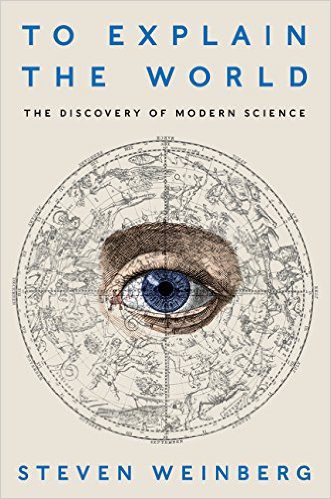 method, which has given us smart phones, the Internet, space travel, and so much more. But the effectiveness of science was not obvious from the beginning. Along those lines, this post was inspired by a book titled To Explain the World: The Discovery of Modern Science by the Nobel Prize-winning physicist Steven Weinberg (Harper 2015).
So, as we turn to the history of how we as a species came to increasingly “heed the guidance of reason and the results of science,” it may be helpful to keep in mind the quip from a L.P. Hartley novel, “The past is a foreign country; they do things differently there” (x).
So for example, the Pre-Socratic philosophers are often fascinating to read, but in many cases, they use what we would call logical fallacies or sophistry: “clever but unsound reasoning.” You see them repeatedly making claims without justification (11). Thales argues that the “universal primary substance” is water; Anaximander, that it is air. Xenophanes makes the case that the “fundamental substance” is earth, Heraclitus that it is fire, and Empedocles that everything is made some combination of those four elements: earth, wind, fire, and air (4-6). All of these arguments are interesting from a certain point of view, but none of them are evidence-based.
The same dynamic was often at work in theology. To give just one example, in the second century, the early church father Irenaeus writes in his book Against Heresies that the reason the Gospels of Matthew, Mark, Luke, and John are considered scripture and not the many other Gospels being written at the time, is that, “The Gospels could not possibly be either more or less in number than they are. Since there are four zones of the world in which we live, and four principal winds…the pillar and foundation of the Church is the gospel…it fittingly has four pillars.” That is classic sophistry: somewhat persuasive rhetoric that makes no sense if you take a step back from the propaganda—because one could, of course, think of similar analogies to justify any number of Gospels.
The larger point is that you can’t build anything of substance on such a false premise (254). You can’t start from the fanciful foundation that, “Everything is made of some combination of earth, wind, fire, and air” and eventually discover how to make an iPhone. But the scientific method can and has given us inventions that have transformed our world in both positive and negative ways (254).
One of the bridges to understanding the power of the scientific method—of setting up experiments to test a hypothesis against reality—was music. The Pythagoreans notice that, “If two strings of equal thickness, composition, and tension are plucked at the same time, the sound is pleasant if the lengths of the strings are in a ratio of small whole numbers”:
- Octave: one string is half the length of the other
- Fifth: two-thirds the length
- Fourth: three-fourths the length
“By contrast, if the lengths of the two strings are not in a ratio of small whole numbers, then the sound is jarring and unpleasant” (16). These observations and experiments helped link music and math, as well as the use of evidence-based reasoning to make predictions about reality.
Ultimately, though, it is also important to point out that pure “mathematics is not a natural science,” a branch of science that deals with the physical world. Rather, math is a language, a tool, that can be used in science; however, “Mathematics in itself, without observations, cannot tell us anything about the world. [Conversely], any mathematical theorem can be neither verified nor refuted by observations of the world” (20).
And it is precisely on the close observation of the natural world that science began to progress. We see thinkers among our ancestors slowly letting go of unfounded speculation and beginning to make small discoveries based on an increasingly sophisticated method of observation, measurement, and experimentation—and the ensuring formulation, testing, and modification of hypotheses based on those experiments—which built on themselves over time (33).
Five thousand years ago, ancient Egyptians were using the stars to track and predict the flooding of the Nile (55). And it’s a myth that everyone thought the world was flat before Columbus. There were ancient Greeks, around 2,500 years ago, who made educated arguments for why the Earth is a sphere based on observing that, “The Earth’s shadow on the Moon during a lunar eclipse is curved, and the position of stars in the sky seems to change as we travel north to south” (64).
And, when Columbus was preparing to set sail, the debate
concerned not the shape of the Earth, but its size. Columbus thought the Earth was small enough so that he could sail from Spain to the East coast of Asia without running out of food and water. He was wrong about the size of the Earth, but was saved by the unexpected appearance of America between Europe and Asia” (65).
But even with all the important discoveries in the ancient world, the real paradigm shift—what we now call the Scientific Revolution—began in the sixteenth century with Copernicus’s discovery that the Earth is not the center of the universe (146). Our planet is merely the third rock from the sun (148).
Copernicus’s book On the Revolution of the Heavenly Spheres, was published in 1543, only 26 years after Martin Luther nailed his “95 Theses” to the door of Wittenberg Chapel in Germany, catalyzing the Protestant Reformation (153). But even as the Protestant Reformers were seeking a revolution in religion, they mostly remained resistant to science. Regarding Copernicus, Luther wrote, “This is what that fool does who wishes to turn the whole of astronomy upside down…. I believe in the Holy Scriptures, for Joshua commanded the Sun to stand still and not the Earth.” Here we see the aforementioned “Argument from Scripture” being used against the “Argument from Scientific Evidence” (156).
But long before the New Atheist movement, scientists were also getting in their own barbs. Johannes Kepler wrote about religious resisters to Copernicanism in one of his books in a paragraph with the indelicate title of Advice for idiots:
But whoever is too stupid to understand astronomical science, or too weak to believe Copernicus without [it] affecting his faith, I would advise him that, having dismissed astronomical studies, and having damned whatever philosophical studies he pleases, he mind his own business and betake himself home to scratch in his own dirt patch. (170)
Unfortunately, calling your opponent an idiot is rarely a way to “win friends and influence people.” That being said, it’s important to recognize that the same irrational fear of science, which put Copernicus’s books on the religious banned book list, is parallel to the sophistry that fuels climate change denial today: “clever but unsound reasoning.”
Climate Change denial, as with the denial of Evolution, is an idolatry: revering a falsehood. But here’s the challenge of the Scientific Revolution: accept the world as it actually is, and respond accordingly. As the science fiction writer Philip K. Dick liked to say, “Reality is what doesn’t go away when you stop believing in it.”
But there has been a long process of coming to trust science that continues to today. When antiseptic techniques were discovered for cleaning your hands in a way that drastically reduced the likelihood of infection, most physicians initially refused to adopt antiseptic practices when moving from patient to patient. Similarly, practices like bleeding patients were widely used even though they had never been proven to be effective and eventually were proven to harm patients.
Tragically, medical history is riddled with unfounded theories like Humorism, that “four humors—blood, phlegm, black bile, and yellow bile, which (respectively) make us sanguine, phlegmatic, melancholic, or choleric.” But we know now that Humorism is wild speculation akin to the Pre-Socratic idea that everything is made of some combination of earth, wind, fire, and air. “Ironically, the opportunity for physicians to study theories [such as Humorism and Astrology] at universities gave medical doctors much higher prestige than surgeons, who knew how to do really useful thing like setting broken bones but until modern times were not usually trained in universities.”
Similarly, clinical trials were not required for new medicines until well into the twentieth century, which resulted in a lot of “snake oil.” Indeed, students of the history of medicine have “often remarked that until sometime around the beginning of the twentieth century the average sick person would do better avoiding the care of physicians.” Thankfully, we live a century into the age of evidence-based, scientific medicine!
As I move toward my conclusion, I invite you to hear these words from Steven Weinberg’s book To Explain the World:
Faced with a puzzling world, people in every culture have sought explanations…. Thales tried to understand matter by guessing that it is all water, but what could he do with this idea? …But imagine how Ptolemy must have felt when he realized that…he had found a theory of planetary motion that allowed him to predict with fair accuracy where any planet would be found in the sky at any time….
What pleasure Copernicus must then have felt when he was able to explain that the fine-tuning and the looping orbits of Ptolemy’s scheme arose simply because we view the solar system from a moving Earth. Still flawed, the Copernican theory did not quite fit the data without ugly complications. How much then the mathematically gifted Kepler must have enjoyed replacing the Copernican mess with motion in ellipses.… (254-255)
Despite the excitement and power of scientific discoveries, however, the attitude of religion toward science has often been to ask, “What does Athens have to do with Jerusalem?” In contrast, our invitation is to choose both: the best of the world’s religions balanced with the insights of modern science.
From our twenty-first century, pluralistic, postmodern perspective, we also know that despite the power of science, there are also limitations to what the scientific method can address. As religious traditions testify, some experiences are subjective, uncanny, and rare and do not lend themselves to observable, repeatable study on demand in laboratory conditions. Or as the scientist J.S. Haldane said about the implications of quantum mechanics: “The universe is not only queerer than we suppose, but queerer than we can suppose.”
In that spirit, I’ll leave you with this advice from the philosopher Wittgenstein: “Don’t think, look.” Don’t limit yourself by always thinking in advance how you presume the world is. Look. Observe closely. Test. Experiment. How might you—how might we—learn to better explain the world?
The Rev. Dr. Carl Gregg is a trained spiritual director, a D.Min. graduate of San Francisco Theological Seminary, and the minister of the Unitarian Universalist Congregation of Frederick, Maryland. Follow him on Facebook (facebook.com/carlgregg) and Twitter (@carlgregg).
Learn more about Unitarian Universalism: http://www.uua.org/beliefs/principles
Previous Post

June 7, 2016
Best Podcasts for Election 2016
Next Post
June 14, 2016 The Nightmare of Orlando Haunts, But the Dream of Stonewall Lives On
Browse Our Archives
Select a Category Advent Anti-Racism Archaeology Atheism Baptism Best of the Year List Book Reviews Buddhism Catholicism Christian Education Church and State Church Planting Climate Change Conscientious Objection to War Creation Spirituality Death Penalty Didache Disability Rights Discernment Easter Ecology Emergent Church Movement Empire-Critical Ethics Evolution Feminist Theology Film Reviews Gandhi Gospel of Mark Gun Control Hinduism Immigration Reform Interfaith Islam JFK Judaism Jungian Spirituality Lectionary Commentary Lent Letters to the Editor LGBT Marriage MLK Multiculturalism Mysticism Nonviolent Activism Occupy Paganism (Earth-centered Religions) Parables Paul Pluralism Politics Process Theology Quantum Physics Requiescat In Pace Seminary and Divinity School Sermon Series Retrospective Sermons Spiritual Direction Spiritual Practices Stewardship (Fundraising) The Book of J The Wheel of the Year (Paganism) Theoblogger Challenge Triathlon Uncategorized Unitarian Universalism Worship Resources Youth Ministry
Select a Month July 2026 May 2026 March 2026 November 2025 October 2025 August 2025 February 2025 December 2024 October 2024 March 2024 January 2024 December 2023 November 2023 March 2023 February 2023 January 2023 December 2022 November 2022 August 2022 March 2022 February 2022 January 2022 December 2021 September 2021 August 2021 July 2021 June 2021 May 2021 February 2021 January 2021 December 2020 August 2020 June 2020 May 2020 April 2020 March 2020 February 2020 January 2020 December 2019 November 2019 October 2019 September 2019 July 2019 June 2019 March 2019 February 2019 January 2019 December 2018 November 2018 October 2018 September 2018 June 2018 May 2018 April 2018 March 2018 February 2018 January 2018 December 2017 November 2017 October 2017 September 2017 August 2017 July 2017 June 2017 May 2017 April 2017 March 2017 February 2017 January 2017 December 2016 November 2016 October 2016 September 2016 August 2016 June 2016 May 2016 April 2016 March 2016 February 2016 January 2016 December 2015 November 2015 October 2015 September 2015 August 2015 July 2015 June 2015 May 2015 April 2015 March 2015 February 2015 January 2015 December 2014 November 2014 October 2014 August 2014 July 2014 June 2014 May 2014 April 2014 March 2014 February 2014 January 2014 December 2013 November 2013 October 2013 September 2013 August 2013 July 2013 June 2013 May 2013 April 2013 March 2013 February 2013 January 2013 December 2012 November 2012 October 2012 September 2012 August 2012 July 2012 June 2012 May 2012 April 2012 March 2012 February 2012 January 2012 December 2011 November 2011 October 2011 September 2011 August 2011 July 2011 June 2011 May 2011 April 2011 March 2011 February 2011 January 2011 December 2010 November 2010 October 2010 August 2009 July 2009 May 2009
Follow Us!
TAKE THE
Religious Wisdom Quiz
Which prophet predicted that Gentiles would become God's people along with Israel?
Select your answer to see how you score.
Ezekiel Hosea Jonah Micah
Related posts from Carl Gregg

Reading America at 250: A Nation Wrestles With...


Andrew Holocek on the Power of Darkness

The Stories That Shape Us: Myths, Archetypes, &...
TRENDING AT PATHEOS More Voices

Reading America at 250: A Nation Wrestles With...
As part of my own reflection on the 250th anniversary of the...

Whenever I am reading a book or listening to an argument, I...

President Trump Ban Animal Torture Videos on Facebook
Call for Stricter Regulations of Animal Abuse Content on Facebook Although President...

Draft Amendments to Address Ritual Abuse in New...
The proposed changes would make it illegal for individuals in domestic partnerships...

How Bans on LGBTQ+ Student Clubs Threaten Religious...
On June 20, 2025, the State of Texas passed Senate Bill 12....

The Truth About the Gen Z Revival
This past year, there has been a lot of media buzz surrounding...
view all More Voices blogs
Ad-Free & Subscriber Log-In Subscription Support
- About Us
- 2026 Calendar
- Videos
- Podcasts
- Library of World Religions
- Faith In Media Tracker
- Advertise With Us
- Write for Us
- Privacy Policy
- Terms of Service
- Do Not Sell My Data
- Contact Us
- Radiant Digital
- Manage Newsletter Subscriptions
- Unsubscribe From Notifications
- Sitemap
Copyright 2008-2026, Patheos. All rights reserved.
Subscription Support Ad-Free & Subscriber Log-In
Follow Patheos