
BuddhistCatholicContemplativeEvangelicalGeneral ChristianHinduJewishLatter-day SaintMuslimNew VisionsProgressive Christian
Beliefs
- Buddhist
- Catholic
- Contemplative
- Evangelical
- General Christian
- Hindu
- Jewish
- Latter-day Saint
- More Voices
- Muslim
- New Visions
- Pagan
- Progressive Christian
Topics
- Religion News
- Food and Religion
- Sports and Religion
- Religious Art
- Religious Music and Entertainment
- Religious Events
- History and Religion
- Style and Religion
- Politics and Religion
- Women in Religion
- Recreation Outdoors and Religion
- Business Finance and Religion
- Careers Workplace and Religion
- Education and Religion
- Family Parenting and Religion
- Health Fitness and Religion
- Home and Religion
- Relationships and Religion
- Technology and Religion
- Travel and Religion
Columnists
- Buddhist Columnists
- Business Finance and Religion Columnists
- Careers Workplace and Religion Columnists
- Catholic Columnists
- Contemplative Columnists
- Education and Religion Columnists
- Evangelists Columnists
- Family Parenting and Religion Columnists
- General Christian Columnists
- Health Fitness and Religion Columnists
- Hindu Columnists
- History and Religion Columnists
- Home and Religion Columnists
- Jewish Columnists
- More Voices Columnists
- Latter Day Columnists
- Muslim Columnists
- New Visions Columnists
- Nonreligious Columnists
- Pagan Columnists
- Politics and Religion Columnists
- Progressive Columnists
- Recreation Outdoors and Religion Columnists
- Relationships and Religion Columnists
- Religion News Columnists
- Religious Art Columnists
- Religious Events Columnists
- Religious Music and Entertainment Columnists
- Sports and Religion Columnists
- Style and Religion Columnists
- Technology and Religion Columnists
- Travel and Religion Columnists
- Women in Religion Columnists
Resource Library
- 2026 Calendar
- Library of World Religions
- The 100 Most Holy Places on Earth
- Patheos Answers
- Podcasts
- Videos
- Faith Leaders Database
- Anglican Episcopalian
- Bahai
- Baptist
- Buddhism
- Christianity
- Confucianism
- Eastern Orthodoxy
- Hinduism
- Holiness and Pentecostal
- ISKCON
- Islam
- Judaism
- Lutheran
- Methodist
- The Church of Jesus Christ of Latter-day Saints
- New Age
- Paganism
- Presbytarian and Reformed
- Protestantism
- Religion Behind the Scenes
- Roman Catholic
- Scientology
- Shia Islam
- Sikhism
- Sufism
- Sunni Islam
- Taoism
- Zen
- See all religions
Research Tools
 Ad-Free & Subscriber Log-In Subscription Support
Ad-Free & Subscriber Log-In Subscription Support
Follow Patheos 

- Trending:
- Forgiveness
- |
- Marriage
- |
- Consciousness
- |
- Death Penalty
- |
- Election
- |
- Halloween

- Home
- More Voices
- Struggling to “Speak the Truth in Love” in Election Season: Pluralistic Ethics & Political Polarization
Struggling to “Speak the Truth in Love” in Election Season: Pluralistic Ethics & Political Polarization
Last updated on: May 9, 2016 at 8:56 pm by Carl Gregg
Struggling to “Speak the Truth in Love” in Election Season: Pluralistic Ethics & Political Polarization 2016-05-09T20:56:27-04:00 Carl Gregg
Patheos Explore the world's faith through different perspectives on religion and spirituality! Patheos has the views of the prevalent religions and spiritualities of the world.
Over the past few decades, many studies have shown a growing political polarization in our country. This widening gap between the right and the left has made finding a middle ground increasingly difficult. So in this presidential election season in which our collective awareness of political polarization is heightened, I would like to reflect on negotiating between divergent perspectives.
There was, for example, a front page headline last week in my hometown paper that read, “Transgender teen says he and his mother were removed from Cruz event.” How do we as a society adjudicate between one person’s “freedom” to choose the bathroom that feels right to them and another person’s (perhaps uninformed) fear about gender-neutral bathrooms? I’ve used quite a few gender-neutral bathrooms over the years, and I can report that it turns out they are just bathrooms!
In reflecting on these issues, I appreciated a story from The Rev. Dr. Amy Butler, the minister at Riverside Church in New York City. On a recent flight returning from Europe, Amy found herself in the midst of a conflict around differing interpretations of religious freedom and individual liberty. As she approached the seat listed on her ticket, she noticed that all around her empty seat were men identically dressed, seemingly part of an orthodox religious group. It turns out that she guessed correctly. As soon as she sat down, the man beside her pressed the flight attendant button and said that Amy would need to be moved to another seat: “his religious freedom, he said, was [being] violated….as his religion does not allow him to sit next to a woman who is not his wife.”
Amy confesses, “I had so many thoughts in that moment.” She did not give up her seat, but the conflict also just beginning. There were other perceived violations of religious freedom around airline food not passing theological muster as well as the men feeling religiously prohibited from interacting with female flight attendants. She writes, “The end result was a noisy, contentious, and anxiety-ridden eight hours.”
So how do we move forward? Is there an unresolvable impasse between a woman’s freedom to sit in her assigned seat and a religiously orthodox man’s conviction that the God of his understanding forbids him to sit next to a woman who is not his wife? How do we solve the dilemma of one person’s perceived religious freedom to sell wedding cakes only to opposite-gender couples or another person’s desired religious liberty to maintain “traditional gender roles” in bathrooms?
Religious liberty is about the freedom to choose your own religion without coercion by the government, religious leaders, or the larger community. But that individual freedom does not extend to unduly controlling other people. When I read about conflicts over religious liberty, I sometimes think that we have lost perspective about what serious religious persecution looks like—such as during the Inquisition when individuals were forced to be part of a state-sponsored religion under threat or imprisonment or death.
Freedom of religion does not give individuals or groups power to impose their religion on others. I respect (though disagree) if the God of your understanding tells you to not use contraception, but that does not give you the right to block your employees’s access to birth control. The First Amendment has both a Free Exercise clause and an Establishment clause: “Congress shall make no law respecting an establishment of religion, or prohibiting the free exercise thereof.” So while you do have freedom of religion, your individual freedom of religion does not include the right to establish your religion over others; that would be one step too far. As our Unitarian forebear and Supreme Court Justice Oliver Wendell Holmes (1841 – 1935) said, “The right to swing my fist ends where the other man’s nose begins.” Or, as Rev. Amy said in reflecting on her airplane encounter, “Religious freedom is just that: freedom. Note that we don’t call it ‘religious comfort.’” When we forget this insight, claims about religious liberty too often end up masking what in reality is an attempt to force an individual or group’s sexism, racism, or homophobia on the larger society.
To be clear, in a free society, individuals can freely choose sexist, racist, or homophobic beliefs; however, a commitment to individual liberty requires limits on how individuals interact with one another. As The Rev. Dr. Martin Luther King, Jr. said, “It may be true that morality cannot be legislated, but behavior can be regulated. It may be true that the law cannot change the heart but it can restrain the heartless. It may be true that the law cannot make a man love me but it can keep him from lynching me.” And I do not mean to be flippant when I say next that simply keeping us from killing one another—and then allowing us to live freely amidst one another in all our diversity is a tremendous catalyst for progress.
As Dr. King said later in that same speech:
One of the tragedies of our whole struggle is…monologue, rather than dialogue, and I am convinced that men hate each other because they fear each other. They fear each other because they don’t know each other and they don’t know each other because they don’t communicate with each other, and they don’t communicate with each other because they are separated from each other.
This dynamic remains true today. So many people have become less sexist not by abstract argument, but through a relationship with their daughter, mother, spouse, or other loved one who was being discriminated against. Likewise, the struggle for Lesbian, Gay, Bisexual, and Transgender justice has been advanced much less by reasoned arguments (although those have been important too) than by people experiencing loved ones coming out of the closet—and seeing that LGBT folk are not a “them” but part of “us.”
Even in the face of our increasingly polarized country, there is a broader trend of expanding concentric 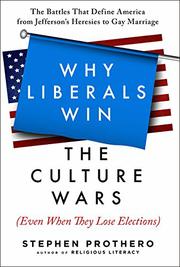 circles of who is included as a fully enfranchised and represented member of “We the People.” Almost 60 years ago, when then-Senator John F. Kennedy was running for president, he had to give a major speech to convince the U.S. public that a Roman Catholic could be president without being unduly influenced by the pope. Today, to use another branch of government as an indication of how far our culture has shifted, there are five Catholic members of the Supreme Court, three Jewish members, and no Protestants. Similarly, as Stephen Prothero has written about in his excellent new book Why Liberals Win the Culture Wars (Even When They Lose Elections): The Battles That Define America from Jefferson’s Heresies to Gay Marriage, despite major persecution against Mormons in our nation’s history, in the last presidential election cycle, “white evangelicals voted for [Governor Mitt] Romney in even greater numbers than they had voted for George W. Bush four years earlier. Romney may have lost, but Mormons won” (137).
When I was young and my worldview was formed almost exclusively from a Southern Baptist perspective, I would have been happy to learn that all six billion people on Earth had become Southern Baptists overnight. But as I grew older, I began to meet increasing numbers of non-Southern Baptists who were kind, well-adjusted, smart, funny, competent human beings. When your roommate is a Roman Catholic, your best friend is an atheist, and your favorite professor is a Buddhist, it is increasingly difficult to maintain with integrity the position that any one belief system is the only or best way of being in the world. This conviction does not make me a relativist. (I don’t believe that simply anything is permissible.). But I am a pluralist, who believes there is more than one legitimate, healthy way of being in the world. So in this presidential election session, be passionate about your convictions, but also be mindful of the difference between “brutal honesty” and “speaking the truth (as you see it) in love.”
The Rev. Dr. Carl Gregg is a trained spiritual director, a D.Min. graduate of San Francisco Theological Seminary, and the minister of the Unitarian Universalist Congregation of Frederick, Maryland. Follow him on Facebook (facebook.com/carlgregg) and Twitter (@carlgregg).
Learn more about Unitarian Universalism: http://www.uua.org/beliefs/principles
Previous Post

April 29, 2016
Evil: Bad Apples or Bad Barrels?
Next Post
May 10, 2016 Julia Ward Howe: Founding Mothers of Unitarian Universalism
Browse Our Archives
Select a Category Advent Anti-Racism Archaeology Atheism Baptism Best of the Year List Book Reviews Buddhism Catholicism Christian Education Church and State Church Planting Climate Change Conscientious Objection to War Creation Spirituality Death Penalty Didache Disability Rights Discernment Easter Ecology Emergent Church Movement Empire-Critical Ethics Evolution Feminist Theology Film Reviews Gandhi Gospel of Mark Gun Control Hinduism Immigration Reform Interfaith Islam JFK Judaism Jungian Spirituality Lectionary Commentary Lent Letters to the Editor LGBT Marriage MLK Multiculturalism Mysticism Nonviolent Activism Occupy Paganism (Earth-centered Religions) Parables Paul Pluralism Politics Process Theology Quantum Physics Requiescat In Pace Seminary and Divinity School Sermon Series Retrospective Sermons Spiritual Direction Spiritual Practices Stewardship (Fundraising) The Book of J The Wheel of the Year (Paganism) Theoblogger Challenge Triathlon Uncategorized Unitarian Universalism Worship Resources Youth Ministry
Select a Month July 2026 May 2026 March 2026 November 2025 October 2025 August 2025 February 2025 December 2024 October 2024 March 2024 January 2024 December 2023 November 2023 March 2023 February 2023 January 2023 December 2022 November 2022 August 2022 March 2022 February 2022 January 2022 December 2021 September 2021 August 2021 July 2021 June 2021 May 2021 February 2021 January 2021 December 2020 August 2020 June 2020 May 2020 April 2020 March 2020 February 2020 January 2020 December 2019 November 2019 October 2019 September 2019 July 2019 June 2019 March 2019 February 2019 January 2019 December 2018 November 2018 October 2018 September 2018 June 2018 May 2018 April 2018 March 2018 February 2018 January 2018 December 2017 November 2017 October 2017 September 2017 August 2017 July 2017 June 2017 May 2017 April 2017 March 2017 February 2017 January 2017 December 2016 November 2016 October 2016 September 2016 August 2016 June 2016 May 2016 April 2016 March 2016 February 2016 January 2016 December 2015 November 2015 October 2015 September 2015 August 2015 July 2015 June 2015 May 2015 April 2015 March 2015 February 2015 January 2015 December 2014 November 2014 October 2014 August 2014 July 2014 June 2014 May 2014 April 2014 March 2014 February 2014 January 2014 December 2013 November 2013 October 2013 September 2013 August 2013 July 2013 June 2013 May 2013 April 2013 March 2013 February 2013 January 2013 December 2012 November 2012 October 2012 September 2012 August 2012 July 2012 June 2012 May 2012 April 2012 March 2012 February 2012 January 2012 December 2011 November 2011 October 2011 September 2011 August 2011 July 2011 June 2011 May 2011 April 2011 March 2011 February 2011 January 2011 December 2010 November 2010 October 2010 August 2009 July 2009 May 2009
Follow Us!
TAKE THE
Religious Wisdom Quiz
Which Psalm contains "Create in me a clean heart, O God"?
Select your answer to see how you score.
Psalm 51 Psalm 33 Psalm 110 Psalm 70
Related posts from Carl Gregg

Reading America at 250: A Nation Wrestles With...


Andrew Holocek on the Power of Darkness

The Stories That Shape Us: Myths, Archetypes, &...
TRENDING AT PATHEOS More Voices

Reading America at 250: A Nation Wrestles With...
As part of my own reflection on the 250th anniversary of the...

Whenever I am reading a book or listening to an argument, I...

President Trump Ban Animal Torture Videos on Facebook
Call for Stricter Regulations of Animal Abuse Content on Facebook Although President...

Draft Amendments to Address Ritual Abuse in New...
The proposed changes would make it illegal for individuals in domestic partnerships...

How Bans on LGBTQ+ Student Clubs Threaten Religious...
On June 20, 2025, the State of Texas passed Senate Bill 12....

The Truth About the Gen Z Revival
This past year, there has been a lot of media buzz surrounding...
view all More Voices blogs
Ad-Free & Subscriber Log-In Subscription Support
- About Us
- 2026 Calendar
- Videos
- Podcasts
- Library of World Religions
- Faith In Media Tracker
- Advertise With Us
- Write for Us
- Privacy Policy
- Terms of Service
- Do Not Sell My Data
- Contact Us
- Radiant Digital
- Manage Newsletter Subscriptions
- Unsubscribe From Notifications
- Sitemap
Copyright 2008-2026, Patheos. All rights reserved.
Subscription Support Ad-Free & Subscriber Log-In
Follow Patheos