
BuddhistCatholicContemplativeEvangelicalGeneral ChristianHinduJewishLatter-day SaintMuslimNew VisionsProgressive Christian
Beliefs
- Buddhist
- Catholic
- Contemplative
- Evangelical
- General Christian
- Hindu
- Jewish
- Latter-day Saint
- More Voices
- Muslim
- New Visions
- Pagan
- Progressive Christian
Topics
- Religion News
- Food and Religion
- Sports and Religion
- Religious Art
- Religious Music and Entertainment
- Religious Events
- History and Religion
- Style and Religion
- Politics and Religion
- Women in Religion
- Recreation Outdoors and Religion
- Business Finance and Religion
- Careers Workplace and Religion
- Education and Religion
- Family Parenting and Religion
- Health Fitness and Religion
- Home and Religion
- Relationships and Religion
- Technology and Religion
- Travel and Religion
Columnists
- Buddhist Columnists
- Business Finance and Religion Columnists
- Careers Workplace and Religion Columnists
- Catholic Columnists
- Contemplative Columnists
- Education and Religion Columnists
- Evangelists Columnists
- Family Parenting and Religion Columnists
- General Christian Columnists
- Health Fitness and Religion Columnists
- Hindu Columnists
- History and Religion Columnists
- Home and Religion Columnists
- Jewish Columnists
- More Voices Columnists
- Latter Day Columnists
- Muslim Columnists
- New Visions Columnists
- Nonreligious Columnists
- Pagan Columnists
- Politics and Religion Columnists
- Progressive Columnists
- Recreation Outdoors and Religion Columnists
- Relationships and Religion Columnists
- Religion News Columnists
- Religious Art Columnists
- Religious Events Columnists
- Religious Music and Entertainment Columnists
- Sports and Religion Columnists
- Style and Religion Columnists
- Technology and Religion Columnists
- Travel and Religion Columnists
- Women in Religion Columnists
Resource Library
- 2026 Calendar
- Library of World Religions
- The 100 Most Holy Places on Earth
- Patheos Answers
- Podcasts
- Videos
- Faith Leaders Database
- Anglican Episcopalian
- Bahai
- Baptist
- Buddhism
- Christianity
- Confucianism
- Eastern Orthodoxy
- Hinduism
- Holiness and Pentecostal
- ISKCON
- Islam
- Judaism
- Lutheran
- Methodist
- The Church of Jesus Christ of Latter-day Saints
- New Age
- Paganism
- Presbytarian and Reformed
- Protestantism
- Religion Behind the Scenes
- Roman Catholic
- Scientology
- Shia Islam
- Sikhism
- Sufism
- Sunni Islam
- Taoism
- Zen
- See all religions
Research Tools
 Ad-Free & Subscriber Log-In Subscription Support
Ad-Free & Subscriber Log-In Subscription Support
Follow Patheos 

- Trending:
- Forgiveness
- |
- Marriage
- |
- Consciousness
- |
- Death Penalty
- |
- Election
- |
- Halloween

- Home
- More Voices
- “Dispatches from the Front Lines of Climate Justice”
“Dispatches from the Front Lines of Climate Justice”
Last updated on: April 19, 2016 at 10:02 am by Carl Gregg
“Dispatches from the Front Lines of Climate Justice” 2016-04-19T10:02:13-04:00 Carl Gregg
Patheos Explore the world's faith through different perspectives on religion and spirituality! Patheos has the views of the prevalent religions and spiritualities of the world.
A few years ago, a park ranger was leading an environmental awareness tour for a group that I was a part of that included a visit to the county landfill. The part of her talk I remember most vividly was that, “We are deceiving ourselves whenever we think we are throwing something away in the trash. There is no ‘away.’” We can try to throw something away from us into the trash can, but there are impacts on the environment from landfills and all the other ways we dispose of our waste. We are always already part of the interconnected ecosystems of this planet. As Dr. King said, “We are caught in an inescapable network of mutuality, tied in a single garment of destiny. Whatever affects one directly, affects all indirectly.”
Here in the early twenty-first century, the greatest threat that affects us all directly is global climate change. Setting aside all the arguments that frustratingly confuse weather and climate, Kerry Emanuel, a climate scientist at MIT, has a standard retort to cynics who say that we shouldn’t overreact without 100 percent certainty: “Uncertainty doesn’t translate into ‘no worries, mate.’” A more accurate understanding of the uncertainty surrounding climate science is that along with the possibility that the impact of climate change will be slightly less, and more delayed than anticipated, is the equal probability that, “the impacts will be more severe, and arrive much faster, than predicted” (Stephenson xii).
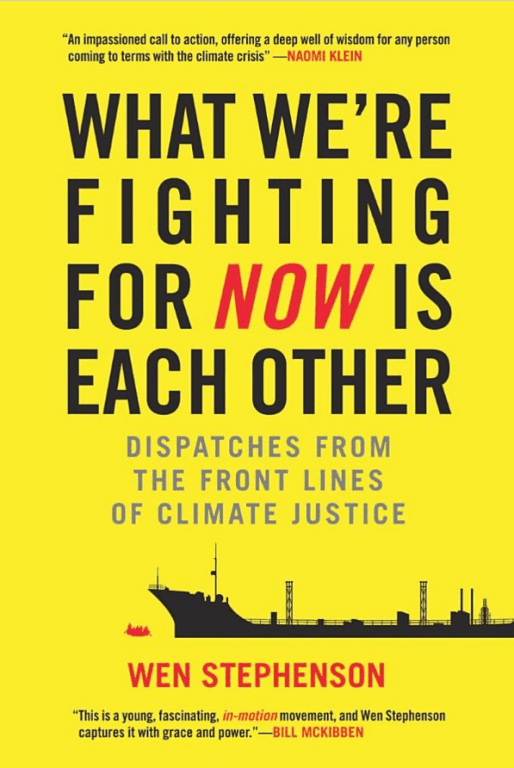
The evidence for climate change is all around us. As Wen Stephenson has detailed in his new book from Beacon Press, What We’re Fighting for Now Is Each Other: Dispatches from the Front Lines of Climate Justice:
This is really happening. The Arctic and the glaciers are melting. The oceans are rising and acidifying. The corals are bleaching, the great forests dying and burning. The storms and floods, the droughts and heat waves are intensifying. The farms and savannas are parched and drying. Nations are disappearing. People are dying. Mass extinction is unfolding…. And the fossil-fuel industry—which holds the fate of humanity in its carbon reserves—is doubling down, economically and politically, on this destruction. (ix)
 We know what needs to be done, but in most cases lack the political will. In a sense, the way forward is as simple as lesson one from the first week of “Economics 101”: the power of incentives and disincentives. We need to tax carbon emissions, creating disincentives for anyone seeking to add more CO2 to the atmosphere, and we need to subsidize clean energy efforts, creating incentives for the shift to a sustainable, green economy (45).
We must reject the lie that the only “bottom line” is profit. This myth of profit alone as the bottom line denies the externalities of how financial profit impacts people and planet. We must demand a true, transparent accounting of a Triple Bottom Line that balances “people, planet, and profit.” Profit motive is real, and should remain a part of the calculus, but we are long past the point of being able to afford to ignore the impact of people and planet (91).
The most frequently cited threshold is that we must avoid increasing global warming by more than 2 °C, but without drastic changes, we are cultivating “a global temperature rise of four or five or even six degrees Celsius (11.8 °F) within this century.” As my wife and I consider whether we will have children, those possibilities are terrifying. In my tradition of Unitarian Universalism, our 6th Principle seeks “The goal of world community with peace, liberty, and justice for all,” but experts predict that, “even a rise of four degrees Celsius (7.2 °F) would bring consequences ‘incompatible with an organized global community’” due to megadroughts, water scarcity, extreme weather events, and more (x-xi).
Allow me to lay two sets of statistics on the table. First, already, four years ago in summer 2012, the National Oceanic and Atmospheric Administration showed that “approximately 80 percent of Arctic sea ice, measured by volume, was gone…. Scientists estimate that we could have an ice-free Arctic summer as soon as 2020 or 2030.” An open ocean absorbs much more heat than reflective sheets of ice, which will further exacerbate climate change (xi).
Second, here’s another estimate from four years ago:
-
568 gigatons = the amount of CO2 scientists agree we can still pump into the atmosphere and hope to remain below the two-degree threshold.
-
2,795 gigatons = the amount of CO2 contained in the world’s proven fossil-fuel reserves, which the fossil-fuel industry shows every intention of extracting and burning.
In other words, the then-known reserves were five times larger than a sane carbon budget would allow. We have to find a way to leave 80 percent of accessible fossil fuels in the ground, forever, while making an all-out effort to shift to clean energy, in the next three to four decades (28-29).
But that’s not the direction we’ve moving in. Instead, the top 200 publicly traded fossil-fuel companies spent $674 billion “in 2012 alone on exploration and development of new reserves” (56).
The coming impact of Climate Change is also far more complicated than saying, from my perspective of living in a Mid-Atlantic state that, “It might not be so bad for Maryland to have the weather patterns South Carolina has been accustomed to” — which would, in turn, mean that South Carolina will become incredibly hot. The concern is much more our food supply. In the words of one climate activist, “You can’t just move Iowa to Siberia…there isn’t any topsoil in the tundra” (57).
In our collective demand for short-term profit, we’ve lost perspective. Earth’s biosphere took 3.8 billion years to evolve, and our species is wreaking havoc on a scale that may only be repairable in geologic time (Wilson 211). To quote one stanza from Wendell Berry’s poem, Manifesto: The Mad Farmer Liberation Front:
Invest in the millennium. Plant sequoias.
Say that your main crop is the forest
that you did not plant,
that you will not live to harvest.
Say that the leaves are harvested
when they have rotted into the mold.
Call that profit. Prophesy such returns.
Put your faith in the two inches of humus
that will build under the trees
every thousand years.
That’s the sort of paradigm shift we need.
There’s a lot more to be said about that whole poem and the importance in general of Berry’s writing, which is conservative in the best sense of that word, but for now I would like to lift up only one more line: “Praise ignorance, for what man has not encountered he has not destroyed.” In the mid-1990s, one of my mentors had that quote on permanent scroll as his screen-saver: “Praise ignorance, for what man has not encountered he has not destroyed.” Back then, that sentiment felt extreme, but I’m increasingly convinced it was prescient. Much more than now, the 1980s and the 1990s were the time when we should have been taking action to prevent climate change:
Today, the climate crisis has long since passed the point of prevention. Climate catastrophe, on some scale, is winging toward us: the missiles have left the silos, the bombs have left the bays. Cities, indeed, entire countries, will be lost. Millions will needlessly suffer and die…. The task now…is to prevent the entire carbon arsenal, or even any sizable fraction of it, from being launched—and to salvage what we can of a livable planet. (134-5)
We must try for ourselves and for future generations.
There will be no divine intervention to save us. We know after Darwinism that, “We are not a little lower than the angels, but merely a little higher than the apes” and deeply interconnected with the ecosystems of this one Earth. To consider what it might mean to develop a response to climate change from this twenty-first century perspective, E.O. Wilson (1929 -), the two-time Pulitzer Prize winning professor emeritus at Harvard has published a new book titled Half-Earth in which he makes the case for what is needed if we are to tame the hubris of our species: “only by committing half of the planet’s surface to nature can we hope to save the immensity of life-forms that compose it” (3). That vision sounds like Wendell Berry: “Praise ignorance, for what man has not encountered he has not destroyed.” Or as Henry David Thoreau said in his essay “Walking”: “In wildness is the preservation of the world.”
However, world-historical decisions such as carving out sections that would total half the world’s surface (including oceans as well as land) would require the buy-in of the world’s leaders. But we will be needed to join the grassroots movement to build the political will to make change. Bill McKibben’s website 350.org is one among many ways of getting involved with the movements for climate justice.
On this upcoming Earth Day approaching—and in the days and years to come—how do you feel called to join the global movement for climate justice?
What part might you individually (or we collectively) play in ensuring the continued blooming of abundant, diverse life on this planet?
The Rev. Dr. Carl Gregg is a trained spiritual director, a D.Min. graduate of San Francisco Theological Seminary, and the minister of the Unitarian Universalist Congregation of Frederick, Maryland. Follow him on Facebook (facebook.com/carlgregg) and Twitter (@carlgregg).
Learn more about Unitarian Universalism: http://www.uua.org/beliefs/principles
Previous Post

April 12, 2016
The Spirituality of Shakespeare
Next Post
April 29, 2016 Evil: Bad Apples or Bad Barrels?
Browse Our Archives
Select a Category Advent Anti-Racism Archaeology Atheism Baptism Best of the Year List Book Reviews Buddhism Catholicism Christian Education Church and State Church Planting Climate Change Conscientious Objection to War Creation Spirituality Death Penalty Didache Disability Rights Discernment Easter Ecology Emergent Church Movement Empire-Critical Ethics Evolution Feminist Theology Film Reviews Gandhi Gospel of Mark Gun Control Hinduism Immigration Reform Interfaith Islam JFK Judaism Jungian Spirituality Lectionary Commentary Lent Letters to the Editor LGBT Marriage MLK Multiculturalism Mysticism Nonviolent Activism Occupy Paganism (Earth-centered Religions) Parables Paul Pluralism Politics Process Theology Quantum Physics Requiescat In Pace Seminary and Divinity School Sermon Series Retrospective Sermons Spiritual Direction Spiritual Practices Stewardship (Fundraising) The Book of J The Wheel of the Year (Paganism) Theoblogger Challenge Triathlon Uncategorized Unitarian Universalism Worship Resources Youth Ministry
Select a Month July 2026 May 2026 March 2026 November 2025 October 2025 August 2025 February 2025 December 2024 October 2024 March 2024 January 2024 December 2023 November 2023 March 2023 February 2023 January 2023 December 2022 November 2022 August 2022 March 2022 February 2022 January 2022 December 2021 September 2021 August 2021 July 2021 June 2021 May 2021 February 2021 January 2021 December 2020 August 2020 June 2020 May 2020 April 2020 March 2020 February 2020 January 2020 December 2019 November 2019 October 2019 September 2019 July 2019 June 2019 March 2019 February 2019 January 2019 December 2018 November 2018 October 2018 September 2018 June 2018 May 2018 April 2018 March 2018 February 2018 January 2018 December 2017 November 2017 October 2017 September 2017 August 2017 July 2017 June 2017 May 2017 April 2017 March 2017 February 2017 January 2017 December 2016 November 2016 October 2016 September 2016 August 2016 June 2016 May 2016 April 2016 March 2016 February 2016 January 2016 December 2015 November 2015 October 2015 September 2015 August 2015 July 2015 June 2015 May 2015 April 2015 March 2015 February 2015 January 2015 December 2014 November 2014 October 2014 August 2014 July 2014 June 2014 May 2014 April 2014 March 2014 February 2014 January 2014 December 2013 November 2013 October 2013 September 2013 August 2013 July 2013 June 2013 May 2013 April 2013 March 2013 February 2013 January 2013 December 2012 November 2012 October 2012 September 2012 August 2012 July 2012 June 2012 May 2012 April 2012 March 2012 February 2012 January 2012 December 2011 November 2011 October 2011 September 2011 August 2011 July 2011 June 2011 May 2011 April 2011 March 2011 February 2011 January 2011 December 2010 November 2010 October 2010 August 2009 July 2009 May 2009
Follow Us!
TAKE THE
Religious Wisdom Quiz
In the Parable of the Ten Virgins, what were the wise ones prepared for?
Select your answer to see how you score.
A king The Sabbath The bridegroom A feast
Related posts from Carl Gregg

Reading America at 250: A Nation Wrestles With...


Andrew Holocek on the Power of Darkness

The Stories That Shape Us: Myths, Archetypes, &...
TRENDING AT PATHEOS More Voices

Reading America at 250: A Nation Wrestles With...
As part of my own reflection on the 250th anniversary of the...

Whenever I am reading a book or listening to an argument, I...

President Trump Ban Animal Torture Videos on Facebook
Call for Stricter Regulations of Animal Abuse Content on Facebook Although President...

Draft Amendments to Address Ritual Abuse in New...
The proposed changes would make it illegal for individuals in domestic partnerships...

How Bans on LGBTQ+ Student Clubs Threaten Religious...
On June 20, 2025, the State of Texas passed Senate Bill 12....

The Truth About the Gen Z Revival
This past year, there has been a lot of media buzz surrounding...
view all More Voices blogs
Ad-Free & Subscriber Log-In Subscription Support
- About Us
- 2026 Calendar
- Videos
- Podcasts
- Library of World Religions
- Faith In Media Tracker
- Advertise With Us
- Write for Us
- Privacy Policy
- Terms of Service
- Do Not Sell My Data
- Contact Us
- Radiant Digital
- Manage Newsletter Subscriptions
- Unsubscribe From Notifications
- Sitemap
Copyright 2008-2026, Patheos. All rights reserved.
Subscription Support Ad-Free & Subscriber Log-In
Follow Patheos