
BuddhistCatholicContemplativeEvangelicalGeneral ChristianHinduJewishLatter-day SaintMuslimNew VisionsProgressive Christian
Beliefs
- Buddhist
- Catholic
- Contemplative
- Evangelical
- General Christian
- Hindu
- Jewish
- Latter-day Saint
- More Voices
- Muslim
- New Visions
- Pagan
- Progressive Christian
Topics
- Religion News
- Food and Religion
- Sports and Religion
- Religious Art
- Religious Music and Entertainment
- Religious Events
- History and Religion
- Style and Religion
- Politics and Religion
- Women in Religion
- Recreation Outdoors and Religion
- Business Finance and Religion
- Careers Workplace and Religion
- Education and Religion
- Family Parenting and Religion
- Health Fitness and Religion
- Home and Religion
- Relationships and Religion
- Technology and Religion
- Travel and Religion
Columnists
- Buddhist Columnists
- Business Finance and Religion Columnists
- Careers Workplace and Religion Columnists
- Catholic Columnists
- Contemplative Columnists
- Education and Religion Columnists
- Evangelists Columnists
- Family Parenting and Religion Columnists
- General Christian Columnists
- Health Fitness and Religion Columnists
- Hindu Columnists
- History and Religion Columnists
- Home and Religion Columnists
- Jewish Columnists
- More Voices Columnists
- Latter Day Columnists
- Muslim Columnists
- New Visions Columnists
- Nonreligious Columnists
- Pagan Columnists
- Politics and Religion Columnists
- Progressive Columnists
- Recreation Outdoors and Religion Columnists
- Relationships and Religion Columnists
- Religion News Columnists
- Religious Art Columnists
- Religious Events Columnists
- Religious Music and Entertainment Columnists
- Sports and Religion Columnists
- Style and Religion Columnists
- Technology and Religion Columnists
- Travel and Religion Columnists
- Women in Religion Columnists
Resource Library
- 2026 Calendar
- Library of World Religions
- The 100 Most Holy Places on Earth
- Patheos Answers
- Podcasts
- Videos
- Faith Leaders Database
- Anglican Episcopalian
- Bahai
- Baptist
- Buddhism
- Christianity
- Confucianism
- Eastern Orthodoxy
- Hinduism
- Holiness and Pentecostal
- ISKCON
- Islam
- Judaism
- Lutheran
- Methodist
- The Church of Jesus Christ of Latter-day Saints
- New Age
- Paganism
- Presbytarian and Reformed
- Protestantism
- Religion Behind the Scenes
- Roman Catholic
- Scientology
- Shia Islam
- Sikhism
- Sufism
- Sunni Islam
- Taoism
- Zen
- See all religions
Research Tools
 Ad-Free & Subscriber Log-In Subscription Support
Ad-Free & Subscriber Log-In Subscription Support
Follow Patheos 

- Trending:
- Forgiveness
- |
- Marriage
- |
- Consciousness
- |
- Death Penalty
- |
- Election
- |
- Halloween

- Home
- More Voices
- Remembering, Changing, Inventing: How Stories About Jesus Were Told
Remembering, Changing, Inventing: How Stories About Jesus Were Told
Last updated on: March 29, 2016 at 10:25 am by Carl Gregg
Remembering, Changing, Inventing: How Stories About Jesus Were Told 2016-03-29T10:25:52-04:00 Carl Gregg
Patheos Explore the world's faith through different perspectives on religion and spirituality! Patheos has the views of the prevalent religions and spiritualities of the world.
One of my favorite college classes was “Jesus and the Gospels.” Ironically, one of my strongest memories from the class was not a lesson the professor intended. During a series of presentations toward the end of the semester, one student—instead of following the assignment to use historical-critical research methods—used the opportunity to denounce everything we had learned that semester as heretical and concluded by quoting Hebrews 13:8, “Jesus Christ is the same yesterday and today and forever.” The professor restrained herself for the most part, and limited herself to saying with a calm sternness, something along the lines of: “Get out. You have clearly learned nothing. Please leave the room now.”
From the perspective of orthodox Christianity, the student was right. We had been learning heresy. But the root of the word heresy simply means “to choose” — as in choosing for oneself what to believe or do, as opposed to believing or doing something because of what an authority figure tells you.
Another strong memory from that class was a quote from the historical Jesus scholar John Dominic Crossan, who said: “The issue is whether the passion accounts are prophecy historicized or history remembered. Raymond Brown [an orthodox Roman Catholic scholar] is 80% in the direction of history remembered. I’m 80% in the opposite direction.” Those statistics are in line with the headline-grabbing press releases from the Jesus Seminar in the 1990s that the historical Jesus only said about 20% of the words attributed to him.
My classmate, in contrast, was making the argument that Jesus said and did 100% of what the Bible says. (That the Christian scriptures are 100% “history remembered.”) But the more I have researched, the more convinced I am of Crossan’s perspective: the Gospels are, for the most part, “prophecy historicized.” In other words, the Gospels evolved from decades of Christians reading ancient Jewish prophecies, telling and re-telling oral traditions, and weaving those ingredients into “history.” (If you are interested in exploring this process further, the best starting point I’ve found is Crossan’s book Who Killed Jesus?)
When seeking to separate “History Remembered” from “Prophecy Historicized” in the “Quest for the Historical Jesus,” one detail that I can’t emphasize strongly enough is the importance of keeping in mind that Jesus of Nazareth was a peasant from an obscure village. Jesus was not royalty about whom we often have historical records. Rather, we only have a general range of years for when he was born and for when he died. (We know the time of year he died—around the annual Jewish holiday of Passover—but not the year, which is often estimated as 27-30 C.E.) Moreover, there is a forty year gap between Jesus’s death and the writing of the Gospel of Mark, the earliest of the canonical Gospels.
Keep in mind that both Jesus and his disciples were “lower-class, illiterate peasants who spoke Aramaic,” whereas the Gospels (Matthew, Mark, Luke, and John), “were written by highly educated Greek-speaking Christians forty to sixty-five years later” (Ehrman 70). Being able to write a text like one of the Gospels was a rare talent. As the scholar Catherine Hezser has shown in her landmark study Jewish Literacy in Roman Palestine, approximately “97 percent of the people in Palestine in Jesus’s day could not read or write.” And of that three precent, more could read than write (80).
Regarding that forty-year gap between the life of the historical Jesus and the earliest Gospel record, two of the biggest myths that need to be debunked are (1) that the Gospels are eyewitness accounts and (2) that people in oral cultures have better memories than we do today. First, the Gospels are almost entirely written in the third-person and do not claim to be composed by eyewitnesses to the historical Jesus (106). Second, “The consensus among both anthropologists and cultural historians” is that people in oral cultures “generally forget about as much as other people” (182). Indeed, rather than having better memories, the situation is more dire: if something is forgotten in an oral culture, it is “lost forever”; whereas, in our Information Age, we can just “google it” (182).
Along these lines, there’s a lot to be learned about the Quest for the Historical Jesus from the “Quest for the Historical Homer,” which has many parallel issues. The most important book in this regard is Albert Lord’s 1960 classic The Singer of Tales (184). What this story of oral cultures documented is that, “In an oral context, every time a story is told it is changed. The ‘gist’ remains pretty much the same, but the details get changed. Often they get changed massively” (185).
The real paradigm shift from an oral culture to a written culture is not that people’s memories are superior in an oral culture. Rather, in an oral culture, the relation to tradition is different since there is no written original to compare. Researchers who make transcripts of oral cultures over time have shown that in an oral culture, “Every performance is and always has been different…. Whoever performs the tradition alters it in light of his [or her] own interests, the sense of what the audience wants to hear, the amount of time [available] to tell or sing it, and numerous other factors” (186).
That being said, if you ask performers in an oral culture if the song is the same over time, many will insistently say “yes.” But what they are really referring to is the “gist” of the song because studies have exposed that word choice and overall length vary widely from performance to performance. This dynamic would also have been the case with Jesus’s teachings, which would’ve varied in the details, even as the gist would have remained fairly consistent—similar to the stump speeches of politicians, which have persistent themes whose details vary depending on the audience.
Such variances would also have been the case when stories about Jesus were passed from person to person during the forty-year gap between his death and the earliest Gospel. So when you hear that the historical Jesus only said about twenty percent of the words attributed to him by the Gospels, underneath that claim is the insight that the “gist” least likely to have varied is the “punchline” at the heart of the stories attributed to Jesus — whereas the surrounding details vary widely even from Gospel to Gospel.
Relatedly, consider this contemporary parable written by the theologian Catherine Keller:
A man died. The people who knew him gathered to share memories. Finally, a portrait was commissioned. But as generations passed, the painting did not seem fine enough. The heirs of the portrait, who had become wealthy, created a new golden frame, immense, carved with motifs from the portrait and encrusted with jewels. People began to feel that the old portrait of that dark fellow with the haunting eyes pulled the effect down. As it began to peel from age, they extended the frame inward. One day the frame covered the whole canvas. (133)
The Quest for the Historical Jesus requires carefully stripping away the frame that has expanded over two millennia.
Regarding how we should approach that pro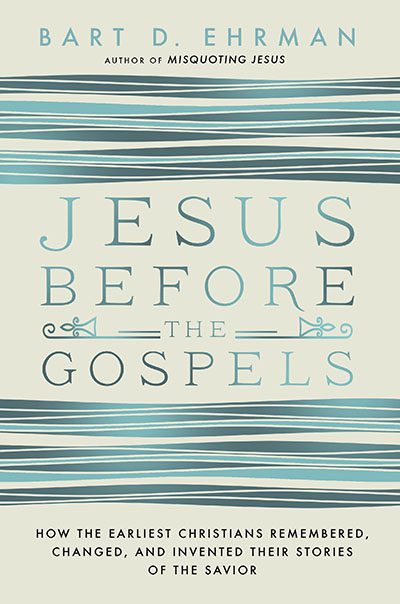 cess, the historical Jesus scholar Bart Ehrman has published an important new book titled Jesus Before the Gospels: How the Earliest Christians Remembered, Changed, and Invented Their Stories of the Savior. The most significant contribution of this book is applying what we have learned from twenty-first century neuroscience to the Quest for the Historical Jesus. Ehrman’s goal is to separate what we might wish we had (accurate eyewitness accounts that reflect 100% of “history remembered” about the life and death of Jesus of Nazareth) from what we do have (written records from decades after the fact that reflect “prophecy historicized”).
Perhaps the most damning way in which modern science challenges the accuracy of “history remembered” is that even if the Christian Gospels were written by eyewitnesses (which they do not claim to be), it is devastating to discover that in criminal cases whose convictions have been overturned by DNA evidence, “in about 75 percent of those reversed judgements the person charged with the crime was convicted solely on the basis of eyewitness testimony” (89). Sometimes that may be because the eyewitness lied to get a conviction, but it is also likely that the eyewitnesses sometimes missed important details or misremembered the event even though they witnessed it firsthand.
Consider three examples. First, in 1902 a criminologist named Franz von Liszt staged a fight at one of his lectures in which two students faked an argument that escalated until one of them pulled out a gun and fired it. After revealing that it was all an act, Professor Liszt assigned a group of students to record what they had witnessed. Another group of students was given the same assignment the next day, and a final group was asked to record their memories of the episode a week later (87). “The most accurate accounts were in error in 26 percent of the details reported. Others were in error in as many as 80 percent” (88). This experiment was one of the earliest scientific tests of eyewitness testimony.
Here’s a second example: when the space shuttle Challenger exploded in 1986, two psychologists at Emory University had the idea of administering a seven-question survey the next day to the 106 students in an undergraduate psychology class about “where they were when they heard the news, what time of day it was, what they were doing at the time, whom they learned it from, etc.” A year-and-a-half later, they were able to find forty-four of the students and administer the same questionnaire. Another six months later, they interviewed forty of the original students:
- 75 percent of those who took the second questionnaire were certain they had never taken the first one. That was obviously wrong….
- Twenty-five percent of the participants got every single answer wrong on the second questionnaire, even though their memories were vivid and they were highly confident in their answers.
- Another 50 percent got only two of the seven questions correct. Only three of the forty-four got all the answers right the second time, and even in those cases there were mistakes in some of the details.
- When the participants’ confidence in their answers was ranked in relation to their accuracy there was “no relation between confidence and accuracy at all” in forty-two of the forty-four instances….
- When confronted with evidence of what really took place, they consistently denied it and said that their present memories were the correct ones.
In the words of the researchers, “No one who had given an incorrect account in the interview even pretended that they now recalled what was stated on the original record. As far as we can tell, the original memories are just gone” (141-142). These findings, which have been replicated in other studies, are significant both for understanding our own memories as well as how Jesus—and other famous figures—were and are remembered.
Among many other significant scientific studies of memory, here’s a third and final example from a study called “Do You Remember Proposing Marriage to the Pepsi Machine?”:
Psychologists at Wesleyan University took forty students to different locations around the campus. “In each location they were instructed either to perform an action, to imagine performing it for ten seconds, to watch the experimenter performing the action, or to imagine the experimenter performing it. The actions were either normal or bizarre. For example, if they were in the library, they were asked to look up a word in a dictionary; or they were asked to pat the dictionary and ask how it was doing. Elsewhere they were asked to check the Pepsi machine for change or to go down on one knee and propose marriage to it.
When interviewed two weeks later, “Whether the action was normal or bizarre, participants who imagined it often remembered doing it…. Imagining the action vividly, but just one time, could produce the false memory. Moreover, imagining someone else performing the action led to just as many false memories as imagining doing it oneself” (94). These modern, scientific understandings of memory are among the many factors that should be considered in studying how stories about Jesus were remembered, changed, and invented.
As I have pursued my own Quest for the Historical Jesus, one of the conclusions I have reached is that the authority of the Christian tradition does not rest solely on whether Jesus of Nazareth did or did not say or do something two thousand years ago. I continue to be interested in that historical investigation, but the more important question is more pragmatic: whether a saying or action from the Christian tradition—or from any other source—helps shape a more compassionate, grounded, and generous life. If it does, then I am grateful—whether it came from the historical Jesus or whether it was changed, misattributed, or invented by a later person. May we be grateful for wisdom from any source if it leads to an increase of love and joy, peace and justice.
The Rev. Dr. Carl Gregg is a trained spiritual director, a D.Min. graduate of San Francisco Theological Seminary, and the minister of the Unitarian Universalist Congregation of Frederick, Maryland. Follow him on Facebook (facebook.com/carlgregg) and Twitter (@carlgregg).
Learn more about Unitarian Universalism: http://www.uua.org/beliefs/principles
Next Post

April 5, 2016 Just Mercy: "Each of Us Is More Than the Worst Thing We’ve Ever Done"
Browse Our Archives
Select a Category Advent Anti-Racism Archaeology Atheism Baptism Best of the Year List Book Reviews Buddhism Catholicism Christian Education Church and State Church Planting Climate Change Conscientious Objection to War Creation Spirituality Death Penalty Didache Disability Rights Discernment Easter Ecology Emergent Church Movement Empire-Critical Ethics Evolution Feminist Theology Film Reviews Gandhi Gospel of Mark Gun Control Hinduism Immigration Reform Interfaith Islam JFK Judaism Jungian Spirituality Lectionary Commentary Lent Letters to the Editor LGBT Marriage MLK Multiculturalism Mysticism Nonviolent Activism Occupy Paganism (Earth-centered Religions) Parables Paul Pluralism Politics Process Theology Quantum Physics Requiescat In Pace Seminary and Divinity School Sermon Series Retrospective Sermons Spiritual Direction Spiritual Practices Stewardship (Fundraising) The Book of J The Wheel of the Year (Paganism) Theoblogger Challenge Triathlon Uncategorized Unitarian Universalism Worship Resources Youth Ministry
Select a Month July 2026 May 2026 March 2026 November 2025 October 2025 August 2025 February 2025 December 2024 October 2024 March 2024 January 2024 December 2023 November 2023 March 2023 February 2023 January 2023 December 2022 November 2022 August 2022 March 2022 February 2022 January 2022 December 2021 September 2021 August 2021 July 2021 June 2021 May 2021 February 2021 January 2021 December 2020 August 2020 June 2020 May 2020 April 2020 March 2020 February 2020 January 2020 December 2019 November 2019 October 2019 September 2019 July 2019 June 2019 March 2019 February 2019 January 2019 December 2018 November 2018 October 2018 September 2018 June 2018 May 2018 April 2018 March 2018 February 2018 January 2018 December 2017 November 2017 October 2017 September 2017 August 2017 July 2017 June 2017 May 2017 April 2017 March 2017 February 2017 January 2017 December 2016 November 2016 October 2016 September 2016 August 2016 June 2016 May 2016 April 2016 March 2016 February 2016 January 2016 December 2015 November 2015 October 2015 September 2015 August 2015 July 2015 June 2015 May 2015 April 2015 March 2015 February 2015 January 2015 December 2014 November 2014 October 2014 August 2014 July 2014 June 2014 May 2014 April 2014 March 2014 February 2014 January 2014 December 2013 November 2013 October 2013 September 2013 August 2013 July 2013 June 2013 May 2013 April 2013 March 2013 February 2013 January 2013 December 2012 November 2012 October 2012 September 2012 August 2012 July 2012 June 2012 May 2012 April 2012 March 2012 February 2012 January 2012 December 2011 November 2011 October 2011 September 2011 August 2011 July 2011 June 2011 May 2011 April 2011 March 2011 February 2011 January 2011 December 2010 November 2010 October 2010 August 2009 July 2009 May 2009
Follow Us!
TAKE THE
Religious Wisdom Quiz
What does 1 Peter say wives can do to win over their unbelieving husbands?
Select your answer to see how you score.
Pray for them constantly Show them love Win them without words by their behavior Share the gospel
Related posts from Carl Gregg

Reading America at 250: A Nation Wrestles With...


Andrew Holocek on the Power of Darkness

The Stories That Shape Us: Myths, Archetypes, &...
TRENDING AT PATHEOS More Voices

Reading America at 250: A Nation Wrestles With...
As part of my own reflection on the 250th anniversary of the...

Whenever I am reading a book or listening to an argument, I...

President Trump Ban Animal Torture Videos on Facebook
Call for Stricter Regulations of Animal Abuse Content on Facebook Although President...

Draft Amendments to Address Ritual Abuse in New...
The proposed changes would make it illegal for individuals in domestic partnerships...

How Bans on LGBTQ+ Student Clubs Threaten Religious...
On June 20, 2025, the State of Texas passed Senate Bill 12....

The Truth About the Gen Z Revival
This past year, there has been a lot of media buzz surrounding...
view all More Voices blogs
Ad-Free & Subscriber Log-In Subscription Support
- About Us
- 2026 Calendar
- Videos
- Podcasts
- Library of World Religions
- Faith In Media Tracker
- Advertise With Us
- Write for Us
- Privacy Policy
- Terms of Service
- Do Not Sell My Data
- Contact Us
- Radiant Digital
- Manage Newsletter Subscriptions
- Unsubscribe From Notifications
- Sitemap
Copyright 2008-2026, Patheos. All rights reserved.
Subscription Support Ad-Free & Subscriber Log-In
Follow Patheos