
BuddhistCatholicContemplativeEvangelicalGeneral ChristianHinduJewishLatter-day SaintMuslimNew VisionsProgressive Christian
Beliefs
- Buddhist
- Catholic
- Contemplative
- Evangelical
- General Christian
- Hindu
- Jewish
- Latter-day Saint
- More Voices
- Muslim
- New Visions
- Pagan
- Progressive Christian
Topics
- Religion News
- Food and Religion
- Sports and Religion
- Religious Art
- Religious Music and Entertainment
- Religious Events
- History and Religion
- Style and Religion
- Politics and Religion
- Women in Religion
- Recreation Outdoors and Religion
- Business Finance and Religion
- Careers Workplace and Religion
- Education and Religion
- Family Parenting and Religion
- Health Fitness and Religion
- Home and Religion
- Relationships and Religion
- Technology and Religion
- Travel and Religion
Columnists
- Buddhist Columnists
- Business Finance and Religion Columnists
- Careers Workplace and Religion Columnists
- Catholic Columnists
- Contemplative Columnists
- Education and Religion Columnists
- Evangelists Columnists
- Family Parenting and Religion Columnists
- General Christian Columnists
- Health Fitness and Religion Columnists
- Hindu Columnists
- History and Religion Columnists
- Home and Religion Columnists
- Jewish Columnists
- More Voices Columnists
- Latter Day Columnists
- Muslim Columnists
- New Visions Columnists
- Nonreligious Columnists
- Pagan Columnists
- Politics and Religion Columnists
- Progressive Columnists
- Recreation Outdoors and Religion Columnists
- Relationships and Religion Columnists
- Religion News Columnists
- Religious Art Columnists
- Religious Events Columnists
- Religious Music and Entertainment Columnists
- Sports and Religion Columnists
- Style and Religion Columnists
- Technology and Religion Columnists
- Travel and Religion Columnists
- Women in Religion Columnists
Resource Library
- 2026 Calendar
- Library of World Religions
- The 100 Most Holy Places on Earth
- Patheos Answers
- Podcasts
- Videos
- Faith Leaders Database
- Anglican Episcopalian
- Bahai
- Baptist
- Buddhism
- Christianity
- Confucianism
- Eastern Orthodoxy
- Hinduism
- Holiness and Pentecostal
- ISKCON
- Islam
- Judaism
- Lutheran
- Methodist
- The Church of Jesus Christ of Latter-day Saints
- New Age
- Paganism
- Presbytarian and Reformed
- Protestantism
- Religion Behind the Scenes
- Roman Catholic
- Scientology
- Shia Islam
- Sikhism
- Sufism
- Sunni Islam
- Taoism
- Zen
- See all religions
Research Tools
 Ad-Free & Subscriber Log-In Subscription Support
Ad-Free & Subscriber Log-In Subscription Support
Follow Patheos 

- Trending:
- Forgiveness
- |
- Marriage
- |
- Consciousness
- |
- Death Penalty
- |
- Election
- |
- Halloween

- Home
- More Voices
- The Spirituality of Doubt
The Spirituality of Doubt
Last updated on: February 11, 2016 at 9:55 am by Carl Gregg
The Spirituality of Doubt 2016-02-10T22:29:26-05:00 Carl Gregg
Patheos Explore the world's faith through different perspectives on religion and spirituality! Patheos has the views of the prevalent religions and spiritualities of the world.
One famous definition of faith from the Christian tradition is Hebrews 11:1, “faith is the assurance of things hoped for, the conviction of things not seen.” Etymologically, the root of the word faith is related to trust. Faith trusts that something is (or will be) the case even though there is not verifiable proof. In many cases, the evidence for faith-based claims is internal, subjective, and unpredictable — as opposed to external, objective, and easily repeatable in laboratory conditions, which doesn’t make those faith claims necessarily less “true,” but it does often make them difficult (if not impossible) to either prove or disprove using the Scientific Method.
The rub, however, from our twenty-first century perspective is that we are almost 500 years into the Scientific Revolution. In 1543, Nicolaus Copernicus’s book On the Revolutions of the Heavenly Spheres shattered the Ptolemaic view of the universe as a three-tiered structure in which heaven is literally up, hell is literally down, and Earth is stationary in the middle — with we humans at the center of “life, the universe, and everything.” The Copernican Revolution — which showed that the Sun, not the Earth, is at the center of our solar system — decentered our place (or lack thereof) in the grand scheme of things, a decentering that has become increasingly clear with the paradigm-shifting discoveries of Darwin, Freud, Einstein, Hubble, and so many others.
I’ve posted previously about the self-proclaimed “Evolutionary Evangelist” Michael Dowd’s comparison of “Flat-Earth Faith” with “Evolutionary Faith.” For Dowd, the problem with “Flat-Earth Faith” is that it is B.C. — not “Before Christ,” but “Before Copernicus.”
At the same time, that doesn’t mean we have to throw out all that B.C. (“Before Copernicus”) material. There remain many compelling reasons to take ancient theologies seriously, metaphorically, and archetypally, but we can go dangerously awry when flat-Earth metaphors are taken literally. Indeed, the twentieth-century theologian Dorothee Sölle (1929 – 2003) “has pointed out that faith without doubt is not stronger, it is simply more ideological” (Paul Rasor, Faith without Certainty, xxi). And there are daily examples in the news of ideological leaders who refuse to change their minds despite stacks of evidence contradicting their positions. Along these lines, Anne Lamotte has written, “The opposite of faith is not doubt: It is certainty. It is madness. You can tell you have created God in your own image when it turns out that he or she hates all the same people you do.”
Stephen Colbert calls this phenomenon truthiness: false “talking points” repeated over and over until many people are manipulated into believing the misinformation. This tactic is not new: ancient Athenian democracy gives us the word demagoguery for politicians who “appeal to emotions, fears, prejudices, and ignorance …to gain power and promote political motives.”
To relate ideology, demagoguery, and truthiness back to our commitment to be an Evolutionary Religion that embraces all that we have learned since the Scientific Revolution, it has been said that the Liberal Turn in Religion is an attempt to create meaningful lives and build beloved communities in a world that is diverse and in which the traditional center has fallen out. Note that the word Liberal comes from the Latin root liber, meaning “free,” so a Liberal Turn in Religion is a move toward freedom in religion. It is a shift from authority grounded in community, hierarchy, and tradition to authority grounded in reason (what is logical) and experience (what one knows firsthand for one’s self or what can be proven through the scientific method).
Moving to the growing edge of doubt today, there is an emerging field of “Ignorance Studies” called agnotology (related to the word agnostic), which is not only about “What don’t we know, and why don’t we know it?” in general, but also specifically about “What keeps ignorance alive, or allows it to be used as a political instrument?” As The X-Files tells us, “The Truth is out there,” but “there are also things people don’t want you to know.” Perhaps the most dangerous example today is climate change denial; however, another example from recent history is how the tobacco industry’s spin doctored the link between cigarette use and cancer.
As explored in a recent article in The New York Times on “The Case for Teaching Ignorance,” there can be a lot of virtue in confessing how much we don’t know: “uncertainty can foster latent curiosity, while emphasizing clarity can convey a warped understanding of knowledge.” To take an example from the medical field, a 1,414-page neurology textbook could mislead a student into thinking that we know more about the brain that we actually do. Even if we know hundred of pages of facts about the brain, that’s a tiny proportion of all that there is to know about the brain. Moreover, to summarize a point made in Thomas Kuhn’s landmark book The Structure of Scientific Revolutions, “The more we know, the more we can ask. Questions don’t give way to answers so much as the two proliferate together.” As the poet Rilke taught, “Live the questions.”
In contrast, the history of Western Civilization has in many ways been biased toward faith and belief over 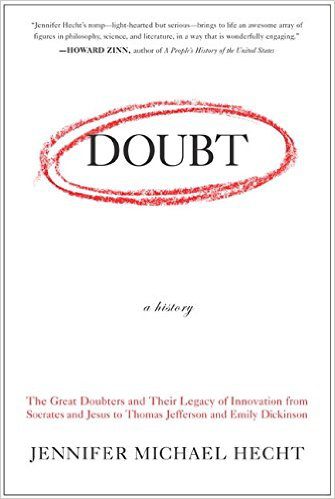 skepticism and doubt. As a counterbalance, the historian Jennifer Michael Hecht has written an excellent volume titled Doubt: A History in which she traces the history of great doubters throughout the ages and across the globe.
For a sample of her perspective, see her “Scale of Doubt Quiz.” In a world where the faith and belief are often the norm, it can be disconcerting to see the framework inverted to favor doubt. But Hecht’s goal is to invite us to take a step back and reflect on what we believe (or disbelieve) — and why.
Regarding her motivation for writing a world history of doubt, Hecht writes, “The only thing…doubters really need, that believers have, is a sense that people like themselves have always been around, that they are part of a grand history…” (494). And in her research she discovered throughout history that there have been, “saints of doubt, martyrs of atheism, and sages of happy disbelief” (ix) — which date to as early as the skepticism of many Pre-Socratic philosophers (4) as well as the Athenian gadfly himself, Socrates, who taught that wisdom is often not how much you know (or think you know) but how aware you are of what you don’t know (11).
There is also strong doubt and skepticism in the Jewish and Christian traditions, two early examples of which are the books of Job and Ecclesiastes (85). But perhaps the most helpful part of a global survey of doubt is a reminder that in contrast to the history of Western Civilization, in the “East, the existence of God was rarely the central question” (86). And there are prominent Eastern traditions in which doubt is revered. Most prominently, the Zen Buddhist tradition teaches, “Great doubt: great awakening. Little doubt: little awakening. No doubt: no awakening” (214).
Regarding the “Great Schism” between those believers and doubters, who find themselves on opposite ends of the “Scale of Doubt,” Jennifer Michael Hecht writes:
Great doubters, like great believers, have been people occupied with this problem, trying to figure out whether the universe actually has a hidden version of humanness, or whether humanness is the error and people would be better off weaning themselves from their sense of narrative, justice, and love, thereby solving the schism by becoming more like the universe in which they are stuck. (xii)
I will not attempt to resolve that schism, but wherever you find yourself on the spectrum of faith and doubt, I would like to leave you with two quotes.
The first is from the philosopher Peter Rollins, a self-proclaimed practitioner of pyro-theology, “an incendiary faith that courageously embraces brokenness, resolutely faces up to unknowing and joyfully accepts the difficulties of existence.” Regarding what Hecht calls the “Great Schism,” Rollins writes that,
The individual who is able to loose themselves from the notion that there is some ultimate purpose to their life frees themselves from the negative melancholy that comes with being unable to find that purpose (or the naïve optimism that comes from thinking that they will). The secret…is that there is no secret. Instead the challenge is to discover and deepen love. For love not only affirms the world, it produces a surplus in that joyful affirmation: acts that enact liberation.
Likewise, regarding how a spirituality of doubt can ironically produce a world-affirming love (for what we know we can do here and now) and liberating acts (for the people and places we know we can help once we are free from false presuppositions), I recommend the poem “From the Place Where We Are Right” by Yehuda Amichai (1924 – 2000) about how doubt (including self-doubt) can open us to new possibilities.
The Rev. Dr. Carl Gregg is a trained spiritual director, a D.Min. graduate of San Francisco Theological Seminary, and the minister of the Unitarian Universalist Congregation of Frederick, Maryland. Follow him on Facebook (facebook.com/carlgregg) and Twitter (@carlgregg).
Learn more about Unitarian Universalism: http://www.uua.org/beliefs/principles
Previous Post

February 2, 2016
Rewatching “Groundhog Day” as a Spiritual Practice
Browse Our Archives
Select a Category Advent Anti-Racism Archaeology Atheism Baptism Best of the Year List Book Reviews Buddhism Catholicism Christian Education Church and State Church Planting Climate Change Conscientious Objection to War Creation Spirituality Death Penalty Didache Disability Rights Discernment Easter Ecology Emergent Church Movement Empire-Critical Ethics Evolution Feminist Theology Film Reviews Gandhi Gospel of Mark Gun Control Hinduism Immigration Reform Interfaith Islam JFK Judaism Jungian Spirituality Lectionary Commentary Lent Letters to the Editor LGBT Marriage MLK Multiculturalism Mysticism Nonviolent Activism Occupy Paganism (Earth-centered Religions) Parables Paul Pluralism Politics Process Theology Quantum Physics Requiescat In Pace Seminary and Divinity School Sermon Series Retrospective Sermons Spiritual Direction Spiritual Practices Stewardship (Fundraising) The Book of J The Wheel of the Year (Paganism) Theoblogger Challenge Triathlon Uncategorized Unitarian Universalism Worship Resources Youth Ministry
Select a Month July 2026 May 2026 March 2026 November 2025 October 2025 August 2025 February 2025 December 2024 October 2024 March 2024 January 2024 December 2023 November 2023 March 2023 February 2023 January 2023 December 2022 November 2022 August 2022 March 2022 February 2022 January 2022 December 2021 September 2021 August 2021 July 2021 June 2021 May 2021 February 2021 January 2021 December 2020 August 2020 June 2020 May 2020 April 2020 March 2020 February 2020 January 2020 December 2019 November 2019 October 2019 September 2019 July 2019 June 2019 March 2019 February 2019 January 2019 December 2018 November 2018 October 2018 September 2018 June 2018 May 2018 April 2018 March 2018 February 2018 January 2018 December 2017 November 2017 October 2017 September 2017 August 2017 July 2017 June 2017 May 2017 April 2017 March 2017 February 2017 January 2017 December 2016 November 2016 October 2016 September 2016 August 2016 June 2016 May 2016 April 2016 March 2016 February 2016 January 2016 December 2015 November 2015 October 2015 September 2015 August 2015 July 2015 June 2015 May 2015 April 2015 March 2015 February 2015 January 2015 December 2014 November 2014 October 2014 August 2014 July 2014 June 2014 May 2014 April 2014 March 2014 February 2014 January 2014 December 2013 November 2013 October 2013 September 2013 August 2013 July 2013 June 2013 May 2013 April 2013 March 2013 February 2013 January 2013 December 2012 November 2012 October 2012 September 2012 August 2012 July 2012 June 2012 May 2012 April 2012 March 2012 February 2012 January 2012 December 2011 November 2011 October 2011 September 2011 August 2011 July 2011 June 2011 May 2011 April 2011 March 2011 February 2011 January 2011 December 2010 November 2010 October 2010 August 2009 July 2009 May 2009
Follow Us!
TAKE THE
Religious Wisdom Quiz
What is the meaning of "Immanuel" in the prophecy of Isaiah?
Select your answer to see how you score.
God the Healer God with Us God Provides God the Redeemer
Related posts from Carl Gregg

Reading America at 250: A Nation Wrestles With...


Andrew Holocek on the Power of Darkness

The Stories That Shape Us: Myths, Archetypes, &...
TRENDING AT PATHEOS More Voices

Reading America at 250: A Nation Wrestles With...
As part of my own reflection on the 250th anniversary of the...

Whenever I am reading a book or listening to an argument, I...

President Trump Ban Animal Torture Videos on Facebook
Call for Stricter Regulations of Animal Abuse Content on Facebook Although President...

Draft Amendments to Address Ritual Abuse in New...
The proposed changes would make it illegal for individuals in domestic partnerships...

How Bans on LGBTQ+ Student Clubs Threaten Religious...
On June 20, 2025, the State of Texas passed Senate Bill 12....

The Truth About the Gen Z Revival
This past year, there has been a lot of media buzz surrounding...
view all More Voices blogs
Ad-Free & Subscriber Log-In Subscription Support
- About Us
- 2026 Calendar
- Videos
- Podcasts
- Library of World Religions
- Faith In Media Tracker
- Advertise With Us
- Write for Us
- Privacy Policy
- Terms of Service
- Do Not Sell My Data
- Contact Us
- Radiant Digital
- Manage Newsletter Subscriptions
- Unsubscribe From Notifications
- Sitemap
Copyright 2008-2026, Patheos. All rights reserved.
Subscription Support Ad-Free & Subscriber Log-In
Follow Patheos