
BuddhistCatholicContemplativeEvangelicalGeneral ChristianHinduJewishLatter-day SaintMuslimNew VisionsProgressive Christian
Beliefs
- Buddhist
- Catholic
- Contemplative
- Evangelical
- General Christian
- Hindu
- Jewish
- Latter-day Saint
- More Voices
- Muslim
- New Visions
- Pagan
- Progressive Christian
Topics
- Religion News
- Food and Religion
- Sports and Religion
- Religious Art
- Religious Music and Entertainment
- Religious Events
- History and Religion
- Style and Religion
- Politics and Religion
- Women in Religion
- Recreation Outdoors and Religion
- Business Finance and Religion
- Careers Workplace and Religion
- Education and Religion
- Family Parenting and Religion
- Health Fitness and Religion
- Home and Religion
- Relationships and Religion
- Technology and Religion
- Travel and Religion
Columnists
- Buddhist Columnists
- Business Finance and Religion Columnists
- Careers Workplace and Religion Columnists
- Catholic Columnists
- Contemplative Columnists
- Education and Religion Columnists
- Evangelists Columnists
- Family Parenting and Religion Columnists
- General Christian Columnists
- Health Fitness and Religion Columnists
- Hindu Columnists
- History and Religion Columnists
- Home and Religion Columnists
- Jewish Columnists
- More Voices Columnists
- Latter Day Columnists
- Muslim Columnists
- New Visions Columnists
- Nonreligious Columnists
- Pagan Columnists
- Politics and Religion Columnists
- Progressive Columnists
- Recreation Outdoors and Religion Columnists
- Relationships and Religion Columnists
- Religion News Columnists
- Religious Art Columnists
- Religious Events Columnists
- Religious Music and Entertainment Columnists
- Sports and Religion Columnists
- Style and Religion Columnists
- Technology and Religion Columnists
- Travel and Religion Columnists
- Women in Religion Columnists
Resource Library
- 2026 Calendar
- Library of World Religions
- The 100 Most Holy Places on Earth
- Patheos Answers
- Podcasts
- Videos
- Faith Leaders Database
- Anglican Episcopalian
- Bahai
- Baptist
- Buddhism
- Christianity
- Confucianism
- Eastern Orthodoxy
- Hinduism
- Holiness and Pentecostal
- ISKCON
- Islam
- Judaism
- Lutheran
- Methodist
- The Church of Jesus Christ of Latter-day Saints
- New Age
- Paganism
- Presbytarian and Reformed
- Protestantism
- Religion Behind the Scenes
- Roman Catholic
- Scientology
- Shia Islam
- Sikhism
- Sufism
- Sunni Islam
- Taoism
- Zen
- See all religions
Research Tools
 Ad-Free & Subscriber Log-In Subscription Support
Ad-Free & Subscriber Log-In Subscription Support
Follow Patheos 

- Trending:
- Forgiveness
- |
- Marriage
- |
- Consciousness
- |
- Death Penalty
- |
- Election
- |
- Halloween

- Home
- More Voices
- Rewatching “Groundhog Day” as a Spiritual Practice
Rewatching “Groundhog Day” as a Spiritual Practice
Last updated on: February 2, 2016 at 11:03 am by Carl Gregg
Rewatching “Groundhog Day” as a Spiritual Practice 2016-02-02T11:03:12-05:00 Carl Gregg
Patheos Explore the world's faith through different perspectives on religion and spirituality! Patheos has the views of the prevalent religions and spiritualities of the world.
The comedic icon Harold Ramis died a little less than two years ago at the far too young age of 69. My introduction to Ramis was in the eighties, through his role as Dr. Egon Spengler in the two Ghostbusters movies, which he co-wrote. He is also remembered fondly by many as the writer-director of Caddyshack (1980), National Lampoon’s Vacation (1983), Groundhog Day (1993), and Analyze This (1999). But critics agree that it is Groundhog Day that stands outs as his “masterpiece.”
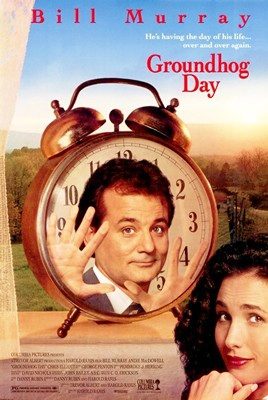 Starring Bill Murray and Andie MacDowell, Groundhog Day is the sixth and final collaboration between Murray and Ramis. One definition of what makes a film, book, song — or any piece of art — a “classic” is that it continues to be a source of wisdom that offers new insights with each repeated encounter. So on this Groundhog Day, I would like to revisit Harold Ramis’s classic film to see what wisdom there might be for us today.
The movie opens on February 1 (Groundhog Day Eve!) with Bill Murray’s character, local TV meteorologist Phil Connors, standing in front of a weather map, saying, “Somebody asked me today, ‘Phil, if you could be anywhere in the world, where would you like to be?’ And I said to him, ‘Prob’ly right here — Elko, Nevada, our nation’s high at 79 today.” You can hear Phil’s discontent with his life in the opening scenes. And after that night’s broadcast, he’s obligated to make the ninety-minute road trip to Punxsutawney, Pennsylvania for his fourth time covering the annual Groundhog Day festivities, an assignment he views as unworthy of his talent.
(I should mention that this year is the 130th Anniversary of the first Groundhog Day. If you do visit, be forewarned that the movie was not filmed in Punxsutawney, but in Woodstock, Illinois because the town square of Woodstock is what Hollywood thought Punxsutawney should look like!)
The premise of the film is that Phil gets trapped in a time loop. The origin and rules of the time loop are never explained. But the upshot is that no matter what Phil does, he wakes up every day, and it is yet-again 6:00 a.m. on February 2, 1993: Groundhog Day. For everyone else, it is as if they are living that February 2 for the first time. But for Phil, the number of times he has lived through this particular February 2 keeps stacking up.
On “Day 1,” when the time loop hasn’t started, Phil’s narcissism is on full display in his sarcastic treatment of everyone he meets. When the owner of the Bed & Breakfast asks him “Will you be checking out today?” He replies snidely, “Chance of departure today: one hundred percent!”
But when Phil wakes up on “Day 2” and begins to realize that surreally, it is still Groundhog Day, the first cracks in his ego begin to show. This time, he nervously responds to the B&B owner, “Chance of departure 80%…75/80.” Phil is having what is sometimes called a “train-wreck event” in which one’s worldview is suddenly and irrevocably challenged. I suspect you can think of parallels in your own life or in the lives of people close to you.
On “Day 3,” one of the many signs that Phil (like the rest of us) is a slow learner in some areas of our lives is that he again accidentally steps — for the third day in a row — into the same large puddle. Feeling demoralized, Phil begins to despair. That night, while attempting to drown his sorrows in a local bowling alley bar, Phil says, “I was in the Virgin Islands once. I met a girl. We ate lobster, drank piña coladas. At sunset, we made love like sea otters. That was a pretty good day. Why couldn’t I get that day over, and over, and over.” It’s easy to be your best self on the beach, but the challenge is everyday life.
Suddenly, Phil realizes that if there’s no tomorrow, then there are no consequences. Thus begins many days of hedonistic hijinks. But eventually Phil tires of adolescent pursuits, and even the most outrageous options begin to seem monotonous because he has tried them all multiple times. Phil’s postmodern “Pilgrim’s Progress” continues through a few more stages. He even tries both killing himself and taking the famous groundhog, Punxsutawney Phil, down with him to see if the critter is the source of his travails. But every time, he wakes up in the same bed, in the same room, and the world has reset itself to 6:00 a.m. on February 2.
Eventually, Phil begins a prolonged pursuit of self-improvement: he starts practicing generosity (giving money each day to the homeless man he had ignored on so many previous versions of the same day), he starts reading books, taking piano lessons, learning French — and even learning to ice sculpt. Admittedly, these pursuits are at first a cynical attempt to win the affections of Phil’s producer, Rita, played by Andie MacDowell. But Phil is changed in the process.
In perhaps the most profound part of the film, Phil comes to befriend that homeless man mentioned earlier — only to discover devastatingly that even with unlimited time and chances, he is unable to save the homeless man’s life. Phil tries countless changes to how he approaches the day and every possible medical interventions, but he is never able to prevent that one homeless man from dying each night. There is a limit to what any of us can accomplish, and everyone can’t be saved.
Ultimately, though, Groundhog Day is a comedy, not a tragedy. And when Phil stops trying so hard to impress Rita, and lets her experience for herself the person he has become, he is able to break out of his old habitual ways of being in the world. And this time when he wakes up in the morning, at long last, it is February 3.
So how long was Phil stuck in the time loop? How long did it take him to learn the lessons he needed? The film doesn’t say explicitly, but Ramis’s own estimation from all the clues in the film is something like “30 or 40 years.” That’s approximately 10,000 – 15,000 Groundhog Days in a row! On one hand, that feels like a lot. On the other hand, as someone in his late thirties, there are lessons that it has taken me close to forty years to learn — and there are many lessons I have yet to master. Can you relate? What were the life lessons that you just didn’t get until your 20s or 30s or 40s, and beyond? And which patterns are you still stuck in?
Now, there are many possible lenses through which to view this film and correspondingly our own lives. One, from the nineteenth-century Danish philosopher, Søren Kierkegaard is to see Phil as progressing through the stages of the aesthetic, ethical, and religious. Phil’s early adolescent rebellion of “no consequences!” epitomizes the hedonistic stage of the aesthetic, who only cares about their own pleasure. And the self-improvement regimes, which have many positive results but culminate in facing his mortality (the limitations on what we can do to help ourselves and others) is an example of Kierkegaard’s ethical stage. Finally, Phil passes into the religious stage, which in this case is in many ways Daoist: only when he stops pursuing his love interest so selfishly, cynically, and forcefully — and instead simply is his natural, evolving self — is he able to authentically connect with another human being.
Related to Daoism, there are many significant Buddhist themes in the film, which isn’t surprising since Harold Ramis is married to a Buddhist — and calls himself, while not fully Buddhist, at least“Buddh-ish.” Fascinatingly, as detailed on the DVD special feature interviews, spiritual groups ranging from Hasidic Jews to the Yoga community responded enthusiastically to the film. Many people in the therapeutic community also saw connections: the repetition in Groundhog can be seen as the “perfect metaphor for psychoanalysis: keep revisiting the same material with increasing insight.”
Along those lines, remember how the film began? It’s “Groundhog Day Eve” and Bill Murray’s character is standing in front of a weather map saying, “Phil, if you could be anywhere in the world, where would you like to be? Prob’ly…Elko, Nevada, our nation’s high at 79 today.” But after spending thirty- to forty-years worth of Groundhog Days in Punxsutawney, PA (where he was dreading spending even one day), when he finally wakes up and it is the day after Groundhog Day, he turns to Rita and says, “Today is tomorrow! Let’s live here. We’ll rent to start.”
As the proverb says,“Wherever you go, there you are.” Wherever you go, if you aren’t working through your “karma” — your emotional baggage — then you’ll likely find yourself slipping back into old habitual patterns that create further suffering for yourself and those around you. But there are ways of increasingly escaping self-involvement and beginning to connect more authentically with yourself, with others, and with this world. There are many different paths to getting there: from Buddhist to Pagan, Humanist to Muslim, and Jewish to Christian. Regardless of your choice, it takes commitment and work.
Relatedly, part of what is fascinating about the “thought experiment” that is the film Groundhog Day is that only Phil changes. Everyone else is the same. But as Phil changes his piece of the puzzle, his actions have powerful ripple-effects. We can’t change everything. But the film invites us to ask whether we are changing that which is in our control, starting with how we are in the world and how we treat others.
Finally, it is no coincidence that the film is set on Groundhog Day. Groundhog Day is our secular version in the U.S. of what the ancient, pagan, Earth-centered traditions call Imbolc, the day precisely halfway between Winter Solstice (“the longest night of the year”) and Spring Equinox, the first day of spring, when there will be equal amounts of darkness and sunlight. Groundhog Day plays with that turning point on the Wheel of the Year with the question of whether Punxsutawney Phil will see his shadow. In the film, Bill Murray’s “everyman” meteorologist — also named Phil! — is faced metaphorically with that same question: on Groundhog Day (on Imbolc), will he (will we?!) turn toward our shadow (our unconscious, habitual ways of being in the world) — or will we choose to live a more intentional, conscious life? Regardless of what others around you are doing, are you ready to change your piece of the puzzle? As we move toward the midpoint between winter and spring, what would it look like in your life to move toward kindness, generosity, and connection? What might such a choice unlock in the days, weeks, and years ahead?
The Rev. Dr. Carl Gregg is a trained spiritual director, a D.Min. graduate of San Francisco Theological Seminary, and the minister of the Unitarian Universalist Congregation of Frederick, Maryland. Follow him on Facebook (facebook.com/carlgregg) and Twitter (@carlgregg).
Learn more about Unitarian Universalism: http://www.uua.org/beliefs/principles
Next Post

February 11, 2016 The Spirituality of Doubt
Browse Our Archives
Select a Category Advent Anti-Racism Archaeology Atheism Baptism Best of the Year List Book Reviews Buddhism Catholicism Christian Education Church and State Church Planting Climate Change Conscientious Objection to War Creation Spirituality Death Penalty Didache Disability Rights Discernment Easter Ecology Emergent Church Movement Empire-Critical Ethics Evolution Feminist Theology Film Reviews Gandhi Gospel of Mark Gun Control Hinduism Immigration Reform Interfaith Islam JFK Judaism Jungian Spirituality Lectionary Commentary Lent Letters to the Editor LGBT Marriage MLK Multiculturalism Mysticism Nonviolent Activism Occupy Paganism (Earth-centered Religions) Parables Paul Pluralism Politics Process Theology Quantum Physics Requiescat In Pace Seminary and Divinity School Sermon Series Retrospective Sermons Spiritual Direction Spiritual Practices Stewardship (Fundraising) The Book of J The Wheel of the Year (Paganism) Theoblogger Challenge Triathlon Uncategorized Unitarian Universalism Worship Resources Youth Ministry
Select a Month July 2026 May 2026 March 2026 November 2025 October 2025 August 2025 February 2025 December 2024 October 2024 March 2024 January 2024 December 2023 November 2023 March 2023 February 2023 January 2023 December 2022 November 2022 August 2022 March 2022 February 2022 January 2022 December 2021 September 2021 August 2021 July 2021 June 2021 May 2021 February 2021 January 2021 December 2020 August 2020 June 2020 May 2020 April 2020 March 2020 February 2020 January 2020 December 2019 November 2019 October 2019 September 2019 July 2019 June 2019 March 2019 February 2019 January 2019 December 2018 November 2018 October 2018 September 2018 June 2018 May 2018 April 2018 March 2018 February 2018 January 2018 December 2017 November 2017 October 2017 September 2017 August 2017 July 2017 June 2017 May 2017 April 2017 March 2017 February 2017 January 2017 December 2016 November 2016 October 2016 September 2016 August 2016 June 2016 May 2016 April 2016 March 2016 February 2016 January 2016 December 2015 November 2015 October 2015 September 2015 August 2015 July 2015 June 2015 May 2015 April 2015 March 2015 February 2015 January 2015 December 2014 November 2014 October 2014 August 2014 July 2014 June 2014 May 2014 April 2014 March 2014 February 2014 January 2014 December 2013 November 2013 October 2013 September 2013 August 2013 July 2013 June 2013 May 2013 April 2013 March 2013 February 2013 January 2013 December 2012 November 2012 October 2012 September 2012 August 2012 July 2012 June 2012 May 2012 April 2012 March 2012 February 2012 January 2012 December 2011 November 2011 October 2011 September 2011 August 2011 July 2011 June 2011 May 2011 April 2011 March 2011 February 2011 January 2011 December 2010 November 2010 October 2010 August 2009 July 2009 May 2009
Follow Us!
TAKE THE
Religious Wisdom Quiz
Who said, "I am not worthy to untie the strap of his sandals"?
Select your answer to see how you score.
Peter John the Baptist Thomas Paul
Related posts from Carl Gregg

Reading America at 250: A Nation Wrestles With...


Andrew Holocek on the Power of Darkness

The Stories That Shape Us: Myths, Archetypes, &...
TRENDING AT PATHEOS More Voices

Reading America at 250: A Nation Wrestles With...
As part of my own reflection on the 250th anniversary of the...

Whenever I am reading a book or listening to an argument, I...

President Trump Ban Animal Torture Videos on Facebook
Call for Stricter Regulations of Animal Abuse Content on Facebook Although President...

Draft Amendments to Address Ritual Abuse in New...
The proposed changes would make it illegal for individuals in domestic partnerships...

How Bans on LGBTQ+ Student Clubs Threaten Religious...
On June 20, 2025, the State of Texas passed Senate Bill 12....

The Truth About the Gen Z Revival
This past year, there has been a lot of media buzz surrounding...
view all More Voices blogs
Ad-Free & Subscriber Log-In Subscription Support
- About Us
- 2026 Calendar
- Videos
- Podcasts
- Library of World Religions
- Faith In Media Tracker
- Advertise With Us
- Write for Us
- Privacy Policy
- Terms of Service
- Do Not Sell My Data
- Contact Us
- Radiant Digital
- Manage Newsletter Subscriptions
- Unsubscribe From Notifications
- Sitemap
Copyright 2008-2026, Patheos. All rights reserved.
Subscription Support Ad-Free & Subscriber Log-In
Follow Patheos