
BuddhistCatholicContemplativeEvangelicalGeneral ChristianHinduJewishLatter-day SaintMuslimNew VisionsProgressive Christian
Beliefs
- Buddhist
- Catholic
- Contemplative
- Evangelical
- General Christian
- Hindu
- Jewish
- Latter-day Saint
- More Voices
- Muslim
- New Visions
- Pagan
- Progressive Christian
Topics
- Religion News
- Food and Religion
- Sports and Religion
- Religious Art
- Religious Music and Entertainment
- Religious Events
- History and Religion
- Style and Religion
- Politics and Religion
- Women in Religion
- Recreation Outdoors and Religion
- Business Finance and Religion
- Careers Workplace and Religion
- Education and Religion
- Family Parenting and Religion
- Health Fitness and Religion
- Home and Religion
- Relationships and Religion
- Technology and Religion
- Travel and Religion
Columnists
- Buddhist Columnists
- Business Finance and Religion Columnists
- Careers Workplace and Religion Columnists
- Catholic Columnists
- Contemplative Columnists
- Education and Religion Columnists
- Evangelists Columnists
- Family Parenting and Religion Columnists
- General Christian Columnists
- Health Fitness and Religion Columnists
- Hindu Columnists
- History and Religion Columnists
- Home and Religion Columnists
- Jewish Columnists
- More Voices Columnists
- Latter Day Columnists
- Muslim Columnists
- New Visions Columnists
- Nonreligious Columnists
- Pagan Columnists
- Politics and Religion Columnists
- Progressive Columnists
- Recreation Outdoors and Religion Columnists
- Relationships and Religion Columnists
- Religion News Columnists
- Religious Art Columnists
- Religious Events Columnists
- Religious Music and Entertainment Columnists
- Sports and Religion Columnists
- Style and Religion Columnists
- Technology and Religion Columnists
- Travel and Religion Columnists
- Women in Religion Columnists
Resource Library
- 2026 Calendar
- Library of World Religions
- The 100 Most Holy Places on Earth
- Patheos Answers
- Podcasts
- Videos
- Faith Leaders Database
- Anglican Episcopalian
- Bahai
- Baptist
- Buddhism
- Christianity
- Confucianism
- Eastern Orthodoxy
- Hinduism
- Holiness and Pentecostal
- ISKCON
- Islam
- Judaism
- Lutheran
- Methodist
- The Church of Jesus Christ of Latter-day Saints
- New Age
- Paganism
- Presbytarian and Reformed
- Protestantism
- Religion Behind the Scenes
- Roman Catholic
- Scientology
- Shia Islam
- Sikhism
- Sufism
- Sunni Islam
- Taoism
- Zen
- See all religions
Research Tools
 Ad-Free & Subscriber Log-In Subscription Support
Ad-Free & Subscriber Log-In Subscription Support
Follow Patheos 

- Trending:
- Forgiveness
- |
- Marriage
- |
- Consciousness
- |
- Death Penalty
- |
- Election
- |
- Halloween

- Home
- More Voices
- Celebrating Darwin Day: “Perpetual Curiosity, Scientific Thinking, & Hunger for Truth”
Celebrating Darwin Day: “Perpetual Curiosity, Scientific Thinking, & Hunger for Truth”
Last updated on: February 17, 2016 at 10:34 am by Carl Gregg
Celebrating Darwin Day: “Perpetual Curiosity, Scientific Thinking, & Hunger for Truth” 2016-02-17T10:34:04-05:00 Carl Gregg
Patheos Explore the world's faith through different perspectives on religion and spirituality! Patheos has the views of the prevalent religions and spiritualities of the world.
Charles Darwin was born on February 12, 1809. In recent years, his birthday has become known as International Darwin Day, an annual opportunity to remember his life and be inspired to act on the principles of “perpetual curiosity, scientific thinking, and hunger for truth” that he represents. But even more than 150 years after the publication of Darwin’s landmark book On the Origin of Species, there remain large parts of humanity unconvinced of Darwin’s genius. Polls here in the U.S. consistently show that, “65% of adults say that humans and other living things have evolved, while 31% say humans and other living things have existed in their present form since the beginning of time.”
The tragedy of “Creationism vs. Evolution” debates today is that coming to terms with Darwin’s theories of evolution, natural selection, and common descent were among the greatest intellectual challenges of the late nineteenth and early twentieth century. But we live in the early twenty-first century in which we are long past the point at which Evolution became settled science. Indeed, we’re less than a decade away from the 100th anniversary of the 1925 Scopes Monkey Trial. W****e humans are not a little lower than the angels, but rather “a little higher than the apes” with whom we share a common ancestor. Indeed, at the DNA level, there is only a 1.23 percent difference between humans and chimpanzees. We humans are not uniquely special creations, but are instead deeply interconnected with the other forms of life and ecosystems on this Earth.
Progressive religious traditions today are part of what is known as the Liberal Turn in Religion**,** which is not a reference to the Democratic Party. It is a reference to classic Liberalism (more akin to contemporary Libertarianism) from the Latin root liber, meaning “free.” Thus, the Liberal Turn in Religion is a move toward freedom in religion. It is a shift from authority grounded in community, hierarchy, and tradition to authority grounded in reason (what is logical) and experience (what one knows firsthand either from one’s personal experience or what can be proven through the scientific method).
And that shift toward being a free religion matters when new ideas emerge like Darwin’s theory of evolution by natural selection. What did Darwin mean by natural selection? Here’s just one passage from Origin of Species:
Owing to this struggle of life, any variation, however slight and from whatever cause proceeding, if it be in any degree profitable to an individual of any species, in its infinitely complete relations to other organic beings and to external nature, will tend to the preservation of that individual, and will generally be inherited by its offspring. (148)
After Darwin, traditional religious claims were increasingly challenged by scientific evidence that complex life originated, not through one divine act of special creation a few thousand years ago, but through billions of years of evolution. The progressive, open-minded religious leaders who first embraced the implications of Darwinism had been deeply influenced by the European Enlightenment. As Immanuel Kant wrote in his essay “What Is Enlightenment?,” which was published in 1784 only a few decades before Darwin’s birth, “Enlightenment is man’s exit from his self-incurred immaturity. Immaturity is the inability to make use of one’s intellect without the direction of another…. Dare to Know!”
If you are interested in reflecting further on how Darwin and other paradigm-shifting thinkers helped lay the 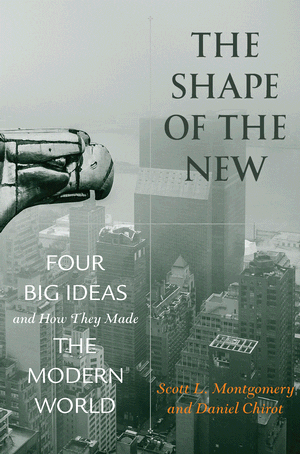 groundwork for the modern world as we know it, the best overview I have found came out last year and is titled The Shape of the New: Four Big Idea and How They Made the Modern World by Scott Montgomery and Daniel Chirot (Princeton University Press). The authors take Adam Smith, Karl Marx, Charles Darwin, and Thomas Jefferson / Alexander Hamilton and reflect on how their big ideas (Capitalism, Socialism, Evolution, and Liberal Democracy) continue to influence us today.
But for now, only a few days after Darwin’s birthday (“International Darwin Day”), I would like to focus on Charles Darwin (1809 – 1882). As I do so, how might his “perpetual curiosity, scientific thinking, and hunger for truth” inspire you today. What might you dare to know? Or how might you inspire others to “dare to know?”
As we begin to reflect on the person behind the revolutionary idea that species originated not through special creation, but by means of natural selection, it is interesting to note that Darwin’s life was nowhere near as radical as his thought. Quite the opposite, Charles Darwin was a
conventional and kindly Victorian gentleman, often ill and confined to bed, married his [first] cousin and retired at an early age to a country home near London, where he lived with his family and worked with the most unthreatening of creatures imaginable: pigeons and barnacles, earthworms and bees…. He was a modest person who lived quietly, attended the occasional scientific meeting, and shunned public debate. (148)
Indeed, he held back on publishing On the Origin of Species for two decades, partially because he was a perfectionist, but also because of his concern over its potential impact—finally publishing so as not to be scooped by another scientist working in the same area. Tragically, Darwin himself was not present when his theory was presented publicly because he was “mourning the death of his two-year-old son, Charles, Jr., from scarlet fever” (149).
But even with the publication of On the Origin of Species in 1859, Darwin still held back. He did not discuss the implications of his theories for us humans because he knew how controversial it would likely be to the public. He was right to be concerned: as we noted earlier, even today one-third of the U.S. denies the scientific evidence of evolution. Nevertheless, after little more than a decade, Darwin did make explicit that humans were included in his theory of evolution in his 1871 book The Descent of Man and his 1872 book The Expression of Emotions in Man and Animals (151).
To briefly consider the context in which Darwin was writing, it is fascinating to note that in 1859, Darwin’s main competition for On the Origin of Species was a book published that same year: A Tale of Two Cities by Charles Dickens (152). I also bring up Dickens because so many of his novels relate thematically to the Industrial Revolution, and the cultural changes related to the Industrial Revolution were happening all around Darwin. Keep in mind that,
When Darwin was born [in 1809], most people still lived in towns and hamlets, worked in fields, cooked over open fireplaces, and did not travel. A half century later, by 1859, when Origin appeared, British cities were teeming, mills were working day and night, coal ovens were common, and trips through the countryside in comfortable trains were common fare for those with means. Thousands of miles of railroads now crossed the country, knitting it together as never before, circulating its goods, its influences, and its citizens. (153)
So while Darwin’s ideas changed the world and helped push us over the threshold from the premodern to the modern world, there were also many other influences ushering in modernity (150).
In reflecting further on Darwin’s life, it is significant that, “he did not begin calling himself an ‘agnostic’ until well after the crushing death of his favored child, Annie, in 1851…. He stopped all churchgoing and religious participation after the funeral” (163). This part of Darwin’s life is a challenge to find a way of being religious (of finding meaning and creating community) that honors both what we know to be true in our own firsthand experience and what we know through reason.
In contrast to the invitation of Darwin Day’s celebration of “perpetual curiosity, scientific thinking, and hunger for truth,” growing up in a theologically conservative environment, I was not taught “intellectual bravery.” And there were times when I felt, as Darwin did, that I could either be true to my reason and experience or I could be true to the religious traditions and religious authorities I was being taught to follow, but I did not have any good examples of how to have both: science and spirituality, reason and religion, head and heart.
There were many kind and compassionate people in the church of my childhood, who taught me valuable lessons, but there was always a sense in which I felt like I had to check my brain at the door of the church. The implicit message I received was that it was okay to ask questions (but not too many questions). And regardless of what questions you asked, you were expected to arrive fairly quickly at the pre-determined “right answers.”
I remember going to conferences in which t-shirts were sold that said, “I believe in the Big Bang: God spoke and bang—it was!” There was a lot of fear and anxiety about students learning in public school science classrooms about Darwin’s theory of evolution, natural selection, and common descent—and then beginning to question the traditional beliefs they had been taught. And here’s the rub: in a sense, they were right to worry. As the saying goes, “It’s not paranoid if they really are after you.” But here’s the other side of that dynamic. Darwin wasn’t targeting traditional religion. His goal was simply to better, more accurately, and more fully understand this incredible world in which we find ourselves.
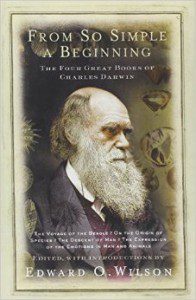 For now, I will conclude with the final paragraph of Darwin’s 1859 book On the Origin of Species. Whereas many scientific texts are often not particularly well written (as far as the beauty of their prose) and become obsolete after new discoveries are made, Darwin’s books have been widely praised for both the writing style and for being well worth revisiting even many years later. So, I invite you to consider anew these words from the conclusion to Darwin’s landmark book:
Thus, from the war of nature, from famine and death, the most exalted object which we are capable of conceiving, namely, the production of the higher animals, directly follows. There is grandeur in this view of life, with its several powers, having been originally breathed into a few forms or into one; and that, whilst this planet has gone cycling on according to the fixed law of gravity, from so simple a beginning endless forms most beautiful and most wonderful have been, and are being, evolved. (170)
In my childhood, Darwin was a boogeyman. But I invite you either now or in the future (if you haven’t already), to spend some time encountering Darwin’s ideas firsthand for yourself— perhaps at first through a secondary source like The Shape of the New and then on to the primary sources (such as The Origin of Species and the also excellent The Voyage of the Beagle) as an inspiration for navigating through the promises and perils of embracing the best of both spirituality and science—of reason and religion—here in the twenty-first century.
The Rev. Dr. Carl Gregg is a trained spiritual director, a D.Min. graduate of San Francisco Theological Seminary, and the minister of the Unitarian Universalist Congregation of Frederick, Maryland. Follow him on Facebook (facebook.com/carlgregg) and Twitter (@carlgregg).
Learn more about Unitarian Universalism: http://www.uua.org/beliefs/principles
Previous Post

February 11, 2016
The Spirituality of Doubt
Browse Our Archives
Select a Category Advent Anti-Racism Archaeology Atheism Baptism Best of the Year List Book Reviews Buddhism Catholicism Christian Education Church and State Church Planting Climate Change Conscientious Objection to War Creation Spirituality Death Penalty Didache Disability Rights Discernment Easter Ecology Emergent Church Movement Empire-Critical Ethics Evolution Feminist Theology Film Reviews Gandhi Gospel of Mark Gun Control Hinduism Immigration Reform Interfaith Islam JFK Judaism Jungian Spirituality Lectionary Commentary Lent Letters to the Editor LGBT Marriage MLK Multiculturalism Mysticism Nonviolent Activism Occupy Paganism (Earth-centered Religions) Parables Paul Pluralism Politics Process Theology Quantum Physics Requiescat In Pace Seminary and Divinity School Sermon Series Retrospective Sermons Spiritual Direction Spiritual Practices Stewardship (Fundraising) The Book of J The Wheel of the Year (Paganism) Theoblogger Challenge Triathlon Uncategorized Unitarian Universalism Worship Resources Youth Ministry
Select a Month July 2026 May 2026 March 2026 November 2025 October 2025 August 2025 February 2025 December 2024 October 2024 March 2024 January 2024 December 2023 November 2023 March 2023 February 2023 January 2023 December 2022 November 2022 August 2022 March 2022 February 2022 January 2022 December 2021 September 2021 August 2021 July 2021 June 2021 May 2021 February 2021 January 2021 December 2020 August 2020 June 2020 May 2020 April 2020 March 2020 February 2020 January 2020 December 2019 November 2019 October 2019 September 2019 July 2019 June 2019 March 2019 February 2019 January 2019 December 2018 November 2018 October 2018 September 2018 June 2018 May 2018 April 2018 March 2018 February 2018 January 2018 December 2017 November 2017 October 2017 September 2017 August 2017 July 2017 June 2017 May 2017 April 2017 March 2017 February 2017 January 2017 December 2016 November 2016 October 2016 September 2016 August 2016 June 2016 May 2016 April 2016 March 2016 February 2016 January 2016 December 2015 November 2015 October 2015 September 2015 August 2015 July 2015 June 2015 May 2015 April 2015 March 2015 February 2015 January 2015 December 2014 November 2014 October 2014 August 2014 July 2014 June 2014 May 2014 April 2014 March 2014 February 2014 January 2014 December 2013 November 2013 October 2013 September 2013 August 2013 July 2013 June 2013 May 2013 April 2013 March 2013 February 2013 January 2013 December 2012 November 2012 October 2012 September 2012 August 2012 July 2012 June 2012 May 2012 April 2012 March 2012 February 2012 January 2012 December 2011 November 2011 October 2011 September 2011 August 2011 July 2011 June 2011 May 2011 April 2011 March 2011 February 2011 January 2011 December 2010 November 2010 October 2010 August 2009 July 2009 May 2009
Follow Us!
TAKE THE
Religious Wisdom Quiz
What tax collector wrote a Gospel and was called by Jesus?
Select your answer to see how you score.
Matthew Luke Mark Barnabas
Related posts from Carl Gregg

Reading America at 250: A Nation Wrestles With...


Andrew Holocek on the Power of Darkness

The Stories That Shape Us: Myths, Archetypes, &...
TRENDING AT PATHEOS More Voices

Reading America at 250: A Nation Wrestles With...
As part of my own reflection on the 250th anniversary of the...

Whenever I am reading a book or listening to an argument, I...

President Trump Ban Animal Torture Videos on Facebook
Call for Stricter Regulations of Animal Abuse Content on Facebook Although President...

Draft Amendments to Address Ritual Abuse in New...
The proposed changes would make it illegal for individuals in domestic partnerships...

How Bans on LGBTQ+ Student Clubs Threaten Religious...
On June 20, 2025, the State of Texas passed Senate Bill 12....

The Truth About the Gen Z Revival
This past year, there has been a lot of media buzz surrounding...
view all More Voices blogs
Ad-Free & Subscriber Log-In Subscription Support
- About Us
- 2026 Calendar
- Videos
- Podcasts
- Library of World Religions
- Faith In Media Tracker
- Advertise With Us
- Write for Us
- Privacy Policy
- Terms of Service
- Do Not Sell My Data
- Contact Us
- Radiant Digital
- Manage Newsletter Subscriptions
- Unsubscribe From Notifications
- Sitemap
Copyright 2008-2026, Patheos. All rights reserved.
Subscription Support Ad-Free & Subscriber Log-In
Follow Patheos