
BuddhistCatholicContemplativeEvangelicalGeneral ChristianHinduJewishLatter-day SaintMuslimNew VisionsProgressive Christian
Beliefs
- Buddhist
- Catholic
- Contemplative
- Evangelical
- General Christian
- Hindu
- Jewish
- Latter-day Saint
- More Voices
- Muslim
- New Visions
- Pagan
- Progressive Christian
Topics
- Religion News
- Food and Religion
- Sports and Religion
- Religious Art
- Religious Music and Entertainment
- Religious Events
- History and Religion
- Style and Religion
- Politics and Religion
- Women in Religion
- Recreation Outdoors and Religion
- Business Finance and Religion
- Careers Workplace and Religion
- Education and Religion
- Family Parenting and Religion
- Health Fitness and Religion
- Home and Religion
- Relationships and Religion
- Technology and Religion
- Travel and Religion
Columnists
- Buddhist Columnists
- Business Finance and Religion Columnists
- Careers Workplace and Religion Columnists
- Catholic Columnists
- Contemplative Columnists
- Education and Religion Columnists
- Evangelists Columnists
- Family Parenting and Religion Columnists
- General Christian Columnists
- Health Fitness and Religion Columnists
- Hindu Columnists
- History and Religion Columnists
- Home and Religion Columnists
- Jewish Columnists
- More Voices Columnists
- Latter Day Columnists
- Muslim Columnists
- New Visions Columnists
- Nonreligious Columnists
- Pagan Columnists
- Politics and Religion Columnists
- Progressive Columnists
- Recreation Outdoors and Religion Columnists
- Relationships and Religion Columnists
- Religion News Columnists
- Religious Art Columnists
- Religious Events Columnists
- Religious Music and Entertainment Columnists
- Sports and Religion Columnists
- Style and Religion Columnists
- Technology and Religion Columnists
- Travel and Religion Columnists
- Women in Religion Columnists
Resource Library
- 2026 Calendar
- Library of World Religions
- The 100 Most Holy Places on Earth
- Patheos Answers
- Podcasts
- Videos
- Faith Leaders Database
- Anglican Episcopalian
- Bahai
- Baptist
- Buddhism
- Christianity
- Confucianism
- Eastern Orthodoxy
- Hinduism
- Holiness and Pentecostal
- ISKCON
- Islam
- Judaism
- Lutheran
- Methodist
- The Church of Jesus Christ of Latter-day Saints
- New Age
- Paganism
- Presbytarian and Reformed
- Protestantism
- Religion Behind the Scenes
- Roman Catholic
- Scientology
- Shia Islam
- Sikhism
- Sufism
- Sunni Islam
- Taoism
- Zen
- See all religions
Research Tools
 Ad-Free & Subscriber Log-In Subscription Support
Ad-Free & Subscriber Log-In Subscription Support
Follow Patheos 

- Trending:
- Forgiveness
- |
- Marriage
- |
- Consciousness
- |
- Death Penalty
- |
- Election
- |
- Halloween

- Home
- More Voices
- How to Make & Keep Your New Year’s Resolutions: Tom Rath’s “Are You Fully Charged?”
How to Make & Keep Your New Year’s Resolutions: Tom Rath’s “Are You Fully Charged?”
Last updated on: January 14, 2016 at 10:00 am by Carl Gregg
How to Make & Keep Your New Year’s Resolutions: Tom Rath’s “Are You Fully Charged?” 2016-01-13T19:26:05-05:00 Carl Gregg
Patheos Explore the world's faith through different perspectives on religion and spirituality! Patheos has the views of the prevalent religions and spiritualities of the world.
Do you know the work of the social scientist and author Tom Rath? I first heard about him about ten years ago through his bestseller How Full Is Your Bucket? There’s also a great children’s version of that book. Over the past decade, he has written six New York Times bestsellers, which have cumulatively sold more than 6 million copies. “He serves as a senior scientist for and advisor to Gallup, where he previously spent thirteen years leading the organization’s work on employee engagement, strengths, leadership, and well-being.”
I am, however, less interested in Rath’s accomplishments than his personal story. When he was 16, a large tumor caused him to lose sight in his left eye. He was diagnosed with a rare genetic condition, which “shuts off a powerful tumor suppressor.” He writes:
My doctors told me I would need to spend a week in the hospital for scans and testing every year for the rest of my life. This allows my physicians to keep track of my cancers — currently growing in my eye, kidneys, pancreas, adrenal glands, and spine — and to operate or try chemotherapy as needed. But if everything goes well, as it has most of the time, I leave the hospital at the end of that week with a fresh 12-month lease on life. Having this extension — with terms that are renewed annually — energizes me to try to make a difference every single day…. It has now been 23 years since my diagnosis. (11-12)
Rath can’t change his genetic condition, but he has dedicated his life to changing what he can: researching how to make the most of the limited time he — or any of us — have. And although most of us don’t have to spend a week annually in the hospital hoping for another year-long lease on life, most of us do have some downtime during the winter holidays, leading up to New Year’s Day, a time for recollection of the past year and resolutions for the new year to come.
Tom Rath’s research and his personal experiences have led him to emphasize the importance of “daily well-being,” focusing on improving the quality of how we spend each day (4). As the writer Annie Dillard says, “How we spend our days is of course how we spend our lives. What we do with this hour and that one is what we are doing” (32). In seeking to increase our well-being, researchers have identified “Five Essential Elements”:
- How you occupy your time or simply liking what you do every day: your Career Well-being
- Having strong relationships and love in your life: your Social Well-being
- Effectively managing your economic life: your Financial Well-being
- Having good health and enough energy to get things done on a daily basis: your Physical Well-being
- The sense of engagement you have with the area where you live: your Community Well-being (6)
Here at the beginning of 2016, I would like to invite you to reflect on how you are (or aren’t) experiencing well-being in each of these areas of your life: Career, Social, Financial, Physical, and Community. As we go, I’ll share a few insights from Rath’s research. I will end each section with a question. I would invite you to notice if one of the areas feels particularly resonant to you or ripe for work in this season of your life.
I should also note that Rath’s books tend to build on one another. So if you would like to continue to explore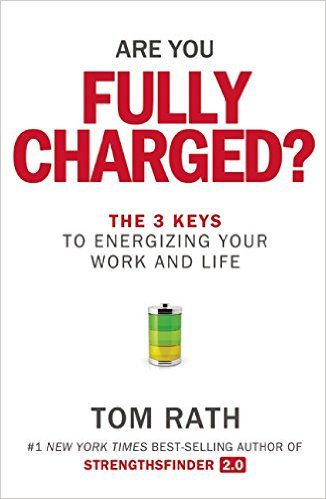 further on your own, you may want to skip straight to his latest book Are You Fully Charged? which also has a great kid’s version titled The Rechargeables.
The first area of Career Well-being is about much more than what you do (or don’t do) to earn a paycheck. It’s about whether you find meaning in the way you spend your time each day. The criteria of meaning is key. With all due respect to Thomas Jefferson, research indicates that much more important than “life, liberty, and the pursuit of happiness” is whether we find meaning in our daily lives (13-14).
Career Well-being often turns on whether you are generally engaged or disengaged throughout the day, which is often correlated with whether or not you spend most of your time in activities which allow you to use your strengths—what you are best at and most enjoy doing. Significantly, “engaged workers had similar happiness levels on working and nonworking days” (21). Studies show that most people are content to work 40 – 60 hours/week if they are engaged and find meaning in what they are doing, “while those who do not get to use their strengths get burned out after just 20 hours of work per week” (28).
For me, one takeaway from Rath’s book is the value of working in 45 minute blocks of intense focus with 15 minute breaks in between. If possible, consider putting your phone in “airplane mode and turning off the wifi on your computer during those 45 minute windows to allow uninterrupted work flow (63).
In the coming year, are there ways in which you could more consistently use your strengths each day? How might you improve your Career Well-being? (29)
The second area of Social Well-being is about “having strong relationships and love in your life.” Looking back on 2015, what are the people, places, and things that made you consistently feel connected, energized, grateful, and more fully yourself? Conversely, which people, places, and things made you consistently feel drained, resentful, and inauthentic?
In the coming year, are there ways (even if just incremental) that you could shape your life to have more people, places, and things in your life that increase your Social Well-being and let go of some of those which decrease your Social Well-being?
The third area is Financial Well-being. To share with you just one insight, it turns out that “retail therapy” (trying to increase happiness through buying material objects for ourselves) is fleetingly effective at best. Spending on others has slightly longer-lasting effect. By far the longest-lasting impact on our well-being comes not from material objects, but from experiences with friends and loved ones, which create lasting memories (55).
In the coming year, how might you spend time and money less on material objects and more on cultivating memorable and meaningful experiences with others?
For the fourth area, Rath summarizes three keys to Physical Well-being: Eat, Move, Sleep. In my own life, I’ve found a lot of guidance around eating well from the work of Michael Pollan, whose motto is “Eat food. Not much. Mostly plants.” I recommend his book Food Rules.
For the second part of “Eat, Move, Sleep,” I tend to exercise in the late afternoon or early evening. But a big takeaway for me from Rath’s research is the benefit of a twenty-minute walk in the morning before breakfast. I’ve tried at various points in my life to motivate myself to exercise in the morning, but it’s been difficult to sustain. But I’ve found that I can motivate myself to set a countdown timer for 10 minutes, walk the dogs out the front door, then retrace my path when the timer rings. Even on my busiest days, those twenty minutes make sure I get in at least some exercise. And even just twenty minutes of exercise improves metabolism and has been shown to boost one’s mood for as long as 12 hours afterward (62).
Relatedly, for those of you who like me are not interested in a Fitbit as another piece of technology to keep up with, if you have an iPhone, be sure to tap on the built-in “Health” app (with the heart icon) on your home screen. Whether you know it or not, Apple has already been tracking your steps. (There’s a similar app for Android phones called Google Fit.) My wife Magin and I often find motivation to take a walk after dinner if we find that we haven’t yet reached 10,000 steps that day (136-137). And although I’m not sure if it would work logistically for me, Rath is one of an increasing number of people I have heard about who love using a treadmill desk. Walking at 1.5 miles per hour, Rath often racks up 30,000 steps daily while talking on the phone, writing, etc. (29, 136).
On the third part of “Eat, Move, Sleep,” I am usually pretty good at giving myself permission to sleep at least 8 hours each night, and Rath’s book is a good reminder of that time being well spent: “On average, the best performers slept 8 hours and 36 minutes” (27). A current challenge for me is what Rath calls “Protect your final hour.” It’s tempting for me to check email and social media up to moments before I lie down to sleep.
In the coming year, what shifts might you feel called to make around how you eat, move, and sleep?
Rath’s fifth and final essential element is Community Well-being (6). For many of us, that’s why we are part of a spiritual community.
In the coming year, how do you feel led to connect in community based on your strengths, passions, and interests (104)?
Overall, Rath’s summaries of social scientific research shows us that to become more fully charged and make the most of our limited time, we should focus on three areas:
- cultivate meaning, engaging in activities that have intrinsic value, use our strengths, and help make the world a better place for others
- seek positive interactions that leave us feeling connected, energized, and grateful — while letting go of people, places, and habits that leave us feeling alienated, enervated, and resentful
- increase our energy through choices around how we eat, move, and sleep (7).
In conclusion, I’ll offer one final tip that intrigues me, but that I have not yet tried. Stickk.com is “a free goal-setting platform created by behavioral economists at Yale University.” Their methodology has been proven to increase your chances of reaching your goals by up to three times. The most fascinating option they provide is that if you do not meet your goal, a donation is made to an Anti-charity that supports the opposite side of a highly controversial issue that you care passionately about.
The Rev. Dr. Carl Gregg is a trained spiritual director, a D.Min. graduate of San Francisco Theological Seminary, and the minister of the Unitarian Universalist Congregation of Frederick, Maryland. Follow him on Facebook (facebook.com/carlgregg) and Twitter (@carlgregg).
Learn more about Unitarian Universalism:
http://www.uua.org/beliefs/principles

Browse Our Archives
Select a Category Advent Anti-Racism Archaeology Atheism Baptism Best of the Year List Book Reviews Buddhism Catholicism Christian Education Church and State Church Planting Climate Change Conscientious Objection to War Creation Spirituality Death Penalty Didache Disability Rights Discernment Easter Ecology Emergent Church Movement Empire-Critical Ethics Evolution Feminist Theology Film Reviews Gandhi Gospel of Mark Gun Control Hinduism Immigration Reform Interfaith Islam JFK Judaism Jungian Spirituality Lectionary Commentary Lent Letters to the Editor LGBT Marriage MLK Multiculturalism Mysticism Nonviolent Activism Occupy Paganism (Earth-centered Religions) Parables Paul Pluralism Politics Process Theology Quantum Physics Requiescat In Pace Seminary and Divinity School Sermon Series Retrospective Sermons Spiritual Direction Spiritual Practices Stewardship (Fundraising) The Book of J The Wheel of the Year (Paganism) Theoblogger Challenge Triathlon Uncategorized Unitarian Universalism Worship Resources Youth Ministry
Select a Month July 2026 May 2026 March 2026 November 2025 October 2025 August 2025 February 2025 December 2024 October 2024 March 2024 January 2024 December 2023 November 2023 March 2023 February 2023 January 2023 December 2022 November 2022 August 2022 March 2022 February 2022 January 2022 December 2021 September 2021 August 2021 July 2021 June 2021 May 2021 February 2021 January 2021 December 2020 August 2020 June 2020 May 2020 April 2020 March 2020 February 2020 January 2020 December 2019 November 2019 October 2019 September 2019 July 2019 June 2019 March 2019 February 2019 January 2019 December 2018 November 2018 October 2018 September 2018 June 2018 May 2018 April 2018 March 2018 February 2018 January 2018 December 2017 November 2017 October 2017 September 2017 August 2017 July 2017 June 2017 May 2017 April 2017 March 2017 February 2017 January 2017 December 2016 November 2016 October 2016 September 2016 August 2016 June 2016 May 2016 April 2016 March 2016 February 2016 January 2016 December 2015 November 2015 October 2015 September 2015 August 2015 July 2015 June 2015 May 2015 April 2015 March 2015 February 2015 January 2015 December 2014 November 2014 October 2014 August 2014 July 2014 June 2014 May 2014 April 2014 March 2014 February 2014 January 2014 December 2013 November 2013 October 2013 September 2013 August 2013 July 2013 June 2013 May 2013 April 2013 March 2013 February 2013 January 2013 December 2012 November 2012 October 2012 September 2012 August 2012 July 2012 June 2012 May 2012 April 2012 March 2012 February 2012 January 2012 December 2011 November 2011 October 2011 September 2011 August 2011 July 2011 June 2011 May 2011 April 2011 March 2011 February 2011 January 2011 December 2010 November 2010 October 2010 August 2009 July 2009 May 2009
Follow Us!
TAKE THE
Religious Wisdom Quiz
How old was Jesus when He started His ministry?
Select your answer to see how you score.
21 28 35 30
Related posts from Carl Gregg
How to Make 2015 a "Year of Well-being"

Reading America at 250: A Nation Wrestles With...


Andrew Holocek on the Power of Darkness
TRENDING AT PATHEOS More Voices

Reading America at 250: A Nation Wrestles With...
As part of my own reflection on the 250th anniversary of the...

Whenever I am reading a book or listening to an argument, I...

President Trump Ban Animal Torture Videos on Facebook
Call for Stricter Regulations of Animal Abuse Content on Facebook Although President...

Draft Amendments to Address Ritual Abuse in New...
The proposed changes would make it illegal for individuals in domestic partnerships...

How Bans on LGBTQ+ Student Clubs Threaten Religious...
On June 20, 2025, the State of Texas passed Senate Bill 12....

The Truth About the Gen Z Revival
This past year, there has been a lot of media buzz surrounding...
view all More Voices blogs
Ad-Free & Subscriber Log-In Subscription Support
- About Us
- 2026 Calendar
- Videos
- Podcasts
- Library of World Religions
- Faith In Media Tracker
- Advertise With Us
- Write for Us
- Privacy Policy
- Terms of Service
- Do Not Sell My Data
- Contact Us
- Radiant Digital
- Manage Newsletter Subscriptions
- Unsubscribe From Notifications
- Sitemap
Copyright 2008-2026, Patheos. All rights reserved.
Subscription Support Ad-Free & Subscriber Log-In
Follow Patheos