
BuddhistCatholicContemplativeEvangelicalGeneral ChristianHinduJewishLatter-day SaintMuslimNew VisionsProgressive Christian
Beliefs
- Buddhist
- Catholic
- Contemplative
- Evangelical
- General Christian
- Hindu
- Jewish
- Latter-day Saint
- More Voices
- Muslim
- New Visions
- Pagan
- Progressive Christian
Topics
- Religion News
- Food and Religion
- Sports and Religion
- Religious Art
- Religious Music and Entertainment
- Religious Events
- History and Religion
- Style and Religion
- Politics and Religion
- Women in Religion
- Recreation Outdoors and Religion
- Business Finance and Religion
- Careers Workplace and Religion
- Education and Religion
- Family Parenting and Religion
- Health Fitness and Religion
- Home and Religion
- Relationships and Religion
- Technology and Religion
- Travel and Religion
Columnists
- Buddhist Columnists
- Business Finance and Religion Columnists
- Careers Workplace and Religion Columnists
- Catholic Columnists
- Contemplative Columnists
- Education and Religion Columnists
- Evangelists Columnists
- Family Parenting and Religion Columnists
- General Christian Columnists
- Health Fitness and Religion Columnists
- Hindu Columnists
- History and Religion Columnists
- Home and Religion Columnists
- Jewish Columnists
- More Voices Columnists
- Latter Day Columnists
- Muslim Columnists
- New Visions Columnists
- Nonreligious Columnists
- Pagan Columnists
- Politics and Religion Columnists
- Progressive Columnists
- Recreation Outdoors and Religion Columnists
- Relationships and Religion Columnists
- Religion News Columnists
- Religious Art Columnists
- Religious Events Columnists
- Religious Music and Entertainment Columnists
- Sports and Religion Columnists
- Style and Religion Columnists
- Technology and Religion Columnists
- Travel and Religion Columnists
- Women in Religion Columnists
Resource Library
- 2026 Calendar
- Library of World Religions
- The 100 Most Holy Places on Earth
- Patheos Answers
- Podcasts
- Videos
- Faith Leaders Database
- Anglican Episcopalian
- Bahai
- Baptist
- Buddhism
- Christianity
- Confucianism
- Eastern Orthodoxy
- Hinduism
- Holiness and Pentecostal
- ISKCON
- Islam
- Judaism
- Lutheran
- Methodist
- The Church of Jesus Christ of Latter-day Saints
- New Age
- Paganism
- Presbytarian and Reformed
- Protestantism
- Religion Behind the Scenes
- Roman Catholic
- Scientology
- Shia Islam
- Sikhism
- Sufism
- Sunni Islam
- Taoism
- Zen
- See all religions
Research Tools
 Ad-Free & Subscriber Log-In Subscription Support
Ad-Free & Subscriber Log-In Subscription Support
Follow Patheos 

- Trending:
- Forgiveness
- |
- Marriage
- |
- Consciousness
- |
- Death Penalty
- |
- Election
- |
- Halloween

- Home
- More Voices
- Why You Should See 2,700 (Not 12) Stars at Night: Reclaiming a Spirituality of Dark Skies
Why You Should See 2,700 (Not 12) Stars at Night: Reclaiming a Spirituality of Dark Skies
Last updated on: December 21, 2015 at 10:21 am by Carl Gregg
Why You Should See 2,700 (Not 12) Stars at Night: Reclaiming a Spirituality of Dark Skies 2015-12-21T10:21:45-05:00 Carl Gregg
Patheos Explore the world's faith through different perspectives on religion and spirituality! Patheos has the views of the prevalent religions and spiritualities of the world.
Today is Winter Solstice, the longest night of the year. Here in the mid-Atlantic, we will have more than fourteen hours of darkness and only nine hours and 26 minutes of daylight. Although I will confess that I love the long, hot days of summer, I am coming to see the long nights of winter as an expanded opportunity to experience the importance of the dark. When was the last time you looked up in wonder at the grandeur of a starry sky and felt how small we humans are in the grand scheme of things?
Looking into the night sky with the power of modern science, we know that, “There are 100 to 200 billion galaxies in the Universe, each of which has hundreds of billions of stars. A recent German supercomputer simulation put that number even higher: 500 billion. In other words, there could be a galaxy out there for every star in the Milky Way” (Bogard, The End of Night, 12). The universe is vast, beyond our full comprehension.
I grew up in a small town in the midlands of South Carolina, where we could see many stars in the night sky. When I would go camping in North Carolina, I could see many more stars. My wife and I now live in downtown Frederick, Maryland, which we love for many reasons, but one of the few downsides is that you can’t see many stars at night.
The world was transformed in the late 19th-century with the beginning of commercially viable electric light bulbs and electric utilities. I suspect many of you have seen the satellite photos taken from space that show the places on Earth that are brightly lit up at night by electronic lights. Even more remarkable is comparing those photos over time.
If you look at a night-time satellite photo of North America from the late 1950s, your eye is drawn first to a solid stream of light that runs from D.C. to New York. There is also a large patch of light in the Midwest, centered around Chicago. And there are small swatches of light throughout the South, which become flecks as you move west, with the exception of areas around a few major cities. But east of the Mississippi in the late 1950s, there remained huge dark areas at night.
By the mid-1970s, the entire eastern half of the U.S. is almost completely bright at night. The western half remains comparatively dark relative to the east; however, compared to the photo of 15 years earlier, the islands of light in the west are growing. Fast forward to the end of the twentieth century, and the eastern half of the U.S. is even more solidly and brightly lit at night. In the West, there are quite a few large patches of light around big cities, and those islands of light in the West are increasingly large and close together, such that it is difficult to find any significant area of darkness. By 2025, a mere decade from now, it is estimated that from space one will see almost the entire continental U.S. brightly illuminated at night with the exception of a few shrinking pools of darkness in the West (14).
The upshot is that, “Already, some two-thirds of Americans and Europeans no longer experience real night…and nearly all of us live in areas considered polluted by light” (9). To quantify that claim, there is a 9-level unit of measurement called the Bortle scale for describing the relative difference between the brightness of the night sky in different areas due to light pollution. So, when scientists tell us that, “two-thirds of Americans and Europeans no longer experience real night,” what they mean is that if most of us look up at night, we see a Class 9 (“Inner-city Sky”), Class 7 (“Suburban/Urban Transition Sky”), or Class 5 (“Suburban Sky”).
Because our landscape has been increasingly electrically lit at night since the late 19th century,
most Americans and Europeans, especially the youngest among us, have rarely or never experienced…a night dark enough to register a 3 (“a rural sky” where only “some indication of light pollution is evident along the horizon”) or 2 (a “truly dark site”). As for Bortle’s Class 1, which he describes as a sky so dark that “the Milky Way casts obvious diffuse shadows on the ground,” many question if such darkness still exists in the Lower 48…a level of darkness that for most of human history was common but for the modern Western world has become unreal. (9-10)
Consider that “from the observatory desk of the Empire State Building we now see 1 percent of the stars those in 1700s-era Manhattan would have seen” (25).
As Henry David Thoreau wrote in his journal in 1856:
Is it not a maimed and imperfect nature that I am conversant with? …Primitive nature is the most interesting to me. I take infinite pains to know all the phenomena of the spring, for instance, thinking that I have here the entire poem, and then, to my chagrin, I learn that it is but an imperfect copy that I possess and have read, that my ancestors have torn out many of the first leaves and grandest passages, and mutilated it in many places. I should not like to think that some demigod had come before me and picked out some of the best of the stars. I wish to know an entire heaven and an entire earth. (282)
Thoreau’s words are even more of a resonant and disturbing call to action today.
The book that has raised my awareness around the masking of the stars in our night sky is Paul Bogard’s The 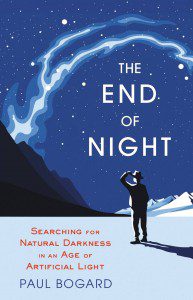 End of Night: Searching for Natural Darkness in an Age of Artificial Light, which I highly recommend. There are many wonderful advantages that come with electric light: the ability to work and play at night, as well as expanded safety and security (92). But Bogard’s book made me consider the consequences of light robbing us of the fullness of the night sky. Bogard introduced me to terms such as “light trespass”: the way unregulated, unshielded lights create unnecessary glare (endangering drivers and pedestrians), waste energy in an age of climate change (by not focusing light where it is intended and needed), and shine into the sky (dimming the view of the stars) (5).
As much as I love living downtown, when I walk around at night, my attention is rarely drawn to the sky, except maybe by the moon. If I do look up, there are very few stars visible, even on a clear night. There is a tipping point for a breathtakingly beautiful night sky. One estimate is that, “An observer needs to see four hundred fifty stars at a time to get that feeling of infinitude, and be swept away” (34). And asking for 450 stars is not unreasonable. Under a clear sky free of light pollution, you should see 2,700 stars (Bogard, Let There Be Night, 68):
When the North American power grid faltered in August 2004, over ten million people took to the streets — not to loot or protest, but to gaze, astonished, at the night sky. For a few summer evenings, a postmodern population knew real quiet and true darkness. Reporters in Canada and the United States, seeking tales of horror and hardship, heard instead about the glories of the firmament. (131)
There’s even a technical term for this effect: “When the horizon disappears and you feel like you’re falling into the stars, it’s called ‘celestial vaulting’” (270). The last time I remember viscerally experiencing celestial vaulting was about a decade ago. I was on a five-day backpacking trip in the Bridger Wilderness of Wyoming. We had hiked two full days, and camped at the top of a mountain. I got up in the middle of the night and happened to look up. I almost fell over from the stunning resplendence of the star-filled sky.
Ralph Waldo Emerson wrote in his 1836 essay “Nature”: “If the stars should appear one night in a thousand years, how would men believe and adore…! But every night come out these envoys of beauty, and light the universe.…” Tragically, from most of our perspectives, the stars no longer appear to come out every night, and far too many of us have forgotten that most nights we should be seeing not a dozen stars, but thousands (67).
There are still a few places in or near the U.S. where you can experience a dark night sky near the lower-end of the Bortle scale:
- Black Rock Desert in Nevada, where the annual Burning Man Festival is held (214),
- Mont Mégantic National Park in southern Quebec, which has been designated a “Dark Sky Reserve” by the International Dark-Sky Association (192),
- Death Valley National Park, which is partially in both California and Nevada (246),
- Natural Bridges National Monument, Capital Reef National Park, and Bryce Canyon National Park, all in southern Utah (262).
- Cherry Springs State Park in Pennsylvania is one of the best places in the eastern U.S. for stargazing.
Other dark sky National Parks include Big Bend, Natural Bridges, Grand Canyon, and Chaco Cultural National Historical Park (262). Significantly, “The National Park Service now includes darkness as one of the resources it’s sworn to protect” (250).
We too can accept that challenge to reclaim and protect our local view of the stars. A famous negative example is Las Vegas, which has twice the amount of light pollution one would expect from its population. In contrast, through Dark Sky ordinances (laws regulating the use of artificial lighting), Flagstaff, Arizona has achieved 25 percent lower light pollution than one would anticipate from its size, and has been recognized as the world’s first Dark Sky Community by the International Dark-Sky Association (184, 240). The IDA’s program requires that a community “inventory its existing lights, change those lights that are causing excessive glare and sky glow, and promise that any new lights would conform to anti-light pollution regulations” (185).
“For a quick gauge of sky quality, locate the Little Dipper. If you can see all four stars in its cup, you have basically good, dark skies. If you can only see the two stars at the front of the cup, your skies are fair to poor. In most American and European cities, you can’t see the Little Dipper at all (281). If we were to get serious about Dark Sky ordinances, then in cities, there might be a shift from “one or two dozen stars visible to three dozen or even four dozen” (243). A more significant change would be that 30 miles away from major cities you would be once again able to see quality skies (226).
A motivation for cities could be that Dark Sky ordinances lead to major savings in energy, which Climate Change activists would also support (243). “It is estimated that the European Union spends some 1.7 billion euros a year on wasted outdoor light. In the United States, the figure is a similar $2.2 billion (228). What might progress toward reclaiming starry skies look like in your community? For steps on creating change, visit the website of the International Dark-Sky Association (darksky.org).
If I had more time, I would summarize the highlights of what I said in my previous posts from this time of year on “A Winter Solstice Spirituality” and “A Spirituality of Winter.” But suffice it to say that the world we are creating for ourselves — that is increasingly lit by electric lights and bright screens 24 hours/day, 7 days a week, 365 days/year — distances us from the daily and seasonal rhythms of nature. An overabundance of light inhibits us from fully entering into those seasons of our lives in which we are called to practice a winter spirituality of inwardness, simplicity, subtraction, darkness, silence, and letting go.
May we increasingly relearn and reclaim the beauty and wonder of the night sky that our ancestors knew.
The Rev. Dr. Carl Gregg is a trained spiritual director, a D.Min. graduate of San Francisco Theological Seminary, and the minister of the Unitarian Universalist Congregation of Frederick, Maryland. Follow him on Facebook (facebook.com/carlgregg) and Twitter (@carlgregg).
Learn more about Unitarian Universalism:
http://www.uua.org/beliefs/principles
Previous Post

December 17, 2015
”Did God Have a Wife?”: Asherah, Heavenly Mother, & Mother Earth
Next Post
December 28, 2015 Top 10 Best Books Read in 2015
Browse Our Archives
Select a Category Advent Anti-Racism Archaeology Atheism Baptism Best of the Year List Book Reviews Buddhism Catholicism Christian Education Church and State Church Planting Climate Change Conscientious Objection to War Creation Spirituality Death Penalty Didache Disability Rights Discernment Easter Ecology Emergent Church Movement Empire-Critical Ethics Evolution Feminist Theology Film Reviews Gandhi Gospel of Mark Gun Control Hinduism Immigration Reform Interfaith Islam JFK Judaism Jungian Spirituality Lectionary Commentary Lent Letters to the Editor LGBT Marriage MLK Multiculturalism Mysticism Nonviolent Activism Occupy Paganism (Earth-centered Religions) Parables Paul Pluralism Politics Process Theology Quantum Physics Requiescat In Pace Seminary and Divinity School Sermon Series Retrospective Sermons Spiritual Direction Spiritual Practices Stewardship (Fundraising) The Book of J The Wheel of the Year (Paganism) Theoblogger Challenge Triathlon Uncategorized Unitarian Universalism Worship Resources Youth Ministry
Select a Month July 2026 May 2026 March 2026 November 2025 October 2025 August 2025 February 2025 December 2024 October 2024 March 2024 January 2024 December 2023 November 2023 March 2023 February 2023 January 2023 December 2022 November 2022 August 2022 March 2022 February 2022 January 2022 December 2021 September 2021 August 2021 July 2021 June 2021 May 2021 February 2021 January 2021 December 2020 August 2020 June 2020 May 2020 April 2020 March 2020 February 2020 January 2020 December 2019 November 2019 October 2019 September 2019 July 2019 June 2019 March 2019 February 2019 January 2019 December 2018 November 2018 October 2018 September 2018 June 2018 May 2018 April 2018 March 2018 February 2018 January 2018 December 2017 November 2017 October 2017 September 2017 August 2017 July 2017 June 2017 May 2017 April 2017 March 2017 February 2017 January 2017 December 2016 November 2016 October 2016 September 2016 August 2016 June 2016 May 2016 April 2016 March 2016 February 2016 January 2016 December 2015 November 2015 October 2015 September 2015 August 2015 July 2015 June 2015 May 2015 April 2015 March 2015 February 2015 January 2015 December 2014 November 2014 October 2014 August 2014 July 2014 June 2014 May 2014 April 2014 March 2014 February 2014 January 2014 December 2013 November 2013 October 2013 September 2013 August 2013 July 2013 June 2013 May 2013 April 2013 March 2013 February 2013 January 2013 December 2012 November 2012 October 2012 September 2012 August 2012 July 2012 June 2012 May 2012 April 2012 March 2012 February 2012 January 2012 December 2011 November 2011 October 2011 September 2011 August 2011 July 2011 June 2011 May 2011 April 2011 March 2011 February 2011 January 2011 December 2010 November 2010 October 2010 August 2009 July 2009 May 2009
Follow Us!
TAKE THE
Religious Wisdom Quiz
Which Christian symbol looks like a fish and spells "ichthys" in Greek?
Select your answer to see how you score.
The dove The anchor The Jesus Fish The triangle
Related posts from Carl Gregg

Reading America at 250: A Nation Wrestles With...


Andrew Holocek on the Power of Darkness

The Stories That Shape Us: Myths, Archetypes, &...
TRENDING AT PATHEOS More Voices

Reading America at 250: A Nation Wrestles With...
As part of my own reflection on the 250th anniversary of the...

Whenever I am reading a book or listening to an argument, I...

President Trump Ban Animal Torture Videos on Facebook
Call for Stricter Regulations of Animal Abuse Content on Facebook Although President...

Draft Amendments to Address Ritual Abuse in New...
The proposed changes would make it illegal for individuals in domestic partnerships...

How Bans on LGBTQ+ Student Clubs Threaten Religious...
On June 20, 2025, the State of Texas passed Senate Bill 12....

The Truth About the Gen Z Revival
This past year, there has been a lot of media buzz surrounding...
view all More Voices blogs
Ad-Free & Subscriber Log-In Subscription Support
- About Us
- 2026 Calendar
- Videos
- Podcasts
- Library of World Religions
- Faith In Media Tracker
- Advertise With Us
- Write for Us
- Privacy Policy
- Terms of Service
- Do Not Sell My Data
- Contact Us
- Radiant Digital
- Manage Newsletter Subscriptions
- Unsubscribe From Notifications
- Sitemap
Copyright 2008-2026, Patheos. All rights reserved.
Subscription Support Ad-Free & Subscriber Log-In
Follow Patheos