
BuddhistCatholicContemplativeEvangelicalGeneral ChristianHinduJewishLatter-day SaintMuslimNew VisionsProgressive Christian
Beliefs
- Buddhist
- Catholic
- Contemplative
- Evangelical
- General Christian
- Hindu
- Jewish
- Latter-day Saint
- More Voices
- Muslim
- New Visions
- Pagan
- Progressive Christian
Topics
- Religion News
- Food and Religion
- Sports and Religion
- Religious Art
- Religious Music and Entertainment
- Religious Events
- History and Religion
- Style and Religion
- Politics and Religion
- Women in Religion
- Recreation Outdoors and Religion
- Business Finance and Religion
- Careers Workplace and Religion
- Education and Religion
- Family Parenting and Religion
- Health Fitness and Religion
- Home and Religion
- Relationships and Religion
- Technology and Religion
- Travel and Religion
Columnists
- Buddhist Columnists
- Business Finance and Religion Columnists
- Careers Workplace and Religion Columnists
- Catholic Columnists
- Contemplative Columnists
- Education and Religion Columnists
- Evangelists Columnists
- Family Parenting and Religion Columnists
- General Christian Columnists
- Health Fitness and Religion Columnists
- Hindu Columnists
- History and Religion Columnists
- Home and Religion Columnists
- Jewish Columnists
- More Voices Columnists
- Latter Day Columnists
- Muslim Columnists
- New Visions Columnists
- Nonreligious Columnists
- Pagan Columnists
- Politics and Religion Columnists
- Progressive Columnists
- Recreation Outdoors and Religion Columnists
- Relationships and Religion Columnists
- Religion News Columnists
- Religious Art Columnists
- Religious Events Columnists
- Religious Music and Entertainment Columnists
- Sports and Religion Columnists
- Style and Religion Columnists
- Technology and Religion Columnists
- Travel and Religion Columnists
- Women in Religion Columnists
Resource Library
- 2026 Calendar
- Library of World Religions
- The 100 Most Holy Places on Earth
- Patheos Answers
- Podcasts
- Videos
- Faith Leaders Database
- Anglican Episcopalian
- Bahai
- Baptist
- Buddhism
- Christianity
- Confucianism
- Eastern Orthodoxy
- Hinduism
- Holiness and Pentecostal
- ISKCON
- Islam
- Judaism
- Lutheran
- Methodist
- The Church of Jesus Christ of Latter-day Saints
- New Age
- Paganism
- Presbytarian and Reformed
- Protestantism
- Religion Behind the Scenes
- Roman Catholic
- Scientology
- Shia Islam
- Sikhism
- Sufism
- Sunni Islam
- Taoism
- Zen
- See all religions
Research Tools
 Ad-Free & Subscriber Log-In Subscription Support
Ad-Free & Subscriber Log-In Subscription Support
Follow Patheos 

- Trending:
- Forgiveness
- |
- Marriage
- |
- Consciousness
- |
- Death Penalty
- |
- Election
- |
- Halloween

- Home
- More Voices
- ”Did God Have a Wife?”: Asherah, Heavenly Mother, & Mother Earth
”Did God Have a Wife?”: Asherah, Heavenly Mother, & Mother Earth
Last updated on: December 17, 2015 at 10:00 am by Carl Gregg
”Did God Have a Wife?”: Asherah, Heavenly Mother, & Mother Earth 2015-12-16T23:51:33-05:00 Carl Gregg
Patheos Explore the world's faith through different perspectives on religion and spirituality! Patheos has the views of the prevalent religions and spiritualities of the world.
In the theologically conservative Protestant Christianity of my childhood, the sacred was always imagined as masculine: God the Father Almighty, Lord Jesus Christ the son, both of whom were represented on Earth by an all-male clergy. As I grew older and learned more about other Christian traditions such as Roman Catholicism, I was fascinated by their devotion to Mary, the mother of Jesus as also the mother of God, given their belief in the divinity of Jesus. And although she was, in some senses, a feminine image of the divine, there remained the issue of her supposedly perpetual virginity: seemingly women could only be sacred images if they were sexless.
What a set-up for unnatural gender dynamics! A single father (who is divine) has an encounter with a human woman, who remains a virgin. But together they have a son, who is said to be fully human and fully divine. And that son, whom tradition calls us to imitate, remained celibate his entire life. Not exactly a model for so-called “traditional family values.” I remain convinced that anyone who thinks that there is a simple biblical vision of “one man, one woman, and 2.5 children” for family values has read the Bible only through a highly selective lens.
For now, allow me to share just one of the many surprising discoveries I found, when I began studying the Bible closely for myself. While reading through 1 and 2 Kings, I noticed six different passages that referred to “Asherah,” a name that was previously unfamiliar to me:
- 1 Kings 15:13, “He also removed his mother Maacah from being queen mother, because she had made an abominable image for Asherah; Asa cut down her image and burned it.…” (There is a parallel passage in 2 Chronicles 15:16.) Who is this “Asherah,” I wondered, that the queen mother is willing to risk getting in so much trouble for worshipping?
- 1 Kings 18:19, “Have all Israel assemble for me at Mount Carmel, with the four hundred fifty prophets of Ba’al and the four hundred prophets of Asherah….” I had heard of Ba’al but who is this Asherah who has four hundred prophets?
- 2 Kings 21:7, “The carved image of Asherah that he had made he set in the house of which the Lord said to David and to his son Solomon, “In this house, and in Jerusalem, which I have chosen out of all the tribes of Israel, I will put my name forever.” Wait! Now an image of Asherah is being put in the Jerusalem Temple? In the final three passages, you’ll continue to see official pushback to Asherah veneration.
- 2 Kings 23:4, “The king commanded the high priest…to bring out of the temple of the Lord all the vessels made for Ba’al, for Asherah, and for all the host of heaven; he burned them outside Jerusalem.…”
- 2 Kings 23:6, “He brought out the image of Asherah from the house of the Lord, outside Jerusalem…burned it…beat it to dust and threw the dust of it upon the graves of the common people.” Notice that the Asherah remains are cast precisely on the graves of common people, who we will see were the ones maintaining Asherah devotion.
- 2 Kings 23:7, “He broke down the houses of the male temple prostitutes that were in the house of the Lord, where the women did weaving for Asherah.”
It turns out that Asherah is an ancient Canaanite Mother Goddess, “who was associated with living trees and hilltop forest sanctuaries, and who could sometimes be symbolized by a wood pole or an image of a tree” (Dever 100 – 102).
In the congregation of my childhood, I remember learning about the contest in 1 Kings, which sets the 450 prophets of Ba’al and the 400 prophets of Asherah against the prophet Elijah. As the story goes, Elijah succeeds in persuading his god Yahweh to miraculously light a stack of wood that has been soaked with water, which according to the Bible proves that Yahweh is a true god. But the prophets of Ba’al and Asherah are unable to light their fire, which according to the Bible exposes Ba’al and Asherah as false gods. The reason I remember this story is the slightly traumatizing scene in verse 40, where Elijah commands that all 450 prophets of Ba’al be captured and killed. And although I heard that story many times, what I never noticed prior to paying attention to Asherah references is that it is only the prophets of Ba’al are killed. Reading between the lines, the prophets of Asherah “were probably spared [because] her cult was widely tolerated, despite the misgivings of some purists” (211).
Taking into account the Hebrew Bible, along with many archeological discoveries related to Asherah, and references to her in other Ancient Near Eastern literature, it appears that Asherah was the “principal female deity of the pantheon in Canaan in pre-Israelite times” and “the consort of the chief male deity El” (210). That Canaanite deity name “El” continued to show up in many places, including names like Israel (“one who wrestles with God”), Samuel (“Name of God”), Emmanuel (“God with us”).
Now, there is a much more detailed story to be told here that involves how four major sources — nicknamed in modern times J, E, P, and D — were edited together into what we know today as the first five books of the Bible (Genesis, Exodus, Levitcus, Numbers, and Deuteronomy). But suffice it to say that in one of those sources (known as the “J-Source”), God is consistently referred to as Yahweh Elohim, which is usually translated into English as “LORD God.” And from the very beginning of the J-Source in Genesis 2, God is consistently called Yahweh Elohim. But in the E-Source, God is exclusively called Elohim (rendered in English as “Lord”) until Exodus 3, when, according to the E-Source, there is a surprising — and seemingly first-time-ever — revelation to Moses that God’s real name is “Yahweh.” But that alleged secret would be a surprise to the community who wrote the J-Source, who knew “Yahweh” was God’s name from way back in the Garden of Eden.
To make a long story short, the E stories emerged from (and have a resulting bias toward) the northern kingdom of Israel, and the J stories emerged from (and have a bias toward) the southern kingdom of Judah**.** In 722 B.C.E., after the Assyrians destroyed the northern kingdom of Israel, J and E were edited together to preserve both traditions in the wake of one kingdom being tragically conquered. (For more details, see Richard Elliott Friedman, Who Wrote the Bible?, 62-63ff.)
Over time, Yahweh, who was originally one among many tribal gods, rises in popularity (especially among the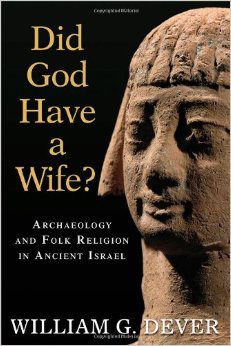 literary elite) such that eventually his identity merges with El, the chief male deity of the Cannannite pantheon. But even with Yahweh’s ascent among the elite individuals responsible for the writing and editing of the Hebrew Bible, that text retains trace evidence of the popular devotion among the Israelite people to the ancient Canaanite Mother Goddess, Asherah. If you are interested in going into more depth, an accessible introduction is Did God Have a Wife? Archaeology and Folk Religion in Ancient Israel by the renowned biblical archaeologist William Dever.
Dever does an excellent job at emphasizing the difference between the after-the-fact, highly selective, idealistic version of Israel’s history that is written down by the literary and priestly elites into the final version of the Hebrew Bible that we have inherited — contrasted with the much messier and more diverse reality on the ground of how religion was actually practiced by most common folk, which included devotion to the goddess Asherah (69-72).
To give three more brief examples of how the Hebrew Bible testifies to the polytheism of many common people prior to the Babylonian exile in 587 B.C.E., Exodus 20:3 has God telling the Israelites, newly freed from slavery in Egypt, “you shall have no other gods before me.” There is not a denial that other gods exist, merely a prohibition from putting them as more important than Yahweh. Similarly, Deuteronomy 32:8-9 says, “8 When the Most High apportioned the nations, when he divided humankind, he fixed the boundaries of the peoples according to the number of the gods; 9 the Lord’s own portion was his people, Jacob his allotted share.” Again, the existence of other gods is clear. Likewise, in Joshua 24:15, Joshua says to the Israelites, “choose this day whom you will serve, whether the gods your ancestors served in the region beyond the River or the gods of the Amorites in whose land you are living; but as for me and my household, we will serve the Lord.”
In considering the consequence of this move from a polytheism that included both male gods and female goddesses to a monotheism that says there is only one true God, who is gendered male, a good general rule-of-thumb in religious studies is that a religion has crossed into a dangerous patriarchal fundamentalism when the Sacred Masculine archetype of Father Sky devolves into a literal Sky Father: worship of a Zeus-like male human figure, who is imagined to actually live in the sky and sit in judgment of humanity.
The archetype of Father Sky is about the sacred practice of looking up in awe and wonder at the beauty of the cosmos, which is meant to balance the Sacred Feminine metaphor of Mother Earth. But whenever a literal “Sky Father” theology reigns, men are literally the beneficiaries. And don’t be fooled by the propaganda that, “We cloister our women at home, forbid them from driving cars, and keep their bodies covered because we respect them so much, want to protect them, and put them up on a pedestal.” As the late feminist theologian Mary Daly often said, “Where God is male, male is God.”
Or to consider the parallel of my favorite underreported belief from Mormon theology, according to the official doctrine of the Church of Jesus Christ of Latter Day Saints, God (“Heavenly Father”) is married. And my hope is that “Heavenly Mother” will continue to embolden feminists in Mormonism. Indeed, back in 1977, during the Mormon General Conference, an organization called Mormons for the Equal Rights Amendment hired a plane to fly a banner over the Salt Lake City LDS Tabernacle that said, “Mother in Heaven Supports the ERA” (Bowman, The Mormon People, 234ff).
So, in the spirit of Asherah, Heavenly Mother, and Mother Earth, I will end with a challenge — a vision, really — from the feminist philosopher of religion Grace Jantzen — words that feel particularly resonant in this holiday season, when a domestic terrorist attack was committed against a Planned Parenthood facility two days before the first Sunday of Advent, which in the Christian tradition is the four-week season leading up to the Feast of Christmas. Jantzen writes that:
a traditional philosophy of religion (and western culture generally) is preoccupied with violence, sacrifice, and death, and built upon mortality not only as a human fact but as a fundamental philosophical category. But what if we were to begin with birth, and with the hope and possibility and wonder implicit in it? How if we were to treat natality and the emergence of this life and this world with the same philosophical seriousness and respect which had traditionally been paid to mortality and the striving for other worlds? …. Such a feminist approach is philosophically viable, and opens up new ways of considering religion, human flourishing, identity, and difference, and ecological concern. (1999:2)
Let us answer “yes” to all the hopes, possibilities and wonder of this life and this world that we have here and now with one another.
The Rev. Dr. Carl Gregg is a trained spiritual director, a D.Min. graduate of San Francisco Theological Seminary, and the minister of the Unitarian Universalist Congregation of Frederick, Maryland. Follow him on Facebook (facebook.com/carlgregg) and Twitter (@carlgregg).
Learn more about Unitarian Universalism:
http://www.uua.org/beliefs/principles
Paganism (Earth-centered Religions)
Previous Post

December 10, 2015
Are You a Faitheist?
Browse Our Archives
Select a Category Advent Anti-Racism Archaeology Atheism Baptism Best of the Year List Book Reviews Buddhism Catholicism Christian Education Church and State Church Planting Climate Change Conscientious Objection to War Creation Spirituality Death Penalty Didache Disability Rights Discernment Easter Ecology Emergent Church Movement Empire-Critical Ethics Evolution Feminist Theology Film Reviews Gandhi Gospel of Mark Gun Control Hinduism Immigration Reform Interfaith Islam JFK Judaism Jungian Spirituality Lectionary Commentary Lent Letters to the Editor LGBT Marriage MLK Multiculturalism Mysticism Nonviolent Activism Occupy Paganism (Earth-centered Religions) Parables Paul Pluralism Politics Process Theology Quantum Physics Requiescat In Pace Seminary and Divinity School Sermon Series Retrospective Sermons Spiritual Direction Spiritual Practices Stewardship (Fundraising) The Book of J The Wheel of the Year (Paganism) Theoblogger Challenge Triathlon Uncategorized Unitarian Universalism Worship Resources Youth Ministry
Select a Month July 2026 May 2026 March 2026 November 2025 October 2025 August 2025 February 2025 December 2024 October 2024 March 2024 January 2024 December 2023 November 2023 March 2023 February 2023 January 2023 December 2022 November 2022 August 2022 March 2022 February 2022 January 2022 December 2021 September 2021 August 2021 July 2021 June 2021 May 2021 February 2021 January 2021 December 2020 August 2020 June 2020 May 2020 April 2020 March 2020 February 2020 January 2020 December 2019 November 2019 October 2019 September 2019 July 2019 June 2019 March 2019 February 2019 January 2019 December 2018 November 2018 October 2018 September 2018 June 2018 May 2018 April 2018 March 2018 February 2018 January 2018 December 2017 November 2017 October 2017 September 2017 August 2017 July 2017 June 2017 May 2017 April 2017 March 2017 February 2017 January 2017 December 2016 November 2016 October 2016 September 2016 August 2016 June 2016 May 2016 April 2016 March 2016 February 2016 January 2016 December 2015 November 2015 October 2015 September 2015 August 2015 July 2015 June 2015 May 2015 April 2015 March 2015 February 2015 January 2015 December 2014 November 2014 October 2014 August 2014 July 2014 June 2014 May 2014 April 2014 March 2014 February 2014 January 2014 December 2013 November 2013 October 2013 September 2013 August 2013 July 2013 June 2013 May 2013 April 2013 March 2013 February 2013 January 2013 December 2012 November 2012 October 2012 September 2012 August 2012 July 2012 June 2012 May 2012 April 2012 March 2012 February 2012 January 2012 December 2011 November 2011 October 2011 September 2011 August 2011 July 2011 June 2011 May 2011 April 2011 March 2011 February 2011 January 2011 December 2010 November 2010 October 2010 August 2009 July 2009 May 2009
Follow Us!
TAKE THE
Religious Wisdom Quiz
Who did God call to lead the Israelites out of Egypt?
Select your answer to see how you score.
Aaron David Moses Joseph
Related posts from Carl Gregg

Vampires, Witches, & NPR: The Legacy of Margot...

“Coming Out of the Broom Closet” #PaganPride

Letting Go of Fear & Celebrating Differences: Insights...
TRENDING AT PATHEOS More Voices

Reading America at 250: A Nation Wrestles With...
As part of my own reflection on the 250th anniversary of the...

Whenever I am reading a book or listening to an argument, I...

President Trump Ban Animal Torture Videos on Facebook
Call for Stricter Regulations of Animal Abuse Content on Facebook Although President...

Draft Amendments to Address Ritual Abuse in New...
The proposed changes would make it illegal for individuals in domestic partnerships...

How Bans on LGBTQ+ Student Clubs Threaten Religious...
On June 20, 2025, the State of Texas passed Senate Bill 12....

The Truth About the Gen Z Revival
This past year, there has been a lot of media buzz surrounding...
view all More Voices blogs
Ad-Free & Subscriber Log-In Subscription Support
- About Us
- 2026 Calendar
- Videos
- Podcasts
- Library of World Religions
- Faith In Media Tracker
- Advertise With Us
- Write for Us
- Privacy Policy
- Terms of Service
- Do Not Sell My Data
- Contact Us
- Radiant Digital
- Manage Newsletter Subscriptions
- Unsubscribe From Notifications
- Sitemap
Copyright 2008-2026, Patheos. All rights reserved.
Subscription Support Ad-Free & Subscriber Log-In
Follow Patheos