
BuddhistCatholicContemplativeEvangelicalGeneral ChristianHinduJewishLatter-day SaintMuslimNew VisionsProgressive Christian
Beliefs
- Buddhist
- Catholic
- Contemplative
- Evangelical
- General Christian
- Hindu
- Jewish
- Latter-day Saint
- More Voices
- Muslim
- New Visions
- Pagan
- Progressive Christian
Topics
- Religion News
- Food and Religion
- Sports and Religion
- Religious Art
- Religious Music and Entertainment
- Religious Events
- History and Religion
- Style and Religion
- Politics and Religion
- Women in Religion
- Recreation Outdoors and Religion
- Business Finance and Religion
- Careers Workplace and Religion
- Education and Religion
- Family Parenting and Religion
- Health Fitness and Religion
- Home and Religion
- Relationships and Religion
- Technology and Religion
- Travel and Religion
Columnists
- Buddhist Columnists
- Business Finance and Religion Columnists
- Careers Workplace and Religion Columnists
- Catholic Columnists
- Contemplative Columnists
- Education and Religion Columnists
- Evangelists Columnists
- Family Parenting and Religion Columnists
- General Christian Columnists
- Health Fitness and Religion Columnists
- Hindu Columnists
- History and Religion Columnists
- Home and Religion Columnists
- Jewish Columnists
- More Voices Columnists
- Latter Day Columnists
- Muslim Columnists
- New Visions Columnists
- Nonreligious Columnists
- Pagan Columnists
- Politics and Religion Columnists
- Progressive Columnists
- Recreation Outdoors and Religion Columnists
- Relationships and Religion Columnists
- Religion News Columnists
- Religious Art Columnists
- Religious Events Columnists
- Religious Music and Entertainment Columnists
- Sports and Religion Columnists
- Style and Religion Columnists
- Technology and Religion Columnists
- Travel and Religion Columnists
- Women in Religion Columnists
Resource Library
- 2026 Calendar
- Library of World Religions
- The 100 Most Holy Places on Earth
- Patheos Answers
- Podcasts
- Videos
- Faith Leaders Database
- Anglican Episcopalian
- Bahai
- Baptist
- Buddhism
- Christianity
- Confucianism
- Eastern Orthodoxy
- Hinduism
- Holiness and Pentecostal
- ISKCON
- Islam
- Judaism
- Lutheran
- Methodist
- The Church of Jesus Christ of Latter-day Saints
- New Age
- Paganism
- Presbytarian and Reformed
- Protestantism
- Religion Behind the Scenes
- Roman Catholic
- Scientology
- Shia Islam
- Sikhism
- Sufism
- Sunni Islam
- Taoism
- Zen
- See all religions
Research Tools
 Ad-Free & Subscriber Log-In Subscription Support
Ad-Free & Subscriber Log-In Subscription Support
Follow Patheos 

- Trending:
- Forgiveness
- |
- Marriage
- |
- Consciousness
- |
- Death Penalty
- |
- Election
- |
- Halloween

- Home
- More Voices
- Are You a Faitheist?
Are You a Faitheist?
Last updated on: December 17, 2015 at 9:23 am by Carl Gregg
Are You a Faitheist? 2015-12-17T09:23:28-05:00 Carl Gregg
Patheos Explore the world's faith through different perspectives on religion and spirituality! Patheos has the views of the prevalent religions and spiritualities of the world.
If you want to test how evolved you are as a person, the holidays often provide an annual testing ground for spiritual maturity. It’s easy to be blissful while sitting on the beach, hiking by yourself in the woods, or pausing to savor a sunset. But as the saying goes, “Our family can push our buttons the most, because our family members are the ones, who sewed our buttons on in the first place!” Our various complexes and neuroses are often forged in our childhood family systems.
Or, even if your family is a supportive tribe with whom you strongly identify, as a nation, we’re facing problems on multiple fronts right now that regularly divide us into factions: the New Jim Crow vs. mass incarceration, the epidemic of mass shootings vs. multiple interpretations of the Second Amendment, Climate Change deniers vs. the Paris Climate Summit. We can’t even agree as a nation on the appropriate times and places to wish one another “Happy Holidays” and “Merry Christmas. As one way of helping bridge such divides, I would like to share with you some insights from Chris Stedman (1987 – ), an interfaith activist who is also the Executive Director of the Yale Humanist Community at Yale University. In his mid-twenties, he published a memoir titled Faitheist.
Prior to encountering Stedman’s book, I had never heard the word, “faitheist,” which combines the words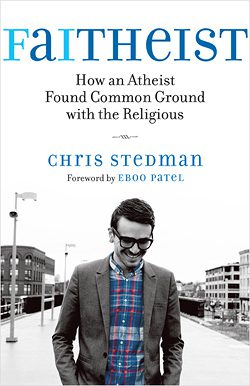 “faith” and “atheist.” When Stedman first heard that word hurled at him, it was not intended as a compliment. He was attending a public forum on how “atheists, agnostics, and other nontheistic, nonreligious people should approach religion” (2). When he tried to make a point about how religion had helped sustain the work for peace and justice of figures like Mahatma Ghandi and The Rev. Dr. Martin Luther King, Jr., someone quickly retorted: “Oh, I get it. You’re one of those atheists. You’re not a real atheist. We’ve got a name for people like you. You’re a faitheist” — which also sounds a bit like “fake atheist” (4). As a young, burgeoning secular humanist, these were stinging words that reminded him of all the people who told him in his childhood that he couldn’t be a real Christian because he was gay.
The late astronomer, cosmologist, and public intellectual Carl Sagan (1934 – 1996) wrote in his book The Demon-Haunted World: Science as a Candle in the Dark that,
The chief deficiency I see in the skeptical movement is its polarization: Us vs. Them — the sense that we have a monopoly on the truth; that those other people who believe in all these stupid doctrines are morons; that if you’re sensible, you’ll listen to us; and if not, to hell with you. This is nonconstructive. It does not get our message across. (1)
Stedman writes that as a young person who had been alienated from traditional religion, he sought out secular humanism “hoping to find a community bound by ethical and humanitarian ideals. Instead, [he] felt isolated and sorely discouraged” (3).
I will confess, however, that when confronted with the ways that fundamentalist religions continue to inspire racism, sexism, and homophobia around the world — as well as to embolden climate change deniers and in extreme cases inspire terrorist attacks — there is part of me that can understand the motivation behind that ancient rationalist dream of the Enlightenment that, humanity “will never be free until the last king is strangled with the entrails of the last priest.” But Stedman challenges us to consider that such violent, reactionary approaches tend to sow the seeds of their own defeat by turning off even would-be supporters.
And although Stedman remains convinced of his atheistic worldview, his humanism has led him to be involved in interfaith circles — as well as to come to see that criticism of “Faitheist” as a compliment. One of Stedman’s biggest critics is the scientist and popular atheist blogger PZ Myers, who promotes a hard-edged approach to all religion, not just fundamentalism. Myers writes: “I say, screw the polite words and careful rhetoric. It’s time for scientists to break out the steel-toed boots and brass knuckles and get out there and hammer on the lunatics and idiots” (150).
Stedman, in contrast, believes in a different way forward into a better world: **“I want to live in a world where love is more commonplace”—**and that the way to create a more loving world is through a more compassionate engagement with those with whom one differs. Stedman continues with the insight that:
Religious pluralism is neither coexistence nor consensus…. “Religious pluralism is the active engagement of religious diversity to a constructive end. Diversity is a mere descriptive fact; ‘pluralism is an achievement’…[with] three essential components: respect for individual religious or non-religious identity, mutually inspiring relationships, and common action for the common good. (163-164)
Stedman writes: “In my youth, being ‘right’ held ultimacy. I valued precision and accuracy, and was sure to correct anyone I felt was ‘wrong.’ I thought I was doing people a favor by correcting them. Now, I strive to lead with listening instead of lecturing” (180). Or to again quote Carl Sagan, this time on the need to respect all human life from a purely secular humanist perspective: “Every one of us is, in the cosmic perspective, precious. If a human disagrees with you, let him [or her] live. In a hundred billion galaxies, you will not find another” (168).
In a similar spirit, the late Israeli poet Yehuda Amichai (1924-2000) writes:
The place where we are right
is hard and trampled
like a yard.
But doubts and loves
dig up the world….
I encourage you in the coming days and weeks — as we approach Winter Solstice, the darkest day of the year — to experiment with sharing not from the place where you are right, but instead risk sharing the stories of your doubts and the stories of what you love, and then listen to the stories of other’s doubts and loves.
In Stedman’s experience, an authentic, robust, engaged religious pluralism (as opposed to a mere descriptive fact of diversity) is achieved through sharing personal stories (164). And I’ll conclude with one example from his excellent memoir. As an atheist and a humanist seeking to make the world a better place, Stedman was working in an assisted-living home. One day, a resident named Marvin, to whom Stedman was assigned, asked Stedman to read a book to him, which he often did. But this time, the book the Marvin pulled off his shelf was a prayer book.
Stedman was hesitant (and knew that it was well within his rights as an employee to bring in another worker to read this religious text), but as he began to read, Marvin visibly relaxed and his gratitude was clear. Stedman writes,
An unexpected feeling overtook me: relief. I had participated in a religious act with Marvin and I felt neither a strong desire to return to my Christian beliefs nor a disdain for his beliefs, as I so often had from seeing any form of religious expression since I left Christianity. In a way, reading the prayer felt like a conversation experience. It was profoundly different than simply “doing my job.” It was entirely unlike previous times when I had read to Marvin. I could tell by the way he sat on the bed, instead of pacing the room as he usually did, that the prayer meant something very profound for him. I realized that though I couldn’t decipher why the prayer was so important to him, it was. It touched him in a profound way. And because I shared in this significant element of his life, our relationship was more honest and real. (113)
May we increasingly offer such graciousness, compassion, and hospitality to one another. And as we are becoming more authentically present to one another, may we allow our hearts, our minds, and our spirits to be transformed.
The Rev. Dr. Carl Gregg is a trained spiritual director, a D.Min. graduate of San Francisco Theological Seminary, and the minister of the Unitarian Universalist Congregation of Frederick, Maryland. Follow him on Facebook (facebook.com/carlgregg) and Twitter (@carlgregg).
Learn more about Unitarian Universalism:
http://www.uua.org/beliefs/principles
Previous Post

November 25, 2015
Lodro Rinzler’s Millennial Hipster Buddhism
Next Post
December 17, 2015 ”Did God Have a Wife?”: Asherah, Heavenly Mother, & Mother Earth
Browse Our Archives
Select a Category Advent Anti-Racism Archaeology Atheism Baptism Best of the Year List Book Reviews Buddhism Catholicism Christian Education Church and State Church Planting Climate Change Conscientious Objection to War Creation Spirituality Death Penalty Didache Disability Rights Discernment Easter Ecology Emergent Church Movement Empire-Critical Ethics Evolution Feminist Theology Film Reviews Gandhi Gospel of Mark Gun Control Hinduism Immigration Reform Interfaith Islam JFK Judaism Jungian Spirituality Lectionary Commentary Lent Letters to the Editor LGBT Marriage MLK Multiculturalism Mysticism Nonviolent Activism Occupy Paganism (Earth-centered Religions) Parables Paul Pluralism Politics Process Theology Quantum Physics Requiescat In Pace Seminary and Divinity School Sermon Series Retrospective Sermons Spiritual Direction Spiritual Practices Stewardship (Fundraising) The Book of J The Wheel of the Year (Paganism) Theoblogger Challenge Triathlon Uncategorized Unitarian Universalism Worship Resources Youth Ministry
Select a Month July 2026 May 2026 March 2026 November 2025 October 2025 August 2025 February 2025 December 2024 October 2024 March 2024 January 2024 December 2023 November 2023 March 2023 February 2023 January 2023 December 2022 November 2022 August 2022 March 2022 February 2022 January 2022 December 2021 September 2021 August 2021 July 2021 June 2021 May 2021 February 2021 January 2021 December 2020 August 2020 June 2020 May 2020 April 2020 March 2020 February 2020 January 2020 December 2019 November 2019 October 2019 September 2019 July 2019 June 2019 March 2019 February 2019 January 2019 December 2018 November 2018 October 2018 September 2018 June 2018 May 2018 April 2018 March 2018 February 2018 January 2018 December 2017 November 2017 October 2017 September 2017 August 2017 July 2017 June 2017 May 2017 April 2017 March 2017 February 2017 January 2017 December 2016 November 2016 October 2016 September 2016 August 2016 June 2016 May 2016 April 2016 March 2016 February 2016 January 2016 December 2015 November 2015 October 2015 September 2015 August 2015 July 2015 June 2015 May 2015 April 2015 March 2015 February 2015 January 2015 December 2014 November 2014 October 2014 August 2014 July 2014 June 2014 May 2014 April 2014 March 2014 February 2014 January 2014 December 2013 November 2013 October 2013 September 2013 August 2013 July 2013 June 2013 May 2013 April 2013 March 2013 February 2013 January 2013 December 2012 November 2012 October 2012 September 2012 August 2012 July 2012 June 2012 May 2012 April 2012 March 2012 February 2012 January 2012 December 2011 November 2011 October 2011 September 2011 August 2011 July 2011 June 2011 May 2011 April 2011 March 2011 February 2011 January 2011 December 2010 November 2010 October 2010 August 2009 July 2009 May 2009
Follow Us!
TAKE THE
Religious Wisdom Quiz
What did God make on the fourth day of creation?
Select your answer to see how you score.
Sun, moon, and stars Plants Man Fish and birds
Related posts from Carl Gregg
"Practicing Safe Texts": Misquoting Moses, Misquoting Jesus, Misquoting...

“Do You Really Want to Know?” From Pope...
What Ta-Nehisi Coates Taught Me About “People Who...

Celebrating Mixed Religion: Or How I Learned to...
TRENDING AT PATHEOS More Voices

Reading America at 250: A Nation Wrestles With...
As part of my own reflection on the 250th anniversary of the...

Whenever I am reading a book or listening to an argument, I...

President Trump Ban Animal Torture Videos on Facebook
Call for Stricter Regulations of Animal Abuse Content on Facebook Although President...

Draft Amendments to Address Ritual Abuse in New...
The proposed changes would make it illegal for individuals in domestic partnerships...

How Bans on LGBTQ+ Student Clubs Threaten Religious...
On June 20, 2025, the State of Texas passed Senate Bill 12....

The Truth About the Gen Z Revival
This past year, there has been a lot of media buzz surrounding...
view all More Voices blogs
Ad-Free & Subscriber Log-In Subscription Support
- About Us
- 2026 Calendar
- Videos
- Podcasts
- Library of World Religions
- Faith In Media Tracker
- Advertise With Us
- Write for Us
- Privacy Policy
- Terms of Service
- Do Not Sell My Data
- Contact Us
- Radiant Digital
- Manage Newsletter Subscriptions
- Unsubscribe From Notifications
- Sitemap
Copyright 2008-2026, Patheos. All rights reserved.
Subscription Support Ad-Free & Subscriber Log-In
Follow Patheos