
BuddhistCatholicContemplativeEvangelicalGeneral ChristianHinduJewishLatter-day SaintMuslimNew VisionsProgressive Christian
Beliefs
- Buddhist
- Catholic
- Contemplative
- Evangelical
- General Christian
- Hindu
- Jewish
- Latter-day Saint
- More Voices
- Muslim
- New Visions
- Pagan
- Progressive Christian
Topics
- Religion News
- Food and Religion
- Sports and Religion
- Religious Art
- Religious Music and Entertainment
- Religious Events
- History and Religion
- Style and Religion
- Politics and Religion
- Women in Religion
- Recreation Outdoors and Religion
- Business Finance and Religion
- Careers Workplace and Religion
- Education and Religion
- Family Parenting and Religion
- Health Fitness and Religion
- Home and Religion
- Relationships and Religion
- Technology and Religion
- Travel and Religion
Columnists
- Buddhist Columnists
- Business Finance and Religion Columnists
- Careers Workplace and Religion Columnists
- Catholic Columnists
- Contemplative Columnists
- Education and Religion Columnists
- Evangelists Columnists
- Family Parenting and Religion Columnists
- General Christian Columnists
- Health Fitness and Religion Columnists
- Hindu Columnists
- History and Religion Columnists
- Home and Religion Columnists
- Jewish Columnists
- More Voices Columnists
- Latter Day Columnists
- Muslim Columnists
- New Visions Columnists
- Nonreligious Columnists
- Pagan Columnists
- Politics and Religion Columnists
- Progressive Columnists
- Recreation Outdoors and Religion Columnists
- Relationships and Religion Columnists
- Religion News Columnists
- Religious Art Columnists
- Religious Events Columnists
- Religious Music and Entertainment Columnists
- Sports and Religion Columnists
- Style and Religion Columnists
- Technology and Religion Columnists
- Travel and Religion Columnists
- Women in Religion Columnists
Resource Library
- 2026 Calendar
- Library of World Religions
- The 100 Most Holy Places on Earth
- Patheos Answers
- Podcasts
- Videos
- Faith Leaders Database
- Anglican Episcopalian
- Bahai
- Baptist
- Buddhism
- Christianity
- Confucianism
- Eastern Orthodoxy
- Hinduism
- Holiness and Pentecostal
- ISKCON
- Islam
- Judaism
- Lutheran
- Methodist
- The Church of Jesus Christ of Latter-day Saints
- New Age
- Paganism
- Presbytarian and Reformed
- Protestantism
- Religion Behind the Scenes
- Roman Catholic
- Scientology
- Shia Islam
- Sikhism
- Sufism
- Sunni Islam
- Taoism
- Zen
- See all religions
Research Tools
 Ad-Free & Subscriber Log-In Subscription Support
Ad-Free & Subscriber Log-In Subscription Support
Follow Patheos 

- Trending:
- Forgiveness
- |
- Marriage
- |
- Consciousness
- |
- Death Penalty
- |
- Election
- |
- Halloween

- Home
- More Voices
- Why Peter Singer Hates on Guide Dogs & the “Make-a-Wish” Foundation: Reflections on “The Most Good You Can Do”
Why Peter Singer Hates on Guide Dogs & the “Make-a-Wish” Foundation: Reflections on “The Most Good You Can Do”
Last updated on: November 19, 2015 at 12:58 pm by Carl Gregg
Why Peter Singer Hates on Guide Dogs & the “Make-a-Wish” Foundation: Reflections on “The Most Good You Can Do” 2015-11-19T12:58:11-05:00 Carl Gregg
Patheos Explore the world's faith through different perspectives on religion and spirituality! Patheos has the views of the prevalent religions and spiritualities of the world.
Recent new stories have ranged from the absurd to the inane, and most recently, to horror. The famed neurosurgeon and current presidential candidate Ben Carson confirmed that he continues to believe — despite all evidence to the contrary — that the Egyptian pyramids were not built as graves for pharaohs, but instead were built to store grain by Joseph, a character in the biblical book of Genesis. That’s absurd.
There has also been a lot of inane hubbub about Starbuck’s plain red holiday coffee cup design, which has been an exercise in missing the point. Jesus didn’t come to be the “patron saint of fourth-quarter earnings.” And the way to keep “Christ in Christmas” has nothing to do with Starbucks and everything to do with giving food to the hungry, clothing the naked, and visiting the sick and imprisoned. But a week of silly headlines descended into horror on Friday evening with the news of the terrorist attacks in Paris.
As I’ve reflected on these headlines, allow me to take the risk of describing a common thread linking these three news stories with a contrasting alternative worldview found in Peter Singer’s ethics. To be clear, I am by no means equating these three stories, but I do see all three as different points on the same long spectrum of fundamentalism.
About ten years ago, a team of researchers at The University of Chicago concluded a decade-long study called The Fundamentalism Project in which they explored the “family resemblances” between the fundamentalisms of the world’s religions. In each case, they found “a reactive, absolutist, and comprehensive mode of anti-secular religious activism.”
I confess that, having been raised in a conservative Christian context, I can understand how a brilliant, gifted, path-breaking brain surgeon such as Ben Carson can come to think that the biblical patriarch Joseph built the pyramids. When one is raised to think that Jesus is at the center of history (that literally “life, the universe, and everything” changed with this one man’s crucifixion and resurrection), then everything about the Bible begins to take on outsized importance. On the silly side of the spectrum, such a worldview can lead one to take offense at the secularization of “Merry Christmas” to “Happy Holidays.” On the far side of the spectrum, violent religious extremists can be led to target Paris, an emblem of the modern, secular Enlightenment values of liberté, égalité, fraternity: (“liberty, equality, brotherhood.”) From a fundamentalist perspective, to hear Peter Singer talk of “Unsanctifying Human Life” feels deeply threatening to core values. Singer’s point, of course, is not that human life is unimportant, but that it is not an unalloyed good — and that there are many competing values that must be weighed. For Singer, the capacity of animals to experience suffering must be weighed against the capacity of humans to experience suffering — and one’s quality of life must also be factored into the equation.
But from the perspective of fundamentalist Christianity, fundamentalist Islam, or other fundamentalisms, there is only one legitimate worldview—their own. Consider, for instance, William Butler Yeats’ poetic reflections on what it can feel like when a pluralistic, postmodern worldview threatens the coherency of a tribalistic, fundamentalist worldview:
Turning and turning in the widening gyre
The falcon cannot hear the falconer;
Things fall apart; the centre cannot hold;
Mere anarchy is loosed upon the world,
The blood-dimmed tide is loosed, and everywhere
The ceremony of innocence is drowned;
The best lack all conviction, while the worst
Are full of passionate intensity.
The Liberal Turn in Religion, of which my own tradition of Unitarian Universalism is a part, is an attempt to create meaningful lives and to build diverse, compassionate, Beloved Communities in a world that is pluralistic, and in which the center has fallen out. The shift is from authority grounded in community, hierarchy, and tradition to authority grounded in reason (what is logical) and experience (what one knows firsthand or through the scientific method).
Singer challenges us to see that, as the old exclusivistic, tribalistic worldviews fall away, retreating into fundamentalism is not our only moral recourse. There are ways to live responsibly and ethically that fully take into account that we are part, not of a 6,000 year-old Creation Story, but of a 13.8 billion year-old evolutionary process. Our planet is not at the center of the universe; rather, even our galaxy is but one of more than 100 billion galaxies in the universe. And we humans are not uniquely special creations, who are a little lower than the angels. We are merely a “little higher than the apes” within the Animal Kingdom and deeply interconnected with the ecosystems of this planet.
The fundamentalist perspective, at its most extreme, is willing to kill those viewed as heretics to protect God’s preferred religion or to defend God’s honor. But their error is projecting the god of their understanding as the God of the Universe. As the spiritual writer Anne Lamott has said, “You can safely assume you’ve created God in your own image when it turns out that God hates all the same people you do.”
That being said, allow me to begin to shift our perspective toward the contrasting worldview of wrestling with Peter Singer’s ethics, which focus on reducing the amount of suffering in the world for all sentient beings. I said a lot in my previous Peter Singer post about different animals’ capacity to experience suffering, a spectrum that includes human beings. So for now, I would like to turn our attention to how our reason and experience—combined with our modern scientific understanding—might help us alleviate human suffering on this planet. A fundamentalist worldview might lead one to think that wealth inequality is not a problem because we should instead literally “store up treasures in heaven” for the afterlife, where there will allegedly be streets paved with gold for all—and/or 72 virgins. But Singer shares with many progressive groups a focus on alleviating suffering in this world and improving life here and now.
Singer has long been associated with his landmark 1975 book, Animal Liberation, which helped launch the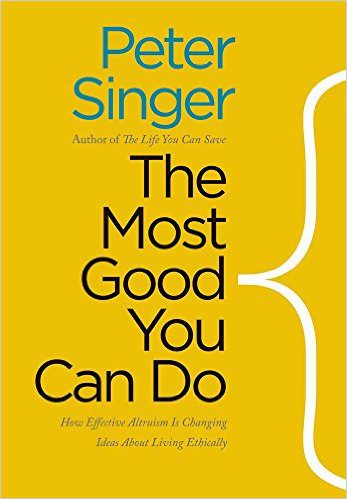 modern animal rights movement. And while he continues to advocate around those concerns, his last two books have been accessible and compelling explorations of what an evidence-based approach tells us about how we might best alleviate suffering for the poorest humans on our planet. Those two books are: The Life You Can Save: How to Do Your Part to End World Poverty and The Most Good You Can Do: How Effective Altruism Is Changing Ideas About Living Ethically.
Globally, of the more than seven billion people currently living on Earth, there are more than one billion living in what could be called extreme poverty, which means they are living on less than $1.53 dollars per day. That figure is adjusted such that, “the currency in the country in which the person lives buys the same amount of food and other essentials that one can buy for $1.53 in the United States in 2014” (111-112). This level of absolute poverty means that you and your family will go without the basic minimum needs for human health. In contrast, as harsh and terrible as poverty remains in our county, it is a “relative poverty” compared to the absolute poverty of the developing world. To a much greater extent, “impoverished Americans have access to safe drinking water, free schooling for their children, free health care through Medicaid, and in many cases, subsidized housing” (112).
So, with his characteristic Spock-like logic, Singer challenges many of our typical approaches to helping others. You may have other criteria, but for Singer, reducing the most amount of suffering and doing the most good you can do are centrally important for living ethically. Accordingly, one of the reasons I value Singer’s perspective is that he is unafraid to take on sacred cows. As the saying goes, “Sacred cows make gourmet burgers!”
For example, who wants to hate on the “Make-A-Wish” foundation? Peter Singer does! Or at least he is willing to put them in a larger context. Singer points out that through the “Make-A-Wish” foundation, “the average cost of making a child’s wish come true is $7,500,” whereas for that same amount of money, the “Against Malaria Foundation” could “save the lives of at least three children and maybe many more” (6).
For Singer, “Saving a child’s life has to be better than fulfilling a child’s wish to be Batkid. If Miles Scott’s parents had been offered that choice — Batkid for a day or a complete cure for their son’s leukemia — they surely would have chosen the cure. When more than one’s child’s life can be saved, the choice is even clearer” (6). The appeal of the “Make-A-Wish” Foundation is undeniable, but Singer challenges us to take a step back and reflect on the most good we can do—as well as that we should begin by making sure every human being has the basic essentials of clean water, healthy food, safe shelter, access to education, and health care. After those basic needs are met for all, then we can legitimately address higher levels of developmental needs such as the those the “Make-A-Wish” foundation helps address.
To share a second example, who wants to hate on guide dogs? Peter Singer does, or at least he is willing to if needed to challenge us to a higher ethical goal. Singer points out that the cost of providing a guide dog to one blind person is approximately $40,000. For that same amount of money, one can prevent “between four hundred and two thousand case of blindness in developing countries” that would otherwise come from trachoma, a contagious bacterial infection of the eye (110). Singer is not theoretically opposed to either granting wishes for dying children or providing guide dogs to people living with blindness; however, he does challenge us to consider the priorities toward which our funds are directed.
If you are curious about Singer’s personal ethics, for many years Peter Singer and his wife have been incrementally increasing the portion of their annual income that they give to charities proven to be the most effective. They used to give ten percent away; they now give approximately one-third of their annual income, and their goal is eventually to give 50% away (13). Fascinatingly, one of Singer’s students is already giving away half of his income. This student, named Matt, calculated that the best way to give away a lot of money through evidence-based charities was to earn a lot of money. So after graduating from Princeton with a philosophy major, Matt went, not to graduate school in philosophy (even though he was accepted into one of the top programs), but instead, to work on Wall Street, which is allowing him to donate an impressive six-figure sum annually. The more he earns, he figures, the more he has to give to the most effective charities (3-4). That’s just one example of many potential paths toward achieving “the most good we can do.”
Related to this trend of effective altruism, there is an increasing uptick in organ donation from living, “unrelated, anonymous donors”:
Donating a kidney is a relatively safe procedure and the benefits for the recipient are very large. In 2014 the waiting list for kidneys in the United States reached the dismal milestone of one hundred thousand, and it continues to grow. The waiting list for a deceased donor can be five years, and in some states is closer to ten years. (68)
The U.S. Organ Procurement and Transplantation Network started tracking the numbers of organ donations from living “unrelated, anonymous donors” in 1988, and for the first ten years, there was only one total. “In 1998, there were 3, in 1999, 6, and in 2000, 21. The trend continued predominantly upward, passing 100 in 2008. In 2013, the last year for which information is available, there were 174 such donations…” (71). In a world of much sadness and despair, there are reasons for hope as ever greater numbers of people feel solidarity not merely with those in their closest tribe;increasingly, they feel a connection expanding in ever-widening concentric circles toward empathy for all beings who are aware, sentient, and experience suffering.
There’s a lot more to say, and if you are interested in learning more, there are two websites that are excellent starting points:
- thelifeyoucansave.org, which is an interactive application of the insights of Peter Singer’s ethical perspective.
- givewell.org, which recommends the world’s best underfunded charities that can provided solid evidence of their effectiveness in alleviating poverty.
To be clear, my point has not been to say that we should all adopt Peter Singer’s ethics, but rather that wrestling with his perspective is one way of becoming clearer about our own ethical convictions.
As you turn your attention to your inner wisdom, what is your reason, your experience, your conscience telling you?
The Rev. Dr. Carl Gregg is a trained spiritual director, a D.Min. graduate of San Francisco Theological Seminary, and the minister of the Unitarian Universalist Congregation of Frederick, Maryland. Follow him on Facebook (facebook.com/carlgregg) and Twitter (@carlgregg).
Learn more about Unitarian Universalism:
http://www.uua.org/beliefs/principles
Next Post

November 25, 2015 Lodro Rinzler’s Millennial Hipster Buddhism
Browse Our Archives
Select a Category Advent Anti-Racism Archaeology Atheism Baptism Best of the Year List Book Reviews Buddhism Catholicism Christian Education Church and State Church Planting Climate Change Conscientious Objection to War Creation Spirituality Death Penalty Didache Disability Rights Discernment Easter Ecology Emergent Church Movement Empire-Critical Ethics Evolution Feminist Theology Film Reviews Gandhi Gospel of Mark Gun Control Hinduism Immigration Reform Interfaith Islam JFK Judaism Jungian Spirituality Lectionary Commentary Lent Letters to the Editor LGBT Marriage MLK Multiculturalism Mysticism Nonviolent Activism Occupy Paganism (Earth-centered Religions) Parables Paul Pluralism Politics Process Theology Quantum Physics Requiescat In Pace Seminary and Divinity School Sermon Series Retrospective Sermons Spiritual Direction Spiritual Practices Stewardship (Fundraising) The Book of J The Wheel of the Year (Paganism) Theoblogger Challenge Triathlon Uncategorized Unitarian Universalism Worship Resources Youth Ministry
Select a Month July 2026 May 2026 March 2026 November 2025 October 2025 August 2025 February 2025 December 2024 October 2024 March 2024 January 2024 December 2023 November 2023 March 2023 February 2023 January 2023 December 2022 November 2022 August 2022 March 2022 February 2022 January 2022 December 2021 September 2021 August 2021 July 2021 June 2021 May 2021 February 2021 January 2021 December 2020 August 2020 June 2020 May 2020 April 2020 March 2020 February 2020 January 2020 December 2019 November 2019 October 2019 September 2019 July 2019 June 2019 March 2019 February 2019 January 2019 December 2018 November 2018 October 2018 September 2018 June 2018 May 2018 April 2018 March 2018 February 2018 January 2018 December 2017 November 2017 October 2017 September 2017 August 2017 July 2017 June 2017 May 2017 April 2017 March 2017 February 2017 January 2017 December 2016 November 2016 October 2016 September 2016 August 2016 June 2016 May 2016 April 2016 March 2016 February 2016 January 2016 December 2015 November 2015 October 2015 September 2015 August 2015 July 2015 June 2015 May 2015 April 2015 March 2015 February 2015 January 2015 December 2014 November 2014 October 2014 August 2014 July 2014 June 2014 May 2014 April 2014 March 2014 February 2014 January 2014 December 2013 November 2013 October 2013 September 2013 August 2013 July 2013 June 2013 May 2013 April 2013 March 2013 February 2013 January 2013 December 2012 November 2012 October 2012 September 2012 August 2012 July 2012 June 2012 May 2012 April 2012 March 2012 February 2012 January 2012 December 2011 November 2011 October 2011 September 2011 August 2011 July 2011 June 2011 May 2011 April 2011 March 2011 February 2011 January 2011 December 2010 November 2010 October 2010 August 2009 July 2009 May 2009
Follow Us!
TAKE THE
Religious Wisdom Quiz
Who said, "I am the voice of one calling in the wilderness"?
Select your answer to see how you score.
Andrew Elijah John the Baptist Isaiah
Related posts from Carl Gregg

Vampires, Witches, & NPR: The Legacy of Margot...

“Do You Really Want to Know?” From Pope...
“Unsanctifying Human Life”: Wrestling with Peter Singer’s Ethics
TRENDING AT PATHEOS More Voices

Reading America at 250: A Nation Wrestles With...
As part of my own reflection on the 250th anniversary of the...

Whenever I am reading a book or listening to an argument, I...

President Trump Ban Animal Torture Videos on Facebook
Call for Stricter Regulations of Animal Abuse Content on Facebook Although President...

Draft Amendments to Address Ritual Abuse in New...
The proposed changes would make it illegal for individuals in domestic partnerships...

How Bans on LGBTQ+ Student Clubs Threaten Religious...
On June 20, 2025, the State of Texas passed Senate Bill 12....

The Truth About the Gen Z Revival
This past year, there has been a lot of media buzz surrounding...
view all More Voices blogs
Ad-Free & Subscriber Log-In Subscription Support
- About Us
- 2026 Calendar
- Videos
- Podcasts
- Library of World Religions
- Faith In Media Tracker
- Advertise With Us
- Write for Us
- Privacy Policy
- Terms of Service
- Do Not Sell My Data
- Contact Us
- Radiant Digital
- Manage Newsletter Subscriptions
- Unsubscribe From Notifications
- Sitemap
Copyright 2008-2026, Patheos. All rights reserved.
Subscription Support Ad-Free & Subscriber Log-In
Follow Patheos