
BuddhistCatholicContemplativeEvangelicalGeneral ChristianHinduJewishLatter-day SaintMuslimNew VisionsProgressive Christian
Beliefs
- Buddhist
- Catholic
- Contemplative
- Evangelical
- General Christian
- Hindu
- Jewish
- Latter-day Saint
- More Voices
- Muslim
- New Visions
- Pagan
- Progressive Christian
Topics
- Religion News
- Food and Religion
- Sports and Religion
- Religious Art
- Religious Music and Entertainment
- Religious Events
- History and Religion
- Style and Religion
- Politics and Religion
- Women in Religion
- Recreation Outdoors and Religion
- Business Finance and Religion
- Careers Workplace and Religion
- Education and Religion
- Family Parenting and Religion
- Health Fitness and Religion
- Home and Religion
- Relationships and Religion
- Technology and Religion
- Travel and Religion
Columnists
- Buddhist Columnists
- Business Finance and Religion Columnists
- Careers Workplace and Religion Columnists
- Catholic Columnists
- Contemplative Columnists
- Education and Religion Columnists
- Evangelists Columnists
- Family Parenting and Religion Columnists
- General Christian Columnists
- Health Fitness and Religion Columnists
- Hindu Columnists
- History and Religion Columnists
- Home and Religion Columnists
- Jewish Columnists
- More Voices Columnists
- Latter Day Columnists
- Muslim Columnists
- New Visions Columnists
- Nonreligious Columnists
- Pagan Columnists
- Politics and Religion Columnists
- Progressive Columnists
- Recreation Outdoors and Religion Columnists
- Relationships and Religion Columnists
- Religion News Columnists
- Religious Art Columnists
- Religious Events Columnists
- Religious Music and Entertainment Columnists
- Sports and Religion Columnists
- Style and Religion Columnists
- Technology and Religion Columnists
- Travel and Religion Columnists
- Women in Religion Columnists
Resource Library
- 2026 Calendar
- Library of World Religions
- The 100 Most Holy Places on Earth
- Patheos Answers
- Podcasts
- Videos
- Faith Leaders Database
- Anglican Episcopalian
- Bahai
- Baptist
- Buddhism
- Christianity
- Confucianism
- Eastern Orthodoxy
- Hinduism
- Holiness and Pentecostal
- ISKCON
- Islam
- Judaism
- Lutheran
- Methodist
- The Church of Jesus Christ of Latter-day Saints
- New Age
- Paganism
- Presbytarian and Reformed
- Protestantism
- Religion Behind the Scenes
- Roman Catholic
- Scientology
- Shia Islam
- Sikhism
- Sufism
- Sunni Islam
- Taoism
- Zen
- See all religions
Research Tools
 Ad-Free & Subscriber Log-In Subscription Support
Ad-Free & Subscriber Log-In Subscription Support
Follow Patheos 

- Trending:
- Forgiveness
- |
- Marriage
- |
- Consciousness
- |
- Death Penalty
- |
- Election
- |
- Halloween

- Home
- More Voices
- Lodro Rinzler’s Millennial Hipster Buddhism
Lodro Rinzler’s Millennial Hipster Buddhism
Last updated on: November 25, 2015 at 10:00 am by Carl Gregg
Lodro Rinzler’s Millennial Hipster Buddhism 2015-11-24T15:06:03-05:00 Carl Gregg
Patheos Explore the world's faith through different perspectives on religion and spirituality! Patheos has the views of the prevalent religions and spiritualities of the world.
I first learned about Lodro Rinzler through his Huffington Post online Buddhist advice column that at one time was called “What Would Sid Do?” ‘Sid’ is Rinzler’s nickname for Siddhartha Gautama, the name of the historical Buddha. Some classic “What Would Sid Do?” posts include:
- “Buddhism and Dating: Would Sid Join Match.com?”
- “Buddhism and Alcohol: Is There Such a Thing as ‘Right Drinking’?”
- “Buddhism and Activism: How Would Sid Produce Social Change?”,
- “Buddhist Breakup Advice,” and
- “The Four Gates of Speech: Is It Really a Good Idea to Call the Ex?”
Rinzler (1982 – ), at thirty-three years-old, is an example of the increasing number of Buddhist teachers from the Millennial generation (born in the early 1980s through the early 2000s). Other fascinating Millennial Buddhist teachers include Vincent and Emily Horn, who are part of the team behind Buddhist Geeks, which explores the “convergence of Buddhism with rapidly evolving technology and an increasingly global culture.”
I don’t want to overemphasize Generational Theory, but we do have different concerns at different times in our lives, and the culture in which we are raised does shape us. And before I proceed to focus on how insights from Lodro Rinzler might help us integrate Buddhist practices into our lives in the world of 2015, I would like to briefly reflect on the range of Buddhist teachers in the world today — with the caveat that the following is not even close to a comprehensive list.
Some of our most well-known and respected Buddhist teachers for us in the West are from the Silent Generation (born from 1925 – 1942). Thich Nhat Hanh (1926 – ) is among the oldest at almost age 90. The Dalai Lama (1935 – ), Pema Chödrön (1936 – ), and Sylvia Boorstein (1936 – ) are all around 80.
And there is a sense in which they have a different style and presence than the more “hippie”-influenced cohort of Baby Boomer Buddhist teachers, born following World War II (1946 – 1964), who are now almost all in their 60s: Jack Kornfield (1945 – ), Lama Surya Das (1950 – ), Sharon Salzberg (1952 – ), Tara Brach (1953 – ), and Stephen Batchelor (1953 – ).
For quite some time, we have also seen Gen Xers (born from the early 1960s through the early 1980s) coming onto the Buddhist teaching scene, such as Adyashanti (1962 – ), Noah Levine (1971 – ), who works at the intersection of Buddhism and the punk movement, and Ethan Nichtern, who heads up the Interdependence Project in New York City.
I have traced this generational sketch of Buddhist teachers to invite you to consider which Buddhist teachers you have read most. Are they all of one or two generations? I invite you to consider how your understanding of Buddhism might broaden through dipping into some of the leading voices of other Buddhist generations, as well as the perennial challenge of exploring some of the early and historic Buddhist texts throughout the past 2,500 years since the life of the historical Buddha.
But for now, to turn our attention to the Millennial, hipster Buddhism of Lodro Rinzler, he is quite prolific, 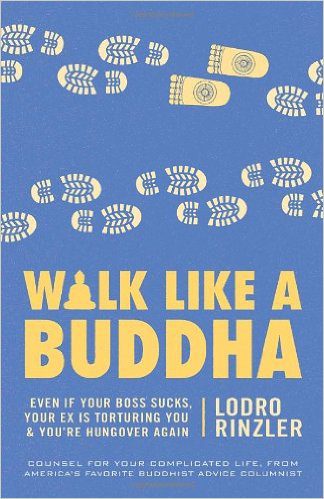 managing to publish at the impressive rate of slightly more than one book per year since 2012:
- The Buddha Walks Into a Bar: A Guide to Life for a New Generation (2012)
- Walk Like a Buddha: Even If Your Boss Sucks, Your Ex Is Torturing You & You’re Hungover Again (2013)
- The Buddha Walks into the Office: A Guide to Livelihood for a New Generation (2014a)
- Sit Like a Buddha: A Pocket Guide to Meditation (2014b)
- How to Love Yourself (and Sometimes Other People): Spiritual Advice for Modern Relationships (2015), co-written with Meggan Watterson
Rinzler seeks to write from his own experience about the real-life concerns facing Buddhist practitioners here in the early twenty-first century.
Almost all of the most-famous Baby Boomer Buddhist teachers were adult converts to Buddhism, traveled to the East to learn from the great masters, then came back home to integrate Eastern wisdom with Western lifestyles. In contrast, Rinzler—and quite a few others of the latest generations of Buddhist teachers—are not adult converts to Buddhism. They were instead raised by Western Buddhist parents. Rinzler was born into a Western-style Buddhism that previous generations had to struggle to make possible.
Rinzler is also an interesting case study of one example of what can happen through introducing Buddhism into parenting. His first experience with meditating was at age six, but he writes that he didn’t really take meditation seriously until he was a teenager. When he was a junior in high school, his parents said, “You know what would make for a great college essay? Spending your summer at this monastery.” They handed him a brochure for Gampo Abbey, a Shambhala monastery in rural Nova Scotia, where Pema Chödrön is the resident teacher. So during the summer before his senior year in high school, Rinzler shaved his head, donned traditional robes, took temporary monastic vows, and entered a silent month-long retreat.
The good news, he writes, is that his parents were right: the experience “did make for a great essay”—he got into Wesleyan. The bad news, depending on your perspective, “is that they had created a monster.” Successfully convincing your seventeen-year-old to spend a month meditating seems like a solid parenting win, and it was in many respects. But Rinzler says that:
“it shaped my experience such that all I wanted to do in my four years at college was meditate, study the dharma, and meditate some more. [He] started a meditation group at Wesleyan University, which then became Buddhist House, a communal living and meditation space on campus. [His] first job out of college was running a meditation center in Boston. It’s only progressed from there” (2013:4).
In the experience of Rinzler and others who have dived deeply into Buddhist practices, the first stage a meditator moves through is often along the lines of “Where did all these thoughts come from?” After a while, one progresses to the second stage of, “This thing actually helps me a little,” which, Rinzler jokes, can evolve into “Meditation is like crack” in which some practitioners want to commit deeply to meditation because they are experiencing how powerfully transformative it can be (2012:9). A regular meditation routine cannot solve all your problems, but meditation has been proven to transform “your mind and heart, making them more expansive and more able to accommodate the obstacles you face on a daily basis. The more expansive your mind and heart, the more you are able to engage your world without life feeling like a battle” (2012:5).
One of the most frequent misconceptions I hear from beginning meditators is that they experience a constant onslaught of distracting thoughts. Rest assured: that’s normal. It is no more realistic to think that anyone could achieve twenty minutes of uninterrupted concentration on one’s breath the first few times you sit on a meditation cushion any more than thinking you could deadlift two hundred pounds the first time you walk into a gym—or run a marathon the first time you lace up running shoes. It takes time to build up one’s capacity for mindfulness and heartfulness (2012:9).
Over time, meditation practice creates increasing spaciousness around the thoughts and emotions that arise within us. According to Pema Chödrön, the invitation then becomes, “Don’t Bite the Hook.” Just because an impulse toward anger, resentment, or revenge arises doesn’t mean we have to bite the hook and let it drag us through the mud. Meditation is one skillful means of increasing our ability to be intentional about our responses to positive and negative stimuli (2012:12). Or to use Rinzler’s analogy, biting the hook is like when some incident would trigger the comic book character Bruce Banner, transforming him through rage into the Incredible Hulk: HULK SMASH! HULK ANGRY (2012:33)! What a revelation to be able to develop the capacity to not bite the hook!
A related misconception is that Buddhist Enlightenment is other-worldly and esoteric. A better translation is “Awakening.” Someone who has become a Buddha (an “Awakened One”) still has all the normal human experiences, but one’s relationship to the stimuli around oneself is different. Anger, resentment, and jealousy will still arise, but they are met, not with habitual reactivity, but with spaciousness, compassion, and intention (2012:44).
Lodro Rinzler’s evident interest in applying Buddhism to all aspects of life emerged out of his college experience of being a practicing Buddhist who was also going to parties, navigating the dating scene, and living as an adult in New York City. What you see in his books is that he does not claim to have The One Universal Right Answer of how to apply Buddhist teachings to the realities of work, sex, and family life in the twenty-first century (2014a:202). Instead, like Sid, the historical Buddha more than 2,500 years ago, he’s figuring it out as he goes along in the crucible of his own firsthand experience.
There’s a lot more to say, but for now, I’ll give you three examples of Rinzler’s suggestions for “What Would Sid Do?”— and you can discern or experiment with whether they hold up to your own experience. The first is a way of setting an intention for your day. Often it is helpful to pick something simple and straightforward such as “I aspire to be a bit kinder than yesterday,” or “My intention is to be a bit more patient.” You may want to write down your intention somewhere you will see it throughout the day. When you are ready for bed, pause to reflect on “how you did in manifesting your intention.” Importantly, take time to savor your successes. Even more importantly, wherever you fell short, be gentle with yourself: practice offering yourself the same loving-kindness or patience that you are seeking to offer more of to others (2014a:10-11).
The second is a Buddhist approach to one’s “ex,” which could be an ex that you used to date, were partnered with, or married to:
place a picture of your ex somewhere you will see it often…. Whenever you see the face…you can think to yourself, ‘I wish for your deepest well-being.’ If that phrase doesn’t ring true to you…make one up for yourself. It could be ‘I wish that you find happiness’ or ‘I wish that you will not suffer so much’” (2014a:104).
It’s important to pay attention to what feels right to you at this time in your life related to the goal you are seeking to move toward.
The third practice is called “Six Words of Advice” because the original Tibetan text is only six words long:
Don’t recall.
Don’t imagine
Don’t think.
Don’t examine.
Don’t control.
Rest.
There are times when recalling, imagining, thinking, examining, and controlling are all good, positive, and desirable ways of being in the world. But the “Six Words of Advice” practice reminds us that there are also times when we need to let go of concerns about the past and future and open ourselves compassionately to whatever is arising and passing away in each moment.
A more expansive translation is:
Let go of what has passed.
Let go of what may come.
Let go of what is happening now.
Don’t try to figure anything out.
Don’t try to make anything happen.
Relax, right now, and rest. (2014a:184)
One promise of Buddhism is increasing inner freedom. The first five of the six words encourage us to let go of various aspects of our existence that can bind us, constrict us, or which we can find ourselves grasping out of habit. After we practice letting go, the sixth and final word gives us something to do: nothing. “Simply relax, right now, and rest.” Thich Nhat Hanh calls this becoming a “business-less person” with “nothing to do and nowhere to go.”
I invite you to experiment with saying the six words for yourself:
Let go of what has passed.
Let go of what may come.
Let go of what is happening now.
Don’t try to figure anything out.
Don’t try to make anything happen.
Relax, right now, and rest.
Try repeating these words a few times silently. Then allow yourself to rest in the present moment.
The Rev. Dr. Carl Gregg is a trained spiritual director, a D.Min. graduate of San Francisco Theological Seminary, and the minister of the Unitarian Universalist Congregation of Frederick, Maryland. Follow him on Facebook (facebook.com/carlgregg) and Twitter (@carlgregg).
Learn more about Unitarian Universalism:
http://www.uua.org/beliefs/principles
Next Post

December 10, 2015 Are You a Faitheist?
Browse Our Archives
Select a Category Advent Anti-Racism Archaeology Atheism Baptism Best of the Year List Book Reviews Buddhism Catholicism Christian Education Church and State Church Planting Climate Change Conscientious Objection to War Creation Spirituality Death Penalty Didache Disability Rights Discernment Easter Ecology Emergent Church Movement Empire-Critical Ethics Evolution Feminist Theology Film Reviews Gandhi Gospel of Mark Gun Control Hinduism Immigration Reform Interfaith Islam JFK Judaism Jungian Spirituality Lectionary Commentary Lent Letters to the Editor LGBT Marriage MLK Multiculturalism Mysticism Nonviolent Activism Occupy Paganism (Earth-centered Religions) Parables Paul Pluralism Politics Process Theology Quantum Physics Requiescat In Pace Seminary and Divinity School Sermon Series Retrospective Sermons Spiritual Direction Spiritual Practices Stewardship (Fundraising) The Book of J The Wheel of the Year (Paganism) Theoblogger Challenge Triathlon Uncategorized Unitarian Universalism Worship Resources Youth Ministry
Select a Month July 2026 May 2026 March 2026 November 2025 October 2025 August 2025 February 2025 December 2024 October 2024 March 2024 January 2024 December 2023 November 2023 March 2023 February 2023 January 2023 December 2022 November 2022 August 2022 March 2022 February 2022 January 2022 December 2021 September 2021 August 2021 July 2021 June 2021 May 2021 February 2021 January 2021 December 2020 August 2020 June 2020 May 2020 April 2020 March 2020 February 2020 January 2020 December 2019 November 2019 October 2019 September 2019 July 2019 June 2019 March 2019 February 2019 January 2019 December 2018 November 2018 October 2018 September 2018 June 2018 May 2018 April 2018 March 2018 February 2018 January 2018 December 2017 November 2017 October 2017 September 2017 August 2017 July 2017 June 2017 May 2017 April 2017 March 2017 February 2017 January 2017 December 2016 November 2016 October 2016 September 2016 August 2016 June 2016 May 2016 April 2016 March 2016 February 2016 January 2016 December 2015 November 2015 October 2015 September 2015 August 2015 July 2015 June 2015 May 2015 April 2015 March 2015 February 2015 January 2015 December 2014 November 2014 October 2014 August 2014 July 2014 June 2014 May 2014 April 2014 March 2014 February 2014 January 2014 December 2013 November 2013 October 2013 September 2013 August 2013 July 2013 June 2013 May 2013 April 2013 March 2013 February 2013 January 2013 December 2012 November 2012 October 2012 September 2012 August 2012 July 2012 June 2012 May 2012 April 2012 March 2012 February 2012 January 2012 December 2011 November 2011 October 2011 September 2011 August 2011 July 2011 June 2011 May 2011 April 2011 March 2011 February 2011 January 2011 December 2010 November 2010 October 2010 August 2009 July 2009 May 2009
Follow Us!
TAKE THE
Religious Wisdom Quiz
True or False: The parable of the Prodigal Son appears only in Luke's Gospel.
Select your answer to see how you score.
FALSE TRUE
Related posts from Carl Gregg
Beyond “McMindfulness”: How Not To Get Stuck in...
What Happens When You Immerse Yourself in the...
What Is “The Fourth Turning of Buddhism”?
Becoming a Buddha, not a Buddhist
TRENDING AT PATHEOS More Voices

Reading America at 250: A Nation Wrestles With...
As part of my own reflection on the 250th anniversary of the...

Whenever I am reading a book or listening to an argument, I...

President Trump Ban Animal Torture Videos on Facebook
Call for Stricter Regulations of Animal Abuse Content on Facebook Although President...

Draft Amendments to Address Ritual Abuse in New...
The proposed changes would make it illegal for individuals in domestic partnerships...

How Bans on LGBTQ+ Student Clubs Threaten Religious...
On June 20, 2025, the State of Texas passed Senate Bill 12....

The Truth About the Gen Z Revival
This past year, there has been a lot of media buzz surrounding...
view all More Voices blogs
Ad-Free & Subscriber Log-In Subscription Support
- About Us
- 2026 Calendar
- Videos
- Podcasts
- Library of World Religions
- Faith In Media Tracker
- Advertise With Us
- Write for Us
- Privacy Policy
- Terms of Service
- Do Not Sell My Data
- Contact Us
- Radiant Digital
- Manage Newsletter Subscriptions
- Unsubscribe From Notifications
- Sitemap
Copyright 2008-2026, Patheos. All rights reserved.
Subscription Support Ad-Free & Subscriber Log-In
Follow Patheos