
BuddhistCatholicContemplativeEvangelicalGeneral ChristianHinduJewishLatter-day SaintMuslimNew VisionsProgressive Christian
Beliefs
- Buddhist
- Catholic
- Contemplative
- Evangelical
- General Christian
- Hindu
- Jewish
- Latter-day Saint
- More Voices
- Muslim
- New Visions
- Pagan
- Progressive Christian
Topics
- Religion News
- Food and Religion
- Sports and Religion
- Religious Art
- Religious Music and Entertainment
- Religious Events
- History and Religion
- Style and Religion
- Politics and Religion
- Women in Religion
- Recreation Outdoors and Religion
- Business Finance and Religion
- Careers Workplace and Religion
- Education and Religion
- Family Parenting and Religion
- Health Fitness and Religion
- Home and Religion
- Relationships and Religion
- Technology and Religion
- Travel and Religion
Columnists
- Buddhist Columnists
- Business Finance and Religion Columnists
- Careers Workplace and Religion Columnists
- Catholic Columnists
- Contemplative Columnists
- Education and Religion Columnists
- Evangelists Columnists
- Family Parenting and Religion Columnists
- General Christian Columnists
- Health Fitness and Religion Columnists
- Hindu Columnists
- History and Religion Columnists
- Home and Religion Columnists
- Jewish Columnists
- More Voices Columnists
- Latter Day Columnists
- Muslim Columnists
- New Visions Columnists
- Nonreligious Columnists
- Pagan Columnists
- Politics and Religion Columnists
- Progressive Columnists
- Recreation Outdoors and Religion Columnists
- Relationships and Religion Columnists
- Religion News Columnists
- Religious Art Columnists
- Religious Events Columnists
- Religious Music and Entertainment Columnists
- Sports and Religion Columnists
- Style and Religion Columnists
- Technology and Religion Columnists
- Travel and Religion Columnists
- Women in Religion Columnists
Resource Library
- 2026 Calendar
- Library of World Religions
- The 100 Most Holy Places on Earth
- Patheos Answers
- Podcasts
- Videos
- Faith Leaders Database
- Anglican Episcopalian
- Bahai
- Baptist
- Buddhism
- Christianity
- Confucianism
- Eastern Orthodoxy
- Hinduism
- Holiness and Pentecostal
- ISKCON
- Islam
- Judaism
- Lutheran
- Methodist
- The Church of Jesus Christ of Latter-day Saints
- New Age
- Paganism
- Presbytarian and Reformed
- Protestantism
- Religion Behind the Scenes
- Roman Catholic
- Scientology
- Shia Islam
- Sikhism
- Sufism
- Sunni Islam
- Taoism
- Zen
- See all religions
Research Tools
 Ad-Free & Subscriber Log-In Subscription Support
Ad-Free & Subscriber Log-In Subscription Support
Follow Patheos 

- Trending:
- Forgiveness
- |
- Marriage
- |
- Consciousness
- |
- Death Penalty
- |
- Election
- |
- Halloween

- Home
- More Voices
- Vampires, Witches, & NPR: The Legacy of Margot Adler
Vampires, Witches, & NPR: The Legacy of Margot Adler
Last updated on: October 30, 2015 at 10:00 am by Carl Gregg
Vampires, Witches, & NPR: The Legacy of Margot Adler 2015-10-29T23:42:19-04:00 Carl Gregg
Patheos Explore the world's faith through different perspectives on religion and spirituality! Patheos has the views of the prevalent religions and spiritualities of the world.
I first heard Margot Adler’s voice on the radio — along with Lourdes Garcia-Navarro, Lakshmi Singh, Sylvia Poggioli, Ofeibea Quist-Arcton, Kai Ryssdal, and so many others. I learned their names through repetition as they signed off at the end of new stories on “Morning Edition” or “All Things Considered”: Margot Adler, NPR News, New York. There were many opportunities to hear Adler, who was an NPR reporter for more than three decades prior to her death from cancer in 2014 at the far too young an age of 68.
When I first began learning more about the Sixth Source of Unitarian Universalism (“Spiritual teachings of earth-centered traditions which celebrate the sacred circle of life and instruct us to live in harmony with the rhythms of nature”), two books — both published on the same day, Halloween 1979 — were recommended to me as starting points:
- The Spiral Dance: A Rebirth of the Ancient Religion of the Goddess by Starhawk
- Drawing Down the Moon: Witches, Druids, Goddess-Worshippers, and Other Pagans in America by Margot Adler.
It took me a while to make the connection, but then I realized: Wait! Margot Adler on NPR is the same Margot Adler that wrote one of the definitive guides to the modern pagan movement in the U.S.?! As it turns out, yes. Adler was also a Unitarian Universalist, a member of Unitarian Church of All Souls in New York City, and an active board member for many years of the national board of the Covenant of UU Pagans (CUUPS).
Margot Adler’s father was a therapist. He was also the only son of the famous psychotherapist Alfred 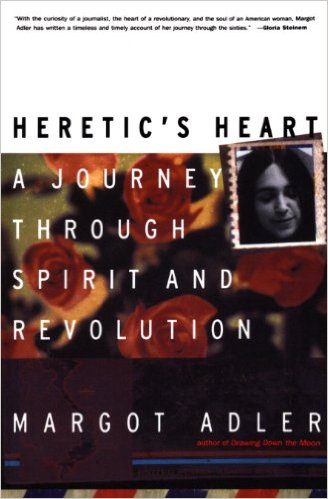 Adler (1870 – 1937), the founder of the school of thought known as “individual psychology” and a close collaborator with both Sigmund Freud and Carl Jung — before the various schisms that later divided them. “Alfred Adler is remembered for the terms ‘inferiority complex,’ ‘lifestyle,’ ‘compensate,’ and ‘overcompensate.’ He discovered the importance of birth order, and emphasized the importance of power issues…over sexual ones.” Margot was the famous Dr. Adler’s only grandchild. And in her autobiography, Heretic’s Heart, Margot writes regarding this heritage that, “I was both proud of it and wary.” And choosing not to follow in her father’s and grandfather’s footsteps, she finished college without taking a single psychology course (38)!
Growing up in a secular Jewish home, when she asked about her family’s religion, she was told, “We believe in the brotherhood of man” (42). And in a classic case of the “grass always looks greener on the other side,” she writes that from her childhood perspective, “the Brotherhood of Man seemed pretty sterile, despite its high ethics, and I grew up believing that my Catholic friends had a better deal” (43). Many of her friends probably thought the same thing about her family. Interestingly, for high school Margot attended the performing arts school that was the inspiration for the film Fame. And in seeking to incorporate an artistic, feminist, ecological perspective into what she calls her “semi-Marxist,” “Brotherhood of Man” childhood, she writes:
In our either/or obsessive world, people go from one totalistic belief to another…. Skepticism and mystery are sworn enemies. You are either a socialist or a capitalist…. You are either a skeptic or a believer….it’s all or nothing. Either you think LSD will save the world, or you think everyone who takes it will lose [their] mind….
The word of the Old Left had great truths, but…it could not bridge these divisions. It was too afraid of the irrational and its pull, and it did not really understand the human need for the voice and mystery of ecstatic experience; it did not realize that one can enter the flow of the mysterious, the non-ordinary reality known to all artists, poets, and indigenous peoples without losing one’s intellectual integrity; that one can dance round a bonfire until dawn and still make one’s living as a scientist or a computer programmer; that one can work to end poverty and exploitation but still embrace song and dance and dream. Like shamans of old, we can attempt to maintain our balance as we [move] in different worlds. (298)
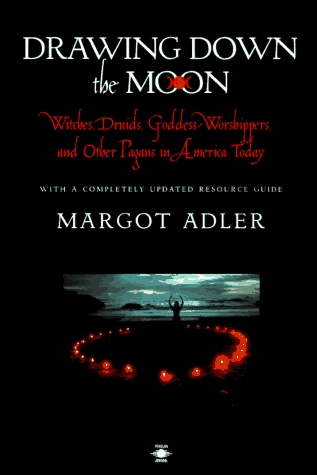 Margot’s interest in exploring the mysterious, ecstatic, and non-ordinary — while maintaining her day job at NPR — led to the extensive travels and interviews that were compiled into her 646-page brick-of-a-book, Drawing Down the Moon: Witches, Druids, Goddess-Worshippers, and Other Pagans in America.
I mentioned earlier that this book was originally published on Halloween in 1979. A completely revised and updated third edition was released in 2006. To reflect on some of the changes in the religious landscape over the last three-and-a-half decades, the best estimates are that in the early 1980s, “modern Pagans, Heathens, Druids, and Wiccans in the United States numbered less than [100,000] people. Today many estimates are four to seven times that number, with more than a million worldwide” (ix). The rapid growth of that movement within Unitarian Universalist circles led to the addition of our Sixth Source of “Earth-centered spirituality” twenty years ago in 1995. And in the congregation I serve as minister, we recently had a surprising 336 people attend our first Pagan Pride Day — more than three times the crowd we expected.
From a much broader historical perspective, one of the most important points to remember is that the negative connotations that some people have with the words “pagan” and “heathen” are of relatively recent origin. Even for centuries after the life of the historical Jesus, the Latin word paganus simply meant “peasant.” Likewise, the word heathen originally meant someone from the “heath” — someone who lived in the country, not the city. And as Christianity (which was primarily an urban phenomenon) rose in prominence in the Roman Empire, those “pagans” and “heathens” who remained in the country and retained their pre-Christian, ancestral, polytheistic, nature-based religions came to be seen as infidels, idolators, and heretics — but those terms were not how they saw themselves; they were merely the negative labels given to them by Christians.
A related confusion is the conflation of Neo- paganismwith Satanism. That view is yet another result of seeing the world from a theologically-conservative Christian perspective. Neo-pagans seek to retrieve pre-Christian traditions — reinterpreting the mythology, gods, and goddesses (those archetypes of the divine masculine and the divine feminine) from the ancient Greeks, Romans, Egyptians, and Sumerians. In contrast, Satanism is grounded within the Christian tradition in which Satan is revered as a “symbolic figure of rebellion” against the Christian God (477).
As a result of such confusions, when Adler was first doing interviews after the release of Drawing Down the Moon, she found herself frequently facing questions based on ignorant stereotypes: “‘Why do you have black hair?’ (I was born that way) and ‘Is that scar on your leg from a ritual?’ (No, I cut myself shaving)” (460). Looking back at that time period, she says that, in the media, there seemed to be only five basic stories:
- the perverted individual who was killing animals and calling themselves a Witch;
- a custody battle between a couple, usually one of them a Witch and the other a Christian;
- a Wiccan gathering that was picketed by fundamentalists;
- a bill that would take away tax-exempt status from Wiccan religious groups;
- a trial of someone for murder who was supposedly a Witch (461).
But in the ensuring three decades, books such as Margot’s have helped increase awareness of how most Neo-Pagan speak for and about themselves:
[They] sense an aliveness and “presence” in nature…. They share the goal of living in harmony with nature and they tend to view humanity’s “advancement” and separation from nature as the prime source of alienation. They see ritual as a tool to end that alienation…. They gravitate to ancient symbols and ancient myths, to the old polytheistic religions.… They are reclaiming these sources, transforming them…. They do not regard pleasure as sinful, nor do they conceive of this world as a burden. While many of their members lead quite ordinary, and often successful, lives in the “real world,” they are able to detach themselves from many of the trends of the day, maintaining a sense of humor, a gentle anarchism, and a remarkable tolerance for diversity…. This religious movement…is only partly an “occult” phenomenon [dealing without “that which is hidden or beyond the range of ordinary apprehension and understanding”]. Often it is interwoven with the visionary and artistic tradition, the ecology movement, the feminist movement, and the libertarian tradition (4-5, 466)
Many ritual within the Pagan tradition are attuned to the eight points on the Wheel of the Year: the two equinoxes (fall and spring), the two solstices (winter and summer), and the four cross-quarter days, exactly in between those first four major points. And the next major point on the Wheel of the Year is Samhain, also known as Halloween or All Hallow’s Eve.
And appropriate for this current point on the Wheel of the Year, there is a final part of the legacy of Margot Adler that I would like to share. In May of 2009, Adler was on the way to a conference and looking for a light “airplane read.” She ended up buying the first novel in the Twilight Saga, and read that book on the way there and the sequel on the flight home. She had never previously been particularly interested in vampires, and may well have never read another vampire book, except that ten days later her husband of thirty-five years was diagnosed with terminal cancer.
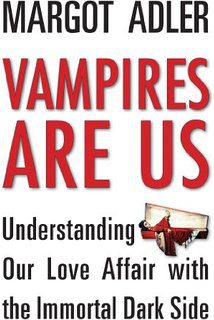 Similar to the reason why “Anne Rice began her huge saga, the Vampire Chronicles, because she was dealing with the death of her young daughter,” as Adler’s beloved husband lay dying of cancer, she found herself drawn to reading about vampires because she was “thinking about mortality” (5). She kept a list and in total read more than 270 vampire novels during this time (ix). She eventually published her reflections in her third and final book Vampires Are Us: Understanding Our Love Affair with the Immortal Dark Side — in which she reflects on why she, and our wider culture more broadly, have been drawn at various points to the vampire archetypes.
One of the keys to Adler’s understanding of the vampire archetype is an insight from a scholar that, “Every age embraces the vampire it needs” (35). For example, Bram Stoker’s Dracula was published in 1897 England, a time when that country had “some of the largest ports in the world.” And Stoker’s novel reflects the fears at the time about immigration through the lens of Dracula, “an Eastern European monster, dark, mysterious, and alien” (35-36). Similarly, “in the 1980s, just as the AIDS epidemic was spreading, there were a slew of vampire novels that saw vampirism as an infection, a disease” (36). Today in series such as Buffy: The Vampire Slayer, the Twilight Saga, True Blood, The Vampire Diaries, and many more, we see much less emphasis on vampires as monstrous, remorseless killing machines, and more much emphasis on “good guy vampires” who are “guilt ridden and conflicted” about their nature. Why are these stories so popular at precisely this cultural moment? Adler writes:
Vampires are exactly us right now, as we continue to wage wars, consume energy, and find ourselves…sucking the lifeblood out of the planet…. We live compromised lives…. You could argue that we are as addicted to oil and fossil fuels as any vampire is addicted to blood…. And the issue…is how we can learn to use our formidable powers without destroying the planet for future generations. (36-37)
Parallel to the ways that those ancient pagan gods and goddesses can serve as archetypes to help us become more aware of previously unconscious parts of our selves, so too there is an invitation to become more conscious of the metaphorical and archetypal motivations underneath why various aspects of our world are particularly attractive or repulsive to us individually and collectively at any given time. There’s a lot more to be said about the ways our cultural stories reflect deep truths about the human condition — such as the ways that all werewolf tales can be seen as archetypal stories about puberty and adolescence — and I’ve written about this dynamic before in “The Hunger Games, the Zombie Apocalypse, and the Meaning of Myths, Old and New.”
But for now, as I move toward my conclusion, I have been reflecting in particular on the legacy of Margot Adler, an ancestor in the Pagan and the Unitarian Universalist traditions. And in this season of Samhain, as All Hallow’s Eve approaches, I invite you to spend some time reflecting on your ancestors: both your intellectual and spiritual ancestors, who inspire you on your journey through this life — as well as the biological ancestors who gave you life.
Take some time to listen to the song linked below. As you listen, open your mind and heart to your ancestors. Is there perhaps one beloved ancestor in particular whose name, whose face rises in your heart today and whose memory you may want to honor? Open your heart and mind to the legacy of those who came before you for how they might inspire our living today:
youtube.com/watch?v=o3e-zLKyZLw
The Rev. Dr. Carl Gregg is a trained spiritual director, a D.Min. graduate of San Francisco Theological Seminary, and the minister of the Unitarian Universalist Congregation of Frederick, Maryland. Follow him on Facebook (facebook.com/carlgregg) and Twitter (@carlgregg).
Learn more about Unitarian Universalism:
http://www.uua.org/beliefs/principles
Paganism (Earth-centered Religions)
Previous Post

October 12, 2015
Why "Columbus Day" Should Be "Indigenous People's Day"
Next Post
November 5, 2015 "How the Founding Fathers Became Infallible and Our Politics Inflexible"
Browse Our Archives
Select a Category Advent Anti-Racism Archaeology Atheism Baptism Best of the Year List Book Reviews Buddhism Catholicism Christian Education Church and State Church Planting Climate Change Conscientious Objection to War Creation Spirituality Death Penalty Didache Disability Rights Discernment Easter Ecology Emergent Church Movement Empire-Critical Ethics Evolution Feminist Theology Film Reviews Gandhi Gospel of Mark Gun Control Hinduism Immigration Reform Interfaith Islam JFK Judaism Jungian Spirituality Lectionary Commentary Lent Letters to the Editor LGBT Marriage MLK Multiculturalism Mysticism Nonviolent Activism Occupy Paganism (Earth-centered Religions) Parables Paul Pluralism Politics Process Theology Quantum Physics Requiescat In Pace Seminary and Divinity School Sermon Series Retrospective Sermons Spiritual Direction Spiritual Practices Stewardship (Fundraising) The Book of J The Wheel of the Year (Paganism) Theoblogger Challenge Triathlon Uncategorized Unitarian Universalism Worship Resources Youth Ministry
Select a Month July 2026 May 2026 March 2026 November 2025 October 2025 August 2025 February 2025 December 2024 October 2024 March 2024 January 2024 December 2023 November 2023 March 2023 February 2023 January 2023 December 2022 November 2022 August 2022 March 2022 February 2022 January 2022 December 2021 September 2021 August 2021 July 2021 June 2021 May 2021 February 2021 January 2021 December 2020 August 2020 June 2020 May 2020 April 2020 March 2020 February 2020 January 2020 December 2019 November 2019 October 2019 September 2019 July 2019 June 2019 March 2019 February 2019 January 2019 December 2018 November 2018 October 2018 September 2018 June 2018 May 2018 April 2018 March 2018 February 2018 January 2018 December 2017 November 2017 October 2017 September 2017 August 2017 July 2017 June 2017 May 2017 April 2017 March 2017 February 2017 January 2017 December 2016 November 2016 October 2016 September 2016 August 2016 June 2016 May 2016 April 2016 March 2016 February 2016 January 2016 December 2015 November 2015 October 2015 September 2015 August 2015 July 2015 June 2015 May 2015 April 2015 March 2015 February 2015 January 2015 December 2014 November 2014 October 2014 August 2014 July 2014 June 2014 May 2014 April 2014 March 2014 February 2014 January 2014 December 2013 November 2013 October 2013 September 2013 August 2013 July 2013 June 2013 May 2013 April 2013 March 2013 February 2013 January 2013 December 2012 November 2012 October 2012 September 2012 August 2012 July 2012 June 2012 May 2012 April 2012 March 2012 February 2012 January 2012 December 2011 November 2011 October 2011 September 2011 August 2011 July 2011 June 2011 May 2011 April 2011 March 2011 February 2011 January 2011 December 2010 November 2010 October 2010 August 2009 July 2009 May 2009
Follow Us!
TAKE THE
Religious Wisdom Quiz
What weapon did David use to defeat Goliath?
Select your answer to see how you score.
A spear A sword A bow and arrow A sling and a stone
Related posts from Carl Gregg

Peak Spiritual Experiences, Psychedelics, & Consciousness Research

”Did God Have a Wife?”: Asherah, Heavenly Mother,...
Why Peter Singer Hates on Guide Dogs &...

"How the Founding Fathers Became Infallible and Our...
TRENDING AT PATHEOS More Voices

Reading America at 250: A Nation Wrestles With...
As part of my own reflection on the 250th anniversary of the...

Whenever I am reading a book or listening to an argument, I...

President Trump Ban Animal Torture Videos on Facebook
Call for Stricter Regulations of Animal Abuse Content on Facebook Although President...

Draft Amendments to Address Ritual Abuse in New...
The proposed changes would make it illegal for individuals in domestic partnerships...

How Bans on LGBTQ+ Student Clubs Threaten Religious...
On June 20, 2025, the State of Texas passed Senate Bill 12....

The Truth About the Gen Z Revival
This past year, there has been a lot of media buzz surrounding...
view all More Voices blogs
Ad-Free & Subscriber Log-In Subscription Support
- About Us
- 2026 Calendar
- Videos
- Podcasts
- Library of World Religions
- Faith In Media Tracker
- Advertise With Us
- Write for Us
- Privacy Policy
- Terms of Service
- Do Not Sell My Data
- Contact Us
- Radiant Digital
- Manage Newsletter Subscriptions
- Unsubscribe From Notifications
- Sitemap
Copyright 2008-2026, Patheos. All rights reserved.
Subscription Support Ad-Free & Subscriber Log-In
Follow Patheos