
BuddhistCatholicContemplativeEvangelicalGeneral ChristianHinduJewishLatter-day SaintMuslimNew VisionsProgressive Christian
Beliefs
- Buddhist
- Catholic
- Contemplative
- Evangelical
- General Christian
- Hindu
- Jewish
- Latter-day Saint
- More Voices
- Muslim
- New Visions
- Pagan
- Progressive Christian
Topics
- Religion News
- Food and Religion
- Sports and Religion
- Religious Art
- Religious Music and Entertainment
- Religious Events
- History and Religion
- Style and Religion
- Politics and Religion
- Women in Religion
- Recreation Outdoors and Religion
- Business Finance and Religion
- Careers Workplace and Religion
- Education and Religion
- Family Parenting and Religion
- Health Fitness and Religion
- Home and Religion
- Relationships and Religion
- Technology and Religion
- Travel and Religion
Columnists
- Buddhist Columnists
- Business Finance and Religion Columnists
- Careers Workplace and Religion Columnists
- Catholic Columnists
- Contemplative Columnists
- Education and Religion Columnists
- Evangelists Columnists
- Family Parenting and Religion Columnists
- General Christian Columnists
- Health Fitness and Religion Columnists
- Hindu Columnists
- History and Religion Columnists
- Home and Religion Columnists
- Jewish Columnists
- More Voices Columnists
- Latter Day Columnists
- Muslim Columnists
- New Visions Columnists
- Nonreligious Columnists
- Pagan Columnists
- Politics and Religion Columnists
- Progressive Columnists
- Recreation Outdoors and Religion Columnists
- Relationships and Religion Columnists
- Religion News Columnists
- Religious Art Columnists
- Religious Events Columnists
- Religious Music and Entertainment Columnists
- Sports and Religion Columnists
- Style and Religion Columnists
- Technology and Religion Columnists
- Travel and Religion Columnists
- Women in Religion Columnists
Resource Library
- 2026 Calendar
- Library of World Religions
- The 100 Most Holy Places on Earth
- Patheos Answers
- Podcasts
- Videos
- Faith Leaders Database
- Anglican Episcopalian
- Bahai
- Baptist
- Buddhism
- Christianity
- Confucianism
- Eastern Orthodoxy
- Hinduism
- Holiness and Pentecostal
- ISKCON
- Islam
- Judaism
- Lutheran
- Methodist
- The Church of Jesus Christ of Latter-day Saints
- New Age
- Paganism
- Presbytarian and Reformed
- Protestantism
- Religion Behind the Scenes
- Roman Catholic
- Scientology
- Shia Islam
- Sikhism
- Sufism
- Sunni Islam
- Taoism
- Zen
- See all religions
Research Tools
 Ad-Free & Subscriber Log-In Subscription Support
Ad-Free & Subscriber Log-In Subscription Support
Follow Patheos 

- Trending:
- Forgiveness
- |
- Marriage
- |
- Consciousness
- |
- Death Penalty
- |
- Election
- |
- Halloween

- Home
- More Voices
- “Unsanctifying Human Life”: Wrestling with Peter Singer’s Ethics
“Unsanctifying Human Life”: Wrestling with Peter Singer’s Ethics
Last updated on: September 18, 2015 at 1:16 pm by Carl Gregg
“Unsanctifying Human Life”: Wrestling with Peter Singer’s Ethics 2015-09-18T13:16:50-04:00 Carl Gregg
Patheos Explore the world's faith through different perspectives on religion and spirituality! Patheos has the views of the prevalent religions and spiritualities of the world.
Our human population has septupled (increased sevenfold) in a mere two centuries — from approximately 1 billion in 1800 to more than 7 billion today. The resulting environmental impact of our species is jeopardizing the entire planet’s climate. We have not, however, always been aware of our potential to have a cataclysmic effect on Earth. As Elizabeth Kolbert wrote about in her Pulitzer Prize winning book The Sixth Extinction, prior to fossil discoveries in the 1700s, we humans didn’t know that any species had ever become extinct, but since then we have come to learn that
there “have been five great mass extinctions during the history of life on this planet”…. The first took place…some 450 million years ago, when living things were still mainly confined to the water. The most devastating took place at the end of the Permian period, some 250 million years ago, and it came perilously close to emptying the earth out altogether…. The most recent — and famous — mass extinction came at the close of the Cretaceous period; it wiped out, in addition to the dinosaurs, the plesiosaurs, the mosasaurs, the ammonites, and the pterosaurs. (6)
Kolbert continues that, “In pushing other species to extinction, humanity is busy sawing off the limb on which it perches,” increasing the likelihood of a potential sixth mass extinction on this planet. There is relatedly an increasing use of the term “Anthropocene” (similar to the word anthropology for the study of humans) to describe a new era of geologic time in which the dominant force shaping the face of the Earth is humanity.
Here in the early twenty-first century, it is important to be honest about what it means to be heirs to the paradigm-shifting discoveries of Copernicus, Darwin, Einstein, Hubble, and so many others. I invite you to consider that minimally, this broadened perspective means at least two things. First, it means that we humans are much less singularly significant than it was once reasonable to maintain. Our species has been wrestling for almost 500 years with the growing awareness that that we are not the center of the universe but rather inhabitants of one far-flung planet, on the edge of one galaxy, that is merely one of more than 100 billion other galaxies in the universe. Second, it means that other beings on this planet are more much significant than was once reasonable to grant — both intrinsically significant to themselves and extrinsically significant to us — since our survival depends on the continued flourishing of the diverse, interdependent ecosystems that comprise this planet’s biosphere.
The person who has most helped me in thinking through how we might make such a shift in worldview with the maximum amount of integrity and compassion is Peter Singer (1946 -), a professor of bioethics at Princeton University, who “is almost certainly the best-known and most widely read of all contemporary philosophers. He may also…be one of the most influential ones…. His 1975 book Animal Liberation, translated into thirteen languages, has sold more than half a million copies” (Kuhse 2). That being said, Singer himself admits that:
“When I wrote [Animal Liberation], I really thought the book would change the world. I know it sounds a little grand now, but at the time the sixties still existed for us. It looked as if real changes were possible, and I let myself believe that this would be one of them. All you have to do is walk around the corner to McDonald’s to see how successful I have been. (11)
However, Singer’s lament about factory farming and the fast food industry is from 1999. And I just saw this past week that McDonald’s is beginning a decade-long plan to use only cage-free eggs — in the wake of its other recent announcement that it is moving away from chicken treated with antibiotics. And while McDonald’s is a long way from getting the Michael Pollan food-justice seal of approval, when such food giants make a shift in the right direction, there are significant ripple effects across the whole industry.
To give you an overview of how Singer thinks we might become less human-centric and more compassionate toward all beings who can experience suffering, the following are four of his central convictions:
- Pain is bad, and similar amounts of pain are equally bad, no matter whose pain it might be. By “pain” here I would include suffering and distress of all kinds. This does not meant that pain is the only thing that is bad, or that inflicting pain is always wrong. Sometimes it may be necessary to inflict pain and suffering on oneself or others…because it will lead to less suffering in the long run….
- Humans are not the only beings capable of feeling pain or of suffering…. Of course, the nature of the beings will affect how much pain they suffer in any given situation.
- When we consider how serious it is to take a life, we should look, not at the…species to which that being belongs, but at the characteristics of the individual being killed, for example, its own desire about continuing to live, or the kind of life it is capable of living.
- We are responsible not only for what we do but also for what we could have prevented. We may never kill a stranger, but we know that our intervention will save the lives of many strangers in a distant country, and yet do nothing…. Consider, for example, the fact that the sum that buys us a meal in a fine restaurant would be enough to provide basic health care to several children who might otherwise die of easily preventable diseases. (Writings on an Ethical Life, xv – xvi)
Some critics say that Singer, as well as other supporters of any form of, for example, legalized euthanasia, risk the slippery slope down to Nazi science, an accusation that fails to account for Singer being well aware of his own family’s history as the child of Jewish parents who fled their native Austria in the late 1930s (Kuhse 5, 9). There is also the perennial question of whether or not Singer is able to follow the implications of his logic. He did not, for example, “kill his mother, who had advanced Alzheimer’s disease and whose care was consuming money that could, those critics said, more profitably be spent elsewhere” (11). But Singer has never said he is a perfectly rational actor; rather, his challenge, both to himself and others, is to continually live into a more ethical way of life. For instance, he has for many years given away more than 20% of his income to organizations that have been proven to do the most good for the world’s poor — an approach he calls “Effective Altruism.”
My title for this post, borrowed from an anthology of Singer’s essays, is “Unsanctifying Human Life.” What I take him to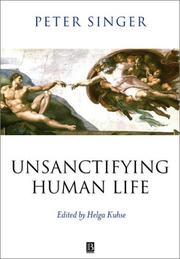 mean is that it is no longer reasonable to maintain the ancient religious worldview that all human life is sacred and inviolable from womb to tomb without exception. Instead, for more than 150 years our species has been wrestling with Darwin’s discovery that we humans are not “a little lower than the angels,” but rather a “little higher that the apes,” and deeply interconnected with the other life forms and larger ecosystems of this planet. Put even more provocatively, it might be increasingly helpful not to think of all humans as “Children of God,” but instead to think of ourselves as part of the Animal Kingdom.
Relatedly, within my own tradition of Unitarian Universalism, there is a small, but growing movement inviting us to ask if our Seven Principles — which thirty years ago were revised to become less male-centric — need now, especially in light of global climate change, to become less human-centric. In particular, the First Principle Project proposes that our support for the “the inherent worth and dignity of every person” be expanded to recognize “the inherent worth and dignity of every being.” We are human beings — and I hear this proposal as a challenge to expand our circle of care, compassion, and concern to other beings on this planet who also experience forms of sentience and subjectivity. As important as our First Principle is — grounded in the opening lines of the U.N.’s Universal Declaration of Human Rights — there is a growing sense that we need to balance individual human rights with the common good of all beings on this one far-flung but beautiful and precious planet.
For now, I will conclude with the closing part of a Buddhist metta (“loving-kindness”) meditation that seeks to open our heart and expand our compassion — starting with compassion for ourselves, then extending to other human beings, and finally including all beings who have the capacity to experience suffering:
May all beings be filled with loving-kindness
May all beings be well.
May all beings be peaceful and at ease.
May all beings awaken to their true nature.
May all beings be free.
The Rev. Dr. Carl Gregg is a trained spiritual director, a D.Min. graduate of San Francisco Theological Seminary, and the minister of the Unitarian Universalist Congregation of Frederick, Maryland. Follow him on Facebook (facebook.com/carlgregg) and Twitter (@carlgregg).
Learn more about Unitarian Universalism:
http://www.uua.org/beliefs/principles
Previous Post

September 10, 2015
“Coming Out of the Broom Closet” #PaganPride
Browse Our Archives
Select a Category Advent Anti-Racism Archaeology Atheism Baptism Best of the Year List Book Reviews Buddhism Catholicism Christian Education Church and State Church Planting Climate Change Conscientious Objection to War Creation Spirituality Death Penalty Didache Disability Rights Discernment Easter Ecology Emergent Church Movement Empire-Critical Ethics Evolution Feminist Theology Film Reviews Gandhi Gospel of Mark Gun Control Hinduism Immigration Reform Interfaith Islam JFK Judaism Jungian Spirituality Lectionary Commentary Lent Letters to the Editor LGBT Marriage MLK Multiculturalism Mysticism Nonviolent Activism Occupy Paganism (Earth-centered Religions) Parables Paul Pluralism Politics Process Theology Quantum Physics Requiescat In Pace Seminary and Divinity School Sermon Series Retrospective Sermons Spiritual Direction Spiritual Practices Stewardship (Fundraising) The Book of J The Wheel of the Year (Paganism) Theoblogger Challenge Triathlon Uncategorized Unitarian Universalism Worship Resources Youth Ministry
Select a Month July 2026 May 2026 March 2026 November 2025 October 2025 August 2025 February 2025 December 2024 October 2024 March 2024 January 2024 December 2023 November 2023 March 2023 February 2023 January 2023 December 2022 November 2022 August 2022 March 2022 February 2022 January 2022 December 2021 September 2021 August 2021 July 2021 June 2021 May 2021 February 2021 January 2021 December 2020 August 2020 June 2020 May 2020 April 2020 March 2020 February 2020 January 2020 December 2019 November 2019 October 2019 September 2019 July 2019 June 2019 March 2019 February 2019 January 2019 December 2018 November 2018 October 2018 September 2018 June 2018 May 2018 April 2018 March 2018 February 2018 January 2018 December 2017 November 2017 October 2017 September 2017 August 2017 July 2017 June 2017 May 2017 April 2017 March 2017 February 2017 January 2017 December 2016 November 2016 October 2016 September 2016 August 2016 June 2016 May 2016 April 2016 March 2016 February 2016 January 2016 December 2015 November 2015 October 2015 September 2015 August 2015 July 2015 June 2015 May 2015 April 2015 March 2015 February 2015 January 2015 December 2014 November 2014 October 2014 August 2014 July 2014 June 2014 May 2014 April 2014 March 2014 February 2014 January 2014 December 2013 November 2013 October 2013 September 2013 August 2013 July 2013 June 2013 May 2013 April 2013 March 2013 February 2013 January 2013 December 2012 November 2012 October 2012 September 2012 August 2012 July 2012 June 2012 May 2012 April 2012 March 2012 February 2012 January 2012 December 2011 November 2011 October 2011 September 2011 August 2011 July 2011 June 2011 May 2011 April 2011 March 2011 February 2011 January 2011 December 2010 November 2010 October 2010 August 2009 July 2009 May 2009
Follow Us!
TAKE THE
Religious Wisdom Quiz
Who did God call to lead the Israelites out of Egypt?
Select your answer to see how you score.
Aaron David Moses Joseph
Related posts from Carl Gregg

Peak Spiritual Experiences, Psychedelics, & Consciousness Research

Why Peter Singer Hates on Guide Dogs &...

"How the Founding Fathers Became Infallible and Our...

Vampires, Witches, & NPR: The Legacy of Margot...
TRENDING AT PATHEOS More Voices

Reading America at 250: A Nation Wrestles With...
As part of my own reflection on the 250th anniversary of the...

Whenever I am reading a book or listening to an argument, I...

President Trump Ban Animal Torture Videos on Facebook
Call for Stricter Regulations of Animal Abuse Content on Facebook Although President...

Draft Amendments to Address Ritual Abuse in New...
The proposed changes would make it illegal for individuals in domestic partnerships...

How Bans on LGBTQ+ Student Clubs Threaten Religious...
On June 20, 2025, the State of Texas passed Senate Bill 12....

The Truth About the Gen Z Revival
This past year, there has been a lot of media buzz surrounding...
view all More Voices blogs
Ad-Free & Subscriber Log-In Subscription Support
- About Us
- 2026 Calendar
- Videos
- Podcasts
- Library of World Religions
- Faith In Media Tracker
- Advertise With Us
- Write for Us
- Privacy Policy
- Terms of Service
- Do Not Sell My Data
- Contact Us
- Radiant Digital
- Manage Newsletter Subscriptions
- Unsubscribe From Notifications
- Sitemap
Copyright 2008-2026, Patheos. All rights reserved.
Subscription Support Ad-Free & Subscriber Log-In
Follow Patheos