
BuddhistCatholicContemplativeEvangelicalGeneral ChristianHinduJewishLatter-day SaintMuslimNew VisionsProgressive Christian
Beliefs
- Buddhist
- Catholic
- Contemplative
- Evangelical
- General Christian
- Hindu
- Jewish
- Latter-day Saint
- More Voices
- Muslim
- New Visions
- Pagan
- Progressive Christian
Topics
- Religion News
- Food and Religion
- Sports and Religion
- Religious Art
- Religious Music and Entertainment
- Religious Events
- History and Religion
- Style and Religion
- Politics and Religion
- Women in Religion
- Recreation Outdoors and Religion
- Business Finance and Religion
- Careers Workplace and Religion
- Education and Religion
- Family Parenting and Religion
- Health Fitness and Religion
- Home and Religion
- Relationships and Religion
- Technology and Religion
- Travel and Religion
Columnists
- Buddhist Columnists
- Business Finance and Religion Columnists
- Careers Workplace and Religion Columnists
- Catholic Columnists
- Contemplative Columnists
- Education and Religion Columnists
- Evangelists Columnists
- Family Parenting and Religion Columnists
- General Christian Columnists
- Health Fitness and Religion Columnists
- Hindu Columnists
- History and Religion Columnists
- Home and Religion Columnists
- Jewish Columnists
- More Voices Columnists
- Latter Day Columnists
- Muslim Columnists
- New Visions Columnists
- Nonreligious Columnists
- Pagan Columnists
- Politics and Religion Columnists
- Progressive Columnists
- Recreation Outdoors and Religion Columnists
- Relationships and Religion Columnists
- Religion News Columnists
- Religious Art Columnists
- Religious Events Columnists
- Religious Music and Entertainment Columnists
- Sports and Religion Columnists
- Style and Religion Columnists
- Technology and Religion Columnists
- Travel and Religion Columnists
- Women in Religion Columnists
Resource Library
- 2026 Calendar
- Library of World Religions
- The 100 Most Holy Places on Earth
- Patheos Answers
- Podcasts
- Videos
- Faith Leaders Database
- Anglican Episcopalian
- Bahai
- Baptist
- Buddhism
- Christianity
- Confucianism
- Eastern Orthodoxy
- Hinduism
- Holiness and Pentecostal
- ISKCON
- Islam
- Judaism
- Lutheran
- Methodist
- The Church of Jesus Christ of Latter-day Saints
- New Age
- Paganism
- Presbytarian and Reformed
- Protestantism
- Religion Behind the Scenes
- Roman Catholic
- Scientology
- Shia Islam
- Sikhism
- Sufism
- Sunni Islam
- Taoism
- Zen
- See all religions
Research Tools
 Ad-Free & Subscriber Log-In Subscription Support
Ad-Free & Subscriber Log-In Subscription Support
Follow Patheos 

- Trending:
- Forgiveness
- |
- Marriage
- |
- Consciousness
- |
- Death Penalty
- |
- Election
- |
- Halloween

- Home
- More Voices
- What Happens When You Immerse Yourself in the Sound of Silence?
What Happens When You Immerse Yourself in the Sound of Silence?
Last updated on: August 25, 2015 at 3:23 pm by Carl Gregg
What Happens When You Immerse Yourself in the Sound of Silence? 2015-08-25T15:23:35-04:00 Carl Gregg
Patheos Explore the world's faith through different perspectives on religion and spirituality! Patheos has the views of the prevalent religions and spiritualities of the world.
In 1950, the activist Audre Lorde wrote a poem titled “Memorial I,” which includes these lines:
If you come as softly
as the wind within the trees
you may hear what I hear
see what sorrow sees.
If you come as lightly
as threading dew
I will take you gladly
nor ask more of you.
You may sit beside me
silent as a breath….
Between the lines of that poem, I hear a caution that when someone is suffering, if you do not come softly/lightly/silently, then an opportunity to offer comfort will often be missed. Lorde’s poem also reminds me of the Jewish practice of sitting Shiva for seven days when an immediate relative dies: a parent, sibling, spouse, or child. The practice of sitting Shiva creates time and space to be present to grief, and that seven-day window is an invitation for friends and family members to offer a ministry of compassionate presence.
My training in counseling and spiritual direction similarly cautions against presuming to say, “I know how you feel,” and instead to recognize that, “Each individual is the expert of their own pain, suffering, and experience.” Realizing that you can’t be an expert on anyone else’s interior life, frees you to practice what the Buddhists call “Beginner’s Mind” in which you try to let go of feeling like you need to know the right thing to say or do, and give yourself permission to simply be present: softly, lightly, silently.
But sitting in caring, compassionate silence beside a longtime friend or loved one is not the only kind of silence. The poet Billy Collins, in his poem “Silence,” says it this way:
There is the sudden silence of the crowd
above a player not moving on the field,
and the silence of the orchid.
The silence of the falling vase
before it strikes the floor,
the silence of the belt when it is not striking the child.
Or in the words of the contemplative teacher Martin Laird:
Not all silence is the same. There is the awkward silence of the road trip with someone we do not know quite well enough to be silent next to, the refrigerating silence of hardened anger, the reverential silence of dogwoods in winter, the vast silence of a cathedral, the focused silence of absorption in our sewing or a good book, the stunned silence of seeing the status of our pension fund. Each features physical silence, the absence of sound waves, but this silence is merely the outer form of other dynamics. (46)
In young adulthood, when I first began exploring the diversity of the world’s religions, I had my first extended immersions into silence among Zen Buddhists, who invited me to enter the zendo, choose a cushion facing a blank wall, and “just sit” for forty-five minutes. As the saying goes, “Don’t just do something, sit there!” My next forays into silence were among the Quakers, who invited me into an hour of silence in which speaking was only to emerge if the Spirit moves you. As the practice was taught to me, “Let the next words from your mouth emerge from your best self, else remain silent.” As I continued to experiment with five-minute, twenty-minute, forty-five minute or ninety-minute meditation periods, I began to feel a shift inside myself. It felt like those times in silence were dropping an anchor into the earth such that when the storms of life inevitably arose, I found myself more grounded than I had felt in similar circumstances before I had begun experimenting with interior journeys into silence.
In my mid-twenties, I began to explore the contemplative side of the Christian tradition, including some five-day silent retreats in monasteries. For five days, I would have no access to television, cell phone, radio, computer, or any of the other technological distractions that pervade our modern life. I also did not know anyone else at these monasteries.
At first, I wondered how I was going to pass the time without being bored out of my mind. Full disclosure, part of the point of silence and solitude is precisely to bore you out of your “Monkey Mind.” And, indeed, I found the actual experience of my brief stint into monastic life to be both scary and liberating. I took long walks on the surrounding land and got plenty of sleep. I had time to read leisurely and to eat slowly. Most importantly, in the silence, I found myself in a time of recollection. Five un-busy days in a row presented me with a more-or-less forced opportunity to reassess my life: to ponder my past, present, and future without any technology or other person to distract me.
To give you a glimpse into the rhythms of monastic life, the monks at the Abbey of Gethsemane in Kentucky 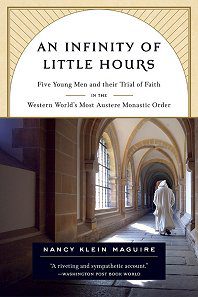 rise at 3:15 a.m. for their first service of the day. And while getting up at 3:00 a.m. sounds terrible at first, it is manageable if you get in the habit of going to bed by 8:00 p.m. with no electronic devices to keep you awake. One advantage of getting up so early is that many monks have essentially six hours of time (3 a.m. – 9 a.m.) for reading, studying, and meditating before their work duties begin midmorning. That’s an expansive amount of free time for self-care and spiritual growth — every day for a lifetime — that most of us cannot come close to matching. And it is one of many reasons that there are insights monastics of all traditions have to teach us who live in the world. If you are interested in learning more about the monastic life, one of my favorite starting points to recommend is a book called An Infinity of Little House: Five Young Men and their Trial of Faith in the Western World’s Most Austere Monastic Order. It tells the story of five novices seeking to be part of the Carthusian Order. It’s as if they set the TV show Survivor in a monastery — Which one will survive? Who will get voted off the island!
Few of us, however, feel called to spend our lives almost exclusively in silence and solitude. But new scientific studies are coming out all the time, heralding the benefits of spending more time in silence than most of us currently do in our frenetic, overstimulated, 24-7 world, although I’m heartened whenever I see stories of schools teaching yoga and mindfulness to young children as we also do in the religious education classes in the congregation I serve as minister.
To take just one example of the benefits of contemplative practices: Some studies of pain management “have reported a [reduction of pain] after as little as four 20-minute meditation sessions. Some mindfulness intervention studies claim to use mindfulness induction techniques, which could be as short as one moment of paying attention to present sensory experience, non-judgmentally and non-reactively.” Those words non-judgmentally and non-reactively are key.
To share another insight from Laird, “The opposite of the contemplative life is not the active life but the reactive life” (42). In other words, the choice is not between either spending all your life in cloistered silence or spending all your life frenetically in the world. Rather, spending time in silence amidst your life in the world can greatly increase your capacity to be non-judgmental and non-reactive to whatever stressful situations come your way.
We hear a lot about mindfulness, but equally important is cultivating heartfulness in one’s meditation practice: opening yourself compassionately to whatever arises as you enter into silence. Regarding what may arise within us when we slow down, the Sufi poet Rumi says in his poem “The Guest House”:
This being human is a guest house.
Every morning a new arrival….
Welcome and entertain them all!
Even if they’re a crowd of sorrows,
who violently sweep your house
empty of its furniture,
still treat each guest honorably.
He may be clearing you out
for some new delight….
Rumi is encouraging us neither to repress whatever arises within us, nor to fixate on it. The invitation of entering into silence is to stop trying to ignore our inner life and instead offer hospitality, compassionate, and welcome to whatever emerges within you — then practice letting it go.
Along these lines, I once heard a practitioner lament to the contemplative teacher Thomas Keating that, “During the last twenty-minute meditation period I must’ve gotten distracted at least a thousand times.” Keating invited him to reframe his distress and see the past twenty-minutes as a time when he had one thousand opportunities to practice letting go of what Buddhists call the “Monkey Mind.” Just as a beginning piano student or athlete is clumsy at first, you get better with practice. So too with contemplative practices: over time your powers of concentration and insight will strengthen.
Accordingly, I would like to invite you to spend at least a few moments right now experimenting firsthand with what happens when you immerse yourself in the sound of silence. Among the many wonderful contemplative practices in the world’s religions from which you can choose, I would like to introduction you to experience a Buddhist practice that is less familiar to many of us called nada yoga:
Nada is the Sanskrit word for “sound,” and nada yoga means meditating on the inner sound, also referred to as the sound of silence. (Interestingly, nada is also the Spanish word for “nothing.”) To detect the nada sound, [I invite you to] turn your attention toward your hearing. If you listen carefully to the sounds around you, you’re likely to hear a continuous, high-pitched inner sound like white noise in the background. It is a sound that is beginningless and endless.
Try listening for that sound now. I invite you for now to let go of any impulse “to theorize about this inner vibration in an effort to figure out exactly what it might be…. Bring your attention to the inner sound and allow it to fill the whole sphere of your awareness. In a small number of people, the inner sound is oppressively loud.” If that is the case for you, I invite you instead to focus on your breath.
I invite you to put both feet on the floor. Straighten your posture — relaxed but alert. Open your heart. And as distractions arise, practice letting go, gently and with compassion, of whatever is seeking to arise within you. Then return your attention gently to the nada sound.
What happens when you listen to the sound of sheer silence?
The Rev. Dr. Carl Gregg is a trained spiritual director, a D.Min. graduate of San Francisco Theological Seminary, and the minister of the Unitarian Universalist Congregation of Frederick, Maryland. Follow him on Facebook (facebook.com/carlgregg) and Twitter (@carlgregg).
Learn more about Unitarian Universalism:
http://www.uua.org/beliefs/principles
Previous Post

August 20, 2015
Equal Access: The Ongoing Struggle for Disability Rights
Next Post
August 26, 2015 What’s Next After “Spiritual But Not Religious”?
Browse Our Archives
Select a Category Advent Anti-Racism Archaeology Atheism Baptism Best of the Year List Book Reviews Buddhism Catholicism Christian Education Church and State Church Planting Climate Change Conscientious Objection to War Creation Spirituality Death Penalty Didache Disability Rights Discernment Easter Ecology Emergent Church Movement Empire-Critical Ethics Evolution Feminist Theology Film Reviews Gandhi Gospel of Mark Gun Control Hinduism Immigration Reform Interfaith Islam JFK Judaism Jungian Spirituality Lectionary Commentary Lent Letters to the Editor LGBT Marriage MLK Multiculturalism Mysticism Nonviolent Activism Occupy Paganism (Earth-centered Religions) Parables Paul Pluralism Politics Process Theology Quantum Physics Requiescat In Pace Seminary and Divinity School Sermon Series Retrospective Sermons Spiritual Direction Spiritual Practices Stewardship (Fundraising) The Book of J The Wheel of the Year (Paganism) Theoblogger Challenge Triathlon Uncategorized Unitarian Universalism Worship Resources Youth Ministry
Select a Month July 2026 May 2026 March 2026 November 2025 October 2025 August 2025 February 2025 December 2024 October 2024 March 2024 January 2024 December 2023 November 2023 March 2023 February 2023 January 2023 December 2022 November 2022 August 2022 March 2022 February 2022 January 2022 December 2021 September 2021 August 2021 July 2021 June 2021 May 2021 February 2021 January 2021 December 2020 August 2020 June 2020 May 2020 April 2020 March 2020 February 2020 January 2020 December 2019 November 2019 October 2019 September 2019 July 2019 June 2019 March 2019 February 2019 January 2019 December 2018 November 2018 October 2018 September 2018 June 2018 May 2018 April 2018 March 2018 February 2018 January 2018 December 2017 November 2017 October 2017 September 2017 August 2017 July 2017 June 2017 May 2017 April 2017 March 2017 February 2017 January 2017 December 2016 November 2016 October 2016 September 2016 August 2016 June 2016 May 2016 April 2016 March 2016 February 2016 January 2016 December 2015 November 2015 October 2015 September 2015 August 2015 July 2015 June 2015 May 2015 April 2015 March 2015 February 2015 January 2015 December 2014 November 2014 October 2014 August 2014 July 2014 June 2014 May 2014 April 2014 March 2014 February 2014 January 2014 December 2013 November 2013 October 2013 September 2013 August 2013 July 2013 June 2013 May 2013 April 2013 March 2013 February 2013 January 2013 December 2012 November 2012 October 2012 September 2012 August 2012 July 2012 June 2012 May 2012 April 2012 March 2012 February 2012 January 2012 December 2011 November 2011 October 2011 September 2011 August 2011 July 2011 June 2011 May 2011 April 2011 March 2011 February 2011 January 2011 December 2010 November 2010 October 2010 August 2009 July 2009 May 2009
Follow Us!
TAKE THE
Religious Wisdom Quiz
According to 2 Peter, what is the Lord not slow in keeping?
Select your answer to see how you score.
His promise His commandments His judgment His mercy
Related posts from Carl Gregg
Beyond “McMindfulness”: How Not To Get Stuck in...
Lodro Rinzler’s Millennial Hipster Buddhism
What Is “The Fourth Turning of Buddhism”?
Becoming a Buddha, not a Buddhist
TRENDING AT PATHEOS More Voices

Reading America at 250: A Nation Wrestles With...
As part of my own reflection on the 250th anniversary of the...

Whenever I am reading a book or listening to an argument, I...

President Trump Ban Animal Torture Videos on Facebook
Call for Stricter Regulations of Animal Abuse Content on Facebook Although President...

Draft Amendments to Address Ritual Abuse in New...
The proposed changes would make it illegal for individuals in domestic partnerships...

How Bans on LGBTQ+ Student Clubs Threaten Religious...
On June 20, 2025, the State of Texas passed Senate Bill 12....

The Truth About the Gen Z Revival
This past year, there has been a lot of media buzz surrounding...
view all More Voices blogs
Ad-Free & Subscriber Log-In Subscription Support
- About Us
- 2026 Calendar
- Videos
- Podcasts
- Library of World Religions
- Faith In Media Tracker
- Advertise With Us
- Write for Us
- Privacy Policy
- Terms of Service
- Do Not Sell My Data
- Contact Us
- Radiant Digital
- Manage Newsletter Subscriptions
- Unsubscribe From Notifications
- Sitemap
Copyright 2008-2026, Patheos. All rights reserved.
Subscription Support Ad-Free & Subscriber Log-In
Follow Patheos