
BuddhistCatholicContemplativeEvangelicalGeneral ChristianHinduJewishLatter-day SaintMuslimNew VisionsProgressive Christian
Beliefs
- Buddhist
- Catholic
- Contemplative
- Evangelical
- General Christian
- Hindu
- Jewish
- Latter-day Saint
- More Voices
- Muslim
- New Visions
- Pagan
- Progressive Christian
Topics
- Religion News
- Food and Religion
- Sports and Religion
- Religious Art
- Religious Music and Entertainment
- Religious Events
- History and Religion
- Style and Religion
- Politics and Religion
- Women in Religion
- Recreation Outdoors and Religion
- Business Finance and Religion
- Careers Workplace and Religion
- Education and Religion
- Family Parenting and Religion
- Health Fitness and Religion
- Home and Religion
- Relationships and Religion
- Technology and Religion
- Travel and Religion
Columnists
- Buddhist Columnists
- Business Finance and Religion Columnists
- Careers Workplace and Religion Columnists
- Catholic Columnists
- Contemplative Columnists
- Education and Religion Columnists
- Evangelists Columnists
- Family Parenting and Religion Columnists
- General Christian Columnists
- Health Fitness and Religion Columnists
- Hindu Columnists
- History and Religion Columnists
- Home and Religion Columnists
- Jewish Columnists
- More Voices Columnists
- Latter Day Columnists
- Muslim Columnists
- New Visions Columnists
- Nonreligious Columnists
- Pagan Columnists
- Politics and Religion Columnists
- Progressive Columnists
- Recreation Outdoors and Religion Columnists
- Relationships and Religion Columnists
- Religion News Columnists
- Religious Art Columnists
- Religious Events Columnists
- Religious Music and Entertainment Columnists
- Sports and Religion Columnists
- Style and Religion Columnists
- Technology and Religion Columnists
- Travel and Religion Columnists
- Women in Religion Columnists
Resource Library
- 2026 Calendar
- Library of World Religions
- The 100 Most Holy Places on Earth
- Patheos Answers
- Podcasts
- Videos
- Faith Leaders Database
- Anglican Episcopalian
- Bahai
- Baptist
- Buddhism
- Christianity
- Confucianism
- Eastern Orthodoxy
- Hinduism
- Holiness and Pentecostal
- ISKCON
- Islam
- Judaism
- Lutheran
- Methodist
- The Church of Jesus Christ of Latter-day Saints
- New Age
- Paganism
- Presbytarian and Reformed
- Protestantism
- Religion Behind the Scenes
- Roman Catholic
- Scientology
- Shia Islam
- Sikhism
- Sufism
- Sunni Islam
- Taoism
- Zen
- See all religions
Research Tools
 Ad-Free & Subscriber Log-In Subscription Support
Ad-Free & Subscriber Log-In Subscription Support
Follow Patheos 

- Trending:
- Forgiveness
- |
- Marriage
- |
- Consciousness
- |
- Death Penalty
- |
- Election
- |
- Halloween

- Home
- More Voices
- Practicing Forgiveness
Practicing Forgiveness
Last updated on: June 9, 2015 at 11:22 am by Carl Gregg
Practicing Forgiveness 2015-06-09T11:22:57-04:00 Carl Gregg
Patheos Explore the world's faith through different perspectives on religion and spirituality! Patheos has the views of the prevalent religions and spiritualities of the world.
When I think about forgiveness, one experience that comes to mind is from when I was in seminary. I had stopped by the office of one of my professors to make what I thought was a simple request that barely affected him. I was shocked when he responded loudly and harshly — not only refusing to accommodate me, but also using this opportunity to tell me all the inadequacies he perceived in me as a student and as a human being. I was stunned, and sat there until the yelling stopped and he said I could leave.
We were alone in his office, but the door was open, and his yelling was overheard. When I walked out of his office, the first two people I passed asked me, “What was that about?” I later learned from his graduate assistant that there were other instances of his unpredictable cruelty, which seemed much more about his own issues than the situations at hand.
Fortunately his class was not a required course, and I would still be on track to have plenty of credits to graduate on time even if I dropped his course. So I scheduled a meeting with the dean, registered a formal complaint in writing, and dropped the course.
After a few days of talking through the incident with friends, I thought I was “over it.” I had dropped the class, and didn’t foresee any reason I ever needed to see him again. However, many months later, I was studying on a porch swing outside the graduate school housing, and saw this professor walk out from one of the apartments. I hadn’t seen him in a long time, and I suddenly felt my stomach twist into a knot. I thought, “Wow. I’m still really angry at him.” I thought that the incident was behind me, but the wound was still open just beneath the surface.
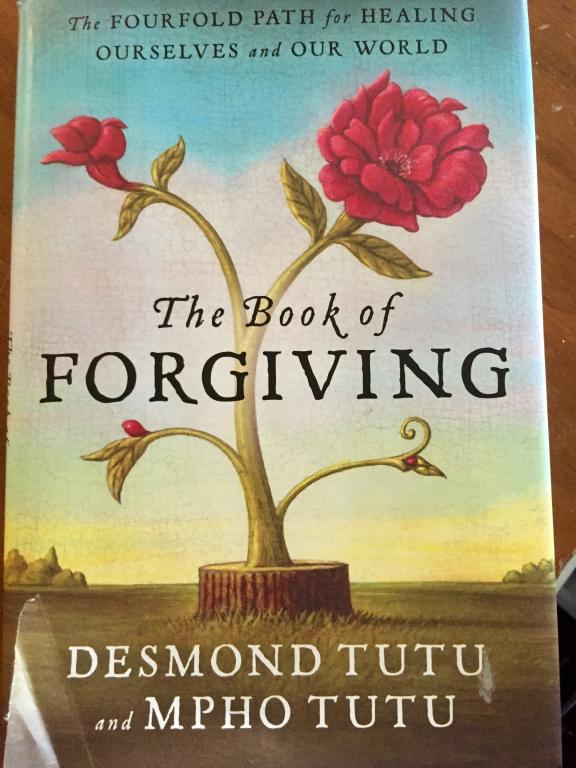 This story is one of many I could share, and you can likely think of your own struggles around forgiveness and unforgiveness. And when I reflect on the practice of forgiveness, one of the first names that comes to mind is Archbishop Desmond Tutu and his leadership of the Truth and Reconciliation Commission in post-apartheid South Africa. Recently, Archbishop Tutu published The Book of Forgiving, co-authored with one of his daughters, Mpho Tutu.
More than a decade ago, Archbishop Tutu published a related bestseller titled No Future Without Forgiveness. And in that book he offers powerful testimony from his firsthand experience that the most life-giving way forward for South Africa was through full disclosure of the atrocities that had been committed. He perceived that the only way to reconcile a divided nation — and move toward a healthy democracy — was through truth-telling. In Tutu’s words, if the nation had not chosen to practice forgiveness, “Our rage and our quest for revenge would have been our destruction.” Extrapolating more broadly, he invites all of us to consider that the same dynamic — that there is “no future without forgiveness” — “is as true for us individually as it is for us globally” (2-3). At least part of what he means is that without forgiveness, we cannot move fully into the future because we remain (both consciously and unconsciously) tied to the past.
Reflecting on his experience leading the Truth and Reconciliation Commission, Tutu writes that from what he has seen, “there is nothing that cannot be forgiven, and there is no one undeserving of forgiveness” (3). I will confess that I’m not sure I completely agree with such unqualified statements about forgiveness; however, Archbishop Tutu is in a powerful moral position to make such claims out of his personal experience in post-apartheid South Africa.
I will also hasten to add that forgiveness is a practice — in many ways similar to practicing the piano or practicing basketball: you get better the more you practice. The more times you practice a sonata or shooting free throws, the more that action becomes an ingrained habit. Similarly, the more you practice forgiving, the more forgiving becomes second nature.
Along these lines a more recent example is after the 2006 Amish school shooting in Pennsylvania, the Amish community went immediately to comfort the family of the murderer. The Amish would agree with Archbishop Tutu that, “there is nothing that cannot be forgiven, and there is no one undeserving of forgiveness.” But both in the case of the Amish and in South Africa, that is an advanced level of forgiveness, cultivated in community with great intentionality and over time. You don’t start at that level of forgiveness any more than a child could compete in the NBA or play a Rachmaninoff concerto after only a few lessons.
More realistic for most of us may be a teaching I heard recently from the Buddhist teacher Noah Levine who said, “I forgive you as much as I can in this moment.” There is wisdom in that easier starting point for practicing authentic forgiveness. And although there are times when we are not yet ready even to begin practicing forgiveness, at a certain point, refusing to forgive can be like “drinking poison yourself and wishing your enemy would die.”
And along the lines of practicing forgiveness as much for our own mental and physical health as for the sake of the offender, there is a famous Zen tale that:
Two monks were walking through the forest and came upon a woman unable to cross a river. Seeing the need, one monk picked up the woman, carried her across and set her down on the other bank. Both monks proceeded on their way, but miles later it became evident that the second monk was disturbed. When the first monk inquired as to why, the second monk said he couldn’t understand why the first monk had violated his vows by touching a woman. The first monk responded**, “I put the woman down miles ago, and you’re still carrying her.”**
In other words, be wary if your choices are only creating more suffering for yourself without having any impact on the other person or group.
It is also important to address some of the central objections to practicing forgiveness. Tutu is clear that the call to practice forgiveness is not about becoming a doormat for further abuse. He writes that forgiveness is “not weakness” (often it is about personal maturity and inner strength), “not a subversion of justice,” “not forgetting,” and “not easy” (33-38). And there may well be serious consequences, legal or otherwise, for the offender irrespective of whether one chooses to forgive. Indeed, as we have seen, forgiveness is often not primarily about the transgressor.
In this spirit, Tutu writes the following as a meditation about forgiveness. As you listen, be attentive to see if there is a particular word or phrase that particularly resonates with your experience of either forgiveness or unforgiveness:
I will forgive you
The words are so small
But there is a universe hidden in them
When I forgive you
All those cords of resentment pain and sadness that had wrapped
themselves around my heart will be gone
When I forgive you
You will no longer define me
You measured me and assessed me and
decided that you could hurt me
I didn’t count
But I will forgive you
Because I do count
I do matter
I am bigger than the image you have of me
I am stronger
I am more beautiful
And I am infinitely more precious than you thought me
I will forgive you
My forgiveness is not a gift that I am giving to you
When I forgive you
My forgiveness will be a gift that gives itself to me (26-27)
And if you are interested in experimenting with practicing forgiveness, Tutu recommends what he calls the “Fourfold Path of Forgiving”:
- Telling the Story
- Naming the Hurt
- Granting Forgiveness
- Renewing or Releasing the Relationship (5)
I particularly appreciate his formulation of the final step: practicing forgiveness does not require renewing the relationship; instead, authentic forgiveness can also mean releasing the relationship. For instance, I will say freely that I have no interest in renewing a relationship with the professor I described to you earlier. But it was helpful for me to be more intentional about releasing the relationship when I realized months later that I was still carrying around both anger and sadness around his cruelty.
Expanding our view more broadly, Tutu writes that practicing forgiveness both individually and societally is about breaking what he calls the “Revenge Cycle” — to have a chance for moving toward healing and wholeness. In the Revenge Cycle, we choose to respond to “hurt, harm, loss, and pain” with “revenge, retaliation, and payback” — but that risks the other continuing the cycle by hurting us further (48). As Gandhi said, “An eye for an eye leaves the whole world blind.”
For Tutu, the biggest factor that allows the Revenge Cycle to continue is “rejecting shared humanity” — refusing or being unable to see the brokenness, wounds, and pain of the other person. In the case of the professor I shared with you earlier, I did consider retaliation such as writing an email to the whole seminary community about his transgression. In response, I have no idea what payback might have come my way. But with some distance and time, I was able to see our shared humanity. I will likely never know for sure, but from what I know about the human condition, my guess is that there was some underlying cause for him lashing at me in such a disproportionate way. Perhaps he had recently been criticized by someone with authority, and perhaps my presence gave him an excuse to try making himself feel better by attempting to belittle me.
Tutu writes:
We can’t create a world without pain or loss or conflict or hurt feelings, but we can create a world of forgiveness…. But ultimately no one can tell you to forgive…. We can invite you on the journey. We can show you what has worked for others. We can tell you that the healing we have seen from those who have walked the Fourfold Path is humbling and transformative.
All of us must walk our own paths, at our own pace…. In the end the forgiveness you seek, whether it’s for another or for yourself…[is carried] in your heart…. You just need to look inside and discover it — discover the power [that changing your heart] has to change your life and to the change our world. (224-225)
Do you feel any prompting in your heart to practice forgiveness: to tell your story, to name the hurt, to grant forgiveness, and to discern whether or renew or release the relationship?
What might it feel like to say — maybe at first only to a trusted friend, in a journal, or in your heart — “I forgive you as much as I can in this moment.”
The Rev. Dr. Carl Gregg is a trained spiritual director, a D.Min. graduate of San Francisco Theological Seminary, and the minister of the Unitarian Universalist Congregation of Frederick, Maryland. Follow him on Facebook (facebook.com/carlgregg) and Twitter (@carlgregg).
Learn more about Unitarian Universalism:
http://www.uua.org/beliefs/principles
Previous Post

June 2, 2015
"Liberal Religion in the Public Square"
Next Post
June 26, 2015 Top Ten Highlights from The Cornel West Reader
Browse Our Archives
Select a Category Advent Anti-Racism Archaeology Atheism Baptism Best of the Year List Book Reviews Buddhism Catholicism Christian Education Church and State Church Planting Climate Change Conscientious Objection to War Creation Spirituality Death Penalty Didache Disability Rights Discernment Easter Ecology Emergent Church Movement Empire-Critical Ethics Evolution Feminist Theology Film Reviews Gandhi Gospel of Mark Gun Control Hinduism Immigration Reform Interfaith Islam JFK Judaism Jungian Spirituality Lectionary Commentary Lent Letters to the Editor LGBT Marriage MLK Multiculturalism Mysticism Nonviolent Activism Occupy Paganism (Earth-centered Religions) Parables Paul Pluralism Politics Process Theology Quantum Physics Requiescat In Pace Seminary and Divinity School Sermon Series Retrospective Sermons Spiritual Direction Spiritual Practices Stewardship (Fundraising) The Book of J The Wheel of the Year (Paganism) Theoblogger Challenge Triathlon Uncategorized Unitarian Universalism Worship Resources Youth Ministry
Select a Month July 2026 May 2026 March 2026 November 2025 October 2025 August 2025 February 2025 December 2024 October 2024 March 2024 January 2024 December 2023 November 2023 March 2023 February 2023 January 2023 December 2022 November 2022 August 2022 March 2022 February 2022 January 2022 December 2021 September 2021 August 2021 July 2021 June 2021 May 2021 February 2021 January 2021 December 2020 August 2020 June 2020 May 2020 April 2020 March 2020 February 2020 January 2020 December 2019 November 2019 October 2019 September 2019 July 2019 June 2019 March 2019 February 2019 January 2019 December 2018 November 2018 October 2018 September 2018 June 2018 May 2018 April 2018 March 2018 February 2018 January 2018 December 2017 November 2017 October 2017 September 2017 August 2017 July 2017 June 2017 May 2017 April 2017 March 2017 February 2017 January 2017 December 2016 November 2016 October 2016 September 2016 August 2016 June 2016 May 2016 April 2016 March 2016 February 2016 January 2016 December 2015 November 2015 October 2015 September 2015 August 2015 July 2015 June 2015 May 2015 April 2015 March 2015 February 2015 January 2015 December 2014 November 2014 October 2014 August 2014 July 2014 June 2014 May 2014 April 2014 March 2014 February 2014 January 2014 December 2013 November 2013 October 2013 September 2013 August 2013 July 2013 June 2013 May 2013 April 2013 March 2013 February 2013 January 2013 December 2012 November 2012 October 2012 September 2012 August 2012 July 2012 June 2012 May 2012 April 2012 March 2012 February 2012 January 2012 December 2011 November 2011 October 2011 September 2011 August 2011 July 2011 June 2011 May 2011 April 2011 March 2011 February 2011 January 2011 December 2010 November 2010 October 2010 August 2009 July 2009 May 2009
Follow Us!
TAKE THE
Religious Wisdom Quiz
What did Jesus do right after being baptized?
Select your answer to see how you score.
Started preaching Went into the wilderness Returned to Galilee Visited the temple
Related posts from Carl Gregg

Why You Should Give Yourself Permission for Self-Care:...

"Are You Living the Life You Chose?": How...

Why a 40-Hour Work Week? (It's Decreased Before....

Winter Solstice Spirituality: “Learning to Walk in the...
TRENDING AT PATHEOS More Voices

Reading America at 250: A Nation Wrestles With...
As part of my own reflection on the 250th anniversary of the...

Whenever I am reading a book or listening to an argument, I...

President Trump Ban Animal Torture Videos on Facebook
Call for Stricter Regulations of Animal Abuse Content on Facebook Although President...

Draft Amendments to Address Ritual Abuse in New...
The proposed changes would make it illegal for individuals in domestic partnerships...

How Bans on LGBTQ+ Student Clubs Threaten Religious...
On June 20, 2025, the State of Texas passed Senate Bill 12....

The Truth About the Gen Z Revival
This past year, there has been a lot of media buzz surrounding...
view all More Voices blogs
Ad-Free & Subscriber Log-In Subscription Support
- About Us
- 2026 Calendar
- Videos
- Podcasts
- Library of World Religions
- Faith In Media Tracker
- Advertise With Us
- Write for Us
- Privacy Policy
- Terms of Service
- Do Not Sell My Data
- Contact Us
- Radiant Digital
- Manage Newsletter Subscriptions
- Unsubscribe From Notifications
- Sitemap
Copyright 2008-2026, Patheos. All rights reserved.
Subscription Support Ad-Free & Subscriber Log-In
Follow Patheos