
BuddhistCatholicContemplativeEvangelicalGeneral ChristianHinduJewishLatter-day SaintMuslimNew VisionsProgressive Christian
Beliefs
- Buddhist
- Catholic
- Contemplative
- Evangelical
- General Christian
- Hindu
- Jewish
- Latter-day Saint
- More Voices
- Muslim
- New Visions
- Pagan
- Progressive Christian
Topics
- Religion News
- Food and Religion
- Sports and Religion
- Religious Art
- Religious Music and Entertainment
- Religious Events
- History and Religion
- Style and Religion
- Politics and Religion
- Women in Religion
- Recreation Outdoors and Religion
- Business Finance and Religion
- Careers Workplace and Religion
- Education and Religion
- Family Parenting and Religion
- Health Fitness and Religion
- Home and Religion
- Relationships and Religion
- Technology and Religion
- Travel and Religion
Columnists
- Buddhist Columnists
- Business Finance and Religion Columnists
- Careers Workplace and Religion Columnists
- Catholic Columnists
- Contemplative Columnists
- Education and Religion Columnists
- Evangelists Columnists
- Family Parenting and Religion Columnists
- General Christian Columnists
- Health Fitness and Religion Columnists
- Hindu Columnists
- History and Religion Columnists
- Home and Religion Columnists
- Jewish Columnists
- More Voices Columnists
- Latter Day Columnists
- Muslim Columnists
- New Visions Columnists
- Nonreligious Columnists
- Pagan Columnists
- Politics and Religion Columnists
- Progressive Columnists
- Recreation Outdoors and Religion Columnists
- Relationships and Religion Columnists
- Religion News Columnists
- Religious Art Columnists
- Religious Events Columnists
- Religious Music and Entertainment Columnists
- Sports and Religion Columnists
- Style and Religion Columnists
- Technology and Religion Columnists
- Travel and Religion Columnists
- Women in Religion Columnists
Resource Library
- 2026 Calendar
- Library of World Religions
- The 100 Most Holy Places on Earth
- Patheos Answers
- Podcasts
- Videos
- Faith Leaders Database
- Anglican Episcopalian
- Bahai
- Baptist
- Buddhism
- Christianity
- Confucianism
- Eastern Orthodoxy
- Hinduism
- Holiness and Pentecostal
- ISKCON
- Islam
- Judaism
- Lutheran
- Methodist
- The Church of Jesus Christ of Latter-day Saints
- New Age
- Paganism
- Presbytarian and Reformed
- Protestantism
- Religion Behind the Scenes
- Roman Catholic
- Scientology
- Shia Islam
- Sikhism
- Sufism
- Sunni Islam
- Taoism
- Zen
- See all religions
Research Tools
 Ad-Free & Subscriber Log-In Subscription Support
Ad-Free & Subscriber Log-In Subscription Support
Follow Patheos 

- Trending:
- Forgiveness
- |
- Marriage
- |
- Consciousness
- |
- Death Penalty
- |
- Election
- |
- Halloween

- Home
- More Voices
- “Liberal Religion in the Public Square”
“Liberal Religion in the Public Square”
Last updated on: June 2, 2015 at 10:00 am by Carl Gregg
“Liberal Religion in the Public Square” 2015-06-01T07:30:46-04:00 Carl Gregg
Patheos Explore the world's faith through different perspectives on religion and spirituality! Patheos has the views of the prevalent religions and spiritualities of the world.
Each year the Unitarian Universalist Association chooses one book as a “Common Read,” and encourages all UUs to read, discuss, and consider action in light of the contents. Previous Common Reads have included:
- The Death of Josseline: Immigration Stories from the Arizona-Mexico Borderlands
- Acts of Faith: The Story of an American Muslim, the Struggle for the Soul of a Generation
- The New Jim Crow: Mass Incarceration in the Age of Colorblindness, and
- Behind the Kitchen Door (about justice for restaurant workers)
If any of those titles pique your interest, I highly recommend any or all of them.
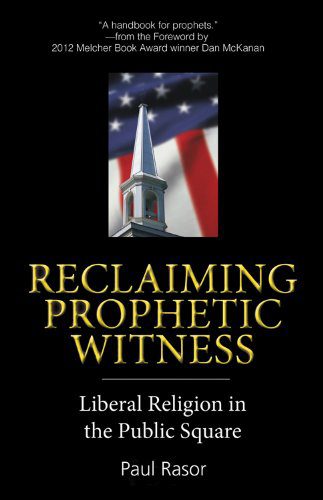 This year’s Common Read is Reclaiming Prophetic Witness: Liberal Religion in the Public Square by a UU minister named Paul Rasor, who is currently the director of the Center for the Study of Religious Freedom at Virginia Wesleyan College. And if you are intrigued by Rasor’s title, one potential piece of good news is that his book is quite short, weighing in at around 100 pages.
A major goal of the book is to challenge religious progressives to reflect on the ways our values do (or could) support our activism to help create a more just, equitable, and peaceful world. But when I think about the title “Reclaiming Prophetic Witness,” what first comes to mind for me is the biblical tradition of the Hebrew prophets. However, the theologically conservative Christian congregation of my childhood taught me to view the Hebrew prophets in a very different way than Rasor has in mind. They taught me to read the “Old Testament” selectively for the ways these books could be seen as predicting events centuries into the future in the life of Jesus.
In contrast, when I took an undergraduate class on the Hebrew prophets and began reading those books from the perspective of their original context, it became clear that most of the biblical prophets were concerned not with the distant future, but with social injustice and corruption in their own day — and that they would be perplexed and shocked if they could somehow have known how Christians would come to read their texts centuries later. As the Jewish literary critic Harold Bloom has said regarding the Christian use of Jewish scripture, “Christianity stole our watch and has spent 2,000 years telling us what time it is.”
There is a lot more to say about the interpretation of the Hebrew Scriptures, but for now let me give just two pivotal examples that were highly influential on twentieth-century social prophets such as Rabbi Abraham Joshua Hershel and The Rev. Dr. Martin Luther King, Jr.
First, from the fifth chapter of the prophet Amos, speaking on behalf of the divine, Amos says to the people:
“21 I hate, I despise your festivals, and I take no delight in your solemn assemblies. 22 Even though you offer me your burnt offerings and grain offerings, I will not accept them; and the offerings of well-being of your fatted animals I will not look upon. 23 Take away from me the noise of your songs; I will not listen to the melody of your harps. 24 But let justice roll down like waters, and righteousness like an ever-flowing stream.”
A second example is from the sixth chapter of the prophet Micah and has been called the “sum of the prophets”:
“6 …Shall I come before [God] with burnt offerings, with calves a year old? 7 Will [God] be pleased with thousands of rams, with ten thousands of rivers of oil? Shall I give my firstborn for my transgression, the fruit of my body for the sin of my soul?” “[God] has told you, O mortal, what is good; and what [is required] of you but to do justice, and to love kindness, and to walk humbly with your God?”
The biblical prophets felt that God wanted the world to be less corrupt and more just, peaceful, and equitable — and they lived out this sacred calling often in very startling, disturbing, and intimidating ways.
But we don’t live in Israel during the eighth-century B.C.E., but instead in the West in the early twenty-first century — on the other side of the Scientific Revolution: after the discoveries of Copernicus, Darwin, Einstein, Hubble and many others. So what might it mean to “reclaim prophetic witness” today? What are our sacred values that can inspire us to work for a more peaceful and just world — to pick up and extend the work of the prophets who have come before us and on whose shoulders we stand?
The late American Pragmatic philosopher Richard Rorty wrote about what it might look like to see ourselves as part of a long line of prophetic witness. Limiting our focus for now to only the past few centuries here in the U.S., Rorty writes about the possibility of increasing numbers of people
acquiring an image of [ourselves] as heirs to a tradition of increasing liberty and rising hope…. wanting [ourselves and our] children to come to think of [ourselves] as proud and loyal citizens of a country that, slowly and painfully, threw off a foreign yoke, freed its slaves, enfranchised its women, restrained its robber barons and licensed its trade unions, liberalized its religious practices, broadened its…moral tolerance, and built colleges in which [increasing percentages] of its population could enroll. A country that numbered Jefferson, Thoreau, Susan B. Anthony, Eugene Debs…Rosa Parks, and James Baldwin among its citizens.
Along these lines, Rasor is inviting us to take a step back and reflect on the core, sacred values that motivated our forebears to work for social change in the hope that explicitly naming those sacred values might ennoble, enliven, and embolden us to, in Dr. King’s words, build the Beloved Community.
For Rasor, such sacred values are “liberal religious values.” And before I proceed, allow me to address the confusion that can arise from Rasor’s subtitle “Liberal Religion in the Public Square.” He does not mean that being a UU necessitates being a Democrat any more than being a Christian necessitates being a Republican. Instead, it is very much possible — and has many times been the case historically — that one can be a Religious Liberal and a Political Conservative or vice-versa.
Just as we seek to be a liberal religious traditions in the best sense of the word liberal (from the Latin root for “free”) — open to new ideas, generous, openhanded, open-hearted, and open-minded — there has also been room historically and there is room today within our the “Big Tent” of Unitarian Universalism for those who are conservative in the best sense of the word: caring about conservation of nature, upholding the beauty of traditions and rituals that accrued deep meaning through the test of time, reminding us of the importance not only of individual rights and equality (which liberals tend to value most highly), but also of community, authority, sanctity, and loyalty. This dynamic is one reason that many religious progressives resonate deeply with contemporary prophets such as Wendell Berry, who are conservative in the best sense of the word. We desperately need such voices within progressive religious communities.
In contrast to this “Big Tent” position, conventional wisdom today too often wrongly holds that all religious people are political, social, and economic conservatives — overemphasizing the Religious Right and ignoring the historic influence of the Religious Left from Women’s Suffrage to Civil Rights, and more. And surveying our landscape today, Rasor highlights:
two ‘theologies’ that dominate the U.S. American cultural experience: the theology of redemptive violence [which insists that “bad violence must be overcome by good violence”] and the theology of free-market fundamentalism…. [which insists that “the free market creates order and balance”]
And one major challenge of Rasor’s book is to consider what alternative convictions religious progressives might bring to the public square.
As a starting point, Rasor offers the following list of “Core Theological Principles of Religious Liberals” for consideration:
- The fundamental unity and interdependence of all existence
- The transforming power of love
- The inherent worth and dignity of all persons
- Human freedom
- Rejection of moral dualism (rejecting the sharp separation of good and evil, refusing to assign individuals and nations to one category or the other)
- Social justice — enable all to live with dignity and respect
- Cooperative power — persuasion over coercion
- Religious freedom
- Theological openness (100-102)
To give just a few examples of what the practical implications could be, in a review of recent resolutions passed by the UUA at recent annual General Assemblies, Rasor notes that, “Most read like political policy platforms rather than statements of religious conviction; fewer than 20 percent mentioned Unitarian Universalist’s core Principles, and then only in passing among the introductory ‘whereas’ clauses” (27).
But what if we introduced our religious convictions — our core, sacred values — into the equation? To give just three examples,
- How might our environmental justice work to curb Climate Change be more sustainable if it emerged out of a deep, felt experience of our UU Seventh Principle, “the interdependent web of all existence of which we are a part.”
- Likewise, how might our work to defend against threats to Voting Rights be stronger if it emerged out of seeing our Fifth Principle as a sacred value: “The right of conscience and the use of the democratic process within our congregations and in society at large?”
- And how might our work for immigration justice or against torture be inspired through the awareness that our First Principle (“The inherent worth and dignity of every person”) is drawn from the first line of the preamble to the 1948 United Nations’ “Universal Declaration of Human Rights,” which recognizes that, “the inherent dignity and the equal and inalienable rights of all members of the human family is the foundation of freedom, justice and peace in the world…”? Likewise, the very first sentence of Article I says, “All human beings are born free and equal in dignity and rights.” For me, it is incredibly powerful, significant, and hopeful to be part of a religious movement that has explicitly chosen to weave into our First Principle the starting point of the Universal Declaration of Human Rights.
Those are the sorts of sentiments that Rasor is trying to tap into when he talks about “Reclaiming Prophetic Witness: Liberal Religion in the Public Square.”
And with all this being said, allow me to be clear as well that by no means am I trying to undermine the First Amendment protection against the “establishment of religion.” At the same time, the First Amendment also prohibits interference with the “free exercise” of religion. And regarding the intersection of religion and state, perhaps Dr. King said it best in his book The Strength to Love:
The church must be reminded that it is not the master or the servant of the state, but rather the conscience of the state. It must be the guide and the critic of the state, and never its tool. If the church does not recapture its prophetic zeal, it will become an irrelevant social club without moral or spiritual authority.
For now, I will conclude with these words from the forward to Rasor’s book that remind us of the many different forms of prophetic witness needed in our world today:
In times like these, prophets must speak loudly, clearly, and with many voices.
We need prophets of economics to explain the cascading consequences of inequality and envision workplace democracy and socially responsible investment.
We need prophets of science who can track the steady increase in global temperatures, chart its implications, and convey the urgency of those implications to policymakers.
We need prophets of the arts to express their vision for social renewal in stirring songs and inspiring stories.
We need prophets who testify to the human costs of inequality and oppression, and tell their stories of how individuals and communities are fighting back.
And…we need prophets of faith to bring the rich resources of religion into the struggle, making ancient traditions new by applying them to today’s challenges.
The question then turns to each of us to look inside ourselves — and around at our occupations and connections — and ask: How do I feel called to speak or act prophetically in my particular spheres of influence?
The Rev. Dr. Carl Gregg is a trained spiritual director, a D.Min. graduate of San Francisco Theological Seminary, and the minister of the Unitarian Universalist Congregation of Frederick, Maryland. Follow him on Facebook (facebook.com/carlgregg) and Twitter (@carlgregg).
Learn more about Unitarian Universalism:
http://www.uua.org/beliefs/principles
Previous Post

May 27, 2015
What Is “The Fourth Turning of Buddhism”?
Next Post
June 9, 2015 Practicing Forgiveness
Browse Our Archives
Select a Category Advent Anti-Racism Archaeology Atheism Baptism Best of the Year List Book Reviews Buddhism Catholicism Christian Education Church and State Church Planting Climate Change Conscientious Objection to War Creation Spirituality Death Penalty Didache Disability Rights Discernment Easter Ecology Emergent Church Movement Empire-Critical Ethics Evolution Feminist Theology Film Reviews Gandhi Gospel of Mark Gun Control Hinduism Immigration Reform Interfaith Islam JFK Judaism Jungian Spirituality Lectionary Commentary Lent Letters to the Editor LGBT Marriage MLK Multiculturalism Mysticism Nonviolent Activism Occupy Paganism (Earth-centered Religions) Parables Paul Pluralism Politics Process Theology Quantum Physics Requiescat In Pace Seminary and Divinity School Sermon Series Retrospective Sermons Spiritual Direction Spiritual Practices Stewardship (Fundraising) The Book of J The Wheel of the Year (Paganism) Theoblogger Challenge Triathlon Uncategorized Unitarian Universalism Worship Resources Youth Ministry
Select a Month July 2026 May 2026 March 2026 November 2025 October 2025 August 2025 February 2025 December 2024 October 2024 March 2024 January 2024 December 2023 November 2023 March 2023 February 2023 January 2023 December 2022 November 2022 August 2022 March 2022 February 2022 January 2022 December 2021 September 2021 August 2021 July 2021 June 2021 May 2021 February 2021 January 2021 December 2020 August 2020 June 2020 May 2020 April 2020 March 2020 February 2020 January 2020 December 2019 November 2019 October 2019 September 2019 July 2019 June 2019 March 2019 February 2019 January 2019 December 2018 November 2018 October 2018 September 2018 June 2018 May 2018 April 2018 March 2018 February 2018 January 2018 December 2017 November 2017 October 2017 September 2017 August 2017 July 2017 June 2017 May 2017 April 2017 March 2017 February 2017 January 2017 December 2016 November 2016 October 2016 September 2016 August 2016 June 2016 May 2016 April 2016 March 2016 February 2016 January 2016 December 2015 November 2015 October 2015 September 2015 August 2015 July 2015 June 2015 May 2015 April 2015 March 2015 February 2015 January 2015 December 2014 November 2014 October 2014 August 2014 July 2014 June 2014 May 2014 April 2014 March 2014 February 2014 January 2014 December 2013 November 2013 October 2013 September 2013 August 2013 July 2013 June 2013 May 2013 April 2013 March 2013 February 2013 January 2013 December 2012 November 2012 October 2012 September 2012 August 2012 July 2012 June 2012 May 2012 April 2012 March 2012 February 2012 January 2012 December 2011 November 2011 October 2011 September 2011 August 2011 July 2011 June 2011 May 2011 April 2011 March 2011 February 2011 January 2011 December 2010 November 2010 October 2010 August 2009 July 2009 May 2009
Follow Us!
TAKE THE
Religious Wisdom Quiz
Who said: "Anyone who listens to the word but does not do what it says is like someone who looks at his face in a mirror"?
Select your answer to see how you score.
Peter Paul James Jesus
Related posts from Carl Gregg

Reading America at 250: A Nation Wrestles With...


Andrew Holocek on the Power of Darkness

The Stories That Shape Us: Myths, Archetypes, &...
TRENDING AT PATHEOS More Voices

Reading America at 250: A Nation Wrestles With...
As part of my own reflection on the 250th anniversary of the...

Whenever I am reading a book or listening to an argument, I...

President Trump Ban Animal Torture Videos on Facebook
Call for Stricter Regulations of Animal Abuse Content on Facebook Although President...

Draft Amendments to Address Ritual Abuse in New...
The proposed changes would make it illegal for individuals in domestic partnerships...

How Bans on LGBTQ+ Student Clubs Threaten Religious...
On June 20, 2025, the State of Texas passed Senate Bill 12....

The Truth About the Gen Z Revival
This past year, there has been a lot of media buzz surrounding...
view all More Voices blogs
Ad-Free & Subscriber Log-In Subscription Support
- About Us
- 2026 Calendar
- Videos
- Podcasts
- Library of World Religions
- Faith In Media Tracker
- Advertise With Us
- Write for Us
- Privacy Policy
- Terms of Service
- Do Not Sell My Data
- Contact Us
- Radiant Digital
- Manage Newsletter Subscriptions
- Unsubscribe From Notifications
- Sitemap
Copyright 2008-2026, Patheos. All rights reserved.
Subscription Support Ad-Free & Subscriber Log-In
Follow Patheos