
BuddhistCatholicContemplativeEvangelicalGeneral ChristianHinduJewishLatter-day SaintMuslimNew VisionsProgressive Christian
Beliefs
- Buddhist
- Catholic
- Contemplative
- Evangelical
- General Christian
- Hindu
- Jewish
- Latter-day Saint
- More Voices
- Muslim
- New Visions
- Pagan
- Progressive Christian
Topics
- Religion News
- Food and Religion
- Sports and Religion
- Religious Art
- Religious Music and Entertainment
- Religious Events
- History and Religion
- Style and Religion
- Politics and Religion
- Women in Religion
- Recreation Outdoors and Religion
- Business Finance and Religion
- Careers Workplace and Religion
- Education and Religion
- Family Parenting and Religion
- Health Fitness and Religion
- Home and Religion
- Relationships and Religion
- Technology and Religion
- Travel and Religion
Columnists
- Buddhist Columnists
- Business Finance and Religion Columnists
- Careers Workplace and Religion Columnists
- Catholic Columnists
- Contemplative Columnists
- Education and Religion Columnists
- Evangelists Columnists
- Family Parenting and Religion Columnists
- General Christian Columnists
- Health Fitness and Religion Columnists
- Hindu Columnists
- History and Religion Columnists
- Home and Religion Columnists
- Jewish Columnists
- More Voices Columnists
- Latter Day Columnists
- Muslim Columnists
- New Visions Columnists
- Nonreligious Columnists
- Pagan Columnists
- Politics and Religion Columnists
- Progressive Columnists
- Recreation Outdoors and Religion Columnists
- Relationships and Religion Columnists
- Religion News Columnists
- Religious Art Columnists
- Religious Events Columnists
- Religious Music and Entertainment Columnists
- Sports and Religion Columnists
- Style and Religion Columnists
- Technology and Religion Columnists
- Travel and Religion Columnists
- Women in Religion Columnists
Resource Library
- 2026 Calendar
- Library of World Religions
- The 100 Most Holy Places on Earth
- Patheos Answers
- Podcasts
- Videos
- Faith Leaders Database
- Anglican Episcopalian
- Bahai
- Baptist
- Buddhism
- Christianity
- Confucianism
- Eastern Orthodoxy
- Hinduism
- Holiness and Pentecostal
- ISKCON
- Islam
- Judaism
- Lutheran
- Methodist
- The Church of Jesus Christ of Latter-day Saints
- New Age
- Paganism
- Presbytarian and Reformed
- Protestantism
- Religion Behind the Scenes
- Roman Catholic
- Scientology
- Shia Islam
- Sikhism
- Sufism
- Sunni Islam
- Taoism
- Zen
- See all religions
Research Tools
 Ad-Free & Subscriber Log-In Subscription Support
Ad-Free & Subscriber Log-In Subscription Support
Follow Patheos 

- Trending:
- Forgiveness
- |
- Marriage
- |
- Consciousness
- |
- Death Penalty
- |
- Election
- |
- Halloween

- Home
- More Voices
- What Is “The Fourth Turning of Buddhism”?
What Is “The Fourth Turning of Buddhism”?
Last updated on: May 29, 2015 at 8:28 am by Carl Gregg
What Is “The Fourth Turning of Buddhism”? 2015-05-29T08:28:03-04:00 Carl Gregg
Patheos Explore the world's faith through different perspectives on religion and spirituality! Patheos has the views of the prevalent religions and spiritualities of the world.
Ken Wilber (1949-) is a contemporary American philosopher who has written a host of books related to what he calls his Integral Theory. And in general I find many of his frameworks for thinking about the world both helpful personally as well as particularly relevant for navigating our pluralistic, postmodern world. As the name “Integral Theory” implies, Wilber seeks to integrate the best of all available sources of knowledge and experience related to any given field.
If you are interested in learning more, back in 2007 he released a short introduction to his perspective called The Integral Vision, which is a good starting point. If you want to go deeper particularly in the area of religion, on the theory-side, I recommend his book Integral Spirituality. On the more practical side of cultivating firsthand religious experience in our contemporary world, I recommend his book Integral Life Practice.
And while I have no intention of trying to read everything Wilber has written, there is one book by him that I haven’t read, but hope to find time for soon. It is called Grace and Grit — and is about his journey with his wife, who was diagnosed with breast cancer in 1983, ten days after their wedding. She died of the disease six years later in 1989.
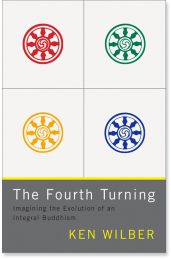 For now, I would like to explore some of the insights in Wilber’s newest book The Fourth Turning: Imagining the Evolution of an Integral Buddhism. (It’s currently only available in an abbreviated e-book form, but will eventually be released as a full book.) I appreciate his interest in tracing the turning points in the history of Buddhism. For those who are interested, Phyllis Tickle in her book The Great Emergence has traced a similar evolution of turning points in Christianity: the way radical shifts happened in the wake of Emperor Constantine’s conversation to Christianity, then in Middle Ages, and again in the Reformation, and once again today religions are shifting in our age in which it is said that “Google is the new Gutenberg.” (The ways in which our “searchable” Information Age is transforming society in ways parallel to how the moveable type printing press changed us more than 500 years earlier.)
Wilber and other scholars have traced similar paradigm shifts in the history of Buddhism. The first turning is the teachings of Siddhartha Gautama, the historical Buddha, who lived and taught in India sometime around the 5th century B.C.E. in (about 500 years before the life of the historical Jesus). This manifestation of the tradition is probably best represented today by Theravādan Buddhism. (3)
The second major turning of the Buddhist wheel of dharma is often traced to the teachings of the Buddhist philosopher Nāgārjuna (c. 150 – c. 250 C.E.) about emptiness from within the Mahāyāna school of Buddhism. A Third Great Turning from around the same time is known as the Yogācāra school (3).
All of these turnings represent major paradigm shifts that led to new innovations and insights. And depending on how you want to count — since Tantric (or Esoteric) Buddhism is sometimes called the Fourth Turning in Buddhism — Ken Wilber is inviting us to consider that we are in the midst of a major new Fourth (or potentially Fifth) Turning on the Buddhist Wheel of Dharma (viii). Regardless, here’s the most important point: irrespective of how many previous turnings one counts, Wilber is proposing that our invitation today — in an age in which “Google is the new Gutenburg” — is to take all the previous wisdom from the 2,500 hundred years of Buddhist traditions and combine those with the best insights of modern science and everything we know as postmodern citizens of the early twenty-first century. Wilber’s helpful phrase for this dynamic is to “transcend and include” (vi). In other words, the challenge is to transcend the limitations of previous paradigms (so that you are no longer constrained by obsolete teachings), but also to include all the parts of the tradition that remain valuable.
And as I’ve been reflecting on what it means to cultivate a twenty-first century, pragmatic Buddhism, there are at least three touchstones that come to mind that can guide our way forward. The first is to realize that the Buddhist tradition has many of the same promises and perils of all the other world religions. What I mean is that in the West, we are for the most part, familiar with all the shadow sides of the Christian tradition (such as the Crusades or the Inquisition) or all the shadow sides of the Islamic tradition (such as Islamist terrorism). But Buddhism — just as with any religion or secular philosophy — can also be perverted and used as an excuse for violence, division, and oppression. To name only three examples from our world today, as reported in The Washington Post:
In Sri Lanka, where about 70 percent of the population is Theravada Buddhist, a group of monks formed the Bodu Bala Sena or the Buddhist Power Force in 2012 to “protect” the country’s Buddhist culture. The force, nicknamed BBS, carried out at least 241 attacks against Muslims and 61 attacks against Christians in 2013….
In Myanmar, at least 300 Rohingya Muslims, whose ancestors were migrants from Bangladesh, have been killed and up to 300,000 displaced [by nationalistic Buddhists]. Ashin Wirathu, a monk who describes himself as the Burmese “bin Laden,” is encouraging the violence by viewing the Rohingya presence as a Muslim “invasion.”
And in Buddhist-majority Thailand, at least 5,000 people have died in Muslim-Buddhist violence in the country’s South. The country’s Knowing Buddha Foundation is not a violent group, but it advocates for a blasphemy law to punish anyone who offends the faith [according to their orthodoxy]. It wants Buddhism declared the state religion and portrays popular culture as a threat to believers.
So much depends on what an individual or community brings to a tradition, as far as whether any given tradition becomes a means of liberation or oppression. A perspective from the Fourth Turning in Buddhism challenges us to take responsibility for letting go of obsolete parts of religions that are oppressive and anachronistic and emphasizing the parts that continue to be of great value — in the case of Buddhism, for example, for increasing compassion, clarity, concentration, and equanimity.
The second touchstone, if you do feel drawn (as I am) toward Buddhist practices, is to be wary of what is sometimes called Spiritual Materialism: the ways that spiritual traditions like Buddhism can be co-opted and commodified to support oppressive systems instead of transforming them.
The final two minutes of the television show Mad Men is a prime example of what I’m referring to. The closing scene has the protagonist, the advertising man Don Draper having a spiritual awakening during an oceanfront, outdoor sunrise meditation class at the Esalen Institute in Big Sur, California (which was a huge part of the human potential movement in the 1960s). That scene closes with the class, including Don, sitting in a meditation posture, closing their eyes, and chanting “Om.”
As the camera zooms in on the blissed out face of Don Draper, you begin to hear the voiceover of the famous 1971 Coca-cola ad “I’d Like to Buy the World a Coke.” The ad shows young people from all over the world gathered on a beautiful hilltop. They are all holding open Coke bottles as they sing together. And for what it’s worth, I think it was a great ending to the show — confronting us with a strong example of the manipulative power of advertising (in which you mostly can’t help yourself from having positive associations with the Coca-Cola brand reinforced even as you perhaps realize you are being manipulated). The jingle is such an earworm, the harmony is beautiful, and the mountain top scene with young people is moving.
The ad also starts out with an admirable sentiment: “I’d like to buy the world a home / And furnish it with love.” That would change the world. As Habitat for Humanity challenges us, everyone deserves a “simple, decent place to live.” But then the commodification comes in as if equally important to buying the world a home is buying the world a Coke: “I’d like to buy the world a Coke…That’s the real thing.” When you take half a step back, could anything be less of the “real thing” than a high-fructose corn syrup, artificially caramel-colored soda?
Advertising can take the beauty of joining together harmoniously across traditional divisions and strong associate it with Coca-Cola through the power of a catchy jingle. And my point is that just as Buddhism and other spiritual traditions can be subject to various fundamentalisms, they can also be commodified in ways that support broken, exploitative systems instead of fulfilling their potential for transforming ourselves and our world for the better.
I would relatedly invite you to consider that the secularized “Mindfulness Based Stress Reduction” movement — which as a whole is doing a lot of good in the world — is also being manipulated in many ways. For example, it has also been used cynically by some to communicate the message of “keep overworking”… just add 30 minutes of meditation at the beginning of your day so that you can lower your blood pressure and handle stress better (and overwork more efficiently and for longer!). In contrast, the deeper promise of the Buddhist tradition is a much more radical transformation:
- cultivating insight into the impermanent nature of reality (including of our “self”),
- changing our relationship to unsatisfactoriness/suffering, and
- existentially experiencing how deeply interconnected we are to one another and all of reality.
Accordingly, my third and final touchstone that points to the actual ‘real thing’ of Buddhism is what is sometimes called Spiritual Bypass, the “hope that Buddhism will be a way to live without vulnerability and risky, deep, empathetic connections,” which is the opposite of what authentic Buddhist practices leads one toward — that is, toward connection, compassion, and interdependence. The Buddhist teacher Stephen Levine says it this way. He begins by listing all the practices he has found to be insufficient (prayer, reading, discourse, contemplation, fighting), then concludes:
If anything other than love could do it
I’d have done it already
and left the hardest for last.
And following The Rev. Dr. Martin Luther King, Jr., religious progressives often talk about our goal as creating the Beloved Community (which through love and compassion seeks to bring people together who previously considered themselves enemies).
And to consider what it means to talk about the Beloved Community from a Buddhist perspective there is a powerful quote from the contemporary Buddhist teacher Thich Nhat Hanh.(Of note, a year before his assassination, Dr. King wrote to the Nobel Committee, “As the Nobel Peace Prize Laureate of 1964, I now have the pleasure of proposing to you the name of Thich Nhat Hanh for that award in 1967. I do not personally know of anyone more worthy of the Nobel Peace Prize than this gentle Buddhist monk from Vietnam.”) Hanh has written:
“The Buddha predicted that the next Buddha would be…the Buddha of love…. It is possible that the next Buddha will not take the form of an individual. The next Buddha may take the form of a community [sangha], a community practicing understanding and loving kindness, a community practicing mindful living. And the practice can be carried out as a group, as a city, as a nation, [as a world, as a cosmos].”
May we be part of creating such Beloved Communities.
We can’t control the vicissitudes of the world, but we can learn to respond to whatever comes our way with greater mindfulness, insight, and compassion. And for the coming days and weeks, I leave you with this Buddhist blessing:
May you be filled with loving-kindness.
May you be well.
May you be peaceful and at ease.
May you be whole.
The Rev. Dr. Carl Gregg is a trained spiritual director, a D.Min. graduate of San Francisco Theological Seminary, and the minister of the Unitarian Universalist Congregation of Frederick, Maryland. Follow him on Facebook (facebook.com/carlgregg) and Twitter (@carlgregg).
Learn more about Unitarian Universalism:
http://www.uua.org/beliefs/principles
Previous Post

April 22, 2015
Betting on Earth's Future
Next Post
June 2, 2015 "Liberal Religion in the Public Square"
Browse Our Archives
Select a Category Advent Anti-Racism Archaeology Atheism Baptism Best of the Year List Book Reviews Buddhism Catholicism Christian Education Church and State Church Planting Climate Change Conscientious Objection to War Creation Spirituality Death Penalty Didache Disability Rights Discernment Easter Ecology Emergent Church Movement Empire-Critical Ethics Evolution Feminist Theology Film Reviews Gandhi Gospel of Mark Gun Control Hinduism Immigration Reform Interfaith Islam JFK Judaism Jungian Spirituality Lectionary Commentary Lent Letters to the Editor LGBT Marriage MLK Multiculturalism Mysticism Nonviolent Activism Occupy Paganism (Earth-centered Religions) Parables Paul Pluralism Politics Process Theology Quantum Physics Requiescat In Pace Seminary and Divinity School Sermon Series Retrospective Sermons Spiritual Direction Spiritual Practices Stewardship (Fundraising) The Book of J The Wheel of the Year (Paganism) Theoblogger Challenge Triathlon Uncategorized Unitarian Universalism Worship Resources Youth Ministry
Select a Month July 2026 May 2026 March 2026 November 2025 October 2025 August 2025 February 2025 December 2024 October 2024 March 2024 January 2024 December 2023 November 2023 March 2023 February 2023 January 2023 December 2022 November 2022 August 2022 March 2022 February 2022 January 2022 December 2021 September 2021 August 2021 July 2021 June 2021 May 2021 February 2021 January 2021 December 2020 August 2020 June 2020 May 2020 April 2020 March 2020 February 2020 January 2020 December 2019 November 2019 October 2019 September 2019 July 2019 June 2019 March 2019 February 2019 January 2019 December 2018 November 2018 October 2018 September 2018 June 2018 May 2018 April 2018 March 2018 February 2018 January 2018 December 2017 November 2017 October 2017 September 2017 August 2017 July 2017 June 2017 May 2017 April 2017 March 2017 February 2017 January 2017 December 2016 November 2016 October 2016 September 2016 August 2016 June 2016 May 2016 April 2016 March 2016 February 2016 January 2016 December 2015 November 2015 October 2015 September 2015 August 2015 July 2015 June 2015 May 2015 April 2015 March 2015 February 2015 January 2015 December 2014 November 2014 October 2014 August 2014 July 2014 June 2014 May 2014 April 2014 March 2014 February 2014 January 2014 December 2013 November 2013 October 2013 September 2013 August 2013 July 2013 June 2013 May 2013 April 2013 March 2013 February 2013 January 2013 December 2012 November 2012 October 2012 September 2012 August 2012 July 2012 June 2012 May 2012 April 2012 March 2012 February 2012 January 2012 December 2011 November 2011 October 2011 September 2011 August 2011 July 2011 June 2011 May 2011 April 2011 March 2011 February 2011 January 2011 December 2010 November 2010 October 2010 August 2009 July 2009 May 2009
Follow Us!
TAKE THE
Religious Wisdom Quiz
I will heal their waywardness and love them freely, making them blossom like this flower and fragrant like this tree. What plant and tree are mentioned?
Select your answer to see how you score.
Lebanon Cedar and Lilies Lotus and palm Rose and olive Iris and cypress
Related posts from Carl Gregg
Beyond “McMindfulness”: How Not To Get Stuck in...
Lodro Rinzler’s Millennial Hipster Buddhism

What Happens When You Immerse Yourself in the...
Becoming a Buddha, not a Buddhist
TRENDING AT PATHEOS More Voices

Reading America at 250: A Nation Wrestles With...
As part of my own reflection on the 250th anniversary of the...

Whenever I am reading a book or listening to an argument, I...

President Trump Ban Animal Torture Videos on Facebook
Call for Stricter Regulations of Animal Abuse Content on Facebook Although President...

Draft Amendments to Address Ritual Abuse in New...
The proposed changes would make it illegal for individuals in domestic partnerships...

How Bans on LGBTQ+ Student Clubs Threaten Religious...
On June 20, 2025, the State of Texas passed Senate Bill 12....

The Truth About the Gen Z Revival
This past year, there has been a lot of media buzz surrounding...
view all More Voices blogs
Ad-Free & Subscriber Log-In Subscription Support
- About Us
- 2026 Calendar
- Videos
- Podcasts
- Library of World Religions
- Faith In Media Tracker
- Advertise With Us
- Write for Us
- Privacy Policy
- Terms of Service
- Do Not Sell My Data
- Contact Us
- Radiant Digital
- Manage Newsletter Subscriptions
- Unsubscribe From Notifications
- Sitemap
Copyright 2008-2026, Patheos. All rights reserved.
Subscription Support Ad-Free & Subscriber Log-In
Follow Patheos