
BuddhistCatholicContemplativeEvangelicalGeneral ChristianHinduJewishLatter-day SaintMuslimNew VisionsProgressive Christian
Beliefs
- Buddhist
- Catholic
- Contemplative
- Evangelical
- General Christian
- Hindu
- Jewish
- Latter-day Saint
- More Voices
- Muslim
- New Visions
- Pagan
- Progressive Christian
Topics
- Religion News
- Food and Religion
- Sports and Religion
- Religious Art
- Religious Music and Entertainment
- Religious Events
- History and Religion
- Style and Religion
- Politics and Religion
- Women in Religion
- Recreation Outdoors and Religion
- Business Finance and Religion
- Careers Workplace and Religion
- Education and Religion
- Family Parenting and Religion
- Health Fitness and Religion
- Home and Religion
- Relationships and Religion
- Technology and Religion
- Travel and Religion
Columnists
- Buddhist Columnists
- Business Finance and Religion Columnists
- Careers Workplace and Religion Columnists
- Catholic Columnists
- Contemplative Columnists
- Education and Religion Columnists
- Evangelists Columnists
- Family Parenting and Religion Columnists
- General Christian Columnists
- Health Fitness and Religion Columnists
- Hindu Columnists
- History and Religion Columnists
- Home and Religion Columnists
- Jewish Columnists
- More Voices Columnists
- Latter Day Columnists
- Muslim Columnists
- New Visions Columnists
- Nonreligious Columnists
- Pagan Columnists
- Politics and Religion Columnists
- Progressive Columnists
- Recreation Outdoors and Religion Columnists
- Relationships and Religion Columnists
- Religion News Columnists
- Religious Art Columnists
- Religious Events Columnists
- Religious Music and Entertainment Columnists
- Sports and Religion Columnists
- Style and Religion Columnists
- Technology and Religion Columnists
- Travel and Religion Columnists
- Women in Religion Columnists
Resource Library
- 2026 Calendar
- Library of World Religions
- The 100 Most Holy Places on Earth
- Patheos Answers
- Podcasts
- Videos
- Faith Leaders Database
- Anglican Episcopalian
- Bahai
- Baptist
- Buddhism
- Christianity
- Confucianism
- Eastern Orthodoxy
- Hinduism
- Holiness and Pentecostal
- ISKCON
- Islam
- Judaism
- Lutheran
- Methodist
- The Church of Jesus Christ of Latter-day Saints
- New Age
- Paganism
- Presbytarian and Reformed
- Protestantism
- Religion Behind the Scenes
- Roman Catholic
- Scientology
- Shia Islam
- Sikhism
- Sufism
- Sunni Islam
- Taoism
- Zen
- See all religions
Research Tools
 Ad-Free & Subscriber Log-In Subscription Support
Ad-Free & Subscriber Log-In Subscription Support
Follow Patheos 

- Trending:
- Forgiveness
- |
- Marriage
- |
- Consciousness
- |
- Death Penalty
- |
- Election
- |
- Halloween

- Home
- More Voices
- The Transient and the Permanent in Christianity: Theodore Parker and the Transcendentalist Revolt
The Transient and the Permanent in Christianity: Theodore Parker and the Transcendentalist Revolt
Last updated on: May 4, 2015 at 1:36 pm by Carl Gregg
The Transient and the Permanent in Christianity: Theodore Parker and the Transcendentalist Revolt 2015-05-04T13:36:52-04:00 Carl Gregg
Patheos Explore the world's faith through different perspectives on religion and spirituality! Patheos has the views of the prevalent religions and spiritualities of the world.
“[I invite you to] imagine you are in Boston some summer Sunday morning in the mid 1850s. You decide to go hear Theodore Parker, the famous Transcendentalist minister, preach to the 28th Congregational Society. Having never been, you arrange to accompany a friend who attends regularly.
As the two of you turn the corner from Tremont onto Winter Street, you are struck by the sheer size of the crowd gathered there. The sight of nearly three thousand people massing for a routine religious service is a novel one. You go down a narrow, dark alley to the entrance of the Boston Music Hall. Inside, you pass through into a large, airy, and elegantly decorated chamber. Before you is a low stage on the back of which stands a large bronze statue of Ludwig van Beethoven, reminding you what the room is used of the rest of the week.
On the stage is the preacher’s desk. On it sit a Bible and hymn book, red velvet cushion ready for the sermon manuscript, and a vase of fresh cut lilies. Mr. Parker was the first minister in Boston to have flowers on his pulpit. Others think flowers on the pulpit irreverent.
You are not used to seeing black and whites, laborers, merchants, and threadbare foreign scholars sitting side by side. As a group they seem inappropriately noisy, and you note that many of them are reading books and even newspapers.
A wave of silence starts from the front of the hall. Mr. Parker has come in. He is a small man, plain featured, with a high forehead, dressed in a carefully tailored dark suit. He recites from memory the “lesson” (which includes not only Scripture, but a poem by Longfellow), then a hymn, in a strong, clear, deep voice. Music follows, provided by an organ and a choir of professional singers.
The sermon lasts exactly an hour. Although there is a scriptural text quoted at the beginning, you quickly realize there is to be no exposition of it; it is to be used only as a motto. His oration — about how our goal in life should not be pleasure, fame, or wealth, but perfect wisdom, justice, love, and holiness — is stirring.
A few people head of the exits as the sermon is ending, but you and your friend stay until the service is over. There is another hymn, and Mr. Parker gives a benediction. Then you exit slowly with the crowds, through the dark alley, into the midday sunshine.”
—Dean Grodzins in “The Transient and Permanent,” 73-75
As the saying goes, “We [stand] on the shoulders of giants, so that we can see more than they, and things at a greater distance, not by virtue of any sharpness of sight on our part, or any physical distinction, but because we are carried high and raised up by their giant size.” The freedom and pluralism we enjoy today is no accident, but was hard worn. And the invitation of studying the past is not only gratitude for past courage and fortitude of our forbears, but also to consider what the parallels are today: where are we called to do likewise that future generations may stand on our shoulders?
In that spirit, I would like to share some with you about the life and legacy of Theodore Parker, who has been called “the most influential minister in mid-nineteenth century America.” As in the above meditation, Parker was the minister of the “28th Congregational Society,” which at the time was,
the largest free church in the country and the largest church of any kind in Boston. In the 1850s, almost three thousand people went weekly to hear him preach (nearly 2% of the population of the city), and some 50,000 listened to him lecture every year, in lyceums from Maine to Illinois. Meanwhile, thousands more bought his published sermons and addresses…which found readers on both sides of the Atlantic. Scholars and thinkers took his work seriously…and [he] could read more than twenty languages. (ix)
Famously, Parker’s turn of phrase from his election sermon in 1846 about “government of all, by all, for all” helped inspire the phrase “government of the people, by the people, for the people” in President Lincoln’s conclusion to his Gettysburg Address 17 years later (x).
Similarly, see if you can spot the well-known saying that emerged out of this passage from Parker:
I do not pretend to understand the moral universe. The arc is a long one. My eye reaches but little ways. I cannot calculate the curve and complete the figure by experience of sight. I can divine it by conscience. And from what I see I am sure it bends toward justice.
Martin Luther King, Jr., shortened that quote to “the arc of the moral universe is long, but it bends toward justice.” That version from Dr. King was chosen by President Obama to weave into the rug in the Oval Office, but its origins lie with the nineteenth-century abolitionist and Unitarian minister Theodore Parker.
I have written previously about the even more radical, activist, second-half of Parker’s career in which he was one of the “Secret Six,” who helped fund and supply the abolitionist John Brown’s 1859 raid on the federal armory Harpers’ Ferry. (Of the “Secret Six,” five were Unitarians, two were Unitarian ministers.) But in this post, I would like to focus on the first half of Parker’s career (through around 1846) in which he became a leader in the Transcendentalist movement (x, 498).
The definitive biography of this part of Parker’s life has been written by Dean Grodzins, and is titled 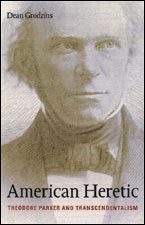 American Heretic: Theodore Parker and Transcendentalism. Grodzins writes that despite his fame, Parker was,
neither tall nor handsome; his big head was bald, and the features on his long face were plain…. [H]is voice was deep and resonant, but not especially strong…. His impact came instead from the force of his complex personality, from the exciting power of his prose, and above all from the strength of his ideas…. (x)
Although today, most people have never heard of Parker, “For nearly a century after his untimely death at age 49, in 1860, interest in him remained high around the world. Two collected editions of his works were published, a fourteen-volume set in London and a fifteen-volume edition in Boston.” His works were translated into German, Swedish, and Japanese. And in addition to multiple biographies about him in English, biographies were also written about him in French, German, and Dutch. “The centennial of Parker’s birth, in 1910, was marked by major celebrations,” but he began to be forgotten by the middle of the twentieth century. The opportunity is to reclaim his legacy of both racial justice work and bold inquiry into the hard questions of theology and philosophy.
Another significant parts of Parker’s legacy is his commitment to transforming the institution of the church. Although Ralph Waldo Emerson is the most famous nineteenth-century Unitarian, Emerson left his pulpit after only a few years for the lecture circuit. But Parker stayed and gives us insight into what it looks like to not only to be an individual calling for change, but also to harness the power of a congregation and larger networks for social change (xi-xiii). Parker’s life reminds us that Transcendentalism was about much more than Thoreau living alone on Walden Pond it was also about infusing progressive religion into existing congregations.
That being said, allow me to take a step back and trace some of the trajectory of Parker’s life that led up to that point. Theodore Parker was born in 1810 in Lexington, Massachusetts. In his family, he was the baby: “the last of eleven children, with nine surviving sisters and brothers, ages four to twenty-five.” When Parker was born, his father was forty-nine and his mother forty-six (1).
Looming large in Parker’s formative years was that during the Revolutionary War, his grandfather has commanded the Minutemen on the nearby Lexington Green — and particularly that his own grandfather, Captain Parker, had proclaimed the famous words, “Don’t fire unless fired upon, but if they want to have a war, let it begin here” (11). You can see that seeds of being a radical — of being willing to use violence if necessary to bring about social change — were planted early in young Parker’s psyche.
Also, keep in mind historically that the supporters of using violence to end slavery in the years leading up to the Civil War were much closer historically to the Revolutionary War than we are to the Civil War. Only 84 years had passed from 1776 to 1860, whereas more than twice as much time (more than 160 years) has passed from the Civil War to today. Parker and the other members of the Secret Six saw themselves as extending the fight for freedom begun at during the American War for Independence.
To further locate Parker historically, William Ellery Channing’s (1780-1842) 1819 sermon “Unitarian Christianity” gave the Unitarian half of Unitarian Universalism its name and led to the formation in 1825 of the American Unitarian Association (which consolidated in 1961 with the Universalist Church of America to form the Unitarian Universalist Association). Parker was only nine years old when Channing preached that landmark sermon on “Unitarian Christianity” (9). Channing, in turn, died in 1842, the year after Parker’s landmark sermon on “The Transient and the Permanent in Christianity.” Along with Emerson’s “Divinity School of Address.” Those three addresses are arguably the three most influential speeches in UU history.
What led to Parker’s controversial sermon on “The Transient and the Permanent in Christianity” was that over the course of a decade, he became increasingly liberal theologically, particularly in regard to how he viewed the Bible. (Keep in mind that Darwin’s paradigm-shifting On the Origin of Species was not published until 1859, the year before Parker’s untimely death.) So Parker was pushing the threshold for his time.
But if you look back at his writings from as late as 1832 during his early twenties, when he was employed as a school teacher, he was still a biblical literalist (31, 43). But as he began to research more for himself, influenced by a local Unitarian minister, his view began to evolve (32-33). By 1836, when Parker graduated from Harvard Divinity School, his doubts had increased significantly about traditional teachings of Christian orthodoxy, particular in regard to miracles (73). That year, 1836, was a breakthrough year for Transcendentalism with many major figures publishing significant works (74). And two years later when Emerson delivered his controversial “Divinity School Address,” Parker was in the audience (113, 124).
As a result of these influences, Parker began asking increasingly bold questions, some of them at first only privately in his journal, but some of them he was also starting to weave publicly into his preaching, such as:
- “How is Christ more a Savior than Socrates?”
- “Why did the world need a Savior?”
- And “The Resurrection — why was the body of Christ raised? — why “carried up?” How is the resurrection of matter proof of the Immortality of Spirit? Is not the material Resurrection of the body of Jesus Christ unspiritualizing? (86)
As he dove deeper into German biblical scholarship, such as David Strauss’ Life of Jesus, he began to ask, “Is not Strauss right, in the main, when he says the New Testament is a collection of myths? No doubt he goes too far, but pray tell me where is far enough” (164-165, 187-188, 212)?
In 1840, as the Transcendentalist Revolt within Unitarianism began to cause divisions among ministers, Parker’s resolve was strengthened and he said famously, “I intend in the coming year to let out all the force of Transcendentalism that is in me, come what will come” (199).
Significantly, the title of Parker’s 1841 sermon “The Transient and the Permanent in Christianity” is an allusion to an article by that that boundary-breaking German biblical scholar David Strauss titled “On Transicency and Permanency in Christianity.” Although Parker did not agree with all of Strauss’ conclusions, Strauss he helped give him the courage to ask the hard question without holding back.
It should be noted, however, that Strauss was fired from his professorship for his pathbreaking scholarship (242). But despite the widespread controversy Parker’s sermon generated, no one in his congregation left or turned against him (303). Essentially, he had been inoculating them to progressive viewpoints over many years. And his continuing successful ministry there is testament to what is possible when one has not only an individual such as Emerson asking radical questions on an itinerant lecture circuit, but also what is possible when a congregation wrestles with the hard questions together over time.
Parker’s sermon “The Transient and the Permanent in Christianity” caused widespread controversy because he preached it not from the safety of his home congregation, but at the ordination of a new Unitarian minister. So leaders from across the Unitarian movement where present in person to hear him.
To give a taste of his sermon — which weighed in at almost 12,000 words, approximately six times longer than my usual sermons — one of his core points was a classic theologically liberal move: he emphasizes the need to apply reason and logic to traditional religious beliefs. And he shift attention from believing things about the person of Jesus to the truth of his teachings. In Parker’s words: “It is hard to see why the great truths of Christianity rest of the personal authority of Jesus, more than the axioms of geometry rest on the personal authority of Euclid, or Archimedes” [9]. Parker’s point is that Jesus’ teachings were either true or false on their own merit, irrespective of who said them.
His sermon concludes, as is appropriate for an ordination, with a provocative charge to the congregation to support the freedom of the pulpit. Again, in Parker’s words:
You may prevent the freedom of speech in this pulpit if you will. You may hire you servants to preach as you bid; to spare your vices and flatter your follies; to prophecy smooth things, and say, It is peace, when there is no peace. Yet in so doing you weaken and enthrall yourselves. And alas for that [one] who consents to think one thing in [the] closet, and preach another in [this] pulpit….over his study and over [that] pulpit might be writ — EMPTINESS; on [the one’s] canonical robes, on [that’s one’] forehead and right hand — DECEIT, DECEIT.
What a strong call to make the most of the freedom we enjoy within progressive religion today: to not hold back in asking the hard questions of ourselves and one another — but also to commit to staying in covenant with one another for the long haul even as we do so.
Parker challenges us with each new generation, to let go of what is transient (that which has become obsolete), but to hold on to the permanency of the community, covenant, and convictions that seem right to us as best we can see with the best of our current insights and knowledge.
For now, I will give the last words to Parker from one of his attempts to redefine tradition religion for our modern age:
Be ours a religion which like sunshine goes everywhere,
its temple all space,
its shrine the good heart,
its creed all truth,
its ritual works of love.
The Rev. Dr. Carl Gregg is a trained spiritual director, a D.Min. graduate of San Francisco Theological Seminary, and the minister of the Unitarian Universalist Congregation of Frederick, Maryland. Follow him on Facebook (facebook.com/carlgregg) and Twitter (@carlgregg).
Learn more about Unitarian Universalism:
http://www.uua.org/beliefs/principles
Previous Post

March 13, 2015
"A God That Could Be Real"
Next Post
March 31, 2015 What Do We Mean We When Say, “Building the Beloved Community”?
Browse Our Archives
Select a Category Advent Anti-Racism Archaeology Atheism Baptism Best of the Year List Book Reviews Buddhism Catholicism Christian Education Church and State Church Planting Climate Change Conscientious Objection to War Creation Spirituality Death Penalty Didache Disability Rights Discernment Easter Ecology Emergent Church Movement Empire-Critical Ethics Evolution Feminist Theology Film Reviews Gandhi Gospel of Mark Gun Control Hinduism Immigration Reform Interfaith Islam JFK Judaism Jungian Spirituality Lectionary Commentary Lent Letters to the Editor LGBT Marriage MLK Multiculturalism Mysticism Nonviolent Activism Occupy Paganism (Earth-centered Religions) Parables Paul Pluralism Politics Process Theology Quantum Physics Requiescat In Pace Seminary and Divinity School Sermon Series Retrospective Sermons Spiritual Direction Spiritual Practices Stewardship (Fundraising) The Book of J The Wheel of the Year (Paganism) Theoblogger Challenge Triathlon Uncategorized Unitarian Universalism Worship Resources Youth Ministry
Select a Month July 2026 May 2026 March 2026 November 2025 October 2025 August 2025 February 2025 December 2024 October 2024 March 2024 January 2024 December 2023 November 2023 March 2023 February 2023 January 2023 December 2022 November 2022 August 2022 March 2022 February 2022 January 2022 December 2021 September 2021 August 2021 July 2021 June 2021 May 2021 February 2021 January 2021 December 2020 August 2020 June 2020 May 2020 April 2020 March 2020 February 2020 January 2020 December 2019 November 2019 October 2019 September 2019 July 2019 June 2019 March 2019 February 2019 January 2019 December 2018 November 2018 October 2018 September 2018 June 2018 May 2018 April 2018 March 2018 February 2018 January 2018 December 2017 November 2017 October 2017 September 2017 August 2017 July 2017 June 2017 May 2017 April 2017 March 2017 February 2017 January 2017 December 2016 November 2016 October 2016 September 2016 August 2016 June 2016 May 2016 April 2016 March 2016 February 2016 January 2016 December 2015 November 2015 October 2015 September 2015 August 2015 July 2015 June 2015 May 2015 April 2015 March 2015 February 2015 January 2015 December 2014 November 2014 October 2014 August 2014 July 2014 June 2014 May 2014 April 2014 March 2014 February 2014 January 2014 December 2013 November 2013 October 2013 September 2013 August 2013 July 2013 June 2013 May 2013 April 2013 March 2013 February 2013 January 2013 December 2012 November 2012 October 2012 September 2012 August 2012 July 2012 June 2012 May 2012 April 2012 March 2012 February 2012 January 2012 December 2011 November 2011 October 2011 September 2011 August 2011 July 2011 June 2011 May 2011 April 2011 March 2011 February 2011 January 2011 December 2010 November 2010 October 2010 August 2009 July 2009 May 2009
Follow Us!
TAKE THE
Religious Wisdom Quiz
What does "Golgotha" mean?
Select your answer to see how you score.
Place of the Skull Mountain of God House of Bread Valley of Death
Related posts from Carl Gregg

Peak Spiritual Experiences, Psychedelics, & Consciousness Research
The Radical Martin Luther King, Jr.: Why We...

"How the Founding Fathers Became Infallible and Our...

Vampires, Witches, & NPR: The Legacy of Margot...
TRENDING AT PATHEOS More Voices

Reading America at 250: A Nation Wrestles With...
As part of my own reflection on the 250th anniversary of the...

Whenever I am reading a book or listening to an argument, I...

President Trump Ban Animal Torture Videos on Facebook
Call for Stricter Regulations of Animal Abuse Content on Facebook Although President...

Draft Amendments to Address Ritual Abuse in New...
The proposed changes would make it illegal for individuals in domestic partnerships...

How Bans on LGBTQ+ Student Clubs Threaten Religious...
On June 20, 2025, the State of Texas passed Senate Bill 12....

The Truth About the Gen Z Revival
This past year, there has been a lot of media buzz surrounding...
view all More Voices blogs
Ad-Free & Subscriber Log-In Subscription Support
- About Us
- 2026 Calendar
- Videos
- Podcasts
- Library of World Religions
- Faith In Media Tracker
- Advertise With Us
- Write for Us
- Privacy Policy
- Terms of Service
- Do Not Sell My Data
- Contact Us
- Radiant Digital
- Manage Newsletter Subscriptions
- Unsubscribe From Notifications
- Sitemap
Copyright 2008-2026, Patheos. All rights reserved.
Subscription Support Ad-Free & Subscriber Log-In
Follow Patheos