
BuddhistCatholicContemplativeEvangelicalGeneral ChristianHinduJewishLatter-day SaintMuslimNew VisionsProgressive Christian
Beliefs
- Buddhist
- Catholic
- Contemplative
- Evangelical
- General Christian
- Hindu
- Jewish
- Latter-day Saint
- More Voices
- Muslim
- New Visions
- Pagan
- Progressive Christian
Topics
- Religion News
- Food and Religion
- Sports and Religion
- Religious Art
- Religious Music and Entertainment
- Religious Events
- History and Religion
- Style and Religion
- Politics and Religion
- Women in Religion
- Recreation Outdoors and Religion
- Business Finance and Religion
- Careers Workplace and Religion
- Education and Religion
- Family Parenting and Religion
- Health Fitness and Religion
- Home and Religion
- Relationships and Religion
- Technology and Religion
- Travel and Religion
Columnists
- Buddhist Columnists
- Business Finance and Religion Columnists
- Careers Workplace and Religion Columnists
- Catholic Columnists
- Contemplative Columnists
- Education and Religion Columnists
- Evangelists Columnists
- Family Parenting and Religion Columnists
- General Christian Columnists
- Health Fitness and Religion Columnists
- Hindu Columnists
- History and Religion Columnists
- Home and Religion Columnists
- Jewish Columnists
- More Voices Columnists
- Latter Day Columnists
- Muslim Columnists
- New Visions Columnists
- Nonreligious Columnists
- Pagan Columnists
- Politics and Religion Columnists
- Progressive Columnists
- Recreation Outdoors and Religion Columnists
- Relationships and Religion Columnists
- Religion News Columnists
- Religious Art Columnists
- Religious Events Columnists
- Religious Music and Entertainment Columnists
- Sports and Religion Columnists
- Style and Religion Columnists
- Technology and Religion Columnists
- Travel and Religion Columnists
- Women in Religion Columnists
Resource Library
- 2026 Calendar
- Library of World Religions
- The 100 Most Holy Places on Earth
- Patheos Answers
- Podcasts
- Videos
- Faith Leaders Database
- Anglican Episcopalian
- Bahai
- Baptist
- Buddhism
- Christianity
- Confucianism
- Eastern Orthodoxy
- Hinduism
- Holiness and Pentecostal
- ISKCON
- Islam
- Judaism
- Lutheran
- Methodist
- The Church of Jesus Christ of Latter-day Saints
- New Age
- Paganism
- Presbytarian and Reformed
- Protestantism
- Religion Behind the Scenes
- Roman Catholic
- Scientology
- Shia Islam
- Sikhism
- Sufism
- Sunni Islam
- Taoism
- Zen
- See all religions
Research Tools
 Ad-Free & Subscriber Log-In Subscription Support
Ad-Free & Subscriber Log-In Subscription Support
Follow Patheos 

- Trending:
- Forgiveness
- |
- Marriage
- |
- Consciousness
- |
- Death Penalty
- |
- Election
- |
- Halloween

- Home
- More Voices
- “The Selma Awakening”
“The Selma Awakening”
Last updated on: May 4, 2015 at 1:36 pm by Carl Gregg
“The Selma Awakening” 2015-05-04T13:36:09-04:00 Carl Gregg
Patheos Explore the world's faith through different perspectives on religion and spirituality! Patheos has the views of the prevalent religions and spiritualities of the world.
I have posted previously on “Seneca Falls, Selma, Stonewall: Claiming Our Social Justice Story” in which I invited us to reflect on the activist legacy in this country. And today during the 50th anniversary month of the Selma to Montgomery Marches, the core questions I will be inviting us to reflect on is when the calls come to take action for social, economic, and environmental justice, will we stand up, will we speak up, will we show up?
To begin to set the stage historically, when you think of the three protest marches from Selma to Montgomery that happened in March 1965, keep in mind the historic resonance that a decade earlier in 1955, Rosa Parks’s refusal to give up her bus seat to a white man helped launch the boycotts in that same city of Montgomery, Alabama. Although the Supreme Court had declared racially segregated schools to be unconstitutional in “Brown v. Board of Education” a year earlier in 1954, much segregation continued including on the buses.
And a decade after the Montgomery Bus Boycotts, nearby Selma, Alabama remained at the center of some of the worst racism, especially in regard to voter discrimination. So a nonviolent march was planned from Selma to the state capital in Montgomery to draw attention to the injustices. On the third attempt, nonviolent protesters completed the 54-mile walk, which continued from March 21 to March 25, 1965. The first two marches, however, were stopped short and became known as “Bloody Sunday” and “Turnaround Tuesday.”
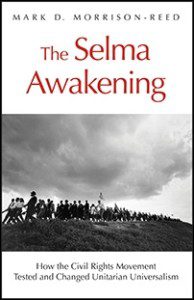 “Bloody Sunday,” March 7, 1965 was fifty years ago this past Saturday. “Turnaround Tuesday,” March 9, 1965 was fifty years ago tomorrow. And if you missed President Obama’s speech this past weekend at the Edmund Pettus Bridge, I encourage you to read the transcript or watch it online. But before I knew that President Obama was going to speech in Selma, I was inspired to write this post after reading Mark Morrison-Reed’s book The Selma Awakening: How the Civil Rights Movement Tested and Changed Unitarian Universalism.
The invitation is to reflect on the past to inform our present and future. To begin with the past, early in the morning of Monday, March 8, 1965, the Rev. Dr. Martin Luther King, Jr. sent the following telegraph:
In the vicious maltreatment of defenseless citizens of Selma, where old women and young children were gassed and clubbed at random, we have witnessed an eruption of the disease of racism which seeks to destroy all America. No American is without responsibility. All are involved in the sorrow that rises from Selma to contaminate every crevice of our national life. The people of Selma will struggle on for the soul of the nation but it is fitting that all Americans help to bear the burden. I call therefore on clergy of all faiths representative of every part of the country, to join me for a ministers’ march to Montgomery on Tuesday morning, March 9th. In this way all America will testify to the fact that the struggle in Selma is for the survival of democracy everywhere in our land. (ix)
Two years earlier in August 1963, 1,600 UUs had shown up for the “March on Washington for Jobs and Freedom” (xii). The next year in 1964 saw the passage of the Civil Rights Act, which UUs and other progressives helped lobby for (76). However, as the recent film Selma powerfully showed, intense voter discrimination and racially targeted violence continued even after the 1964 Civil Rights Act. More action was needed. President Johnson was sympathetic, but resistant to pushing for further voting rights legislation so soon after the 1964 Act. He had other legislative priorities.
The Selma to Montgomery Marches were planned to raise awareness about the immediate need to pass voting rights legislation. But the protesters were met on Bloody Sunday by brutal violence — billy clubs, cattle prods, and clouds of tear gas — coordinated through the white power establishment of the County Sheriff. As images of these horrific attacks were seen across the county, Dr. King’s telegram was dispatched early the next morning.
And as one who responded wrote:
Before two days were out, approximately sixty [UU] ministers had made their pilgrimage to Selma — nearly ten percent of our active parish ministry. I was unutterably proud of our presence. But there was no time for pride… We had come because we had to. We were [also] late, very late, twelve years late. The first voter registration drive was in 1952. They were beaten into submission, beaten on street corners, on the steps of the courthouse, in their own churches, in their own homes — and we did not notice. (101-102)
Ultimately, in addition to many other clergy and laity from many faith groups, as many as “250 UU ministers and hundreds of laypeople journeyed to Selma or Montgomery. Others led demonstrations in their local communities.” (195).
Morrison-Reed does a masterful job of tracing the tapestry of people who went in Selma. But for now allow me to focus on one: The Rev. James Reeb. Reeb was originally from Kansas and had been ordained as a Presbyterian minister. But his passion for social justice, particularly the Civil Right Movement, led him to move his affiliation to Unitarian Universalism. He served for three years as the Assistant Minister of All Souls Church Unitarian in Washington, D.C. before moving to Boston in 1964 to work on housing desegregation. He and his wife Marie had four children, the youngest of whom was an infant where the news came that Monday of Dr. King’s telegram.
But whereas James and Marie had walked together in the March on Washington, she strongly objected to him going to Selma after having seen the footage the night before of Bloody Sunday. Nevertheless, Reeb felt called to show up; his conscience would not allow him to stay at home while human beings in his own country were being treated so cruelly. And he was present for “Turnaround Tuesday,” when the protesters turned around on the second march, choosing to wait for a protective court order. But that evening after dinner at a local integrated restaurant with some fellow UU ministers, Reeb and two others were attacked by local white segregationists. Reeb suffered a severe blow to the head from a large club, and died two days later on Thursday evening. He was only 38 years old. “President Lyndon Johnson called Marie Reeb to offer his condolences” (104-112).
That Saturday, the UUA Board of Trustees was holding its regularly scheduled meeting in Boston. But in the wake of Reeb’s death, they voted to adjoin immediately and go together to Alabama (114). They showed up.
That Monday, a memorial service was held for Rev. Reeb. Dr. King preached the eulogy, which included these words:
“His crime was that he dared to live his faith; he placed himself alongside the disinherited black brethren of this community. James Reeb could not be accused of being only concerned about justice for Negroes away from home. He and his family live in Roxbury, Massachusetts, a predominantly Negro community. [They] devoted their lives to aiding families in low-income housing areas….”
King went on to ask, “Who killed Jim Reeb?” “A few sick, demented, and misguided men.”
Then he asked, “What killed Jim Reeb?” And he answered that it was an indifferent ministry, an irrelevant church, irresponsible politicians, a law enforcement establishment embracing lawlessness in the name of the law, a timid federal government…. (122-123)
But as important as it is to remember the martyrdom of James Reeb in the cause of racial justice, consider as well this passage from the sermon preach at the UU Church of Birmingham that weekend:
Another man died in Selma, within the same social context, shot by a state trooper in an atmosphere of violence. His name was Jimmie Lee Jackson…. Nobody really cared or got upset about Jimmie Lee Jackson…. He was a human being, as was James Reeb and as are you and I…. here’s the tragedy…for implicit in the response of the government and of the people was just that [another black man] was dead.” (120)
We should remember as well the memory of Viola Liuzzo, a Unitarian Universalist lay woman and mother of five, who was shot by white segregationists while she was driving marchers back to Selma after the successful third march (138).
But the important difference, as has been reported in powerful short film produced by The New York Times, is that,
President Johnson received 57 phone calls expressing concern for [the attack on Rev. Reeb]. In contrast, the murder of Jimmie Lee Jackson, a black man and the original inspiration for the march that became Bloody Sunday, received little national attention. When Johnson gave his historic speech advocating for passage of the Voting Rights Bill, he invoked the death of the white minister, James Reeb, as opposed to the black man, Jimmie Lee Jackson. And with the support of a galvanized nation now behind it, the Voting Rights Bill was signed into law on Aug. 6, 1965. In 1967, Dr. King noted, “The failure to mention Jimmy [sic] Jackson only reinforced the impression that to white Americans the life of a Negro is insignificant and meaningless.”
And although it is reprehensible that all-white juries swiftly acquitted the man who murdered Reeb and the man who murdered Liuzzo, Jimmie Lee Jackson’s murderer was not even indicted (181). (For more details, see “45 Years Later, an Apology and 6 Months.”) Horrifying echoes continue to today in the wake of the death of Michael Brown, Eric Garner, and many other people of color.
So when we hear objections today to the #BlackLivesMatter movement, saying that we should instead say #AllLivesMatter — well, yes, all lives matters. But the history of racial injustice in this country shows that we must stand up in particular for the continuing discrimination against people of color in this country.
Along these lines, I cannot recommend strongly enough to you Michele Alexander’s book The New Jim Crow: Mass Incarceration in an Age of Colorblindness. As she and others have shown, there is tremendous racial bias in our criminal justice system. Consider, for instance, that “There are more black men under correctional control today than there were under slavery in 1850.”
I’m reminded of the realization I shared earlier of the UU minister who arrived in Selma fifty years ago feeling a tension between his pride that so many UUs had showed up and his increasing realization that the white UUs were also late to a brutal struggle for human dignity that had been actively going for more than a decade. Today, we should be proud of the Unitarian Universalists and other progressive activists around the country who have been waking up and acting up for justice particularly since the death of Michael Brown in Ferguson, Missouri last August. But Trayvon Martin, Michael Brown, Tamir Rice and Eric Garner are but few names in an ocean of victims of racial injustice that call us to join the struggle for “peace, liberty, and justice for all.”
As we becoming increasingly aware of injustice, will we stand up, will we speak up, and will we show up? Many Unitarian Universalists did show up for the Civil Rights Movement, just as our forbears were leaders and allies in the abolitionist and women’s rights movements. The social justice legacy they helped shape is now ours. And our invitation and challenge is to show up in the ongoing struggle for social, economic, and environmental justice.
For now, I will leave the last words to Mark Morrison-Reed from the conclusion of his book The Selma Awakening:
Unitarian Universalists did not know that Selma would become a pivotal moment in [our] history.… Called, sent, drawn, or compelled, hundreds responded. When they left there were two UU martyrs in their hearts and there was a conviction in their stride….
It is not possible, nor necessary, to know the outcome of our actions; therefore, we act in faith. Faith asks not that we succeed, but that we try. We try because we yearn to live out our values. Conscience urges us on, for we have dreamed of a better, more just tomorrow. We care; therefore, we act. In acting, we risk having our hearts broken a thousand times; therefore, we are sustained by hope. That is the price those who cleared the way for us accepted. It is what living fully, freely, and with integrity demands. (221-222)
May we live in such a way that fifty years from now, our children and grandchildren will look back on us and be grateful for the legacy we have handed on to them of being known as a people who, when faced with injustice, stand up, speak up, and show up.
The Rev. Dr. Carl Gregg is a trained spiritual director, a D.Min. graduate of San Francisco Theological Seminary, and the minister of the Unitarian Universalist Congregation of Frederick, Maryland. Follow him on Facebook (facebook.com/carlgregg) and Twitter (@carlgregg).
Learn more about Unitarian Universalism:
http://www.uua.org/beliefs/principles
Previous Post

March 5, 2015
The Generosity Path
Next Post
March 13, 2015 "A God That Could Be Real"
Browse Our Archives
Select a Category Advent Anti-Racism Archaeology Atheism Baptism Best of the Year List Book Reviews Buddhism Catholicism Christian Education Church and State Church Planting Climate Change Conscientious Objection to War Creation Spirituality Death Penalty Didache Disability Rights Discernment Easter Ecology Emergent Church Movement Empire-Critical Ethics Evolution Feminist Theology Film Reviews Gandhi Gospel of Mark Gun Control Hinduism Immigration Reform Interfaith Islam JFK Judaism Jungian Spirituality Lectionary Commentary Lent Letters to the Editor LGBT Marriage MLK Multiculturalism Mysticism Nonviolent Activism Occupy Paganism (Earth-centered Religions) Parables Paul Pluralism Politics Process Theology Quantum Physics Requiescat In Pace Seminary and Divinity School Sermon Series Retrospective Sermons Spiritual Direction Spiritual Practices Stewardship (Fundraising) The Book of J The Wheel of the Year (Paganism) Theoblogger Challenge Triathlon Uncategorized Unitarian Universalism Worship Resources Youth Ministry
Select a Month July 2026 May 2026 March 2026 November 2025 October 2025 August 2025 February 2025 December 2024 October 2024 March 2024 January 2024 December 2023 November 2023 March 2023 February 2023 January 2023 December 2022 November 2022 August 2022 March 2022 February 2022 January 2022 December 2021 September 2021 August 2021 July 2021 June 2021 May 2021 February 2021 January 2021 December 2020 August 2020 June 2020 May 2020 April 2020 March 2020 February 2020 January 2020 December 2019 November 2019 October 2019 September 2019 July 2019 June 2019 March 2019 February 2019 January 2019 December 2018 November 2018 October 2018 September 2018 June 2018 May 2018 April 2018 March 2018 February 2018 January 2018 December 2017 November 2017 October 2017 September 2017 August 2017 July 2017 June 2017 May 2017 April 2017 March 2017 February 2017 January 2017 December 2016 November 2016 October 2016 September 2016 August 2016 June 2016 May 2016 April 2016 March 2016 February 2016 January 2016 December 2015 November 2015 October 2015 September 2015 August 2015 July 2015 June 2015 May 2015 April 2015 March 2015 February 2015 January 2015 December 2014 November 2014 October 2014 August 2014 July 2014 June 2014 May 2014 April 2014 March 2014 February 2014 January 2014 December 2013 November 2013 October 2013 September 2013 August 2013 July 2013 June 2013 May 2013 April 2013 March 2013 February 2013 January 2013 December 2012 November 2012 October 2012 September 2012 August 2012 July 2012 June 2012 May 2012 April 2012 March 2012 February 2012 January 2012 December 2011 November 2011 October 2011 September 2011 August 2011 July 2011 June 2011 May 2011 April 2011 March 2011 February 2011 January 2011 December 2010 November 2010 October 2010 August 2009 July 2009 May 2009
Follow Us!
TAKE THE
Religious Wisdom Quiz
What attitude does Jesus teach toward children?
Select your answer to see how you score.
Send them away Welcome them Teach them to fight Ignore them
Related posts from Carl Gregg

Peak Spiritual Experiences, Psychedelics, & Consciousness Research


"How the Founding Fathers Became Infallible and Our...

Vampires, Witches, & NPR: The Legacy of Margot...
TRENDING AT PATHEOS More Voices

Reading America at 250: A Nation Wrestles With...
As part of my own reflection on the 250th anniversary of the...

Whenever I am reading a book or listening to an argument, I...

President Trump Ban Animal Torture Videos on Facebook
Call for Stricter Regulations of Animal Abuse Content on Facebook Although President...

Draft Amendments to Address Ritual Abuse in New...
The proposed changes would make it illegal for individuals in domestic partnerships...

How Bans on LGBTQ+ Student Clubs Threaten Religious...
On June 20, 2025, the State of Texas passed Senate Bill 12....

The Truth About the Gen Z Revival
This past year, there has been a lot of media buzz surrounding...
view all More Voices blogs
Ad-Free & Subscriber Log-In Subscription Support
- About Us
- 2026 Calendar
- Videos
- Podcasts
- Library of World Religions
- Faith In Media Tracker
- Advertise With Us
- Write for Us
- Privacy Policy
- Terms of Service
- Do Not Sell My Data
- Contact Us
- Radiant Digital
- Manage Newsletter Subscriptions
- Unsubscribe From Notifications
- Sitemap
Copyright 2008-2026, Patheos. All rights reserved.
Subscription Support Ad-Free & Subscriber Log-In
Follow Patheos