
BuddhistCatholicContemplativeEvangelicalGeneral ChristianHinduJewishLatter-day SaintMuslimNew VisionsProgressive Christian
Beliefs
- Buddhist
- Catholic
- Contemplative
- Evangelical
- General Christian
- Hindu
- Jewish
- Latter-day Saint
- More Voices
- Muslim
- New Visions
- Pagan
- Progressive Christian
Topics
- Religion News
- Food and Religion
- Sports and Religion
- Religious Art
- Religious Music and Entertainment
- Religious Events
- History and Religion
- Style and Religion
- Politics and Religion
- Women in Religion
- Recreation Outdoors and Religion
- Business Finance and Religion
- Careers Workplace and Religion
- Education and Religion
- Family Parenting and Religion
- Health Fitness and Religion
- Home and Religion
- Relationships and Religion
- Technology and Religion
- Travel and Religion
Columnists
- Buddhist Columnists
- Business Finance and Religion Columnists
- Careers Workplace and Religion Columnists
- Catholic Columnists
- Contemplative Columnists
- Education and Religion Columnists
- Evangelists Columnists
- Family Parenting and Religion Columnists
- General Christian Columnists
- Health Fitness and Religion Columnists
- Hindu Columnists
- History and Religion Columnists
- Home and Religion Columnists
- Jewish Columnists
- More Voices Columnists
- Latter Day Columnists
- Muslim Columnists
- New Visions Columnists
- Nonreligious Columnists
- Pagan Columnists
- Politics and Religion Columnists
- Progressive Columnists
- Recreation Outdoors and Religion Columnists
- Relationships and Religion Columnists
- Religion News Columnists
- Religious Art Columnists
- Religious Events Columnists
- Religious Music and Entertainment Columnists
- Sports and Religion Columnists
- Style and Religion Columnists
- Technology and Religion Columnists
- Travel and Religion Columnists
- Women in Religion Columnists
Resource Library
- 2026 Calendar
- Library of World Religions
- The 100 Most Holy Places on Earth
- Patheos Answers
- Podcasts
- Videos
- Faith Leaders Database
- Anglican Episcopalian
- Bahai
- Baptist
- Buddhism
- Christianity
- Confucianism
- Eastern Orthodoxy
- Hinduism
- Holiness and Pentecostal
- ISKCON
- Islam
- Judaism
- Lutheran
- Methodist
- The Church of Jesus Christ of Latter-day Saints
- New Age
- Paganism
- Presbytarian and Reformed
- Protestantism
- Religion Behind the Scenes
- Roman Catholic
- Scientology
- Shia Islam
- Sikhism
- Sufism
- Sunni Islam
- Taoism
- Zen
- See all religions
Research Tools
 Ad-Free & Subscriber Log-In Subscription Support
Ad-Free & Subscriber Log-In Subscription Support
Follow Patheos 

- Trending:
- Forgiveness
- |
- Marriage
- |
- Consciousness
- |
- Death Penalty
- |
- Election
- |
- Halloween

- Home
- More Voices
- Rosa Parks: The Rest of the Story
Rosa Parks: The Rest of the Story
Last updated on: May 4, 2015 at 1:33 pm by Carl Gregg
Rosa Parks: The Rest of the Story 2015-05-04T13:33:41-04:00 Carl Gregg
Patheos Explore the world's faith through different perspectives on religion and spirituality! Patheos has the views of the prevalent religions and spiritualities of the world.
One of many reasons why the film Selma is so riveting is that it focuses much more on the behind-the-scene dynamics of the Selma-to-Montgomery marches than the more familiar public events. And the often-hidden background is what I would like to focus on in this post. Among the many important and significant figures that made Dr. King’s leadership possible, I would like to share with you about “Rosa Parks: The Rest of the Story.” I’ll be drawing from an important new biography published in 2013 by Beacon Press from political science professor Jeanne Theoharis on The Rebellious Life of Mrs. Rosa Parks.
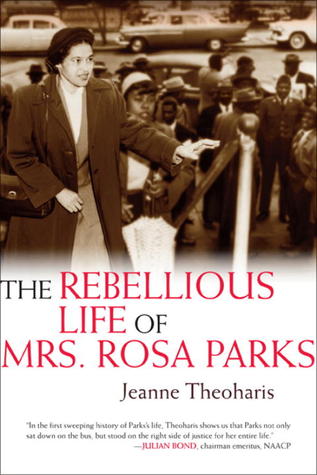 Parks is mostly remember for one isolated moment in her life — an act of civil disobedience: being arrested for refusing to give up her seat to a white man. For her courageous act of conscience that helped catalyze the Montgomery Bus Boycotts, she has been called the “mother of the civil rights movement.” Upon her death in 2005, she was the “first woman and second African American” to “have her body lie in honor in the Capitol rotunda” (vii). To quote some representative commentaries, then-Senator Barack Obama, described Parks as a “small, quiet woman whose name will be remembered.” Senator Hillary Clinton similarly recalled “quiet Rosa Parks moments” (viii). The New York Times called her the “accidental matriarch of the civil rights movement.” Almost universally she was remembered as “quiet,” “humble,” “dignified,” “soft-spoken,” “not angry” and “never raised her voice” — and she was remembered almost exclusively for that one moment in time when she refused to give up her seat (viii-ix).
This romanticized view of Rosa Parks masks the fullness of her life that included “nearly seventy years of activism” (vii). Her refusal on December 1, 1955 to not give up her seat was deeply shaped her previous decade of activism. And she continued social justice work for decades to come. And although she recognized the strategic value of nonviolence — far from being meek and mild — Rosa Park’s “hero was Malcolm X.” She “certainly loved and admired King greatly, but Malcolm’s boldness and clarity, his affirmation of what needed to be done for black people, made him her champion…. Indeed, the Parks family, like many black Southerners, had long kept a gun in their home, even as they participated in the nonviolent movement” (207-8).
Remembering the fullness of Parks’ life can remind us of the importance of committing long term to increasing social justice. And as important an individual acts of conscience are, they usually emerge out of — and are most effective when connected to — a larger ongoing movement and community (ix). Along these lines, Theoharis, Parks’s biographer, notes that whereas many closer looks at public figures expose their all-too-human flaws, “It is a rare gift…to get to deconstruct the popular narrative and demythologize an historical figure, and, in the process, discover a more impressive and substantive person underneath” (xvi).
Rosa Louise Parks was born in 1913. “Her grandparents had been enslaved” (3). Parks grew up up amidst the terrors of the Jim Crow era, and World War II catalyzed her move toward activism as she watched black soldiers like her brother serve honorably in the U.S. armed forces to defend freedom and equality only in the world to be denied freedom and equality when they returned home (17). Seeking to make a difference, in December 1943, she attended her first meeting of the Montgomery branch of the NAACP. Coincidently, it was election day, and as the only woman present, she was elected secretary (17).
In the film Selma, one of the many wrenching scene involves a woman (played by Oprah Winfrey) struggling to register to vote in the face of a corrupt registrar’s intimidation tactics. And from 1943 to 1945, Rosa Parks was one of those women. She finally prevailed through extreme perseverance and clever strategy, and was able to vote in the 1945 gubernatorial election (21-22). And throughout the late 1940s, Parks traveled throughout Alabama” documenting suspicious deaths, rapes of black women by white men, instances of voter intimidation, and other incidents of racial injustice.” If someone was the victim of racial injustice it was widely known that “Rosa will talk with you” as part of gathering evidence to for a federal anti-lynching bill and related legislation (27).
All of that groundwork, starting in 1943, is part of what culminated in her decision not to give up her seat on December 1, 1955. But it is also important to note that after more than a decade of painstaking, dangerous, often demoralizing organizing work in the 40s and early 50s, major systemic changes began to happen in the lead up to that moment on the bus on December 1, 1955. A year-and-a-half earlier on in May 1954, the Supreme Court of the United States declared racially segregated schools to be unconstitutional in “Brown v. Board of Education,” overturning the racist precedent of the 1896 case of Plessy v. Ferguson, which upheld “separate but equal” for schools (34). A year later, on May 31, 1955, only six months before that day on the bus, the Supreme Court issued a follow-up ruling in “Brown II” that integration must happen with “all deliberate speed” (36).
Significantly, two months after that “Brown II” decision, from late July through early August of 1955, Parks attended “a two-week workshop at the Highlander Folk School [in Tennessee] entitled ‘Racial Desegregation: Implementing the Supreme Court Decision’” (35). Beyond the important content of the training, Parks was deeply impressed by the simple practice of whites and blacks eating together at the same tables and sleeping together in the same rooms: “the naturalness of the Highlander’s integration — evident but not belabored — was key” (38). This experience concretely showed her that a different way of being in the world really was possible.
Also, only weeks after Parks completed the Highlander training, fourteen-year-old Emmett Till’s horrific murder in Mississippi captured the attention of the media and the country. Parks wept when she saw the photo of Till’s body in Jet magazine (43). Furthermore, “four days before she would make her historic bus stand, Parks attended a packed mass meeting at Dexter Avenue Church” about the “series of recent lynchings in Mississippi.” As Theoharis writes, “the popular view of Parks as either an accidental or angelic heroine misses the years of gathering courage, fortitude, and community, which then enabled her to refuse to give up her seat” (42).
Now, there’s a lot more to be said here in particular about the history of bus resistance in Montgomery that is detailed in Theoharis’s book, but I will skip ahead to that fateful evening. Significantly, Parks had a humiliating confrontation with that same bus driver back in 1943, and had intentionally avoided his bus for the next twelve years. But that evening, she was tired and distracted. She was looking forward to a short fifteen minute bus ride home to her husband, who was cooking dinner. And she was enjoying the Christmas decorations out the bus window.
Also related to the unplanned timing of her act of civil disobedience, “she had never before that evening been directly asked to give up her seat for a white person” (62). That evening, because the white section was full, when another white man boarded the bus, the bus driver called for the next row to be cleared — which would mean four African-Americans, including Parks, giving up their seats so that one white man could sit down and not have to share the row with a person of color. In Parks’ words, “People always say that I didn’t give up my seat because I was tired but that isn’t true. I was not tired physically, or no more tired than I was at the end of a working day…. No, the only tired I was, was tired of giving in” (62).
It is important to note as well that “city code gave the ‘powers of the police officer’ to bus drivers. All bus drivers were white, and they all carried a gun (63). Theoharis records that:
The bus was crowded, and the tension heightened as [the driver] walked back to her. Refusing to assume a deferential position, Parks looked him straight in the eye.
[The driver] asked, “Are you going to stand up?”
Parks replied, “No….because I got on first and paid the same fare, and I didn’t think it was right for me to have to stand so someone else who got on later could sit down.”
“Well I’m going to have you arrested.”
“You may do that,” Parks replied.”
Given her NAACP organizing experience, Parks was exceedingly cognizant of the dangers a black woman faced in getting arrested. “I didn’t know if I would get off the bus alive….” “but I was resigned to the fact that I had to express my unwillingness to be humiliated in this manner.” (63-64)
In retrospect, we know that Parks’ bravery was vindicated and widely lauded. But she had no idea at the time of what the result of her civil disobedience would be. Over the years, Parks repeatedly highlighted that,
There were other people she knew on the bus, but none came to her defense. Calling it “one of the worst days of my life,” she said, “I felt very much alone.” She fantasized about what it would have been like if the whole bus had emptied or if the other three had stayed where they were “because if they’d had to arrest four of us instead of one, then that would have given me a little support.” (68)
Parks’ civil disobedience helped launch the Montgomery Bus Boycott, which contributed to the Supreme Court’s unanimous decision, almost a year after Parks’ arrest, to nullify bus segregation laws.
Now, again, there is much more to be said about all that happened in the wake of Parks’ arrest, including the sexism that excluded her from the male-dominated leadership of the Civil Rights Movement. And for the details, I encourage anyone interested to read The Rebellious Life of Mrs. Rosa Parks. But to be keep my focus on “the rest of the story” of Parks’ life, it often not remembered that barely more than a month after Parks refused to give up her seat, both she and her husband had been forced out of their respective jobs and were unable to get hired anywhere else (101, 119). The Parks family suffered economic hardship for a full decade until John Conyers, Detroit’s second black member elected to the U.S. House of Representatives, hired her in 1965 as an administrative assistant (164). But even as the family’s situation improved economically, the negative consequences of her bravery continued. And even after moving to Detroit, “Parks continued to receive hate mail and menacing phone calls well into the 1970s” (168).
I noted earlier that the tributes given upon Parks’ death almost uniformly failed to noted how radical she was or anything close to the extent of her seven decades of activism. But while she was alive, she did her best to subvert such misconceptions. For example, at a Kennedy Center gala in honor of her 77th birthday, while most of the performers were apolitical, when it was Parks’ turn to speak, her focus was on contemporary injustice, in particular Nelson Mandela’s anti-apartheid movement in South Africa (231).
And after being mugged at age 81, she said, “I hope to someday see an end to the conditions in our country that would make people want to hurt others” (234). She also spoke out after the terrorist attacks of September 11th, 2001 “against a ‘military response’ to the attacks and to call on the United States to act ‘cooperatively as part of a community of nations within the framework of international law’” (235).
Theoharis, in her conclusion, writes that,
Doing justice to Parks’s legacy requires something much harder for the nation than a simple casket lying in the Capitol. It means acknowledging the roots of racial and social injustice in American society are deep and manifest. It entails a profound recommitment to the goals she had spent her lifetime fighting for — real justice under the law, community empowerment and voting rights, educational access and equity, economic justice, and black history in all parts of the curriculum. It calls for dedicated, persistent action, year after year, decade after decade, as she did, to create systemic social change. (244)
In her early eighties, speaking about she wanted her legacy to be, Parks said, “I’d like people to say I’m a person who always wanted to be free and wanted it not only for myself.” May it be so for us and for all people.
The Rev. Dr. Carl Gregg is a trained spiritual director, a D.Min. graduate of San Francisco Theological Seminary, and the minister of the Unitarian Universalist Congregation of Frederick, Maryland. Follow him on Facebook (facebook.com/carlgregg) and Twitter (@carlgregg).
Learn more about Unitarian Universalism:
http://www.uua.org/beliefs/principles
Previous Post

January 13, 2015
Building Your Own Ethics
Next Post
January 28, 2015 An Honest Heretic: Religion, Science, & Dr. Joseph Priestley
Browse Our Archives
Select a Category Advent Anti-Racism Archaeology Atheism Baptism Best of the Year List Book Reviews Buddhism Catholicism Christian Education Church and State Church Planting Climate Change Conscientious Objection to War Creation Spirituality Death Penalty Didache Disability Rights Discernment Easter Ecology Emergent Church Movement Empire-Critical Ethics Evolution Feminist Theology Film Reviews Gandhi Gospel of Mark Gun Control Hinduism Immigration Reform Interfaith Islam JFK Judaism Jungian Spirituality Lectionary Commentary Lent Letters to the Editor LGBT Marriage MLK Multiculturalism Mysticism Nonviolent Activism Occupy Paganism (Earth-centered Religions) Parables Paul Pluralism Politics Process Theology Quantum Physics Requiescat In Pace Seminary and Divinity School Sermon Series Retrospective Sermons Spiritual Direction Spiritual Practices Stewardship (Fundraising) The Book of J The Wheel of the Year (Paganism) Theoblogger Challenge Triathlon Uncategorized Unitarian Universalism Worship Resources Youth Ministry
Select a Month July 2026 May 2026 March 2026 November 2025 October 2025 August 2025 February 2025 December 2024 October 2024 March 2024 January 2024 December 2023 November 2023 March 2023 February 2023 January 2023 December 2022 November 2022 August 2022 March 2022 February 2022 January 2022 December 2021 September 2021 August 2021 July 2021 June 2021 May 2021 February 2021 January 2021 December 2020 August 2020 June 2020 May 2020 April 2020 March 2020 February 2020 January 2020 December 2019 November 2019 October 2019 September 2019 July 2019 June 2019 March 2019 February 2019 January 2019 December 2018 November 2018 October 2018 September 2018 June 2018 May 2018 April 2018 March 2018 February 2018 January 2018 December 2017 November 2017 October 2017 September 2017 August 2017 July 2017 June 2017 May 2017 April 2017 March 2017 February 2017 January 2017 December 2016 November 2016 October 2016 September 2016 August 2016 June 2016 May 2016 April 2016 March 2016 February 2016 January 2016 December 2015 November 2015 October 2015 September 2015 August 2015 July 2015 June 2015 May 2015 April 2015 March 2015 February 2015 January 2015 December 2014 November 2014 October 2014 August 2014 July 2014 June 2014 May 2014 April 2014 March 2014 February 2014 January 2014 December 2013 November 2013 October 2013 September 2013 August 2013 July 2013 June 2013 May 2013 April 2013 March 2013 February 2013 January 2013 December 2012 November 2012 October 2012 September 2012 August 2012 July 2012 June 2012 May 2012 April 2012 March 2012 February 2012 January 2012 December 2011 November 2011 October 2011 September 2011 August 2011 July 2011 June 2011 May 2011 April 2011 March 2011 February 2011 January 2011 December 2010 November 2010 October 2010 August 2009 July 2009 May 2009
Follow Us!
TAKE THE
Religious Wisdom Quiz
Who was called by God to leave his home and go to a land God would show him?
Select your answer to see how you score.
Jacob Abram Moses Noah
Related posts from Carl Gregg

Why "Columbus Day" Should Be "Indigenous People's Day"
What Ta-Nehisi Coates Taught Me About “People Who...

Letting Go of Fear & Celebrating Differences: Insights...
Top Ten Highlights from The Cornel West Reader
TRENDING AT PATHEOS More Voices

Reading America at 250: A Nation Wrestles With...
As part of my own reflection on the 250th anniversary of the...

Whenever I am reading a book or listening to an argument, I...

President Trump Ban Animal Torture Videos on Facebook
Call for Stricter Regulations of Animal Abuse Content on Facebook Although President...

Draft Amendments to Address Ritual Abuse in New...
The proposed changes would make it illegal for individuals in domestic partnerships...

How Bans on LGBTQ+ Student Clubs Threaten Religious...
On June 20, 2025, the State of Texas passed Senate Bill 12....

The Truth About the Gen Z Revival
This past year, there has been a lot of media buzz surrounding...
view all More Voices blogs
Ad-Free & Subscriber Log-In Subscription Support
- About Us
- 2026 Calendar
- Videos
- Podcasts
- Library of World Religions
- Faith In Media Tracker
- Advertise With Us
- Write for Us
- Privacy Policy
- Terms of Service
- Do Not Sell My Data
- Contact Us
- Radiant Digital
- Manage Newsletter Subscriptions
- Unsubscribe From Notifications
- Sitemap
Copyright 2008-2026, Patheos. All rights reserved.
Subscription Support Ad-Free & Subscriber Log-In
Follow Patheos