
BuddhistCatholicContemplativeEvangelicalGeneral ChristianHinduJewishLatter-day SaintMuslimNew VisionsProgressive Christian
Beliefs
- Buddhist
- Catholic
- Contemplative
- Evangelical
- General Christian
- Hindu
- Jewish
- Latter-day Saint
- More Voices
- Muslim
- New Visions
- Pagan
- Progressive Christian
Topics
- Religion News
- Food and Religion
- Sports and Religion
- Religious Art
- Religious Music and Entertainment
- Religious Events
- History and Religion
- Style and Religion
- Politics and Religion
- Women in Religion
- Recreation Outdoors and Religion
- Business Finance and Religion
- Careers Workplace and Religion
- Education and Religion
- Family Parenting and Religion
- Health Fitness and Religion
- Home and Religion
- Relationships and Religion
- Technology and Religion
- Travel and Religion
Columnists
- Buddhist Columnists
- Business Finance and Religion Columnists
- Careers Workplace and Religion Columnists
- Catholic Columnists
- Contemplative Columnists
- Education and Religion Columnists
- Evangelists Columnists
- Family Parenting and Religion Columnists
- General Christian Columnists
- Health Fitness and Religion Columnists
- Hindu Columnists
- History and Religion Columnists
- Home and Religion Columnists
- Jewish Columnists
- More Voices Columnists
- Latter Day Columnists
- Muslim Columnists
- New Visions Columnists
- Nonreligious Columnists
- Pagan Columnists
- Politics and Religion Columnists
- Progressive Columnists
- Recreation Outdoors and Religion Columnists
- Relationships and Religion Columnists
- Religion News Columnists
- Religious Art Columnists
- Religious Events Columnists
- Religious Music and Entertainment Columnists
- Sports and Religion Columnists
- Style and Religion Columnists
- Technology and Religion Columnists
- Travel and Religion Columnists
- Women in Religion Columnists
Resource Library
- 2026 Calendar
- Library of World Religions
- The 100 Most Holy Places on Earth
- Patheos Answers
- Podcasts
- Videos
- Faith Leaders Database
- Anglican Episcopalian
- Bahai
- Baptist
- Buddhism
- Christianity
- Confucianism
- Eastern Orthodoxy
- Hinduism
- Holiness and Pentecostal
- ISKCON
- Islam
- Judaism
- Lutheran
- Methodist
- The Church of Jesus Christ of Latter-day Saints
- New Age
- Paganism
- Presbytarian and Reformed
- Protestantism
- Religion Behind the Scenes
- Roman Catholic
- Scientology
- Shia Islam
- Sikhism
- Sufism
- Sunni Islam
- Taoism
- Zen
- See all religions
Research Tools
 Ad-Free & Subscriber Log-In Subscription Support
Ad-Free & Subscriber Log-In Subscription Support
Follow Patheos 

- Trending:
- Forgiveness
- |
- Marriage
- |
- Consciousness
- |
- Death Penalty
- |
- Election
- |
- Halloween

- Home
- More Voices
- How to Make 2015 a “Year of Well-being”
How to Make 2015 a “Year of Well-being”
Last updated on: May 4, 2015 at 1:32 pm by Carl Gregg
How to Make 2015 a “Year of Well-being” 2015-05-04T13:32:47-04:00 Carl Gregg
Patheos Explore the world's faith through different perspectives on religion and spirituality! Patheos has the views of the prevalent religions and spiritualities of the world.
A colleague reminded me recently of a quote from Zora Neale Hurston’s novel Their Eyes Were Watching God that is resonant with this time of year: “There are years that ask questions and years that answer.” What was 2014 for you? “A Year of Questions,” “A Year of Answers,” or somewhere in between?
From a different perspective, the online magazine Slate spent last year tracking what various people were outraged about. If you follow the news regularly, it’s probably not surprising to hear that there is a lot of umbrage-taking in our culture. But it is nonetheless stunning to see every day of 2014 connected to a story about which one or more groups were incensed. And a fair percentage of the stories are what some pundits call “fake outrage”: exaggerated anger, exploiting someone’s misstatement to score partisan political points.
What does 2015 hold in store for you? Will it be a “Year of Questions,” “A Year of Answers,” “A Year of Outrage”? You can likely think of other overarching themes that may connect more with your particular situation in life. But I would like to invite you to consider one other way of being in the world that you can intentionally choose for 2015 and beyond. What would it look like for 2015 to be a “Year of Well-being”? For example, what difference might it make for you to regularly set an intention for yourself in 2015 based on Buddhist loving-kindness meditation: “May I be filled with loving-kindness. May I be peaceful and at ease. May I be well.” And then to extend that intention to anyone nearby: “May you be filled with loving-kindness. May you be peaceful and at ease. May you be well.” And finally to all beings: “May we be filled with loving-kindness. May we be peaceful and at ease. May we be well.” Admittedly, there is truth in the bumper sticker adage that, “If you’re not outraged, you’re not paying attention.” But how might your relationship to other people and yourself change this next year if you invested equally as much time and energy in cultivating well-being as many people do in stoking outrage?
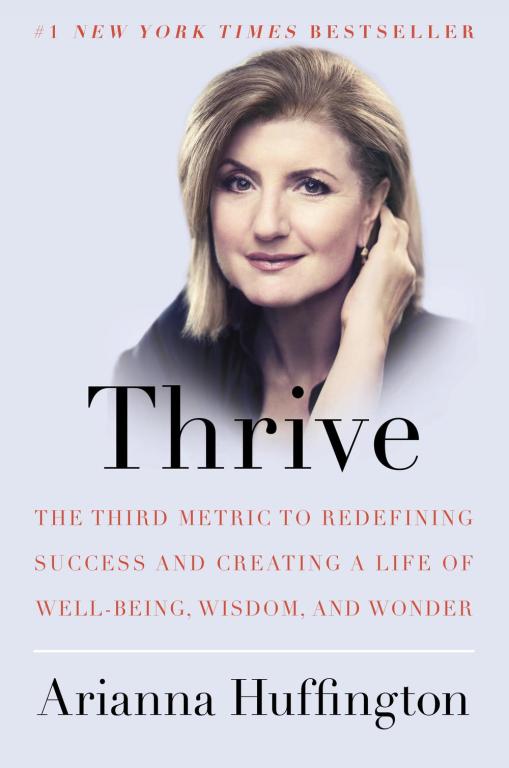 Along these lines, I heard a interesting interview with Arianna Huffington, the founder of the online media website The Huffington Post, about the motivation behind writing her new book Thrive. Her wake-up call came in 2007 when she collapsed from exhaustion, hitting her head on the corner of her desk, cutting her eye and breaking her cheekbone in the process. After extensive medical tests, it turned out the only thing wrong with her was profound sleep deprivation (1).
She had founded The Huffington Post two years earlier in 2005, and to keep up with its explosive growth, she had been “working eighteen hours a day, seven days a week.” Outwardly, she seemed like the ideal of success and had been chosen by Time magazine “as one of the world’s 100 Most Influential People.” In terms of “money and power,” she was successful. But she writes that she was “not living a successful life by any sane definition” (2). And collapsing was a loud wake-up call.
The term “wake up call” is deeply resonant with Buddhism. The word “Buddha” is a title that means “Awakened One” that was given to the prince-turned-spiritual teacher Siddhartha Gautama. For the historical Buddha, his wake up calls came when he wandered out of the walled gardens of his palace and for the first time encountered poverty, sickness, and death. And he began to seek a different sort of life. Like Huffington, the historical Buddha in his childhood seemed to have it all from the perspective of money and power. But he came to see that there is much more to living a good life than money and power alone.
Money and power are important if we’re going to change the world, but if we are to truly thrive and flourish as human beings, we must take into account not only the “bottom line” of profit, but also additional factors such as what some commentators call the “triple bottom line of “people, planet, and profit.” For Huffington, in addition to money and power as measures of success, she has in the years since her wake-up call identified a handful of “third metrics” that have served as touchstones for her as she has studied people who are not burned-out and exhausted, but instead thriving. For Huffington, these “third metrics” are well-being, wisdom, wonder, and giving.
For this post, I am primarily limiting myself to the first of that list: well-being. And in consulting with experts, Huffington has identified three steps that anyone can begin experimenting with immediately to increase well-being. The first as you can probably guess from her wake up call story is to get more sleep. That could include going to bed earlier or taking a short nap in the early afternoon if your schedule and job allows for a siesta. For on-the-job napping, I have friends, who keep a yoga mat in their office, which they use to catch a twenty-minute power nap with the office door locked (111). Because many of us have less control over our first meeting of the day, for going to bed earlier, Huffington recommends starting with setting an alarm to remind yourself to go to bed just thirty minutes earlier, then work back from there until ideally you find yourself waking up in the morning before your alarm clock feeling refreshed (82). And here’s a “pro-tip”: if you put that reminder alarm to go to bed early in your bedroom, then when you get up to turn off the alarm, that “at least gets you in the right room at the right time” (84).
Personally, I stay busy most of the time, but one of my priorities has always been getting 7-8 hours of sleep a night, and I take a twenty-minute power naps in the afternoon when I can:
As Dr. Michael Rosen, chief wellness officer of the Cleveland Clinic, put it, “Sleep is the most underrated health habit.” …There’s practically no element of our lives that’s not improved by getting adequate sleep. And there is no element of life that’s not diminished by lack of sleep…. Our creativity, ingenuity, confidence, leadership, and decision making can all be enhanced simply by getting enough sleep. [Doctors at Harvard Medical School’s Division of Sleep Medicine add that] “Sleep deprivation negatively impacts our mood, our ability to focus, and our ability to access higher-level cognitive functions. (75)
Huffington’s personal experience and research have led her to become a self-described “sleep-evangelist.”
And after getting more sleep, her second step is getting more exercise. Again, start simple if you need to: take the steps instead of the elevator, add a walk in the morning, afternoon, or evening, and build up from there. Exercise, as study after study shows is not only good for our longterm health, but also a huge stress reliever and sleep aid. You could even experiment with the new “Super-Short Workout” Fitness trend, which is endorsed by The New York Times.
Huffington’s third step is to meditate, starting with five minutes and building up to twenty (or more) minutes a day. You can start even more simply by introducing some contemplative silence into another part of your day: turn off the radio for some or all of your commute, take a walk or exercise without listening to an iPod and allow that silence to be your gateway to meditating more. For details, there are some links to free beginner’s guides to meditation on the UU Buddhist webpage of the congregation I serve.
I also appreciate that meditation is the third of Huffington’s three steps. Over the years when people have come to my office asking for advice about meditation, by far the most common problem people have named is that when they sit down to try and meditate, they find themselves falling asleep. My response is that your body is telling you that before learning to meditate, you need to get more sleep. Adequate rest is step one. And exercise is often an important intermediate step because it gets us out of our “monkey mind” and into our body. So if you reprioritize sleep and exercising (even thirty minutes/day more for each), you will have a much more solid foundation for meditation and will have taken significant strides toward creating a year of more well-being.
For the technologically inclined, there are a few Meditation and Mindfulness apps for smartphones that can help you get started. Some good ones include “Buddhify,” “Headspace,” and “Insight Timer.” If you are at a computer for much of the day, Huffington also recommends the website donothingfor2minutes.com, which:
is simply a full-screen video of waves crashing at sunset with a timer counting down for two minutes, along with the instructions, “Just relax and look at the waves. Don’t touch your mouse or keypad for two minutes.” If you do, a bright red flashing “FAIL” comes up on the screen — perhaps not the most Zen reminder to go back to your break, but effective nonetheless. (269)
Personally, looking back over the past few years, I am already doing fairly well with setting aside time for sleep, exercise, and meditation. But one major hindrance to well-being that particularly stands out to me is that my summers for the past three years straight have been extremely busy. So in 2015, one change I hope to make is take more of my vacation time for actual vacation. And with 2015 stretched out before us, I invite you to consider if you can go ahead and block off any vacation time you are allotted to make sure that you have time away.
For now, I will move toward my conclusion five questions from the spiritual teacher Parker Palmer that are inspired by Anne Hillman’s poem “We look with uncertainty.” Which of these questions most resonates with you in the new year?
• How can I let go of my need for fixed answers in favor of aliveness?
• What is my next challenge in daring to be [not perfect, but] human?
• How can I open myself to the beauty of nature and human nature?
• Who or what do I need to learn to love next? And next? And next?
• What is the new creation that wants to be born in and through me?
In that spirit of open reflection, as we continue to consider what it might mean to experiment with making 2015 a “Year of Well-being,” looking back on 2014, is there something — a person, place, or thing — that has been a hindrance to your well-being? Is there is something that you feel called to say “no” to or let go of for the new year?
Looking forward to the year ahead, is there something that you want to do, affirm, or say “yes” to in 2015?
What one next step might you take to cultivate more well-being in 2015?
The Rev. Dr. Carl Gregg is a trained spiritual director, a D.Min. graduate of San Francisco Theological Seminary, and the minister of the Unitarian Universalist Congregation of Frederick, Maryland. Follow him on Facebook (facebook.com/carlgregg) and Twitter (@carlgregg).
Learn more about Unitarian Universalism:
http://www.uua.org/beliefs/principles
Previous Post

December 30, 2014
Best of 2014: Books, Music, Film, & Podcasts
Next Post
January 13, 2015 Building Your Own Ethics
Browse Our Archives
Select a Category Advent Anti-Racism Archaeology Atheism Baptism Best of the Year List Book Reviews Buddhism Catholicism Christian Education Church and State Church Planting Climate Change Conscientious Objection to War Creation Spirituality Death Penalty Didache Disability Rights Discernment Easter Ecology Emergent Church Movement Empire-Critical Ethics Evolution Feminist Theology Film Reviews Gandhi Gospel of Mark Gun Control Hinduism Immigration Reform Interfaith Islam JFK Judaism Jungian Spirituality Lectionary Commentary Lent Letters to the Editor LGBT Marriage MLK Multiculturalism Mysticism Nonviolent Activism Occupy Paganism (Earth-centered Religions) Parables Paul Pluralism Politics Process Theology Quantum Physics Requiescat In Pace Seminary and Divinity School Sermon Series Retrospective Sermons Spiritual Direction Spiritual Practices Stewardship (Fundraising) The Book of J The Wheel of the Year (Paganism) Theoblogger Challenge Triathlon Uncategorized Unitarian Universalism Worship Resources Youth Ministry
Select a Month July 2026 May 2026 March 2026 November 2025 October 2025 August 2025 February 2025 December 2024 October 2024 March 2024 January 2024 December 2023 November 2023 March 2023 February 2023 January 2023 December 2022 November 2022 August 2022 March 2022 February 2022 January 2022 December 2021 September 2021 August 2021 July 2021 June 2021 May 2021 February 2021 January 2021 December 2020 August 2020 June 2020 May 2020 April 2020 March 2020 February 2020 January 2020 December 2019 November 2019 October 2019 September 2019 July 2019 June 2019 March 2019 February 2019 January 2019 December 2018 November 2018 October 2018 September 2018 June 2018 May 2018 April 2018 March 2018 February 2018 January 2018 December 2017 November 2017 October 2017 September 2017 August 2017 July 2017 June 2017 May 2017 April 2017 March 2017 February 2017 January 2017 December 2016 November 2016 October 2016 September 2016 August 2016 June 2016 May 2016 April 2016 March 2016 February 2016 January 2016 December 2015 November 2015 October 2015 September 2015 August 2015 July 2015 June 2015 May 2015 April 2015 March 2015 February 2015 January 2015 December 2014 November 2014 October 2014 August 2014 July 2014 June 2014 May 2014 April 2014 March 2014 February 2014 January 2014 December 2013 November 2013 October 2013 September 2013 August 2013 July 2013 June 2013 May 2013 April 2013 March 2013 February 2013 January 2013 December 2012 November 2012 October 2012 September 2012 August 2012 July 2012 June 2012 May 2012 April 2012 March 2012 February 2012 January 2012 December 2011 November 2011 October 2011 September 2011 August 2011 July 2011 June 2011 May 2011 April 2011 March 2011 February 2011 January 2011 December 2010 November 2010 October 2010 August 2009 July 2009 May 2009
Follow Us!
TAKE THE
Religious Wisdom Quiz
What Christian group is known for large-scale evangelistic crusades?
Select your answer to see how you score.
Evangelicals Orthodox Quakers Methodists
Related posts from Carl Gregg
How to Make & Keep Your New Year’s...

"Are You Living the Life You Chose?": How...
Pragmatic Buddhism, Westernized Dharma, 21st-century Sangha
TRENDING AT PATHEOS More Voices

Reading America at 250: A Nation Wrestles With...
As part of my own reflection on the 250th anniversary of the...

Whenever I am reading a book or listening to an argument, I...

President Trump Ban Animal Torture Videos on Facebook
Call for Stricter Regulations of Animal Abuse Content on Facebook Although President...

Draft Amendments to Address Ritual Abuse in New...
The proposed changes would make it illegal for individuals in domestic partnerships...

How Bans on LGBTQ+ Student Clubs Threaten Religious...
On June 20, 2025, the State of Texas passed Senate Bill 12....

The Truth About the Gen Z Revival
This past year, there has been a lot of media buzz surrounding...
view all More Voices blogs
Ad-Free & Subscriber Log-In Subscription Support
- About Us
- 2026 Calendar
- Videos
- Podcasts
- Library of World Religions
- Faith In Media Tracker
- Advertise With Us
- Write for Us
- Privacy Policy
- Terms of Service
- Do Not Sell My Data
- Contact Us
- Radiant Digital
- Manage Newsletter Subscriptions
- Unsubscribe From Notifications
- Sitemap
Copyright 2008-2026, Patheos. All rights reserved.
Subscription Support Ad-Free & Subscriber Log-In
Follow Patheos