
BuddhistCatholicContemplativeEvangelicalGeneral ChristianHinduJewishLatter-day SaintMuslimNew VisionsProgressive Christian
Beliefs
- Buddhist
- Catholic
- Contemplative
- Evangelical
- General Christian
- Hindu
- Jewish
- Latter-day Saint
- More Voices
- Muslim
- New Visions
- Pagan
- Progressive Christian
Topics
- Religion News
- Food and Religion
- Sports and Religion
- Religious Art
- Religious Music and Entertainment
- Religious Events
- History and Religion
- Style and Religion
- Politics and Religion
- Women in Religion
- Recreation Outdoors and Religion
- Business Finance and Religion
- Careers Workplace and Religion
- Education and Religion
- Family Parenting and Religion
- Health Fitness and Religion
- Home and Religion
- Relationships and Religion
- Technology and Religion
- Travel and Religion
Columnists
- Buddhist Columnists
- Business Finance and Religion Columnists
- Careers Workplace and Religion Columnists
- Catholic Columnists
- Contemplative Columnists
- Education and Religion Columnists
- Evangelists Columnists
- Family Parenting and Religion Columnists
- General Christian Columnists
- Health Fitness and Religion Columnists
- Hindu Columnists
- History and Religion Columnists
- Home and Religion Columnists
- Jewish Columnists
- More Voices Columnists
- Latter Day Columnists
- Muslim Columnists
- New Visions Columnists
- Nonreligious Columnists
- Pagan Columnists
- Politics and Religion Columnists
- Progressive Columnists
- Recreation Outdoors and Religion Columnists
- Relationships and Religion Columnists
- Religion News Columnists
- Religious Art Columnists
- Religious Events Columnists
- Religious Music and Entertainment Columnists
- Sports and Religion Columnists
- Style and Religion Columnists
- Technology and Religion Columnists
- Travel and Religion Columnists
- Women in Religion Columnists
Resource Library
- 2026 Calendar
- Library of World Religions
- The 100 Most Holy Places on Earth
- Patheos Answers
- Podcasts
- Videos
- Faith Leaders Database
- Anglican Episcopalian
- Bahai
- Baptist
- Buddhism
- Christianity
- Confucianism
- Eastern Orthodoxy
- Hinduism
- Holiness and Pentecostal
- ISKCON
- Islam
- Judaism
- Lutheran
- Methodist
- The Church of Jesus Christ of Latter-day Saints
- New Age
- Paganism
- Presbytarian and Reformed
- Protestantism
- Religion Behind the Scenes
- Roman Catholic
- Scientology
- Shia Islam
- Sikhism
- Sufism
- Sunni Islam
- Taoism
- Zen
- See all religions
Research Tools
 Ad-Free & Subscriber Log-In Subscription Support
Ad-Free & Subscriber Log-In Subscription Support
Follow Patheos 

- Trending:
- Forgiveness
- |
- Marriage
- |
- Consciousness
- |
- Death Penalty
- |
- Election
- |
- Halloween

- Home
- More Voices
- Building Your Own Ethics
Building Your Own Ethics
Last updated on: May 4, 2015 at 1:33 pm by Carl Gregg
Building Your Own Ethics 2015-05-04T13:33:15-04:00 Carl Gregg
Patheos Explore the world's faith through different perspectives on religion and spirituality! Patheos has the views of the prevalent religions and spiritualities of the world.
I have posted previously about “Building Your Own Theology.” And this idea that you can “build your own theology” — as opposed to ascribing to a pre-existing theological system designed in the past or by someone else — is connected to what is meant when Unitarian Universalism is described as a theologically liberal religion. I should add that when we talk about Unitarian Universalism as a theologically liberal religion, that does not necessitate political liberalism.
Irrespective of one’s politics, the “Liberal Turn” in religion was the move from religious authority vested in hierarchy, community, and tradition to religious authority derived from human reason and individual experience. And again this “Liberal Turn” is not in the modern sense of an orientation toward the Democratic or Green Party, but in the classical sense of Liberalism (from the Latin root, liber, meaning “free”). Historically, this Liberal Turn in theology toward individual freedom of belief began in the 18th-century with the Enlightenment. Both then and now, practicing liberal religion means you are free to build your own theology based on what you know to be true based on reason and your firsthand experience.
And we have seen the fruit of that turn to liberal religion born out as individuals and groups have won hearts and minds for greater equality with the truth that regardless of those infamous “clobber texts” in ancient scriptures that are racist, sexist, and heterosexist, we have seen in our firsthand experience that slavery is wrong, women and men are equal, and same-sex relationships are just as beautiful, significant, and difficult as heterosexual relationships — and deserve all the same advantages and protections under the law. Liberal religion means not being locked into an antiquated belief system simply because we have allegedly “always done it that way,” but instead embracing the freedom to build a new theology as new information comes to light.
This follow-up post on “Building Your Own Ethics” emerges out of a course I taught this fall in the congregation I serve. Instead of memorizing pre-existing ethical systems, we discussed our responses to case studies. In particular, the curriculum challenged us, as we moved through the diverse series of ethical dilemmas, to be attentive to the following questions:
- Are you consistent in your ethical approach to each case study? Why or why not? And is having a single ethical approach to all situations a virtue or vice?
- Is there a pattern underneath your responses to ethical situations — that is, do you notice yourself relying on your logic, emotions, “gut reaction,” etc.?
- Do you find your opinion changing because of points raised through the group discussion process? Or do you tend to maintain your original position?
Paying attention to these dynamics can help us be more intentional as we seek to build our ethics.
Emphasizing the need to “build your own ethics” is important because it is so clearly the situation in which we find ourselves already fifteen years into the 21st century. In contrast, I was raised from a different perspective. The theologically conservative religion of my childhood taught we that Jesus was the center of history: that the destiny of the entire universe changed with the life, death, and resurrection of one person more than 2,000 years ago.
But as I grew up, I learned more about science. And while I continue to have a deep respect for Jesus’ ethical teachings and many valuable spiritual insights from the Christian tradition, I also began to have a much greater appreciation for the overwhelming scale of our 13.8 billion year old universe. And that after Copernicus, Einstein, Hubble, and others we know that earth is not the center of the universe, but rather the “third rock from the sun” in a solar system that is merely on the periphery of the Milky Way galaxy that, in turn, is merely one among more than 100 billion other galaxies. And after Darwin, we know that our species is not “a little a lower than the angels,” but merely “a little higher than the apes.” Here in the year 2015, we know too much about the diverse cultural pluralism across time and around the world to believe that any single ethical system is handed down from “on high” or could be applicable to all times and places. Instead, we know that all ethical systems are contingent on time, chance, and historical context. And to me that makes being intention and responsible about “building your own ethics” all the more vital and important.
 The person who has helped me the most in reflecting on “building your own ethics” is the late American pragmatist philosopher Richard Rorty (1931-2007). I first read his book Contingency, Irony, Solidarity well more than a decade ago. And although there are parts of it that I disagree with, the basic three-part movement has stuck with me. In the first two parts, I both appreciated and wrestled with his honesty about the radical contingency of our historical context that we have reflected on already: living after-Copernicus, after-Darwin, after-Freud and realizing both how infinitesimally small we are in the grand sweep of the universe. But then there’s the twist: we can choose solidarity with one another anyway. We don’t have to, and there is no guarantee that we will. But we can. And despite all the terrible things we have done and continue to do to our fellow human beings and this planet, we as a species have chosen solidarity and compassion, dignity and decency more often than we might have.
One of his major points is that there is no “neutral, noncircular” justification for whatever ethics we build as individuals or as societies (197). By that he means that whatever ethical systems we come up with are deeply shaped by time. chance, and historical context. There is no One Right Way of Acting Ethically in All Times and Places. We are but one species on this one far flung planet that is on the edge of one galaxy among more than a 100 billion other galaxies.
The implications of such a realization does not have to be despair at our insignificance. Rather, it can been seen as an opportunity to embrace the preciousness of our life: that we are here right now, despite all the twists and turns of time and chance that led to this present moment in the 13.8 billion year old universe story. The hope in this evolutionary perspective is the challenge to let go of fundamentalist perspectives such as the one that led to the barbaric atrocity in France this past week.
Instead of an evolutionary perspective, many traditional religions maintain a pre-Copernican, pre-Darwinian worldview that teaches that individuals must make sacrifices in this life in exchange for rewards in a next life. But, Rorty writes that, “willingness to endure suffering for the sake of future reward [is] transferable from individual rewards to social ones, from one’s hope for paradise to one’s hopes for one’s grandchildren” (85). I find that shift to an incredibly beautiful promise. Let me be clear that by no means am I saying that I can prove whether or not God or an afterlife exists. Rather, what I am inviting you to consider is that from our finite human perspective, we will never be able to answer metaphysical questions with certainty. So while metaphysical questions may be fascinating to speculate about, why not focus the best of our energy on what we can do: building a better world right here and now on this earth for ourselves and for future generations.
Recently, I’ve been thinking a lot about how we tell the stories of how we reached our present situation. And I’ve given you one example of the story of how we theological liberals came to believe that human reason and individual experience are legitimate sources of religious authority — and how we came to see Copernicus, Darwin, and Einstein as equally important for building an ethics or theology as Buddha or Jesus, Moses or Mohammed.
 And I would like to move toward my conclusion by reflecting some on the story we need to better learn to tell if we are going to more fully transfer our hopes from individual salvation in the next world to the social hope of how we human beings — we “clever animals” — might learn to live together in this world. Part of the promise here is the invitation to tell this story of social hope in an inspiring, patriotic way. Rorty writes in his book Philosophy and Social Hope that this might mean:
acquiring an image of [ourselves] as heirs to a tradition of increasing liberty and rising hope…. wanting [ourselves and our] children to come to think of [ourselves] as proud and loyal citizens of a country that, slowly and painfully, threw off a foreign yoke, freed its slaves, enfranchised its women, restrained its robber barons and licensed its trade unions, liberalized its religious practices, broadened its religious and moral tolerance, and built colleges in which [increasingly percentages] of its population could enroll — a country that numbered Jefferson, Thoreau, Susan B. Anthony, Eugene Debs…Rosa Parks, and James Baldwin among its citizens. (121-122)
This “narrative of freedom and hope” is one we can learn to tell better, more boldly, and more robustly.
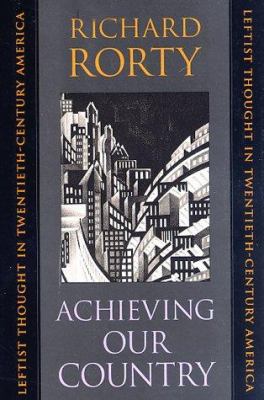 Rorty continues in what may be his most accessible book Achieving Our Country by noting that few people at the turn of the twentieth century would have predicted the Progressive Movement, the forty-hour week, Women’s Suffrage, the New Deal, the Civil Rights Movement, the successes of second-wave feminism” or what we are seeing today in legalized same-sex marriage in 36 U.S. states and the District of Columbia. “Nobody in [2015] can know that America will not, in the course of the next century, witness even greater moral progress” (106).
And as we continue to reflect on what role we (as individuals and as a congregation) may feel called to play in advancing the cause of social justice in our time, I will leave you with this reflection from Rorty from that essay in Philosophy and Social Hope in which he attempts to imagine what it might be like to look back on our present day from vantage point of the turn-of-the-22nd-century:
Just as twentieth-century Americans had trouble imagining how their pre-Civil War ancestors could have stomached slavery, so we at the end of the twenty-first century have trouble imagining how our great-grandparents could have legally permitted a CEO to get 20 times more than her lowest paid employee. We cannot understand how Americans a hundred years ago could have tolerated the horrible contrast between a childhood spent in the suburbs and one spent in the ghettos. Such inequalities seems to us evident moral abominations, but the vast majority of our ancestors took them to be regrettable necessities. (243)
There is no guarantee that the “arc of the universe will bend toward justice.” But may we do our part in working for what the UU 6th Principle calls, “The goal of world community with peace, liberty, and justice for all.” Together, may we build a future with hope.
The Rev. Dr. Carl Gregg is a trained spiritual director, a D.Min. graduate of San Francisco Theological Seminary, and the minister of the Unitarian Universalist Congregation of Frederick, Maryland. Follow him on Facebook (facebook.com/carlgregg) and Twitter (@carlgregg).
Learn more about Unitarian Universalism:
http://www.uua.org/beliefs/principles
Previous Post

January 7, 2015
How to Make 2015 a "Year of Well-being"
Next Post
January 19, 2015 Rosa Parks: The Rest of the Story
Browse Our Archives
Select a Category Advent Anti-Racism Archaeology Atheism Baptism Best of the Year List Book Reviews Buddhism Catholicism Christian Education Church and State Church Planting Climate Change Conscientious Objection to War Creation Spirituality Death Penalty Didache Disability Rights Discernment Easter Ecology Emergent Church Movement Empire-Critical Ethics Evolution Feminist Theology Film Reviews Gandhi Gospel of Mark Gun Control Hinduism Immigration Reform Interfaith Islam JFK Judaism Jungian Spirituality Lectionary Commentary Lent Letters to the Editor LGBT Marriage MLK Multiculturalism Mysticism Nonviolent Activism Occupy Paganism (Earth-centered Religions) Parables Paul Pluralism Politics Process Theology Quantum Physics Requiescat In Pace Seminary and Divinity School Sermon Series Retrospective Sermons Spiritual Direction Spiritual Practices Stewardship (Fundraising) The Book of J The Wheel of the Year (Paganism) Theoblogger Challenge Triathlon Uncategorized Unitarian Universalism Worship Resources Youth Ministry
Select a Month July 2026 May 2026 March 2026 November 2025 October 2025 August 2025 February 2025 December 2024 October 2024 March 2024 January 2024 December 2023 November 2023 March 2023 February 2023 January 2023 December 2022 November 2022 August 2022 March 2022 February 2022 January 2022 December 2021 September 2021 August 2021 July 2021 June 2021 May 2021 February 2021 January 2021 December 2020 August 2020 June 2020 May 2020 April 2020 March 2020 February 2020 January 2020 December 2019 November 2019 October 2019 September 2019 July 2019 June 2019 March 2019 February 2019 January 2019 December 2018 November 2018 October 2018 September 2018 June 2018 May 2018 April 2018 March 2018 February 2018 January 2018 December 2017 November 2017 October 2017 September 2017 August 2017 July 2017 June 2017 May 2017 April 2017 March 2017 February 2017 January 2017 December 2016 November 2016 October 2016 September 2016 August 2016 June 2016 May 2016 April 2016 March 2016 February 2016 January 2016 December 2015 November 2015 October 2015 September 2015 August 2015 July 2015 June 2015 May 2015 April 2015 March 2015 February 2015 January 2015 December 2014 November 2014 October 2014 August 2014 July 2014 June 2014 May 2014 April 2014 March 2014 February 2014 January 2014 December 2013 November 2013 October 2013 September 2013 August 2013 July 2013 June 2013 May 2013 April 2013 March 2013 February 2013 January 2013 December 2012 November 2012 October 2012 September 2012 August 2012 July 2012 June 2012 May 2012 April 2012 March 2012 February 2012 January 2012 December 2011 November 2011 October 2011 September 2011 August 2011 July 2011 June 2011 May 2011 April 2011 March 2011 February 2011 January 2011 December 2010 November 2010 October 2010 August 2009 July 2009 May 2009
Follow Us!
TAKE THE
Religious Wisdom Quiz
In Revelation, what does John eat that is sweet in his mouth but sour in his stomach?
Select your answer to see how you score.
Honey A little scroll The word of God A sealed book
Related posts from Carl Gregg
Why Peter Singer Hates on Guide Dogs &...
“Unsanctifying Human Life”: Wrestling with Peter Singer’s Ethics

What Do We Mean We When Say, “Building...
TRENDING AT PATHEOS More Voices

Reading America at 250: A Nation Wrestles With...
As part of my own reflection on the 250th anniversary of the...

Whenever I am reading a book or listening to an argument, I...

President Trump Ban Animal Torture Videos on Facebook
Call for Stricter Regulations of Animal Abuse Content on Facebook Although President...

Draft Amendments to Address Ritual Abuse in New...
The proposed changes would make it illegal for individuals in domestic partnerships...

How Bans on LGBTQ+ Student Clubs Threaten Religious...
On June 20, 2025, the State of Texas passed Senate Bill 12....

The Truth About the Gen Z Revival
This past year, there has been a lot of media buzz surrounding...
view all More Voices blogs
Ad-Free & Subscriber Log-In Subscription Support
- About Us
- 2026 Calendar
- Videos
- Podcasts
- Library of World Religions
- Faith In Media Tracker
- Advertise With Us
- Write for Us
- Privacy Policy
- Terms of Service
- Do Not Sell My Data
- Contact Us
- Radiant Digital
- Manage Newsletter Subscriptions
- Unsubscribe From Notifications
- Sitemap
Copyright 2008-2026, Patheos. All rights reserved.
Subscription Support Ad-Free & Subscriber Log-In
Follow Patheos