
BuddhistCatholicContemplativeEvangelicalGeneral ChristianHinduJewishLatter-day SaintMuslimNew VisionsProgressive Christian
Beliefs
- Buddhist
- Catholic
- Contemplative
- Evangelical
- General Christian
- Hindu
- Jewish
- Latter-day Saint
- More Voices
- Muslim
- New Visions
- Pagan
- Progressive Christian
Topics
- Religion News
- Food and Religion
- Sports and Religion
- Religious Art
- Religious Music and Entertainment
- Religious Events
- History and Religion
- Style and Religion
- Politics and Religion
- Women in Religion
- Recreation Outdoors and Religion
- Business Finance and Religion
- Careers Workplace and Religion
- Education and Religion
- Family Parenting and Religion
- Health Fitness and Religion
- Home and Religion
- Relationships and Religion
- Technology and Religion
- Travel and Religion
Columnists
- Buddhist Columnists
- Business Finance and Religion Columnists
- Careers Workplace and Religion Columnists
- Catholic Columnists
- Contemplative Columnists
- Education and Religion Columnists
- Evangelists Columnists
- Family Parenting and Religion Columnists
- General Christian Columnists
- Health Fitness and Religion Columnists
- Hindu Columnists
- History and Religion Columnists
- Home and Religion Columnists
- Jewish Columnists
- More Voices Columnists
- Latter Day Columnists
- Muslim Columnists
- New Visions Columnists
- Nonreligious Columnists
- Pagan Columnists
- Politics and Religion Columnists
- Progressive Columnists
- Recreation Outdoors and Religion Columnists
- Relationships and Religion Columnists
- Religion News Columnists
- Religious Art Columnists
- Religious Events Columnists
- Religious Music and Entertainment Columnists
- Sports and Religion Columnists
- Style and Religion Columnists
- Technology and Religion Columnists
- Travel and Religion Columnists
- Women in Religion Columnists
Resource Library
- 2026 Calendar
- Library of World Religions
- The 100 Most Holy Places on Earth
- Patheos Answers
- Podcasts
- Videos
- Faith Leaders Database
- Anglican Episcopalian
- Bahai
- Baptist
- Buddhism
- Christianity
- Confucianism
- Eastern Orthodoxy
- Hinduism
- Holiness and Pentecostal
- ISKCON
- Islam
- Judaism
- Lutheran
- Methodist
- The Church of Jesus Christ of Latter-day Saints
- New Age
- Paganism
- Presbytarian and Reformed
- Protestantism
- Religion Behind the Scenes
- Roman Catholic
- Scientology
- Shia Islam
- Sikhism
- Sufism
- Sunni Islam
- Taoism
- Zen
- See all religions
Research Tools
 Ad-Free & Subscriber Log-In Subscription Support
Ad-Free & Subscriber Log-In Subscription Support
Follow Patheos 

- Trending:
- Forgiveness
- |
- Marriage
- |
- Consciousness
- |
- Death Penalty
- |
- Election
- |
- Halloween

- Home
- More Voices
- Winter Solstice Spirituality: “Learning to Walk in the Dark”
Winter Solstice Spirituality: “Learning to Walk in the Dark”
Last updated on: May 4, 2015 at 1:31 pm by Carl Gregg
Winter Solstice Spirituality: “Learning to Walk in the Dark” 2015-05-04T13:31:00-04:00 Carl Gregg
Patheos Explore the world's faith through different perspectives on religion and spirituality! Patheos has the views of the prevalent religions and spiritualities of the world.
My favorite season is summer, but I aspire to love the winter. Winter and I are on better terms we used to be, there’s still work to do. As with many other people, when the seasons change, I can feel a difference in how I relate to the world.
For the past few years, I’ve kept an exercise log. And I noticed recently that, starting around mid-November — as the days started growing darker and colder — I stopped exercising for almost a month while hardly noticing. I’m now back in the game, but the larger point is an invitation to notice how the external rhythm of the seasons affects us and consider how we might relate to various seasons more intentionally.
As I said previously in a post on “The Spirituality of Winter,” how might this time of year be a particularly fruitful season to experiment with the spiritual practices of silence, letting go, and saying “No?” I also have a corresponding post on “The Spirituality of Spring.” But that’s a really a topic for another day for we are many months from spring. For now, in these days after Winter Solstice — the shortest day, longest night of the year, and the official beginning of winter — I would like to reflect further on the spirituality of winter starting with these words from Donald Hall, a former poet laureate of New Hampshire, from his book Seasons at Eagle Pond. Unlike my love of summer, heat, and long hours of daylight, Hall writes,
Some of us…are darkness-lovers. We do not dislike the early and late daylight of June, whippoorwill’s graytime, but we cherish the gradually increasing dark of November, which we wrap around ourselves in the prosperous warmth of woodstove, oil, electric blanket, storm window, and insulation. We are partly tuber, partly bear. Inside our warmth we fold ourselves in the dark and its cold — around us, outside us, safely away from us; we tuck ourselves up in the long sleep and comfort of cold’s opposite, warming ourselves by thought of the cold, lighting ourselves by darkness’s idea. Or we are Persephone gone underground again.… Sheltered between stove and electric light, we hollow islands of safety within the cold and dark. As light grows less each day, our fur grows thicker.
Or, as the spiritual writer Barbara Brown Taylor said in an article a few years ago about “Redeeming Darkness,”
Ask any expectant mother if she wants her baby to come early and she will say no, she does not. As badly as her back hurts, as long as it has been since she has seen her toes, she is willing to wait because the baby is not ready yet. The eyelashes are ready, but not the fingernails. The kidneys are ready, but not the lungs. Those wing-shaped sacks are still preparing to make the leap from fluid to air. There is still more time to do in the dusky womb, where the baby is growing like a seed in the dark.
The cold, dark days of winter and the barren branches of deciduous trees all invite us to see the virtues of stillness, patience, and waiting for the new life and new hope that will come in a future season. In the words of Albert Camus, “In the depth of winter, I finally learned that within me there lay an invincible summer.”
In reflecting on these themes, it is vital to name that not only are we here in the Northern Hemisphere entering into a season of winter and darkness, but also we in this country are in a season of tragic reminders of pervasive racial injustice. And as we continue to reflect on what it means, on this darkest day of the year, to experiment with the spirituality of winter — consider these words from the Unitarian Universalist religious educator Jacqui James about conscious and unconscious associations with words such as dark, night, and black:
Blackmail, blacklist, black mark. Black Monday, black mood, black-hearted. Black plague, black mass, black market.
Good guys wear white, bad guys wear black. We fear black cats, and the Dark Continent. But it’s okay to tell a white lie, lily-white hands are coveted, it’s great to be pure as the driven snow.
Angels and brides wear white. Devil’s food cake is chocolate; angel’s food cake is white!
We shape language and we are shaped by it. In our culture, white is esteemed. It is heavenly, sunlike, clean, pure, immaculate, innocent, and beautiful. At the same time, black is evil, wicked, gloomy, depressing, angry, sullen. Ascribing negative and positive values to black and white enhances the institutionalization of this culture’s racism.
Let us acknowledge the negative connotations of whiteness. White things can be soft, vulnerable, pallid, and ashen. Light can be blinding, bleaching, enervating. Conversely, we must acknowledge that darkness has a redemptive character, that in darkness there is power and beauty. The dark nurtured and protected us before our birth.
Welcome darkness. Don’t be afraid of it or deny it. Darkness brings relief from the blinding sun, from scorching heat, from exhausting labor. Night signals permission to rest, to be with our loved ones, to conceive new life, to search our hearts, to remember our dreams. The dark of winter is a time of hibernation. Seeds grow in the dark, fertile earth.
The words black and dark don’t need to be destroyed or ignored, only balanced and reclaimed in their wholeness. The words white and light don’t need to be destroyed or ignored, only balanced and reclaimed in their wholeness. Imagine a world that had only light—or dark. We need both. Dark and light. Light and dark.
 In this spirit, Barbara Brown Taylor, whose article I quote earlier about expectant mothers, has expanded her reflection into a new book titled Learning to Walk in the Dark.
Such perspectives on learning to embrace a spirituality of winter, darkness, silence, and stillness may be more important than ever. With the increasing spread of smart phones and tablets, we live in what may least dark time in human history. And as much as I love my iPhone and the ability to stream television and movies at night, scientists tell us that,
Every time we turn on a light after dark, receptors in our eyes and skin send messages to our adrenal, pituitary, and pineal glands to stop what they are doing and get ready for a new day. Fluorescent lights and computer screens both flicker on and off at about 60-120 cycles a second, which is enough to fool your brain into thinking that the sun is coming up, but even the light from a cell phone charger or a glow-in-the-dark clock can cue your body that morning is under way. When that happens, your adrenal gland starts pumping more adrenaline into your bloodstream to handle the stress of an ordinary day. This tells your pituitary gland to back off on the human growth hormone your body uses to repair your muscles and bones at night. It also signals your pineal gland to stop making melatonin, the hormone that regulates your sleep, which it can only do in the dark. No wonder sleep aids have their own section in the supermarket. (69)
So as grateful as I am for the advent of widespread electrical lighting and the miracles of modern technology, there are ways that these quite recent human inventions cut against the grain of how our circadian rhythms have evolved to function over billions of years.
I’m reminded of a time about a decade ago when I was on a five-day backpacking trip in Wyoming’s Bridger Wilderness. When you are in a state like Wyoming with low population density — and then two full days of hiking uphill into an isolated national wilderness, light pollution is drastically reduced from what we are accustomed to. I remember getting up in the middle of the night, and being stunned with the sheer resplendence of the night sky — far beyond what I was accustomed to seeing even when visiting what we might call the “country” or more rural parts of our state. As Taylor writes:
the Milky Way, about which Ovid wrote more than two thousand years ago, is now invisible to two-thirds of those living in the United States. If this does not bother you, that may be because you have never seen stretched out above your head like a meadow of smallest starts. Lie down in it, even with your eyes, and you risk wondering things that will make you dizzy for days. (60)
As we consider the implications of the disappearing darkness from our lives with the advent of modern technology, it is important to keep in mind the earlier quote from Jacqui James about the consequences of positive connotation bias for light and negative connotation bias for dark. In religion, one place this impulse has been present in a way that has impacted Western Culture is orthodox Christianity. In the Bible, “When God is angry with people, they are plunged into darkness. Locusts darken the land. People grope in the dark without light, for the day of the Lord is darkness and not light…. light stands for knowledge and darkness ignorance (43).” 1 John 1:5 says, “God is light and in him there is no darkness at all.” The male pronoun “him” in that sentence is no coincidence.
As I wrote about some last week regarding the film Exodus: Gods and Kings, part of the problem is that God, given our patriarchal past, has for the most part been understood as male. And in the classical archetypes, masculinity has been associated with descriptors such as bright, hot, hard, active, above, up, external, and solid — similar words, you may notice, to the season of summer. Femininity, in turn, is traditionally described as dark, cool, soft, still, down, interior, and empty — similar words to the season of winter. And although our culture is moving toward a more nuanced and mature understanding of gender complexity, the perceived value of those two sets of words historically has been shaped by our culture’s misogyny, sexism, and heteronormativity. So, “learning to walk in the dark,” coming to embrace darkness, stillness, and the spirituality of winter is potentially transformative on many levels.
Along these lines, Taylor points out that too many traditional religions limit themselves to what she calls a “full solar spirituality,” which emphasizes “the sunny side of faith…which includes a sure sense of God’s presence, certainty of belief, divine guidance in all things, and reliable answers to prayer” (7). Reflecting on her childhood, she writes, “I was suffering from the full solar version of Christianity, dedicated to keeping young people like me out of as many dark places as possible, including but not limited to smoky nightclubs, back alleys, dark bedrooms, shady dope dens, and dim jail cells…. [And] In many ways it was just what I needed at that point in my life” (42). The problem is that “full solar spirituality” can cause an arrested development in one’s theology. When faced with the complex problems of the adult world, “full solar spirituality” can only respond with saccharine slogans such as “God will not let you be tested beyond your strength” that are inadequate to the dark nights of the soul that will come to all (8).
As she has grown older and wiser, Taylor writes she has increasingly found the need to move from a full-solar spirituality — that demands brightness, cheer, and light all the time — to a lunar spirituality, “in which the divine light available to me waxes and waves with the season,” as do the phases of the moon (9).
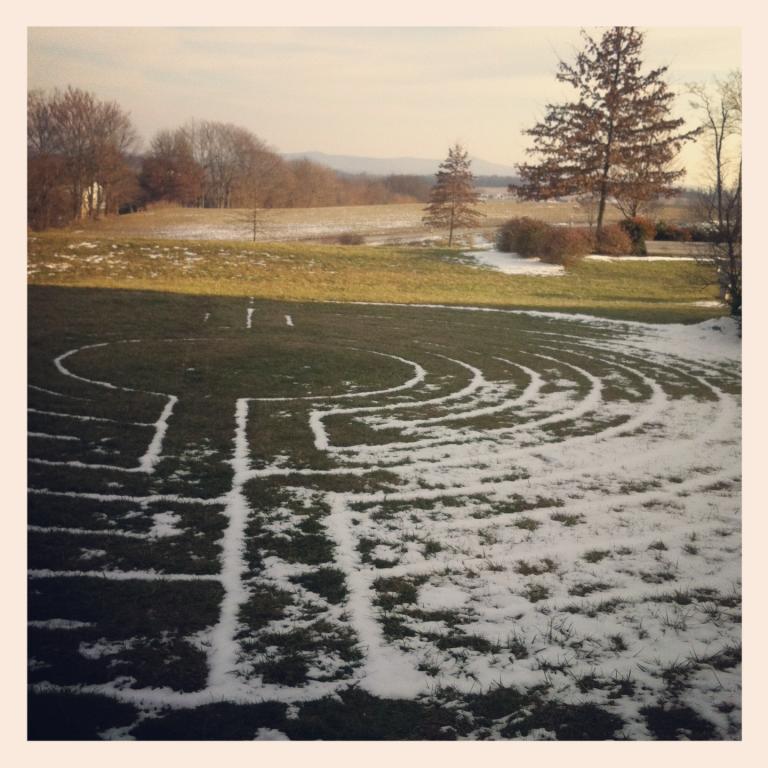
Photo credit: Carl Gregg
These sorts of insights are why a Sixth Source was added to Unitarian Universalism: “Spiritual teachings of earth-centered traditions which celebrate the sacred circle of life and instruct us to live in harmony with the rhythms of nature.” It’s why the Earth-centered Spirituality Group at the congregation I serve hosts monthly full-moon labyrinth walks. In our society that is often exclusively focused on linear path of “onward and upward forever,” of always wanting more and more, it can be a transformative practice to regularly set aside time and space to walk the circular path of the labyrinth — which invites you not to seek another place where the grass is allegedly greener, but instead to become evermore fully present to all that you already have right here and now.
On these days near the Winter Solstice, the longest night of the year, how might you be called to experiment with embracing darkness and silence?
In this winter season, of what might you be called to let go?
The Rev. Dr. Carl Gregg is a trained spiritual director, a D.Min. graduate of San Francisco Theological Seminary, and the minister of the Unitarian Universalist Congregation of Frederick, Maryland. Follow him on Facebook (facebook.com/carlgregg) and Twitter (@carlgregg).
Learn more about Unitarian Universalism:
http://www.uua.org/beliefs/principles
The Wheel of the Year (Paganism)
Previous Post

December 15, 2014
Did the Exodus Happen? And What It Means Today
Next Post
December 23, 2014 Top 10 Best Netflix Streamed in 2014
Browse Our Archives
Select a Category Advent Anti-Racism Archaeology Atheism Baptism Best of the Year List Book Reviews Buddhism Catholicism Christian Education Church and State Church Planting Climate Change Conscientious Objection to War Creation Spirituality Death Penalty Didache Disability Rights Discernment Easter Ecology Emergent Church Movement Empire-Critical Ethics Evolution Feminist Theology Film Reviews Gandhi Gospel of Mark Gun Control Hinduism Immigration Reform Interfaith Islam JFK Judaism Jungian Spirituality Lectionary Commentary Lent Letters to the Editor LGBT Marriage MLK Multiculturalism Mysticism Nonviolent Activism Occupy Paganism (Earth-centered Religions) Parables Paul Pluralism Politics Process Theology Quantum Physics Requiescat In Pace Seminary and Divinity School Sermon Series Retrospective Sermons Spiritual Direction Spiritual Practices Stewardship (Fundraising) The Book of J The Wheel of the Year (Paganism) Theoblogger Challenge Triathlon Uncategorized Unitarian Universalism Worship Resources Youth Ministry
Select a Month July 2026 May 2026 March 2026 November 2025 October 2025 August 2025 February 2025 December 2024 October 2024 March 2024 January 2024 December 2023 November 2023 March 2023 February 2023 January 2023 December 2022 November 2022 August 2022 March 2022 February 2022 January 2022 December 2021 September 2021 August 2021 July 2021 June 2021 May 2021 February 2021 January 2021 December 2020 August 2020 June 2020 May 2020 April 2020 March 2020 February 2020 January 2020 December 2019 November 2019 October 2019 September 2019 July 2019 June 2019 March 2019 February 2019 January 2019 December 2018 November 2018 October 2018 September 2018 June 2018 May 2018 April 2018 March 2018 February 2018 January 2018 December 2017 November 2017 October 2017 September 2017 August 2017 July 2017 June 2017 May 2017 April 2017 March 2017 February 2017 January 2017 December 2016 November 2016 October 2016 September 2016 August 2016 June 2016 May 2016 April 2016 March 2016 February 2016 January 2016 December 2015 November 2015 October 2015 September 2015 August 2015 July 2015 June 2015 May 2015 April 2015 March 2015 February 2015 January 2015 December 2014 November 2014 October 2014 August 2014 July 2014 June 2014 May 2014 April 2014 March 2014 February 2014 January 2014 December 2013 November 2013 October 2013 September 2013 August 2013 July 2013 June 2013 May 2013 April 2013 March 2013 February 2013 January 2013 December 2012 November 2012 October 2012 September 2012 August 2012 July 2012 June 2012 May 2012 April 2012 March 2012 February 2012 January 2012 December 2011 November 2011 October 2011 September 2011 August 2011 July 2011 June 2011 May 2011 April 2011 March 2011 February 2011 January 2011 December 2010 November 2010 October 2010 August 2009 July 2009 May 2009
Follow Us!
TAKE THE
Religious Wisdom Quiz
How many chapters does the book of Judges have?
Select your answer to see how you score.
25 23 19 21
Related posts from Carl Gregg

Peak Spiritual Experiences, Psychedelics, & Consciousness Research

”Did God Have a Wife?”: Asherah, Heavenly Mother,...
Why Peter Singer Hates on Guide Dogs &...

"How the Founding Fathers Became Infallible and Our...
TRENDING AT PATHEOS More Voices

Reading America at 250: A Nation Wrestles With...
As part of my own reflection on the 250th anniversary of the...

Whenever I am reading a book or listening to an argument, I...

President Trump Ban Animal Torture Videos on Facebook
Call for Stricter Regulations of Animal Abuse Content on Facebook Although President...

Draft Amendments to Address Ritual Abuse in New...
The proposed changes would make it illegal for individuals in domestic partnerships...

How Bans on LGBTQ+ Student Clubs Threaten Religious...
On June 20, 2025, the State of Texas passed Senate Bill 12....

The Truth About the Gen Z Revival
This past year, there has been a lot of media buzz surrounding...
view all More Voices blogs
Ad-Free & Subscriber Log-In Subscription Support
- About Us
- 2026 Calendar
- Videos
- Podcasts
- Library of World Religions
- Faith In Media Tracker
- Advertise With Us
- Write for Us
- Privacy Policy
- Terms of Service
- Do Not Sell My Data
- Contact Us
- Radiant Digital
- Manage Newsletter Subscriptions
- Unsubscribe From Notifications
- Sitemap
Copyright 2008-2026, Patheos. All rights reserved.
Subscription Support Ad-Free & Subscriber Log-In
Follow Patheos