
BuddhistCatholicContemplativeEvangelicalGeneral ChristianHinduJewishLatter-day SaintMuslimNew VisionsProgressive Christian
Beliefs
- Buddhist
- Catholic
- Contemplative
- Evangelical
- General Christian
- Hindu
- Jewish
- Latter-day Saint
- More Voices
- Muslim
- New Visions
- Pagan
- Progressive Christian
Topics
- Religion News
- Food and Religion
- Sports and Religion
- Religious Art
- Religious Music and Entertainment
- Religious Events
- History and Religion
- Style and Religion
- Politics and Religion
- Women in Religion
- Recreation Outdoors and Religion
- Business Finance and Religion
- Careers Workplace and Religion
- Education and Religion
- Family Parenting and Religion
- Health Fitness and Religion
- Home and Religion
- Relationships and Religion
- Technology and Religion
- Travel and Religion
Columnists
- Buddhist Columnists
- Business Finance and Religion Columnists
- Careers Workplace and Religion Columnists
- Catholic Columnists
- Contemplative Columnists
- Education and Religion Columnists
- Evangelists Columnists
- Family Parenting and Religion Columnists
- General Christian Columnists
- Health Fitness and Religion Columnists
- Hindu Columnists
- History and Religion Columnists
- Home and Religion Columnists
- Jewish Columnists
- More Voices Columnists
- Latter Day Columnists
- Muslim Columnists
- New Visions Columnists
- Nonreligious Columnists
- Pagan Columnists
- Politics and Religion Columnists
- Progressive Columnists
- Recreation Outdoors and Religion Columnists
- Relationships and Religion Columnists
- Religion News Columnists
- Religious Art Columnists
- Religious Events Columnists
- Religious Music and Entertainment Columnists
- Sports and Religion Columnists
- Style and Religion Columnists
- Technology and Religion Columnists
- Travel and Religion Columnists
- Women in Religion Columnists
Resource Library
- 2026 Calendar
- Library of World Religions
- The 100 Most Holy Places on Earth
- Patheos Answers
- Podcasts
- Videos
- Faith Leaders Database
- Anglican Episcopalian
- Bahai
- Baptist
- Buddhism
- Christianity
- Confucianism
- Eastern Orthodoxy
- Hinduism
- Holiness and Pentecostal
- ISKCON
- Islam
- Judaism
- Lutheran
- Methodist
- The Church of Jesus Christ of Latter-day Saints
- New Age
- Paganism
- Presbytarian and Reformed
- Protestantism
- Religion Behind the Scenes
- Roman Catholic
- Scientology
- Shia Islam
- Sikhism
- Sufism
- Sunni Islam
- Taoism
- Zen
- See all religions
Research Tools
 Ad-Free & Subscriber Log-In Subscription Support
Ad-Free & Subscriber Log-In Subscription Support
Follow Patheos 

- Trending:
- Forgiveness
- |
- Marriage
- |
- Consciousness
- |
- Death Penalty
- |
- Election
- |
- Halloween

- Home
- More Voices
- Can You Be Both a Religious Liberal and a Political Conservative?
Can You Be Both a Religious Liberal and a Political Conservative?
Last updated on: May 4, 2015 at 1:26 pm by Carl Gregg
Can You Be Both a Religious Liberal and a Political Conservative? 2015-05-04T13:26:39-04:00 Carl Gregg
Patheos Explore the world's faith through different perspectives on religion and spirituality! Patheos has the views of the prevalent religions and spiritualities of the world.
Religious Liberals (sometimes called “Religious Progressives”) are open to growing, changing, and evolving based on new evidence, insights, and experiences. In contrast, Religious Conservatives tend to resist changing, growing, and evolving even when new facts come to light. Theological conservatives tend to preserve traditions, current social structures, and long-standing community ties that can be undermined if innovation comes too rapidly.
But can you be a religious liberal and a political conservative? Or more provocatively, can you be a Religious Progressive and a Republican?
Historically, it has not always been the case that theological liberalism (the questioning of traditional religious dogma) was seen to necessitate political liberalism. To consider my own tradition of Unitarian Universalism, Mark Morrison-Reed has written in his book The Selma Awakening:
During the first half of the twentieth century, prior to the rise of McCarthyism, Unitarianism had included outspoken Socialists like John Haynes Holmes on the one hand, and on the other a strong contingent of Republicans, including President William Howard Taft and Senator Leverett Saltonstall. On the Universalist side, Clarence Skinner represented the progressive wing, while several congressmen who attended [Universalist] National Memorial [Church] in Washington, D.C., were Dixiecrats. (197)
So as early as the first half of the twentieth-century, prominent national figures were both religious liberals and a political conservatives. What changed was the 1960s and 70s. Morrison-Reed continues that, “Civil rights was the first in a series of issues that grew to include Vietnam War resistance, Black Power, women’s liberation, [Lesbian, Gay, Bisexual, and Transgender] rights, environmental concerns, and, most recently, immigration reform. These movements reshaped, and polarized, the American political landscape” (197).
 Now, I should pause at this point and clarify that by no means am I suggesting that we religious liberals should be less bold in “standing on the side of love” for social, economic, and environmental justice. Rather, we should be proud and emboldened by the work for peace and justice that our ancestors have done historically and that we are continuing today. Indeed, the current Unitarian Universalist Association Common Read (a book selected annually for all UUs to read, discuss, and act on) is Paul Rasor’s 2012 book Reclaiming Prophetic Witness: Liberal Religion in the Public Square. Rasor laments the ways that too often all religion has come to be stereotyped as theologically conservative religion. And he outlines how our liberal theological heritage can empower and ground our work for peace and justice. (I have a post planned for early 2015 on Rasor’s book.)
At the same time, I want to take seriously that history challenges us that theologically liberal religions have included major figures who were both politically liberal and politically conservative. And I also want to take seriously that “big tents” such as Unitarian Universalism or the Emergent Church Movement are large enough to reach across the partisan divide that grown increasingly wide since the 1960s. In so doing, we may be able to build relationships of mutual trust and respect with the actual, complex human beings behind those far too simple labels of “Democrat” and “Republican.”
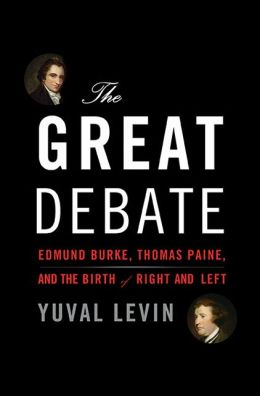 And to better understand the roots of the partisanship that began to grow deeper in this country in the 1960s, I would like to turn back the clock farther to a time of even greater social change: the late eighteenth century, the time of the American Revolution and French Revolution. As our guide, I would like to look at a helpful and accessible new book that I highly recommend by Yuval Levin titled The Great Debate: Edmund Burke, Thomas Paine, and the Birth of Right and Left. I first started studying these figures, who are at the roots of the modern day political movements we call “The Left” and “The Right,” in college in a philosophy class on Liberalism and Conservatism.
(For those with a good memory, I also invite you to also keep in mind everything I wrote in an election post two years ago about Jonathan Haidt’s important book The Righteous Mind: Why Good People Are Divided by Politics and Religion.)
To begin with the “Left,” the Latin root of the word Liberalism is liber, meaning “free.” And it has given us a range of words from liberal to libertarian and a range of connotations from the positive example of the Statue of Liberty on the New York shoreline welcoming new immigrants to a land of freedom to the negative example of the irresponsible libertine, who abuses freedom. And although Liberalism is sometimes seen as a “dirty word” (as if all liberals were libertines) when we talk about “Progressive Christianity” or Unitarian Universalism as a “Liberal Religious Tradition,” we mean liberal in the best sense of the word: open to new ideas, generous, openhanded, open-hearted, and open-minded.
And historically the Liberal Turn in Religion (which started with Schleiermacher in the 18th-century) is precisely that demand of freedom from obsolete religious beliefs and corrupt authorities, whose only justification is tradition. Liberal Religion says that, “we have always done it that way” is not sufficient justification to keep doing or believing something. The Liberal Turn in Religion is, likewise, about freedom for exploring wherever human reason and experience leads us. It’s what Unitarian Universalists call our 4th Principle: “A free and responsible search for truth and meaning.”
But what about those individuals whose free and responsible search for truth and meaning leads them to politically conservative positions? And what insights might Paine and Burke, those 18th-century luminaries, have for us twenty-first century religious liberals, who want to build a tent big enough to cover the partisan divide?
To begin with Thomas Paine, it is most fitting that his most famous publication is a 50-page pamphlet titled “Common Sense” — because classic Liberalism (and the Enlightenment in general) is about the turn from history, tradition, and alleged one-time divine revelation in the past to universal truths that are apparent and verifiable in all times and places through human reason and experience. Another word for such universally provable truths is common sense.
One major target of Thomas Paine’s pen was the hereditary British monarchy, which he saw as opposed to common sense (Levin 16-17). For Paine, if you took one step back from the accepted conventions, it became self-evident that any one particular allegedly-noble family had come to power through some sort of historically-contingent circumstances that were usually manipulative, selfish, and violent (51-52). He saw nothing natural about the so-called “divine right of kings.” Why, he asked, would you want to give perpetual authority to the heirs of someone who lied, cheated, or killed their way to power? Or even if one generation is good, noble, and came to power for legitimate reasons, why would one assume that future generations of that same royal line would also be the best possible rulers?
Instead, Paine argues in his 1791 book The Rights of Man that, “all men are born equal, and with equal natural right” (46). You can hear echoes of the same Liberal, Enlightenment view that inspired Thomas Jefferson and other founders of this nation to throw off the yoke of the hereditary British monarchy and demand that government be based on the “consent of the governed.”
To bring Edmund Burke into the equation, it’s fascinating to note that he agrees with Paine about the corrupt origins of most monarchies. They even both agree about the historically-contingent and often corrupt origins of religion (74-5, 154). But Burke cautions that we are often unwise to ask those sorts of questions (53, 164). We should, in other words, not pull back the curtain and expose that the “Wonderful Wizard of Oz” is actually a mere, imperfect mortal. For Burke, we need such illusions, built up over time, to keep a stable society. (You can perhaps hear Marx’s head explode at this point.)
Moreover, Burke warns that theorists such as Thomas Paine are naive to put so much trust in human 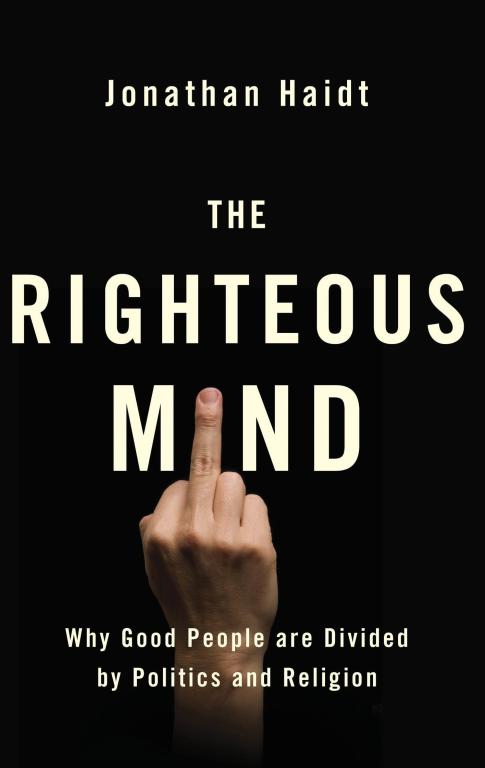 reason. For Burke, it is “common sense” that humans are ruled much more by their emotions than by reason. Jonathan Haidt’s image for this truth is “The Elephant and the Rider”: our reason is like a human riding on top of an elephant. The elephant is our emotions, and we have far less control over them than we like to think.
Furthermore, Burke thinks that Paine and other liberals are often foolish in their failure to see that “human rights” are as equally historically contingent as the idea of hereditary monarchies. Burke is correct that human rights are actually not self-evident, but rather are historically-contingent conventions developed over time in humane societies. So we should be careful about undermining such societies (55-59). Whereas Paine is always in a rush to allow each new generation to tear down past social, political, and religious arrangements and rebuild them based on reason and the needs of the present, Burke is concerned that by tearing down traditions and conventions one is more likely to result not in reason, compassion, peace, and justice but rather in anarchy, violence, and “might makes right” (158, 163, 213).
 Burke is for social progress. But he is for gradual evolution, whereas Paine is for immediate revolution (67). Keep in mind that Burke and Paine are writing for the world stage in response to the intense upheaval and violence of the French Revolution in which the king, queen, and other nobility were beheaded by guillotine in the streets. (The equivalent today would perhaps be if the Occupy Movement was seeking to remedy our growing wealth inequality not by nonviolent protest, but by decapitating the “Wolves of Wall Street”!)
At the same time, when I hear people in power telling marginalized groups to be patient, I can’t help hearing in response, Dr. King’s challenge in his Letter from a Birmingham Jail to
the white moderate, who is more devoted to “order” than to justice; who prefers a negative peace which is the absence of tension to a positive peace which is the presence of justice; who constantly says: “I agree with you in the goal you seek, but I cannot agree with your methods of direct action”; who paternalistically believes he can set the timetable for another [human being’s] freedom….
Burke was nothing if not paternalistic. And it’s is much easier for Burke to say “slow down and wait” for freedom, equality, and justice from his privileged seat in the British House of Commons.
Overall, my experience of reading Burke and Paine — and of reading Levin’s book The Great Debate — is of feeling a pendulum swinging back and forth within me. The paradigms represented by the “left” and “right” are not problems that can be solved; rather they are a polarity that can, at best, be managed. We need prophets like Thomas Paine calling for liberty and equality now — through revolution if necessary. But we also need voices likes Burke reminding us that we are not merely a collection of rational individuals. Human nature is much more complex than reason alone and we are much more driven by selfishness and emotions than we usually admit. There are also important values to be found in history and traditions — and important obligations that we owe to the common good — beyond what is merely in one individual’s best interest (102-103).
Just as Unitarian Universalism and other progressive religious movements intend ourselves to be liberal religious traditions in the best sense of the word liberal — open to new ideas, generous, openhanded, open-hearted, and open-minded — there has been room historically and there is room today within our big tents for those who are conservative in the best sense of the word: caring about conservation of nature, upholding the beauty of traditions and rituals that accrued deep meaning through the test of time, reminding us of the importance not only of individual rights and equality, but also of community, authority, sanctity, and loyalty. This dynamic is one reason that many religious progressives resonate deeply with contemporary prophets such as Wendell Berry, who are conservative in the best sense of the word. We desperately need such voices within progressive religious communities.
We Unitarian Universalists like to say that we are “Standing on the Side of Love.” And, wherever you find yourself on the political spectrum, this coming Election Day, may you discern within your own conscience what it means to vote on the side of love.
For Further Reflection
Carl Gregg, “The Righteous Mind” and the Democratic Process, available at http://www.patheos.com/blogs/carlgregg/2012/11/the-righteous-mind-and-the-democratic-process/
The Rev. Dr. Carl Gregg is a trained spiritual director, a D.Min. graduate of San Francisco Theological Seminary, and the minister of the Unitarian Universalist Congregation of Frederick, Maryland. Follow him on Facebook (facebook.com/carlgregg) and Twitter (@carlgregg).
Learn more about Unitarian Universalism:
http://www.uua.org/beliefs/principles
Previous Post

October 29, 2014
The Future of Islam
Next Post
November 10, 2014 Deeds Not Creeds, Behavior Is Believable
Browse Our Archives
Select a Category Advent Anti-Racism Archaeology Atheism Baptism Best of the Year List Book Reviews Buddhism Catholicism Christian Education Church and State Church Planting Climate Change Conscientious Objection to War Creation Spirituality Death Penalty Didache Disability Rights Discernment Easter Ecology Emergent Church Movement Empire-Critical Ethics Evolution Feminist Theology Film Reviews Gandhi Gospel of Mark Gun Control Hinduism Immigration Reform Interfaith Islam JFK Judaism Jungian Spirituality Lectionary Commentary Lent Letters to the Editor LGBT Marriage MLK Multiculturalism Mysticism Nonviolent Activism Occupy Paganism (Earth-centered Religions) Parables Paul Pluralism Politics Process Theology Quantum Physics Requiescat In Pace Seminary and Divinity School Sermon Series Retrospective Sermons Spiritual Direction Spiritual Practices Stewardship (Fundraising) The Book of J The Wheel of the Year (Paganism) Theoblogger Challenge Triathlon Uncategorized Unitarian Universalism Worship Resources Youth Ministry
Select a Month July 2026 May 2026 March 2026 November 2025 October 2025 August 2025 February 2025 December 2024 October 2024 March 2024 January 2024 December 2023 November 2023 March 2023 February 2023 January 2023 December 2022 November 2022 August 2022 March 2022 February 2022 January 2022 December 2021 September 2021 August 2021 July 2021 June 2021 May 2021 February 2021 January 2021 December 2020 August 2020 June 2020 May 2020 April 2020 March 2020 February 2020 January 2020 December 2019 November 2019 October 2019 September 2019 July 2019 June 2019 March 2019 February 2019 January 2019 December 2018 November 2018 October 2018 September 2018 June 2018 May 2018 April 2018 March 2018 February 2018 January 2018 December 2017 November 2017 October 2017 September 2017 August 2017 July 2017 June 2017 May 2017 April 2017 March 2017 February 2017 January 2017 December 2016 November 2016 October 2016 September 2016 August 2016 June 2016 May 2016 April 2016 March 2016 February 2016 January 2016 December 2015 November 2015 October 2015 September 2015 August 2015 July 2015 June 2015 May 2015 April 2015 March 2015 February 2015 January 2015 December 2014 November 2014 October 2014 August 2014 July 2014 June 2014 May 2014 April 2014 March 2014 February 2014 January 2014 December 2013 November 2013 October 2013 September 2013 August 2013 July 2013 June 2013 May 2013 April 2013 March 2013 February 2013 January 2013 December 2012 November 2012 October 2012 September 2012 August 2012 July 2012 June 2012 May 2012 April 2012 March 2012 February 2012 January 2012 December 2011 November 2011 October 2011 September 2011 August 2011 July 2011 June 2011 May 2011 April 2011 March 2011 February 2011 January 2011 December 2010 November 2010 October 2010 August 2009 July 2009 May 2009
Follow Us!
TAKE THE
Religious Wisdom Quiz
Nahum describes the Lord as riding in the whirlwind and storms. What does he say are the clouds?
Select your answer to see how you score.
His chariot His glory His covering The dust of his feet
Related posts from Carl Gregg

Peak Spiritual Experiences, Psychedelics, & Consciousness Research

"How the Founding Fathers Became Infallible and Our...

Vampires, Witches, & NPR: The Legacy of Margot...

“Do You Really Want to Know?” From Pope...
TRENDING AT PATHEOS More Voices

Reading America at 250: A Nation Wrestles With...
As part of my own reflection on the 250th anniversary of the...

Whenever I am reading a book or listening to an argument, I...

President Trump Ban Animal Torture Videos on Facebook
Call for Stricter Regulations of Animal Abuse Content on Facebook Although President...

Draft Amendments to Address Ritual Abuse in New...
The proposed changes would make it illegal for individuals in domestic partnerships...

How Bans on LGBTQ+ Student Clubs Threaten Religious...
On June 20, 2025, the State of Texas passed Senate Bill 12....

The Truth About the Gen Z Revival
This past year, there has been a lot of media buzz surrounding...
view all More Voices blogs
Ad-Free & Subscriber Log-In Subscription Support
- About Us
- 2026 Calendar
- Videos
- Podcasts
- Library of World Religions
- Faith In Media Tracker
- Advertise With Us
- Write for Us
- Privacy Policy
- Terms of Service
- Do Not Sell My Data
- Contact Us
- Radiant Digital
- Manage Newsletter Subscriptions
- Unsubscribe From Notifications
- Sitemap
Copyright 2008-2026, Patheos. All rights reserved.
Subscription Support Ad-Free & Subscriber Log-In
Follow Patheos