
BuddhistCatholicContemplativeEvangelicalGeneral ChristianHinduJewishLatter-day SaintMuslimNew VisionsProgressive Christian
Beliefs
- Buddhist
- Catholic
- Contemplative
- Evangelical
- General Christian
- Hindu
- Jewish
- Latter-day Saint
- More Voices
- Muslim
- New Visions
- Pagan
- Progressive Christian
Topics
- Religion News
- Food and Religion
- Sports and Religion
- Religious Art
- Religious Music and Entertainment
- Religious Events
- History and Religion
- Style and Religion
- Politics and Religion
- Women in Religion
- Recreation Outdoors and Religion
- Business Finance and Religion
- Careers Workplace and Religion
- Education and Religion
- Family Parenting and Religion
- Health Fitness and Religion
- Home and Religion
- Relationships and Religion
- Technology and Religion
- Travel and Religion
Columnists
- Buddhist Columnists
- Business Finance and Religion Columnists
- Careers Workplace and Religion Columnists
- Catholic Columnists
- Contemplative Columnists
- Education and Religion Columnists
- Evangelists Columnists
- Family Parenting and Religion Columnists
- General Christian Columnists
- Health Fitness and Religion Columnists
- Hindu Columnists
- History and Religion Columnists
- Home and Religion Columnists
- Jewish Columnists
- More Voices Columnists
- Latter Day Columnists
- Muslim Columnists
- New Visions Columnists
- Nonreligious Columnists
- Pagan Columnists
- Politics and Religion Columnists
- Progressive Columnists
- Recreation Outdoors and Religion Columnists
- Relationships and Religion Columnists
- Religion News Columnists
- Religious Art Columnists
- Religious Events Columnists
- Religious Music and Entertainment Columnists
- Sports and Religion Columnists
- Style and Religion Columnists
- Technology and Religion Columnists
- Travel and Religion Columnists
- Women in Religion Columnists
Resource Library
- 2026 Calendar
- Library of World Religions
- The 100 Most Holy Places on Earth
- Patheos Answers
- Podcasts
- Videos
- Faith Leaders Database
- Anglican Episcopalian
- Bahai
- Baptist
- Buddhism
- Christianity
- Confucianism
- Eastern Orthodoxy
- Hinduism
- Holiness and Pentecostal
- ISKCON
- Islam
- Judaism
- Lutheran
- Methodist
- The Church of Jesus Christ of Latter-day Saints
- New Age
- Paganism
- Presbytarian and Reformed
- Protestantism
- Religion Behind the Scenes
- Roman Catholic
- Scientology
- Shia Islam
- Sikhism
- Sufism
- Sunni Islam
- Taoism
- Zen
- See all religions
Research Tools
 Ad-Free & Subscriber Log-In Subscription Support
Ad-Free & Subscriber Log-In Subscription Support
Follow Patheos 

- Trending:
- Forgiveness
- |
- Marriage
- |
- Consciousness
- |
- Death Penalty
- |
- Election
- |
- Halloween

- Home
- More Voices
- The Meaning of the Daodejing (Tao Te Ching) for Today
The Meaning of the Daodejing (Tao Te Ching) for Today
Last updated on: May 4, 2015 at 1:24 pm by Carl Gregg
The Meaning of the Daodejing (Tao Te Ching) for Today 2015-05-04T13:24:05-04:00 Carl Gregg
Patheos Explore the world's faith through different perspectives on religion and spirituality! Patheos has the views of the prevalent religions and spiritualities of the world.
Parker Palmer, in his modern spiritual classic A Hidden Wholeness: The Journey Toward an Undivided Life relates the classic Daoist tale known as “The Woodcarver”:
A master carver, made a bell stand of precious wood. When it was finished, all who saw it
were astounded. They said it must be the work of spirits.
The Prince of Lu said to the master carver: “What is your secret?”
He replied: “I am only a workman: I have no secret. There is only this: When I began to think about the work you commanded I guarded my spirit, did not expend it on trifles, that were no to the point. I fasted in order to set my heart at rest. After three days fasting, I had forgotten gain and success. After five days I had forgotten criticism. After seven days I had forgotten my body with all its limbs.
“By this time all thought of your Highness and of the court had faded away. All that might distract me from the work had vanished. I was collected in the single thought of the bell stand. Then I went to the forest to see the trees in their own natural state. When the right tree appeared before my eyes, the bell stand also appeared in it, clearly, beyond doubt. All I had to do was to put forth my hand and begin. If I had not met this particular tree, there would have been no bell stand at all.
“What happened?
“My own collected thought encountered the hidden potential in the wood; from this live encounter came the work, which you ascribe to the spirits.” (95-96)

This story reflects the key Daoist principle known as wuwei, which translated literally means “non-action.” This principle and practice emphasizes effortlessness, non-interference, and non-intervention.
From a meditative state of calm, centered equanimity (“mental calmness, composure, and evenness of temper, especially in a difficult situation”), the Woodcarver waited patiently for right tree, the right timing, and the right movement to align. This ancient tale of doing one thing extraordinarily well — with focus, with grace, with a deep connection to nature — is a potential source of wisdom for us today in our crazy-busy age of technological distraction. Daosim reminds us that there are other ways of being in the world that can help us find balance and order amidst chaos.
As the bumper sticker wisdom goes, Daoism says to us, “Don’t just do something…sit there!” Just doing something — something, anything — is the opposite of wuwei (“non-action”). Daoism invites us to consider if the most radical act we can do in some circumstances is paradoxically just to sit there and do nothing. For examle, is there a time in your life when you took the risk of stepping back and trusting others — and because you did not try to micromanage the process, the outcome was a beautifully surprising result that you never would never have anticipated and that you would likely have blocked from happening if you had interfered in the planning?
Personally, I experience this phenomenon all the time as a minister. First of all, it would be far beyond my capacity to even begin to try to control the ten thousand or more amazing things that are happening all the time in various ways connected to the congregation I serve: social justice work, art shows, spirituality groups, music, discussion groups, and so much more. There is a sense in which my role as minister is to be centering presence amidst all that activity, but micromanaging those ten thousand things not only would be impossible, but also would undermine the congregation’s collective flourishing in so many different areas.
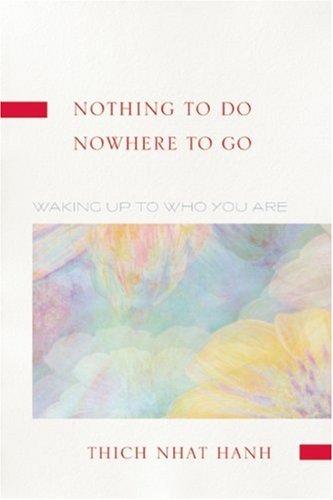 Along these lines, I have read many books by the contemporary Buddhist teacher Thich Nhat Hanh, but the most challenging to me is his book Nothing To Do, Nowhere to Go: Waking Up to Who You Are. Reflecting on the teachings of the 9th-century Buddhist master Linji, Hanh invites to us to consider that what might be inhibiting our spiritual growth is that we are always just doing something. Even if that something is seeking a spiritual teacher, visiting retreat centers, and reading spiritual books, Hanh writes, “You will not be equal to the person who has nothing to do when he [or she] enters the temple and sits down in the lotus position” — and just sits with nothing else to do and nowhere else to go (42-43). Ironically, spiritual activities can themselves be a distraction from being fully present to ourself, our breath, and the world around us in the arising of each new present moment.
Learning to just sit might be the most transformative spiritual practice of them all. And Hanh writes that Zen Master Linji’s term for such a practitioner is a “businessless person.” What a radical aspiration in our time of mass overcommitment when there are so many books, articles, and seminars on “time management.”
Since I have been using some analogies from Zen Buddhism, I should say that although there are important similarities between Buddhism and Daoism, there are significant differences as well. So allow me to turn now to a more direct focus on the most important Daoist text, the Daodejing.
Regarding the spelling of that book, some of you will recall my previous post on the Yijing (or I Ching). In both these cases, everything would be simpler if we all understood Chinese. Since most of us do not, some confusion arises because we are in the midst of a shift from the Wade-Giles transliteration system (which was started by British sinologists in the 19th-century) to the new standard of the Pinyin system (which literally means “spelled-out sounds” and which was developed by the Chinese people themselves).
In the long run, spelling the names of these ancient Chinese classics in a way that is more closely aligned with the Chinese language is a good thing. And frankly it was always confusing to use the spelling I Ching and expect people to remember that it is pronounced “E-Ching, not “EYE-Ching”; so Yijing (is a better spelling around all, although it takes some good used to. Likewise, it was always confusing to use the spelling Tao Te Ching and expect people to remember that the “T” should be pronounced as a “D.” So the spelling Daodejing is must clearer, although it too takes so time to get used to. I should probably also mention that Laozi is the new standard Pinyin spelling of Lao Tzu, who is understood traditionally as the author of the Daodejing.
And if you are curious to learn more about the Daodejing, the best accessible Daoism scholar I have  found recently is Hans-Georg Moeller, who has both his own translation and commentary on the Daodejing, as well as an accessible general introduction called The Philosophy of the Daodejing, which was published in 2006 by Columbia University Press. According to Moeller and other leading contemporary scholars of Daoism, the text we know as the Daodejing was not written by Laozi or any one historical figure. Instead, it is “an anthology of wise sayings that were transmitted among the intellectual ‘elite’ of ancient China, and it comprises materials from different sources and from different times. The earliest strata of the text may well be 2,500 year old or more” (Moeller, Daodejing, 5). These ancient oral traditions began to be collected and written down in what became a standard form around 300 B.C.E.
At first this anthology was called the “Laozi,” in reference to the legend that a historical figure named Laozi was the sole author of the entire text. Later during China’s Han dynasty (206 B.C.E. – 220 C.E.) it became known as the Daodejing, which is a combination of three Chinese words:
- Dao, meaning most literally “Way” or more loosely “the best way of ‘proceeding’ or of ‘going on’
- De, literally “power” or more loosely “the power or efficacy that a perfectly ordered or governed process displays”
- Jing, meaning “Classical Scripture”
When all three words are combined, the Daodejing is a honorific title meaning, “The Classical Scripture of the Way and Its Efficacy” (5,8).
Originally the wisdom saying that became the Daodejing were memorized through recitation by the Chinese social elite who would have be trained to known them by heart (Moeller, Philosophy, 2, 4). So what we might perceive today as repetition and lack of any organization in the written text of the Daodejing is precisely what helped the Daodejing’s original adherents to memorize the oral traditions.
And it is important to emphasize as well that not only was the Daodejing in its original context known mostly to China’s social elite who had the leisure time to memorize the Daoist oral traditions, but also the Daodejing’s original intent is explicitly elitist: “It was not meant to be studied by everyone. It was composed, in the strict sense, for only one type of person: the Daoist sage ruler” (25).
Consider, for example, this stanza from Chapter 20 of the Dao:
What simplicity!
The ordinary people are shining —
I alone seem to be hidden.
The ordinary people are distinct —
I alone am undifferentiated….
My desires alone are different from those of the other people,
and I esteem the nurturing mother. (68)
That’s not exactly a rousing endorsement of our modern democratic ideals (62). But it is a good reminder that the way of being in the world outlined in the Daodejing was not originally intended to be universally practiced by all parts of society; rather, it is a guide for leaders.
As Chapter 57 of the Dao says:
I do not act,
and the people change by themselves
I love stillness,
and the people correct themselves.
I am without task,
and the people prosper by themselves. (60-61)
The paradoxical promise of such a leader is that such emptiness at the center will allow room for the rest of us to live into our full potential. (To me, it sounds like libertarianism meets paradoxical mysticism.)
And along these lines, if someone tells me that they have recently read the Daodejing and are trying to practice wuwei (“non-action”) in all parts of their life, I always want to say, “Oh, so you recently inherited an ancient Chinese kingdom to rule? If so, then a thoroughgoing Daoist practice should work out wonderfully for you!” If that’s not the case, then the wiser course is likely a more selective and strategic application of Daoist principles and practices. And joking aside, I do think there is important wisdom in Daoism for navigating our contemporary world. One of the most concrete examples is the call to refrain from micromanaging people and processes that might well prosper better if left to their own natural timing, rhythms, and inclinations.
And although there is much more to say about the meaning of the Daodejing for today, I would like, for now, to make one final point about the Daoist perspective. The Daoist worldview reminds us that all of us humans — whether sage-rulers or just us common folk — are merely one part of the massive whole of the cosmos. We humans are not special in the grand scheme of things, so we should be cautious to over interpreting what happens to us as either “Good” or “Bad” in any sort of ultimate perspective. From the Daoist point of view, all that happens is part of a complex, intricate larger whole, and we may or may not be have the capacity from our finite human perspective to comprehend why things happen to us (55, 141).
As it says in chapter 58 of the Daodejing:
It is upon bad luck
that good luck depends.
It is upon good luck
that bad luck depends.
Who knows where it ends?
But perhaps this view is better exemplified in this ancient Daoist story:
There was an old man at a frontier fort in the north who understood Daoism. One day he lost his horse, which wandered into the land of the Hu tribesmen. His neighbors came to condole with him and the man said, “How do you know that this is bad luck [that I lost my horse]?”
After a few months, the horse returned with some fine horses of the Hu breed, and the people congratulated him. The old man said, “How do you know that this is good luck [that I now have so many fine horses]?”
He became very prosperous with so many horses. Then the son one day broke his leg riding, and all the people came to condole with him again. The old man said, “How do you know that this is bad luck [that my son broke his leg riding]?”
One day the Hu tribesmen invaded the frontier fort. All the [healthy] young men fought with arrows to defend it, and nine tenths of them were killed. Because the son [had a broken leg], both father and son escaped unharmed.
Therefore, good luck changes into bad, and bad luck changes into good. It cannot be known where their altering ends. (99-101)
And so we find ourselves returning to one of the central characteristics of the Daoist master: equanimity: “mental calmness, composure, and evenness of temper, especially in a difficult situation.” Whatever happens us is is never just about us individually or even all about us collectively as humans. We are part of a larger whole.
What wisdom might the Daodejing hold for you? Are there situations in your life that might be best served by choosing non-action, non-interference, non-intervention?
What might it feel like to experiment with occasionally being a “businessless person?” Don’t just do something, sit there — with nothing to do and nowhere to go.
Or might you, like the master carver, be well served by waiting patiently for the right time and right place to act with effortless precision?
Or does the story of the old man at the frontier fort invite you to consider if perhaps some of what is going on in your life — whether seemingly good or bad — is actually not about you, but is part a much larger whole?
The Rev. Dr. Carl Gregg is a trained spiritual director, a D.Min. graduate of San Francisco Theological Seminary, and the minister of the Unitarian Universalist Congregation of Frederick, Maryland. Follow him on Facebook (facebook.com/carlgregg) and Twitter (@carlgregg).
Learn more about Unitarian Universalism:
http://www.uua.org/beliefs/principles
Previous Post

August 28, 2014
Eve Was Framed, the Serpent Was Right!
Next Post
October 23, 2014 Reading the Same Text Differently with Jews & Christians
Browse Our Archives
Select a Category Advent Anti-Racism Archaeology Atheism Baptism Best of the Year List Book Reviews Buddhism Catholicism Christian Education Church and State Church Planting Climate Change Conscientious Objection to War Creation Spirituality Death Penalty Didache Disability Rights Discernment Easter Ecology Emergent Church Movement Empire-Critical Ethics Evolution Feminist Theology Film Reviews Gandhi Gospel of Mark Gun Control Hinduism Immigration Reform Interfaith Islam JFK Judaism Jungian Spirituality Lectionary Commentary Lent Letters to the Editor LGBT Marriage MLK Multiculturalism Mysticism Nonviolent Activism Occupy Paganism (Earth-centered Religions) Parables Paul Pluralism Politics Process Theology Quantum Physics Requiescat In Pace Seminary and Divinity School Sermon Series Retrospective Sermons Spiritual Direction Spiritual Practices Stewardship (Fundraising) The Book of J The Wheel of the Year (Paganism) Theoblogger Challenge Triathlon Uncategorized Unitarian Universalism Worship Resources Youth Ministry
Select a Month July 2026 May 2026 March 2026 November 2025 October 2025 August 2025 February 2025 December 2024 October 2024 March 2024 January 2024 December 2023 November 2023 March 2023 February 2023 January 2023 December 2022 November 2022 August 2022 March 2022 February 2022 January 2022 December 2021 September 2021 August 2021 July 2021 June 2021 May 2021 February 2021 January 2021 December 2020 August 2020 June 2020 May 2020 April 2020 March 2020 February 2020 January 2020 December 2019 November 2019 October 2019 September 2019 July 2019 June 2019 March 2019 February 2019 January 2019 December 2018 November 2018 October 2018 September 2018 June 2018 May 2018 April 2018 March 2018 February 2018 January 2018 December 2017 November 2017 October 2017 September 2017 August 2017 July 2017 June 2017 May 2017 April 2017 March 2017 February 2017 January 2017 December 2016 November 2016 October 2016 September 2016 August 2016 June 2016 May 2016 April 2016 March 2016 February 2016 January 2016 December 2015 November 2015 October 2015 September 2015 August 2015 July 2015 June 2015 May 2015 April 2015 March 2015 February 2015 January 2015 December 2014 November 2014 October 2014 August 2014 July 2014 June 2014 May 2014 April 2014 March 2014 February 2014 January 2014 December 2013 November 2013 October 2013 September 2013 August 2013 July 2013 June 2013 May 2013 April 2013 March 2013 February 2013 January 2013 December 2012 November 2012 October 2012 September 2012 August 2012 July 2012 June 2012 May 2012 April 2012 March 2012 February 2012 January 2012 December 2011 November 2011 October 2011 September 2011 August 2011 July 2011 June 2011 May 2011 April 2011 March 2011 February 2011 January 2011 December 2010 November 2010 October 2010 August 2009 July 2009 May 2009
Follow Us!
TAKE THE
Religious Wisdom Quiz
Who prophesied the fall of Babylon?
Select your answer to see how you score.
Isaiah Jeremiah Ezekiel Daniel
Related posts from Carl Gregg

Reading America at 250: A Nation Wrestles With...


Andrew Holocek on the Power of Darkness

The Stories That Shape Us: Myths, Archetypes, &...
TRENDING AT PATHEOS More Voices

Reading America at 250: A Nation Wrestles With...
As part of my own reflection on the 250th anniversary of the...

Whenever I am reading a book or listening to an argument, I...

President Trump Ban Animal Torture Videos on Facebook
Call for Stricter Regulations of Animal Abuse Content on Facebook Although President...

Draft Amendments to Address Ritual Abuse in New...
The proposed changes would make it illegal for individuals in domestic partnerships...

How Bans on LGBTQ+ Student Clubs Threaten Religious...
On June 20, 2025, the State of Texas passed Senate Bill 12....

The Truth About the Gen Z Revival
This past year, there has been a lot of media buzz surrounding...
view all More Voices blogs
Ad-Free & Subscriber Log-In Subscription Support
- About Us
- 2026 Calendar
- Videos
- Podcasts
- Library of World Religions
- Faith In Media Tracker
- Advertise With Us
- Write for Us
- Privacy Policy
- Terms of Service
- Do Not Sell My Data
- Contact Us
- Radiant Digital
- Manage Newsletter Subscriptions
- Unsubscribe From Notifications
- Sitemap
Copyright 2008-2026, Patheos. All rights reserved.
Subscription Support Ad-Free & Subscriber Log-In
Follow Patheos