
BuddhistCatholicContemplativeEvangelicalGeneral ChristianHinduJewishLatter-day SaintMuslimNew VisionsProgressive Christian
Beliefs
- Buddhist
- Catholic
- Contemplative
- Evangelical
- General Christian
- Hindu
- Jewish
- Latter-day Saint
- More Voices
- Muslim
- New Visions
- Pagan
- Progressive Christian
Topics
- Religion News
- Food and Religion
- Sports and Religion
- Religious Art
- Religious Music and Entertainment
- Religious Events
- History and Religion
- Style and Religion
- Politics and Religion
- Women in Religion
- Recreation Outdoors and Religion
- Business Finance and Religion
- Careers Workplace and Religion
- Education and Religion
- Family Parenting and Religion
- Health Fitness and Religion
- Home and Religion
- Relationships and Religion
- Technology and Religion
- Travel and Religion
Columnists
- Buddhist Columnists
- Business Finance and Religion Columnists
- Careers Workplace and Religion Columnists
- Catholic Columnists
- Contemplative Columnists
- Education and Religion Columnists
- Evangelists Columnists
- Family Parenting and Religion Columnists
- General Christian Columnists
- Health Fitness and Religion Columnists
- Hindu Columnists
- History and Religion Columnists
- Home and Religion Columnists
- Jewish Columnists
- More Voices Columnists
- Latter Day Columnists
- Muslim Columnists
- New Visions Columnists
- Nonreligious Columnists
- Pagan Columnists
- Politics and Religion Columnists
- Progressive Columnists
- Recreation Outdoors and Religion Columnists
- Relationships and Religion Columnists
- Religion News Columnists
- Religious Art Columnists
- Religious Events Columnists
- Religious Music and Entertainment Columnists
- Sports and Religion Columnists
- Style and Religion Columnists
- Technology and Religion Columnists
- Travel and Religion Columnists
- Women in Religion Columnists
Resource Library
- 2026 Calendar
- Library of World Religions
- The 100 Most Holy Places on Earth
- Patheos Answers
- Podcasts
- Videos
- Faith Leaders Database
- Anglican Episcopalian
- Bahai
- Baptist
- Buddhism
- Christianity
- Confucianism
- Eastern Orthodoxy
- Hinduism
- Holiness and Pentecostal
- ISKCON
- Islam
- Judaism
- Lutheran
- Methodist
- The Church of Jesus Christ of Latter-day Saints
- New Age
- Paganism
- Presbytarian and Reformed
- Protestantism
- Religion Behind the Scenes
- Roman Catholic
- Scientology
- Shia Islam
- Sikhism
- Sufism
- Sunni Islam
- Taoism
- Zen
- See all religions
Research Tools
 Ad-Free & Subscriber Log-In Subscription Support
Ad-Free & Subscriber Log-In Subscription Support
Follow Patheos 

- Trending:
- Forgiveness
- |
- Marriage
- |
- Consciousness
- |
- Death Penalty
- |
- Election
- |
- Halloween

- Home
- More Voices
- Reading the Same Text Differently with Jews & Christians
Reading the Same Text Differently with Jews & Christians
Last updated on: May 4, 2015 at 1:24 pm by Carl Gregg
Reading the Same Text Differently with Jews & Christians 2015-05-04T13:24:33-04:00 Carl Gregg
Patheos Explore the world's faith through different perspectives on religion and spirituality! Patheos has the views of the prevalent religions and spiritualities of the world.
This post is about the ways Christians have often appropriated Jewish scripture in a way that does not fully appreciate the ways that Jews understand their own texts in very differently. In my next post, I will turn the tables to consider Jewish readings of Christian scripture.
Isaiah’s Context (8th-century B.C.E.)
Imagine that you are atttending a Jewish Saturday morning services. A young woman, who is becoming a bat mizvah (“a daughter of the covenant”), ascends the steps to the bimah (the elevated platform at the front of the sanctuary) and reads the Haftarah portion (the passage from the prophetic books — as opposed to the other reading, which is from the Torah, the first five books of the Bible). She would read it first in Hebrew, and then translate it into English. From the ninth chapter of the prophet Isaiah:
1 But there will be no gloom for those who were in anguish. In the former time he brought into contempt the land of Zebulun and the land of Naphtali, but in the latter time he will make glorious the way of the sea, the land beyond the Jordan, Galilee of the nations. 2 The people who walked in darkness have seen a great light; those who lived in a land of deep darkness — on them light has shined. 3 You have multiplied the nation, you have increased its joy; they rejoice before you as with joy at the harvest, as people exult when dividing plunder. 4 For the yoke of their burden, and the bar across their shoulders, the rod of their oppressor, you have broken as on the day of Midian. 5 For all the boots of the tramping warriors and all the garments rolled in blood shall be burned as fuel for the fire. 6 For a child has been born for us, a son given to us; authority rests upon his shoulders; and he is named Wonderful Counselor, Mighty God, Everlasting Father, Prince of Peace. 7 His authority shall grow continually, and there shall be endless peace for the throne of David and his kingdom. He will establish and uphold it with justice and with righteousness from this time onward and forevermore. The zeal of the Lord of hosts will do this.
How might hearing those words from Isaiah on Saturday morning in a Jewish congregation be different than hearing those same words read at a Christian congregation on Sunday morning? And how might that different setting affect the direction in which the scripture is interpreted?
To explore these questions, imagine now that that you are in the 8th century B.C.E., more than 2,700 years ago. You are in the ancient Near East, in the southern kingdom of Judah. You are part of the political elite in the inner circle of the current king, who is a descendant of the house of David. You are hearing Isaiah of Jerusalem deliver a new prophetic oracle — one of many passionate presentations that he has made to the royal court in recent years. At this point, there is no book of Isaiah. You are hearing these words for the first time as they are being delivered live 2,700 years ago in the court of the king of Judah.
You would catch all of Isaiah’s poetic allusions. You are familiar with the intense pressure on your king — the king of Judah — to get involved with the recent Syro-Ephramite crisis, when King Tiglath-Pileser III (“TP3”) of Assyria invaded the territory of King Pekah of Israel. Pekah, along with King Rezin of Syria, wanted your king to get involved with that conflict. (Assyria is modern-day Iraq, and you can see parallels today in the way President Obama feels pressure to intervene in Syria, Iraq, and other troubled regions.)
Turning back to the past, you have heard the prophet Isaiah address this political crisis many times. Isaiah is loyal to the kings of Judah, who are decedents of David, and he has been involved with lobbying the king to trust in divine protection not in the military. Isaiah has been a strong advocate of non-interventionist, isolationist foreign policy — urging the king not to become entangled in political alliances with the kings of Israel and Syria against Assyria’s “TP3.” Assyria was the great regional power at this time, and threatened to conquer all the surrounding territories. The verses we heard read earlier are from Isaiah chapter 9. And most of the first twelve chapters of the book of Isaiah consist of Isaiah’s prophetic speeches from the time of the Syro-Ephraimite War and the corresponding reign of King Hezekiah of Judah.
As an important figure in Judah’s royal court, you would have heard Isaiah deliver all those oracles in person as he attempted to influence the nation’s defense policy. And while we today have to look up obscure biblical allusions in annotated resources such as The New Interpreter’s Study Bible (NISB), as the political elite three thousand years ago, you would have known immediately that Isaiah’s references to “Zebulun and Naphtali” are the ancient tribal names of the areas that Assyria had recently captured. You would have recognized “the way of the sea” as an allusion to “The coastal region south of Mount Carmel,” and “the land beyond the Jordan” as “The region east of the Galilee.” Both of these areas had also been captured by Assyria.
Likewise, the names of Tiglath-Pileser III of Assyria (“TP3”), King Pekah of Israel, King Hezekiah of Judah, and King Rezin of Syria would have been as familiar to you, the political elites in Isaiah audience 2,700 years ago, as the leaders in that region today are to us: Prime Minister Benjamin Netanyahu of Israel, President Bashar al-Assad of Syria, or former Prime Minister of Iraq, Nouri al-Maliki. And Isaiah’s references to the intricacies of the Syro-Ephramite crisis between Syria, Israel, Assyria, and Judah would be like the references we hear today to 9/11 and Isis, Syria and Iraq. The Syro-Ephraimite War – and the surrounding political pressures and diplomacy – were the defining geo-political events of their day. And these events were part of the text and subtext of speeches given by the political and religious leaders of that time.
Isaiah did not know that his words would be edited and collected as Holy Scripture — nor did he know that there would be another anthology of books called the New Testament that would appropriate and re-contextualize his words. Isaiah was originally speaking as a Jew about the political situation in the 8th century B.C.E. in order to influence the immediate decision-making of the political elites of his day. Isaiah’s original purpose was to “celebrate the birth of a new crown prince,” who had been born not long after the height of the Syro-Ephramite crisis in the 8****th century B.C.E. This new crown prince was a descendant of King David and brought with him all the hope associated with David’s line: hope that this new crown price would grow up to reunite the divided kingdoms of Israel and Judah, reclaim the lands lost in recent years to Assyria, and reinstitute the golden age of the United Kingdom of Israel as it had been under King David over 250 years earlier (NISB, 121). That was the hope with which Isaiah sought to inspire the political elite of Judah 2,700 year ago: hope in the face of fears about the war-mongering King of Assyria, hope amidst political pressures from neighboring Syria and Israel for Judah intervene, hope in the future leadership of a newborn crown prince born 700 years before Jesus of Nazareth.
Matthew’s Context (1****st century C.E.)
Having learned more about the original context of Isaiah, I am curious how if you now read this passage from the fourth chapter of Matthew’s Gospel differently than you might have previously:
12 Now when Jesus heard that John had been arrested, he withdrew into Galilee; 13 and leaving Nazareth he went and dwelt in Capernaum by the sea, in the territory of Zebulun and Naphtali, 14 that what was spoken by the prophet Isaiah might be fulfilled: 15 “The land of Zebulun and the land of Naphtali, toward the sea, across the Jordan, Galilee of the Gentiles — 16 the people who sat in darkness have seen a great light, and for those who sat in the region and shadow of death light has dawned.”
Who were those “People that walked in darkness?” And “when did they see a great light?” Was the “light” Jesus in the first century C.E. or a newborn crown prince 700 years earlier?
The conservative Christian tradition of my childhood taught me, when I read a passage in which a Gospel writer quoted a passage from the Hebrew prophets, that I should think, “Isn’t it amazing how that ancient prophecy predicted details about Jesus’ ministry?” But the more I explore the original context of the Hebrew prophets, the more I think that Isaiah would be dumbfounded by Matthew’s interpretation of his words.
In Isaiah’s understanding, the fruit of his prophetic speech was born out in his lifetime. Isaiah told the reigning king of Judah that he should place his hope in God and in the future descendants of David, specifically the newborn crown prince. But Hezekiah chose to ignore Isaiah’s warning and, instead, attacked Assyria. He was, if you were wondering, spectacularly unsuccessful. The Assyrian counterattack “ravage[d] Judah” and “besiege[d]” the capital Jerusalem (NISB, 955). I can imagine Isaiah saying, “Thus sayeth the Lord: I told you so.” Isaiah spoke a prophetic word, and the king ignored it, so, from Isaiah’s perspective, the shelf life of his prophecy had expired. Isaiah would be shocked if he somehow found out that someone had applied his prophetic speech to a situation 800 years after his death.
So what is Matthew doing? Matthew says that Jesus “left Nazareth and made his home in Capernaum…so that what had been spoken through the prophet Isaiah might be fulfilled.” He then quotes the first two verses of Isaiah chapter 9 about how in the “gloom[y]” and “anguish[ed]” “Zebulun,” “Naphtali,” and Galilee” there will be a “great light [for] those who [have] lived in a land of deep darkness.” Matthew’s readers would have known that Nazareth (which Jesus was leaving) was part of what used to be the tribal territory called Zebulun, and Capernaum (where Jesus was going) belonged to what used to be the land of the Naphtali tribe, and that both Nazareth and Capernaum were in the “Galilee of the Gentiles.” But this raises the question of whether Jesus decided to leave Nazareth and go to Capernaum in obedience to a prophecy from Isaiah. But I do not think Jesus was consulting the book of Isaiah as a playbook in that way.
Nevertheless, it is important to emphasize that Matthew wasn’t stupid, nor did he think that his intended audience for his Gospel was ignorant. Instead, Matthew was extending a trajectory of scriptural interpretation that was already in place. Even though Isaiah was speaking only to his immediate context, later Jewish interpreters — in the centuries between Isaiah and Matthew — applied Isaiah’s words to the Jewish kings of their own day, who faced similar situations to that of Hezekiah in the 8th century. Later Jewish interpreters even applied Isaiah’s words to the “expected messiah” (NISB, 124). So, when Matthew applied Isaiah’s words to Jesus, he was continuing a direction of interpretation that was already in place: reading backward from one’s own context and interpreting the words of long ago prophets as applicable to one’s own present experience, irrespective of the original author’s intention.
Matthew was unconcerned with Isaiah’s original intention. In Matthew’s day, there was no “New Testament.” And even what we now call the “Hebrew Scriptures” only included two-thirds of its final content: the Torah and the Prophets. If pressed, Matthew — as well as other similar interpreters — might have said that this way of reading meaning backward into the Hebrew Scripture exposed a deeper meaning of the scripture, even though it had almost nothing to do with what the original author thought he or she was saying.
One could argue that this is one (among many) legitimate forms of scriptural interpretation. But when this way of reading the Hebrew Bible is multiplied again and again over the last two thousand years, you can begin to sympathize with the Jewish complaint that in regard to the Hebrew Scriptures, “Christianity stole our watch and has spent 2,000 years telling us what time it is.” When this direction of interpretation is continued (especially without close examination), the result is Christian appropriation of Jewish scriptures and traditions usually without any form of reciprocity or accountability.
So, how do we read the Bible more responsibly in light of this awareness? To begin to respond that question, I want to return to some of those differences in translation that you may have noticed between the Jewish translation of Isaiah 9 and the translations you may be more accustomed to hearing. The most recognizable differences are not the first two verses of Isaiah chapter 9 quoted in the Gospel of Matthew, but verse five, which is nowhere in the New Testament. It was instead made famous almost 1,700 later by Handel’s Messiah: “He shall be called, ‘Wonderful, Counselor, the Mighty God, the Everlasting Father, the Prince of Peace.’” A much better translation of that verse is from Jewish Publication Society: “The Mighty God is planning grace; The Eternal Father, a peaceable ruler.”
Jews are strict monotheists, who have studied their scriptures closely. It is unreasonable to assume that the Jewish people failed to notice Isaiah’s prediction that the human messiah would be called “the Mighty God” and “the Everlasting Father.” **What Isaiah is actually describing is the “throne name” of the 8****th-**century crown prince. That young child was given a name that meant “The Mighty God is planning grace; The Eternal Father, a peaceable ruler” as a symbolic way of describing what kind of king he was hope to be as well as the kind of God that he as king would represent. Matthew, however, was not concerned with the 8th-century B.C.E. He was concerned with using Isaiah’s words to support Matthew’s understanding of Jesus.
Choosing our Direction (21****st century C.E.)
So in what direction should we read the Bible? Does your interpretation lead you backward to the Hebrew Scriptures or forward to another part of the Christian tradition? Does it lead you sideways toward your neighbors or downward toward helping the poor? And whatever scripture you are reading — whether Jewish or Christian, Buddhist or Hindu, or the latest issue of the journal Science if that is scripture to you — the call is to be attentive to the undercurrents of our interpretations.
One of my favorite guides for interpreting scripture comes from the Yale New Testament scholar Dale 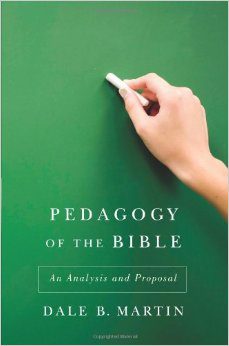 Martin who argues in his book The Pedagogy of the Bible that we citizens of the twenty-first century must own that we are “responsible for the truth, goodness, morality, and social effect of how [we] interpret the Bible or any other text” (16). People throughout history have used the Bible and other scriptures to affirm both slavery and emancipation, sexism and equality, violence and nonviolence. If your interpretation leads to violence, oppression, and inequality instead of liberation, justice, and peace, then reader-response critics such as Martin invite you to consider that the responsibility is much more on you, the individual interpreter (or the interpretive community of which you are a part), than on the Bible or other sacred text. You could similarly say that it is illegitimate for anyone to blame the Bible (or the Qur’an or other sacred books) for hate, apathy, or vengefulness, just as it is illegitimate to blame racism, sexism, heterosexism, or any other oppression on scripture.
We know too much in the twenty-first century to let ourselves off the hook that easily. If your interpretations do not lead to more love, compassion, forgiveness, justice, mercy, and grace in the world— what Paul called the “fruit of the Spirit” (love, joy, peace, patience, kindness, goodness, faithfulness, gentleness, and self-control), then those interpretations are irresponsible and should be denounced. We all pick and choose. And if you pick and choose, why not choose love? In the words of William Sloane Coffin, “The world is too dangerous for anything but truth and too small for anything but love.” And I am grateful to be with you in this tradition of Unitarian Universalism, in which we seek together to stand on the side of love.
The Rev. Dr. Carl Gregg is a trained spiritual director, a D.Min. graduate of San Francisco Theological Seminary, and the minister of the Unitarian Universalist Congregation of Frederick, Maryland. Follow him on Facebook (facebook.com/carlgregg) and Twitter (@carlgregg).
Learn more about Unitarian Universalism:
http://www.uua.org/beliefs/principles
Previous Post

October 21, 2014
The Meaning of the Daodejing (Tao Te Ching) for Today
Next Post
October 24, 2014 Jewish Readings of Christian Scripture: Parables as Deeds Not Creeds
Browse Our Archives
Select a Category Advent Anti-Racism Archaeology Atheism Baptism Best of the Year List Book Reviews Buddhism Catholicism Christian Education Church and State Church Planting Climate Change Conscientious Objection to War Creation Spirituality Death Penalty Didache Disability Rights Discernment Easter Ecology Emergent Church Movement Empire-Critical Ethics Evolution Feminist Theology Film Reviews Gandhi Gospel of Mark Gun Control Hinduism Immigration Reform Interfaith Islam JFK Judaism Jungian Spirituality Lectionary Commentary Lent Letters to the Editor LGBT Marriage MLK Multiculturalism Mysticism Nonviolent Activism Occupy Paganism (Earth-centered Religions) Parables Paul Pluralism Politics Process Theology Quantum Physics Requiescat In Pace Seminary and Divinity School Sermon Series Retrospective Sermons Spiritual Direction Spiritual Practices Stewardship (Fundraising) The Book of J The Wheel of the Year (Paganism) Theoblogger Challenge Triathlon Uncategorized Unitarian Universalism Worship Resources Youth Ministry
Select a Month July 2026 May 2026 March 2026 November 2025 October 2025 August 2025 February 2025 December 2024 October 2024 March 2024 January 2024 December 2023 November 2023 March 2023 February 2023 January 2023 December 2022 November 2022 August 2022 March 2022 February 2022 January 2022 December 2021 September 2021 August 2021 July 2021 June 2021 May 2021 February 2021 January 2021 December 2020 August 2020 June 2020 May 2020 April 2020 March 2020 February 2020 January 2020 December 2019 November 2019 October 2019 September 2019 July 2019 June 2019 March 2019 February 2019 January 2019 December 2018 November 2018 October 2018 September 2018 June 2018 May 2018 April 2018 March 2018 February 2018 January 2018 December 2017 November 2017 October 2017 September 2017 August 2017 July 2017 June 2017 May 2017 April 2017 March 2017 February 2017 January 2017 December 2016 November 2016 October 2016 September 2016 August 2016 June 2016 May 2016 April 2016 March 2016 February 2016 January 2016 December 2015 November 2015 October 2015 September 2015 August 2015 July 2015 June 2015 May 2015 April 2015 March 2015 February 2015 January 2015 December 2014 November 2014 October 2014 August 2014 July 2014 June 2014 May 2014 April 2014 March 2014 February 2014 January 2014 December 2013 November 2013 October 2013 September 2013 August 2013 July 2013 June 2013 May 2013 April 2013 March 2013 February 2013 January 2013 December 2012 November 2012 October 2012 September 2012 August 2012 July 2012 June 2012 May 2012 April 2012 March 2012 February 2012 January 2012 December 2011 November 2011 October 2011 September 2011 August 2011 July 2011 June 2011 May 2011 April 2011 March 2011 February 2011 January 2011 December 2010 November 2010 October 2010 August 2009 July 2009 May 2009
Follow Us!
TAKE THE
Religious Wisdom Quiz
Which prophet anointed both Saul and David as kings of Israel?
Select your answer to see how you score.
Gad Eli Nathan Samuel
Related posts from Carl Gregg

Did the Exodus Happen? And What It Means...
Tectonic Shifts in the Global Religious Landscape since...
Scientific Rigor and Spiritual Evolution: The Work of...
Religious Mystic & Rational Humanist: The Mystical Humanism...
TRENDING AT PATHEOS More Voices

Reading America at 250: A Nation Wrestles With...
As part of my own reflection on the 250th anniversary of the...

Whenever I am reading a book or listening to an argument, I...

President Trump Ban Animal Torture Videos on Facebook
Call for Stricter Regulations of Animal Abuse Content on Facebook Although President...

Draft Amendments to Address Ritual Abuse in New...
The proposed changes would make it illegal for individuals in domestic partnerships...

How Bans on LGBTQ+ Student Clubs Threaten Religious...
On June 20, 2025, the State of Texas passed Senate Bill 12....

The Truth About the Gen Z Revival
This past year, there has been a lot of media buzz surrounding...
view all More Voices blogs
Ad-Free & Subscriber Log-In Subscription Support
- About Us
- 2026 Calendar
- Videos
- Podcasts
- Library of World Religions
- Faith In Media Tracker
- Advertise With Us
- Write for Us
- Privacy Policy
- Terms of Service
- Do Not Sell My Data
- Contact Us
- Radiant Digital
- Manage Newsletter Subscriptions
- Unsubscribe From Notifications
- Sitemap
Copyright 2008-2026, Patheos. All rights reserved.
Subscription Support Ad-Free & Subscriber Log-In
Follow Patheos