
BuddhistCatholicContemplativeEvangelicalGeneral ChristianHinduJewishLatter-day SaintMuslimNew VisionsProgressive Christian
Beliefs
- Buddhist
- Catholic
- Contemplative
- Evangelical
- General Christian
- Hindu
- Jewish
- Latter-day Saint
- More Voices
- Muslim
- New Visions
- Pagan
- Progressive Christian
Topics
- Religion News
- Food and Religion
- Sports and Religion
- Religious Art
- Religious Music and Entertainment
- Religious Events
- History and Religion
- Style and Religion
- Politics and Religion
- Women in Religion
- Recreation Outdoors and Religion
- Business Finance and Religion
- Careers Workplace and Religion
- Education and Religion
- Family Parenting and Religion
- Health Fitness and Religion
- Home and Religion
- Relationships and Religion
- Technology and Religion
- Travel and Religion
Columnists
- Buddhist Columnists
- Business Finance and Religion Columnists
- Careers Workplace and Religion Columnists
- Catholic Columnists
- Contemplative Columnists
- Education and Religion Columnists
- Evangelists Columnists
- Family Parenting and Religion Columnists
- General Christian Columnists
- Health Fitness and Religion Columnists
- Hindu Columnists
- History and Religion Columnists
- Home and Religion Columnists
- Jewish Columnists
- More Voices Columnists
- Latter Day Columnists
- Muslim Columnists
- New Visions Columnists
- Nonreligious Columnists
- Pagan Columnists
- Politics and Religion Columnists
- Progressive Columnists
- Recreation Outdoors and Religion Columnists
- Relationships and Religion Columnists
- Religion News Columnists
- Religious Art Columnists
- Religious Events Columnists
- Religious Music and Entertainment Columnists
- Sports and Religion Columnists
- Style and Religion Columnists
- Technology and Religion Columnists
- Travel and Religion Columnists
- Women in Religion Columnists
Resource Library
- 2026 Calendar
- Library of World Religions
- The 100 Most Holy Places on Earth
- Patheos Answers
- Podcasts
- Videos
- Faith Leaders Database
- Anglican Episcopalian
- Bahai
- Baptist
- Buddhism
- Christianity
- Confucianism
- Eastern Orthodoxy
- Hinduism
- Holiness and Pentecostal
- ISKCON
- Islam
- Judaism
- Lutheran
- Methodist
- The Church of Jesus Christ of Latter-day Saints
- New Age
- Paganism
- Presbytarian and Reformed
- Protestantism
- Religion Behind the Scenes
- Roman Catholic
- Scientology
- Shia Islam
- Sikhism
- Sufism
- Sunni Islam
- Taoism
- Zen
- See all religions
Research Tools
 Ad-Free & Subscriber Log-In Subscription Support
Ad-Free & Subscriber Log-In Subscription Support
Follow Patheos 

- Trending:
- Forgiveness
- |
- Marriage
- |
- Consciousness
- |
- Death Penalty
- |
- Election
- |
- Halloween

- Home
- More Voices
- The Sacred in Music
The Sacred in Music
Last updated on: May 4, 2015 at 1:23 pm by Carl Gregg
The Sacred in Music 2015-05-04T13:23:16-04:00 Carl Gregg
Patheos Explore the world's faith through different perspectives on religion and spirituality! Patheos has the views of the prevalent religions and spiritualities of the world.
Poetry and music engage us in ways beyond what can be contained in prose alone. Poetry uses language playfully to gesture beyond the more straightforward meaning of most texts, offering the possibility of breaking open fixed ideas to new possibilities. As Emily Dickinson once mused about the power of poetry:
Tell all the truth but tell it slant —
Success in Circuit lies
Too bright for our infirm Delight
The Truth’s superb surprise
As Lightning to the Children eased
With explanation kind
The Truth must dazzle gradually
Or every man be blind —
And music — with lyrics that are poetry set to a tune — can often take the power of that poetic truth told 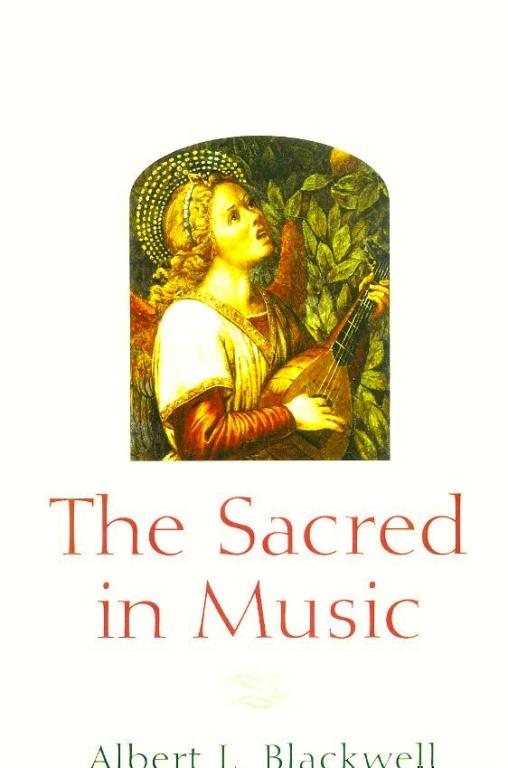 “slant” to an even higher level. As the Cambridge professor George Steiner has said, “Music is at once cerebral in the highest degree…and it is at the same time somatic, carnal and a searching out of the resonances in our bodies at levels deeper than will or consciousness…” (Blackwell, 217). Consider the full-bodied experience — all that is taken in through your eyes, ears, and body — of being in a sanctuary when an organ is playing at full volume with all the stops out, or being in a concert hall amidst the swelling climax of a symphony, or being at a rock concert in the middle of a rapturous crowd and physically feeling the sound coming from the speakers. The power and poetry of music hits us and engages us on so many levels all at once.
Stacy Horn, in her book Imperfect Harmony: Finding Happiness Singing with Others, explores the neurological research that is increasingly supporting what many of us who have sung in choirs already know: that singing — even alone in the shower, but especially in long group sessions like a choir — can produce a “Singer’s high,” triggering the release of neurochemicals in our brains and bodies similar to a “Runner’s high.” As the title of an article about Horn’s work says, “Join the choir. Science shows it’ll make you feel better.” Or just give yourself permission to sing robustly from the congregation during hymns; it’s good for you!
George Steiner further explores the ways in which music can also be sacramental: a way of experiencing the sacred, which is sometimes called the “depth dimension in life”: those moments when we feel fully alive, fully connected with the people and the world around us, when we are fully in the present moment and aware of the depth and richness of each instant, even as it arises and passes away to allow the next present moment to emerge.
In the Christian tradition, Saint Augustine of Hippo famously said that, “The one who sings prays twice,” which is one way of expressing the difference of speaking the words of the Roman Catholic mass aloud compared to the power of singing Bach’s Mass in B Minor. And it can perhaps help in this particular instance that the lyrics are in Latin, which can make it easier to simply let the aesthetics of the experience enrapture you without worrying too much about the word’s meaning. Or from a more humanist perspective, the 20th-century composer Mauricio Kagel says that, “musicians may not all believe in God, but they all believe in Bach” — meaning that the transformative and transporting power of great music can be intrinsically sufficient in and of itself.
And the range of music’s power — of “the sacred in music” — to energize us to exercise harder as well as to meet us where we are in our brokenness is captured beautifully in the opening stanza of Leonard Cohen’s Hallelujah:
I’ve heard there was a secret chord
That David played, and it pleased the Lord…
It goes like this
The fourth, the fifth
The minor fall, the major lift
The baffled king composing Hallelujah
“The Fourth, the fifth / The minor fall, the major lift.” Whether music is major or minor, fast or slow can make all the difference in shaping our experience.
And one practice that I invite you to consider is called audio divina. Audio divina is related to the more well known spiritual practice of lectio divina (“divine reading”), which involved reading a small portion of a text slowly and contemplatively, paying attention to any words or phrases that particularly resonate inside of you, then reflecting, drawing, or journaling about what meaning that word or phrase may have for your life. Similarly, audio divina involves deep, intentional listening to a poem read aloud or to a piece of music in which you pay attention to any lyric or musical phrase that particularly resonates with you. It often helps to re-listen to that section a few times. And then reflect on why that section in particular resonated with you and open yourself to considering what meaning might emerge between that piece of music and your life or the life of the world.
In 2012, the independent film A Late Quartet was released starring Christopher Walken, Catherine Keener, and the late Philip Seymour Hoffman. (In retrospect, it’s worth seeing for Hoffman’s performance alone.) The film is about the internal dynamics, the bonds, and the rivalry within a world-famous string quartet based in New York City preparing for their 25th anniversary concert that is complicated by the revelation that the cellist of the group has an illness that will force him to retire. The film is inspired by and built around Beethoven’s Opus 131 String Quartet in C-sharp minor. One of the most memorable lines is from Walken’s character, who is the one wrestling with the diagnosis that is forcing his premature retirement. In spirit of audio divina, Walken’s character says, “I can be grateful, and so must you be for even one singular phrase, one transcendent moment.” That is the sacred in music.
The Rev. Dr. Carl Gregg is a trained spiritual director, a D.Min. graduate of San Francisco Theological Seminary, and the minister of the Unitarian Universalist Congregation of Frederick, Maryland. Follow him on Facebook (facebook.com/carlgregg) and Twitter (@carlgregg).
Learn more about Unitarian Universalism:
http://www.uua.org/beliefs/principles
Previous Post

August 19, 2014
Tectonic Shifts in the Global Religious Landscape since WWI
Next Post
August 28, 2014 Eve Was Framed, the Serpent Was Right!
Browse Our Archives
Select a Category Advent Anti-Racism Archaeology Atheism Baptism Best of the Year List Book Reviews Buddhism Catholicism Christian Education Church and State Church Planting Climate Change Conscientious Objection to War Creation Spirituality Death Penalty Didache Disability Rights Discernment Easter Ecology Emergent Church Movement Empire-Critical Ethics Evolution Feminist Theology Film Reviews Gandhi Gospel of Mark Gun Control Hinduism Immigration Reform Interfaith Islam JFK Judaism Jungian Spirituality Lectionary Commentary Lent Letters to the Editor LGBT Marriage MLK Multiculturalism Mysticism Nonviolent Activism Occupy Paganism (Earth-centered Religions) Parables Paul Pluralism Politics Process Theology Quantum Physics Requiescat In Pace Seminary and Divinity School Sermon Series Retrospective Sermons Spiritual Direction Spiritual Practices Stewardship (Fundraising) The Book of J The Wheel of the Year (Paganism) Theoblogger Challenge Triathlon Uncategorized Unitarian Universalism Worship Resources Youth Ministry
Select a Month July 2026 May 2026 March 2026 November 2025 October 2025 August 2025 February 2025 December 2024 October 2024 March 2024 January 2024 December 2023 November 2023 March 2023 February 2023 January 2023 December 2022 November 2022 August 2022 March 2022 February 2022 January 2022 December 2021 September 2021 August 2021 July 2021 June 2021 May 2021 February 2021 January 2021 December 2020 August 2020 June 2020 May 2020 April 2020 March 2020 February 2020 January 2020 December 2019 November 2019 October 2019 September 2019 July 2019 June 2019 March 2019 February 2019 January 2019 December 2018 November 2018 October 2018 September 2018 June 2018 May 2018 April 2018 March 2018 February 2018 January 2018 December 2017 November 2017 October 2017 September 2017 August 2017 July 2017 June 2017 May 2017 April 2017 March 2017 February 2017 January 2017 December 2016 November 2016 October 2016 September 2016 August 2016 June 2016 May 2016 April 2016 March 2016 February 2016 January 2016 December 2015 November 2015 October 2015 September 2015 August 2015 July 2015 June 2015 May 2015 April 2015 March 2015 February 2015 January 2015 December 2014 November 2014 October 2014 August 2014 July 2014 June 2014 May 2014 April 2014 March 2014 February 2014 January 2014 December 2013 November 2013 October 2013 September 2013 August 2013 July 2013 June 2013 May 2013 April 2013 March 2013 February 2013 January 2013 December 2012 November 2012 October 2012 September 2012 August 2012 July 2012 June 2012 May 2012 April 2012 March 2012 February 2012 January 2012 December 2011 November 2011 October 2011 September 2011 August 2011 July 2011 June 2011 May 2011 April 2011 March 2011 February 2011 January 2011 December 2010 November 2010 October 2010 August 2009 July 2009 May 2009
Follow Us!
TAKE THE
Religious Wisdom Quiz
How many commandments were written on stone tablets?
Select your answer to see how you score.
Ten Thirteen Twelve Seven
Related posts from Carl Gregg

Reading America at 250: A Nation Wrestles With...


Andrew Holocek on the Power of Darkness

The Stories That Shape Us: Myths, Archetypes, &...
TRENDING AT PATHEOS More Voices

Reading America at 250: A Nation Wrestles With...
As part of my own reflection on the 250th anniversary of the...

Whenever I am reading a book or listening to an argument, I...

President Trump Ban Animal Torture Videos on Facebook
Call for Stricter Regulations of Animal Abuse Content on Facebook Although President...

Draft Amendments to Address Ritual Abuse in New...
The proposed changes would make it illegal for individuals in domestic partnerships...

How Bans on LGBTQ+ Student Clubs Threaten Religious...
On June 20, 2025, the State of Texas passed Senate Bill 12....

The Truth About the Gen Z Revival
This past year, there has been a lot of media buzz surrounding...
view all More Voices blogs
Ad-Free & Subscriber Log-In Subscription Support
- About Us
- 2026 Calendar
- Videos
- Podcasts
- Library of World Religions
- Faith In Media Tracker
- Advertise With Us
- Write for Us
- Privacy Policy
- Terms of Service
- Do Not Sell My Data
- Contact Us
- Radiant Digital
- Manage Newsletter Subscriptions
- Unsubscribe From Notifications
- Sitemap
Copyright 2008-2026, Patheos. All rights reserved.
Subscription Support Ad-Free & Subscriber Log-In
Follow Patheos